PUBLISHER: Mordor Intelligence | PRODUCT CODE: 2117511

PUBLISHER: Mordor Intelligence | PRODUCT CODE: 2117511
Regenerative Aesthetics - Market Share Analysis, Industry Trends & Statistics, Growth Forecasts (2026 - 2031)
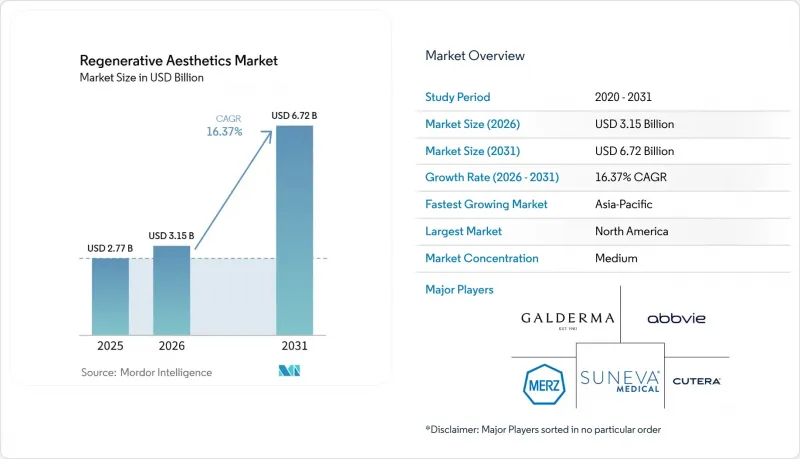
According to Mordor Intelligence, the regenerative aesthetics market is projected to expand from USD 2.77 billion in 2025 and USD 3.15 billion in 2026 to USD 6.72 billion by 2031, registering a CAGR of 16.37% between 2026 and 2031.
This report is Segmented by Product Type (Biologics and Cell Products, and Others), Technology (Autologous Biologics, and Others), Application (Facial Rejuvenation and Volume Restoration, and Others), End-User (Dermatology Clinics and Aesthetic Physicians, and Others), and Geography (North America, Europe, Asia-Pacific, and Others). The Market Forecasts are Provided in Terms of Value (USD).
Global Regenerative Aesthetics Market Trends and Insights
Durable, Natural-Looking Outcomes with Lower Retreatment Frequency
The regenerative aesthetics market gained momentum as patients moved away from overfilled and static outcomes and started favoring results tied to collagen renewal, tissue remodeling, and natural movement. This change matters commercially because clinics can price regenerative protocols at a premium when they combine PRP with biostimulators and structured follow-up visits. A 2025 Journal of Clinical Medicine publication reported that adipose-derived stromal vascular fraction gel improved periorbital skin quality and collagen density, which supports the move toward biologically active treatment plans. Galderma also reported nine-month SHAPE Up HIT trial data in 2025 showing lasting patient satisfaction when Sculptra and Restylane Lyft were combined for facial volume loss linked to GLP-1 therapy use. In the regenerative aesthetics market, that kind of durability is supporting a clear premium for combinations that aim to restore tissue quality rather than only add volume.
Rising Adoption of Cell-Based, Exosome, and Biomaterial Combination Protocols
The regenerative aesthetics market still centers on PRP because it has an autologous origin, an established role in device-cleared preparation systems, and a stronger evidence base than many newer modalities. A 2025 meta-analysis in Dermatology and Therapy found that PRP was safe and effective for improving hair density and reducing hair loss, with no serious adverse events across the reviewed trials.At the same time, the U.S. FDA has continued to state that exosome products intended for therapeutic injection are unapproved biologics, which is keeping regulatory pressure on allogeneic approaches and favoring compliant autologous routes. That is pushing the regenerative aesthetics market toward product strategies that stay closer to cleared PRP systems, closed preparation platforms, and biologic-device combinations with clearer regulatory footing.
Regulatory Ambiguity for Exosomes, Stem Cells, and Combination Products
The regenerative aesthetics market still faces a clear regulatory gap because clinical interest in exosomes and stem-cell-linked products has moved faster than formal product authorization. The U.S. FDA has stated that exosome products intended for therapeutic use are unapproved biologics, and no exosome product has been approved for aesthetic injection in the United States. This is creating a split market where cleared autologous PRP systems and approved biostimulators can grow through standard channels while more experimental offerings remain difficult to commercialize at scale. Larger suppliers benefit because they are better able to invest in documentation, compliance, and physician education that smaller operators often cannot match. For the regenerative aesthetics market, that keeps growth concentrated in product categories with clearer approval pathways and slows wider adoption of offerings that still sit in a legal gray area.
Other drivers and restraints analyzed in the detailed report include:
- Premium Clinic Chain Expansion and Medical Tourism in High-Growth Markets
- Growing Consumer Preference for Minimally Invasive and Regenerative Anti-Aging Treatments
- High Out-of-Pocket Treatment Cost
For complete list of drivers and restraints, kindly check the Table Of Contents.
Segment Analysis
Biologics and cell products held 49.84% of the regenerative aesthetics market size in 2025, which made this the clear anchor of supplier revenue and clinic usage. That lead reflects the central role of PRP systems, polynucleotide injectables, and adipose-derived cellular preparations in treatment plans that clinicians view as scientifically grounded and easier to position with patients. The regenerative aesthetics market is leaning toward these products because they support the move from simple filling to tissue response, skin quality improvement, and gradual remodeling. As a result, product leadership in this category reflects both demand strength and a more workable regulatory path.
Combination products and drug-device is forecasted to expand at an 18.92% CAGR through 2031, which makes it the fastest-growing product segment in the regenerative aesthetics market. Biomaterials and Filters still hold an important place because scaffolds, extracellular matrix components, and bio-stimulatory materials are becoming more relevant in multi-step protocols. Devices and Equipment remain smaller by share, but their role is widening as radiofrequency microneedling and focused ultrasound systems are used with biologics rather than sold only as standalone procedures. This pattern suggests the regenerative aesthetics market is rewarding product designs that fit directly into integrated clinic workflows rather than single-use treatment categories.
Autologous biologics commanded 53.67% of market revenue in 2025, giving this technology the broadest installed base in the regenerative aesthetics market. Its strength comes from low immunogenic risk, practitioner familiarity, and a growing set of studies that support PRP-derived growth factor approaches across skin and hair applications. Autologous systems, therefore, remain the most practical entry point for many clinics building or expanding regenerative treatment menus.
Device-assisted combination products is projected to grow at a 19.24% CAGR through 2031, making it the fastest-moving technology line in the regenerative aesthetics market. Biomaterials and Tissue Scaffolds remain useful in scar care, wound support, and structural applications where physical support matters alongside tissue signaling. The commercial appeal of device combinations is clear because they let clinics pair tissue stimulation with precise delivery, which improves treatment storytelling and supports premium pricing. In practice, the regenerative aesthetics market is moving toward technologies that make biologics more visible, more measurable, and easier to repeat across large treatment networks.
Complete Report Scope:
- By Product Type
- Biologics and Cell Products
- Biomaterials and Fillers
- Combination Products and Drug-Device Hybrids
- Devices and Equipment
- By Technology
- Autologous Biologics
- Allogeneic Cell-Based Products
- Biomaterials and Tissue Scaffolds
- Device-Assisted Combination Procedures
- By Application
- Facial Rejuvenation and Volume Restoration
- Hair Restoration
- Scar Revision and Acne Scarring
- Wound Healing and Reconstructive Adjuncts
- Body Contouring and Soft-Tissue Defect Repair
- By End-User
- Dermatology Clinics and Aesthetic Physicians
- Plastic Surgery Clinics and Ambulatory Surgical Centers
- Med Spas and Aesthetic Chains
- Hospitals and Specialty Centers
- By Geography
- North America
- United States
- Canada
- Mexico
- Europe
- Germany
- United Kingdom
- France
- Italy
- Spain
- Rest of Europe
- Asia-Pacific
- China
- Japan
- India
- Australia
- South Korea
- Rest of Asia-Pacific
- Middle East and Africa
- GCC
- South Africa
- Rest of Middle East and Africa
- South America
- Brazil
- Argentina
- Rest of South America
- North America
Geography Analysis
North America held 43.92% of the regenerative aesthetics market share in 2025, which kept it as the largest regional revenue base. The region's position rests on high consumer spending per procedure, dense practitioner training networks, and early access to biostimulatory injectables and device combinations. The regenerative aesthetics market in the United States is also being shaped by a more organized clinic layer, as LaserAway reached 224 clinics by June 2026 and Avelure Med Spa launched across 12 locations in May 2026. FDA enforcement also matters because it pushes provider spending toward compliant autologous biologics and approved biostimulators rather than unapproved exosome injections.
Asia-Pacific is forecasted to grow at an 18.76% CAGR through 2031, making it the fastest-growing region in the regenerative aesthetics market. South Korea remains an innovation hub for injectable regeneration, while China and India continue to widen the regional demand base through rising procedure uptake and expanding clinic infrastructure. The regenerative aesthetics market in Asia-Pacific is moving quickly because regional providers are adopting both injectables and device-linked treatment plans rather than relying on one modality alone.
Europe continues to hold a significant share in the regenerative aesthetics market because Germany, France, Italy, and the United Kingdom already have mature infrastructure for biostimulators and well-characterized regenerative products. The region also benefits from regulatory frameworks that support broad clinical use of established products while raising compliance requirements for newer entrants. Middle East and Africa, led by GCC markets, and South America, led by Brazil, remain smaller but are still expanding as medical tourism, clinic density, and premium treatment access improve.
- Abbvie
- Anika Therapeutics
- Arthrex
- BTL Industries, Inc.
- Candela Medical
- CollPlant Biotechnologies Ltd.
- Croma-Pharma GmbH
- Cutera
- EmCyte
- Galderma
- Hologic
- Integra LifeSciences
- Lipogems International SpA
- Lumenis
- Merz Pharma GmbH and Co. KGaA
- Prollenium Medical Technologies Inc.
- RegenLab SA
- Revance Therapeutics, Inc.
- Sinclair Pharma plc
- Suneva Medical
Additional Benefits:
- The market estimate (ME) sheet in Excel format
- 3 months of analyst support
TABLE OF CONTENTS
1 Introduction
- 1.1 Study Assumptions and Market Definition
- 1.2 Scope of the Study
2 Research Methodology
3 Executive Summary
4 Market Landscape
- 4.1 Market Overview
- 4.2 Market Drivers
- 4.2.1 Durable, Natural-Looking Outcomes with Lower Retreatment Frequency
- 4.2.2 Rising Adoption of Cell-Based, Exosome, and Biomaterial Combination Protocols
- 4.2.3 Premium Clinic Chain Expansion and Medical Tourism in High-Growth Markets
- 4.2.4 AI-Guided Imaging, Treatment Planning, and Personalized Aesthetic Protocols
- 4.2.5 Growing Consumer Preference for Minimally Invasive and Regenerative Anti-Aging Treatments
- 4.2.6 Advancements in Platelet-Rich Plasma (PRP), Platelet-Rich Fibrin (PRF), and Autologous Biologics Technologies
- 4.3 Market Restraints
- 4.3.1 Regulatory Ambiguity for Exosomes, Stem Cells, and Combination Products
- 4.3.2 Technique Sensitivity and Lack of Standardized Clinical Protocols
- 4.3.3 High Out-of-Pocket Treatment Cost
- 4.3.4 Limited Long-Term Clinical Evidence and Reimbursement Support
- 4.4 Supply/Value Chain Analysis
- 4.5 Regulatory Landscape
- 4.6 Technological Outlook
- 4.7 Porter's Five Forces Analysis
- 4.7.1 Threat of New Entrants
- 4.7.2 Bargaining Power of Suppliers
- 4.7.3 Bargaining Power of Buyers
- 4.7.4 Threat of Substitutes
- 4.7.5 Competitive Rivalry
5 Market Size & Growth Forecasts (Value, USD)
- 5.1 By Product Type
- 5.1.1 Biologics and Cell Products
- 5.1.2 Biomaterials and Fillers
- 5.1.3 Combination Products and Drug-Device Hybrids
- 5.1.4 Devices and Equipment
- 5.2 By Technology
- 5.2.1 Autologous Biologics
- 5.2.2 Allogeneic Cell-Based Products
- 5.2.3 Biomaterials and Tissue Scaffolds
- 5.2.4 Device-Assisted Combination Procedures
- 5.3 By Application
- 5.3.1 Facial Rejuvenation and Volume Restoration
- 5.3.2 Hair Restoration
- 5.3.3 Scar Revision and Acne Scarring
- 5.3.4 Wound Healing and Reconstructive Adjuncts
- 5.3.5 Body Contouring and Soft-Tissue Defect Repair
- 5.4 By End-User
- 5.4.1 Dermatology Clinics and Aesthetic Physicians
- 5.4.2 Plastic Surgery Clinics and Ambulatory Surgical Centers
- 5.4.3 Med Spas and Aesthetic Chains
- 5.4.4 Hospitals and Specialty Centers
- 5.5 By Geography
- 5.5.1 North America
- 5.5.1.1 United States
- 5.5.1.2 Canada
- 5.5.1.3 Mexico
- 5.5.2 Europe
- 5.5.2.1 Germany
- 5.5.2.2 United Kingdom
- 5.5.2.3 France
- 5.5.2.4 Italy
- 5.5.2.5 Spain
- 5.5.2.6 Rest of Europe
- 5.5.3 Asia-Pacific
- 5.5.3.1 China
- 5.5.3.2 Japan
- 5.5.3.3 India
- 5.5.3.4 Australia
- 5.5.3.5 South Korea
- 5.5.3.6 Rest of Asia-Pacific
- 5.5.4 Middle East and Africa
- 5.5.4.1 GCC
- 5.5.4.2 South Africa
- 5.5.4.3 Rest of Middle East and Africa
- 5.5.5 South America
- 5.5.5.1 Brazil
- 5.5.5.2 Argentina
- 5.5.5.3 Rest of South America
- 5.5.1 North America
6 Competitive Landscape
- 6.1 Market Concentration
- 6.2 Market Share Analysis
- 6.3 Company Profiles (includes Global level Overview, Market level overview, Core Segments, Financials as available, Strategic Information, Market Rank/Share for key companies, Products & Services, Recent Developments)
- 6.3.1 AbbVie Inc.
- 6.3.2 Anika Therapeutics, Inc.
- 6.3.3 Arthrex, Inc.
- 6.3.4 BTL Industries, Inc.
- 6.3.5 Candela Corporation
- 6.3.6 CollPlant Biotechnologies Ltd.
- 6.3.7 Croma-Pharma GmbH
- 6.3.8 Cutera, Inc.
- 6.3.9 EmCyte Corporation
- 6.3.10 Galderma SA
- 6.3.11 Hologic, Inc.
- 6.3.12 Integra LifeSciences Holdings Corporation
- 6.3.13 Lipogems International SpA
- 6.3.14 Lumenis Be Ltd.
- 6.3.15 Merz Pharma GmbH and Co. KGaA
- 6.3.16 Prollenium Medical Technologies Inc.
- 6.3.17 RegenLab SA
- 6.3.18 Revance Therapeutics, Inc.
- 6.3.19 Sinclair Pharma plc
- 6.3.20 Suneva Medical, Inc.
7 Market Opportunities & Future Outlook
- 7.1 White-space & Unmet-need Assessment

