PUBLISHER: Mordor Intelligence | PRODUCT CODE: 2117544

PUBLISHER: Mordor Intelligence | PRODUCT CODE: 2117544
Industrial Filters - Market Share Analysis, Industry Trends & Statistics, Growth Forecasts (2026 - 2031)
According to Mordor Intelligence, the industrial filters market size is projected to expand from USD 41.85 billion in 2025 and USD 44.12 billion in 2026 to USD 58.73 billion by 2031, and is expected to register a CAGR of 5.89% between 2026 to 2031.
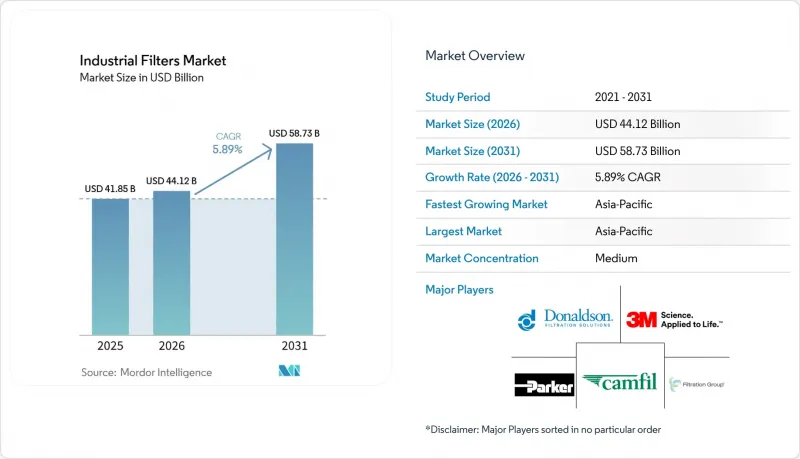
This report is Segmented by Type (Liquid Filtration, Air Filtration), Filter Media (Activated Carbon, Fiber Glass, and More), End-User Industry (Chemicals & Petrochemicals, Oil & Gas, Food & Beverage, Pharmaceuticals, and More), and Geography (Asia-Pacific, North America, Europe, South America, and Middle-East and Africa). The Market Forecasts are Provided in Terms of Value (USD).
Global Industrial Filters Market Trends and Insights
Increasing Demand for Industrial Water Treatment and Process Fluid Filtration
Industrial water treatment is shifting from a compliance function to a direct operating priority, driving demand across the industrial filters market. Water-stressed production zones in India, the Middle East, and northern China are pushing plants to recycle and reclaim wastewater more aggressively. This shift favors higher-performance liquid systems over basic separation methods, particularly in petrochemicals, textiles, and process manufacturing. It also supports a transition from conventional paper and fiberglass options to membrane and activated carbon media within reuse loops. The food and beverage sector adds another stable layer of demand, as clarification, microbial control, and clean-in-place processes keep liquid filtration systems operating at high utilization rates.
Stringent Environmental Regulations Driving Compliance Capital Expenditure
Stricter emissions rules are making filtration upgrades a required expense across the industrial filters market. The revised Industrial Emissions Directive in Europe entered into force in August 2024, and member states were required to transpose it by July 1, 2026, tightening obligations for a wide range of industrial facilities. The European Commission also stated that non-compliant installations can face penalties tied to annual turnover, making delays more costly for operators. In the United States, the EPA revised National Emission Standards for Hazardous Air Pollutants (NESHAP) rules for integrated iron and steel manufacturing in 2025 and extended the compliance timeline to April 2027, keeping advanced filtration projects active in plant planning. These overlapping regulatory cycles are also generating more service work, as many mid-sized plants now rely on specialist firms for system design and compliance support.
High Installation, Replacement, and Maintenance Costs
Cost remains a practical barrier across the industrial filters market, especially for smaller plants that struggle to justify large upfront expenditures. Industrial water filtration installations can range from USD 20,000 to more than USD 250,000, with installation and commissioning adding significantly to total project costs. In pharmaceutical-grade systems, replacement cartridges and membranes also account for a notable share of annual operating budgets. When budgets are constrained, operators often extend service intervals beyond recommended levels, which increases contamination risk and can lead to greater downtime. Larger suppliers are exploring modular and service-based models in response, but adoption among mid-market buyers remains limited.
Other drivers and restraints analyzed in the detailed report include:
- Growing Demand for Air Quality Management in Industrial Settings
- Growing Adoption of Smart and Internet of Things (IoT)-Enabled Filtration Systems
- Filter Fouling and Performance Degradation
For complete list of drivers and restraints, kindly check the Table Of Contents.
Segment Analysis
Liquid filtration held 58.44% of the industrial filters market share in 2025, while air filtration is projected to grow at a 6.47% CAGR through 2031. Liquid systems retained the larger revenue base because chemicals, refining, food processing, and pharmaceuticals require continuous process-fluid management. The large installed base supports steady replacement demand even when new project timing is uneven. The industrial filters market continues to depend on liquid filtration for scale, while air filtration is contributing a larger share of near-term growth.
Air filtration is gaining ground as plant operators face stricter requirements for worker exposure limits, dust capture, and clean manufacturing conditions. This segment of the industrial filters market is also more fragmented among small- and medium-sized industrial buyers, which supports firmer unit economics for suppliers. Camfil's expansion in Malaysia in 2026 reflects confidence that Asian air filtration demand will remain strong enough to justify additional local capacity. On the liquid side, Eaton introduced BECO Helix depth filter cartridges in 2025 to increase particle-holding capacity and extend service life, demonstrating that innovation remains active in the larger, more mature segment.
Complete Report Scope:
- By Type
- Liquid Filtration
- Air Filtration
- By Filter Media
- Activated Carbon
- Fiber Glass
- Filter Paper
- Metal
- Non-Woven Fabric
- Membrane
- Other Filter Media
- By End-user Industry
- Food and Beverage
- Chemicals and Petrochemicals
- Power Generation
- Oil and Gas
- Pharmaceuticals
- Metal and Mining
- Automotive
- Other End-use Industry
- By Geography
- Asia-Pacific
- China
- India
- Japan
- South Korea
- Rest of Asia-Pacific
- North America
- United States
- Canada
- Mexico
- Europe
- Germany
- United Kingdom
- France
- Italy
- Russia
- Rest of Europe
- South America
- Brazil
- Argentina
- Rest of South America
- Middle-East and Africa
- Saudi Arabia
- South Africa
- Rest of Middle-East and Africa
- Asia-Pacific
Geography Analysis
Asia-Pacific held 39.84% of the industrial filters market share in 2025 and is projected to grow at a 6.73% CAGR through 2031. China accounted for 24% of global revenue in 2025, supported by upgrades in petrochemicals, semiconductors, and food processing. India is emerging as a second growth engine, with pharmaceutical hubs in Hyderabad and Ahmedabad driving demand for membrane systems aligned with export-oriented compliance requirements. MANN+HUMMEL opened its largest development center outside Germany in Karnataka in May 2026, with combined investments expected to exceed INR 100 crores (USD 12 million), underscoring the region's strategic role in future supply and product development.
South Korea and Japan contribute to regional depth through semiconductor cleanroom filtration and precision industrial fluid management. Southeast Asia is also expanding its demand base as food processing and petrochemical capacity continue to grow. These trends give Asia-Pacific a mix of large-volume industrial demand and high-specification applications, which should sustain activity across both local production and imported premium systems.
North America held the second-largest regional position in 2025, supported by recurring replacement activity driven by an aging installed base in refining, chemicals, and food processing. Donaldson reported above-market performance in fiscal 2025 from new dust-collection equipment and power-generation project wins, indicating healthy demand in industrial air applications. In Europe, the July 2026 transposition deadline for the revised Industrial Emissions Directive is accelerating plant upgrade decisions that had been deferred under the prior regulatory cycle. Germany, the United Kingdom, and France remain important demand centers, as chemicals, pharmaceuticals, energy, and food manufacturing continue to require high-performance filtration.
South America remains a developing opportunity, led by Brazil's oil and gas and food processing sectors, with Argentina contributing volume through chemicals and mining. In the Middle East and Africa, refinery operations, desalination infrastructure, mining activity, and growing pharmaceutical manufacturing are supporting longer-term regional demand. Saudi Arabia and South Africa are notable markets where water treatment and industrial processing needs are material to long-term filtration spending. While these regions represent smaller shares today, they remain connected to infrastructure programs and export-oriented industrial investment that support the broader industrial filters market.
- 3M
- AAF International
- Ahlstrom-Munksjo
- Air Filters Inc.
- BWF Envirotec GmbH
- Camfil
- Clarcor Inc.
- Donaldson Company Inc.
- Eaton Corporation
- Filtra-Systems Company LLC
- Filtration Group
- GRAVER Technologies
- Huber Technology GmbH
- Hydac International GmbH
- Industrial Filter and Pump Mfg. Co.
- Lydall, Inc.
- Mann+Hummel
- Nanjing Kairui Filter Co. Ltd.
- PARKER HANNIFIN CORP
- Sefar AG
- WAMGROUP S.p.A.
Additional Benefits:
- The market estimate (ME) sheet in Excel format
- 3 months of analyst support
TABLE OF CONTENTS
1 Introduction
- 1.1 Study Assumptions and Market Definition
- 1.2 Scope of the Study
2 Research Methodology
3 Executive Summary
4 Market Landscape
- 4.1 Market Overview
- 4.2 Market Drivers
- 4.2.1 Increasing Demand for High-Purity Filtration Across Process Industries
- 4.2.2 Stringent Environmental and Industrial Emission Regulations Driving Filtration Adoption
- 4.2.3 Growing Demand for Advanced Filtration Solutions in Pharmaceutical and Biotechnology Manufacturing
- 4.2.4 Increasing Modernization of Industrial Facilities with Energy-Efficient Filtration Technologies
- 4.2.5 Growing Adoption of Smart Filtration Systems and Predictive Maintenance Technologies
- 4.3 Market Restraints
- 4.3.1 High Installation, Replacement, and Maintenance Costs of Advanced Filtration Systems
- 4.3.2 Filter Fouling and Performance Degradation Leading to Operational Downtime
- 4.3.3 Volatility in the Supply and Cost of Specialized Filtration Materials
- 4.4 Value Chain Analysis
- 4.5 Porter's Five Forces Analysis
- 4.5.1 Threat of New Entrants
- 4.5.2 Bargaining Power of Suppliers
- 4.5.3 Bargaining Power of Buyers
- 4.5.4 Threat of Substitutes
- 4.5.5 Competitive Rivalry
5 Market Size and Growth Forecasts (Value)
- 5.1 By Type
- 5.1.1 Liquid Filtration
- 5.1.2 Air Filtration
- 5.2 By Filter Media
- 5.2.1 Activated Carbon
- 5.2.2 Fiber Glass
- 5.2.3 Filter Paper
- 5.2.4 Metal
- 5.2.5 Non-Woven Fabric
- 5.2.6 Membrane
- 5.2.7 Other Filter Media
- 5.3 By End-user Industry
- 5.3.1 Food and Beverage
- 5.3.2 Chemicals and Petrochemicals
- 5.3.3 Power Generation
- 5.3.4 Oil and Gas
- 5.3.5 Pharmaceuticals
- 5.3.6 Metal and Mining
- 5.3.7 Automotive
- 5.3.8 Other End-use Industry
- 5.4 By Geography
- 5.4.1 Asia-Pacific
- 5.4.1.1 China
- 5.4.1.2 India
- 5.4.1.3 Japan
- 5.4.1.4 South Korea
- 5.4.1.5 Rest of Asia-Pacific
- 5.4.2 North America
- 5.4.2.1 United States
- 5.4.2.2 Canada
- 5.4.2.3 Mexico
- 5.4.3 Europe
- 5.4.3.1 Germany
- 5.4.3.2 United Kingdom
- 5.4.3.3 France
- 5.4.3.4 Italy
- 5.4.3.5 Russia
- 5.4.3.6 Rest of Europe
- 5.4.4 South America
- 5.4.4.1 Brazil
- 5.4.4.2 Argentina
- 5.4.4.3 Rest of South America
- 5.4.5 Middle-East and Africa
- 5.4.5.1 Saudi Arabia
- 5.4.5.2 South Africa
- 5.4.5.3 Rest of Middle-East and Africa
- 5.4.1 Asia-Pacific
6 Competitive Landscape
- 6.1 Market Concentration
- 6.2 Strategic Moves
- 6.3 Market Share (%)/Ranking Analysis
- 6.4 Company Profiles (includes Global Overview, Market Overview, Core Segments, Financials as available, Strategic Information, Products and Services, and Recent Developments)
- 6.4.1 3M
- 6.4.2 AAF International
- 6.4.3 Ahlstrom-Munksjo
- 6.4.4 Air Filters Inc.
- 6.4.5 BWF Envirotec GmbH
- 6.4.6 Camfil
- 6.4.7 Clarcor Inc.
- 6.4.8 Donaldson Company Inc.
- 6.4.9 Eaton Corporation
- 6.4.10 Filtra-Systems Company LLC
- 6.4.11 Filtration Group
- 6.4.12 GRAVER Technologies
- 6.4.13 Huber Technology GmbH
- 6.4.14 Hydac International GmbH
- 6.4.15 Industrial Filter and Pump Mfg. Co.
- 6.4.16 Lydall, Inc.
- 6.4.17 Mann+Hummel
- 6.4.18 Nanjing Kairui Filter Co. Ltd.
- 6.4.19 PARKER HANNIFIN CORP
- 6.4.20 Sefar AG
- 6.4.21 WAMGROUP S.p.A.
7 Market Opportunities and Future Outlook
- 7.1 White-Space and Unmet-Need Assessment

