PUBLISHER: Mordor Intelligence | PRODUCT CODE: 2117557

PUBLISHER: Mordor Intelligence | PRODUCT CODE: 2117557
Push Notification Software - Market Share Analysis, Industry Trends & Statistics, Growth Forecasts (2026 - 2031)
According to Mordor Intelligence, the push notification software market size is projected to expand from USD 1.58 billion in 2025 and USD 1.83 billion in 2026 to USD 3.78 billion by 2031, registering a CAGR of 15.61% between 2026 to 2031.
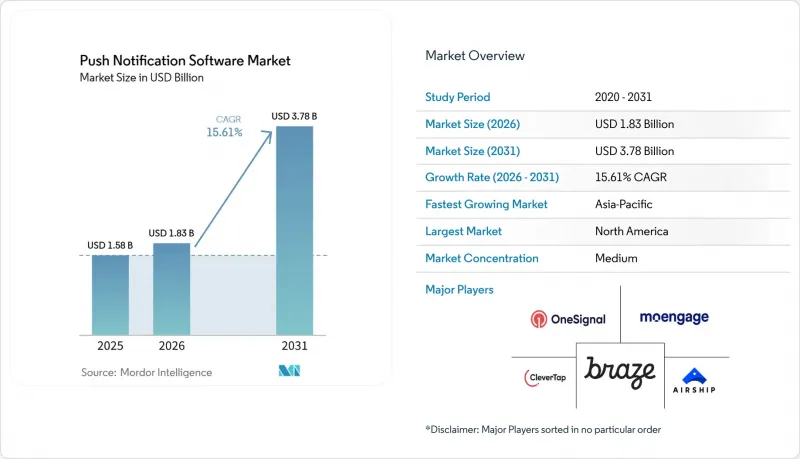
This report is Segmented by Deployment Mode (Cloud-Based, and On-Premises), Enterprise Size (Large Enterprises, and Small and Medium Enterprises), Notification Channel (Mobile Push Notifications, Web Push Notifications, and More), End-User Industry (Retail and E-Commerce, Banking, Financial Services, and Insurance, and More), and Geography. The Market Forecasts are Provided in Terms of Value (USD).
Global Push Notification Software Market Trends and Insights
Rising Need For Real-Time Mobile and Web Customer Engagement
The push notification software market benefits from the growing need for immediate and relevant customer communication across mobile applications and websites. Brands increasingly use event-triggered messages for abandoned carts, inventory availability, price changes, account activity, and other time-sensitive actions. Retailers that use these triggers have reported stronger order recovery than businesses that depend only on scheduled campaign broadcasts. India and Southeast Asian countries continue to offer a wide mobile-first audience for real-time engagement tools, although subscriber scale alone does not guarantee effective communication. Businesses are focusing more closely on retaining existing users because customer reacquisition through paid channels can be expensive. Mature users of the push notification software market have embedded notification delivery into broader retention programs, which makes these platforms more difficult to replace once they are linked to customer data and workflow systems.
Growth of First-Party Data and Permission-Based Messaging
The reduction in third-party tracking options has made push subscriptions a more important source of first-party customer information. A push token can provide an opted-in, device-linked communication route that remains available when browsers refresh or applications update. This capability gives brands a direct way to engage known users without relying entirely on fragmented advertising audiences. OneSignal released OneSignal AI and its Model Context Protocol Server in open beta during July 2026, allowing AI assistants to use behavioral data for audience creation and campaign work. The European Data Protection Board stated that consent under the applicable privacy framework must be freely given, specific, informed, and unambiguous when personal data processing is involved. Providers with consent management, subscriber records, and opt-out controls can therefore have an advantage in enterprise purchasing decisions.
Notification Fatigue and User Opt-Out Pressure
Notification fatigue remains a constraint on the push notification software market because poorly timed or repetitive messages can lead users to disable communications. Device-level opt-outs can be difficult to reverse because brands often need a new application install or renewed permission from the user. Retail, media, and other high-volume senders face greater risk when messages are not tailored to customer behavior and preferences. Batch's 2025 benchmark reviewed 800 billion messages across 1.2 billion visitors and found different permission outcomes across platforms and industry categories. A growing subscriber list does not necessarily translate into long-term platform revenue if businesses do not invest in relevance and frequency management. Predictive suppression tools can help providers identify users with elevated opt-out risk and reduce contact volume before the relationship is lost.
Other drivers and restraints analyzed in the detailed report include:
- Expansion of Lifecycle Automation in SaaS and Commerce Workflows
- Omnichannel Retention Strategies Replacing Single-Channel Campaigns
- Tightening Consent, Privacy, and Device-Level Permission Controls
For complete list of drivers and restraints, kindly check the Table Of Contents.
Segment Analysis
Cloud-based deployment held 72.63% of the push notification software market share in 2025. The segment benefits from automatic software updates, flexible capacity, and pricing models that reduce up-front implementation costs. Cloud delivery also supports the web-based application programming interfaces that are necessary for browser notifications and broader digital engagement programs. Small and mid-sized buyers often favor cloud tools because they can begin with limited technical support and expand usage as their subscriber base grows. Braze added multilingual translation support and workspace-level messaging rate limits in its April 2026 release, showing how cloud platforms can deliver new capabilities across customer accounts. Security certifications such as SOC 2 Type II and ISO 27001 have become important enterprise requirements for cloud providers, raising the entry barrier for smaller vendors.
On-premises deployment is expected to record a 15.96% CAGR through 2031, making it the fastest-growing deployment approach. Financial institutions, government contractors, and healthcare organizations often require stronger control over data location and processing environments. The healthcare and life sciences segment's 18.37% CAGR is linked in part to demand for private cloud or on-premises environments that support HIPAA requirements in the United States. Braze added European hosting on Google Cloud for BrazeAI Decisioning Studio during April 2026 to address data-residency requirements among European clients. This development illustrates the growing role of hosted private environments that combine cloud delivery with stronger customer controls. Providers that offer flexible deployment without reducing core functionality can serve both cloud-first companies and regulated organizations.
Large enterprises accounted for 64.38% of the push notification software market share in 2025. These organizations often operate across several business units and connect notification tools with CRM systems, customer data platforms, analytics products, and data warehouses. Such integrations can create operational switching costs because replacing a provider may disrupt established customer journeys and reporting processes. Large buyers also require consent management, audit records, role-based access controls, dedicated infrastructure, and service-level agreements. Healthcare systems, retail chains, and banking, financial services, and insurance institutions place particular importance on delivery reliability and secure handling of data. Providers without certified integrations for systems such as Salesforce, Oracle, SAP, and major customer data platforms may struggle to meet enterprise procurement needs.
The SME segment is projected to grow at a 16.78% CAGR through 2031. Self-service onboarding, freemium plans, and consumption-based pricing have lowered the cost and complexity of adoption for smaller businesses. OneSignal stated that its platform had been adopted by more than 1 million businesses globally and supported messaging across push, email, SMS, RCS, in-app messaging, and Live Activities. The company's July 2026 AI release was designed to help lean teams create segments, write campaign content, build journeys, and schedule communications with less manual work. Providers such as Pushwoosh, PushEngage, and WebEngage use usage-based pricing that allows smaller customers to align spending with subscriber growth. AI-supported automation can further narrow the gap between large-company engagement programs and the resources available to smaller teams.
Complete Report Scope:
- By Deployment Model
- Cloud-Based
- On-Premises
- By Enterprise Size
- Large Enterprises
- Small and Medium Enterprises
- By Notification Channel
- Mobile Push Notifications
- Web Push Notifications
- Desktop Push Notifications
- By End User Industry
- Retail and E-Commerce
- Banking, Financial Services, and insurance (BFSI)
- IT and Telecommunication
- Media and Entertainment
- Travel and Hospitality
- Healthcare and Life Sciences
- Education
- Other End User Industries
- By Geography
- North America
- United States
- Canada
- Mexico
- South America
- Brazil
- Argentina
- Rest of South America
- Europe
- Germany
- United Kingdom
- France
- Italy
- Spain
- Russia
- Rest of Europe
- Asia-Pacific
- China
- Japan
- india
- South Korea
- Australia
- Rest of Asia-Pacific
- Middle East and Africa
- Middle East
- Turkey
- Saudi Arabia
- United Arab Emirates
- Rest of Middle East
- Africa
- South Africa
- Nigeria
- Rest of Africa
- Middle East
- North America
Geography Analysis
North America held 36.61% of the global push notification software market share in 2025. The region has mature software-as-a-service adoption among retail, banking, financial services, insurance, media, and digital commerce companies. Enterprise deployments often connect deeply with Salesforce, HubSpot, and customer data platforms, making notification systems part of established customer engagement operations. These integrations can increase switching costs and support longer vendor relationships. Europe represented the second-largest regional market, with Germany, the United Kingdom, and France serving as significant enterprise buyer locations. European customers place greater emphasis on consent management, data residency, and audit infrastructure because privacy compliance affects platform selection. The European data protection framework has therefore made governance features an important competitive differentiator for providers serving the region.
Asia-Pacific is expected to grow at a 19.24% CAGR through 2031. Mobile-first commerce in India, China, and Southeast Asia supports demand from fintech, quick commerce, education technology, and digital health applications. Regional providers such as MoEngage, WebEngage, and Netcore Cloud have used their experience in Indian customer engagement programs to expand outside their domestic markets. Aurora Mobile's JPush deployment with Pobo Financial in July 2026 demonstrated the need for high-availability delivery systems for financial communications in China. Japan and South Korea contribute enterprise demand from gaming, retail, media, and consumer application companies with high smartphone penetration.
South America is an emerging area for the push notification software market, with Brazil and Mexico supporting adoption through fintech and e-commerce growth. Mobile-first internet use makes direct customer engagement especially relevant for businesses seeking cost-effective retention programs. Brazil's large digital commerce environment is encouraging investment in lifecycle automation and behavior-based communications. The Middle East and Africa remains at an earlier stage of adoption, although financial services digitization in Saudi Arabia and the United Arab Emirates is creating demand among banks, fintech providers, and e-commerce businesses. Nigeria and South Africa are important African markets because improving mobile infrastructure and digital commerce activity are expanding the addressable user base. Providers that support local languages and regional payment integrations may be better positioned as digital infrastructure develops across these regions.
- OneSignal, Inc.
- Airship Group, Inc.
- Braze, Inc.
- CleverTap
- MoEngage, Inc.
- Iterable, Inc.
- Salesforce, Inc.
- Adobe Inc.
- Oracle Corporation
- Attentive Mobile, Inc.
- PushEngage
- Firebase, LLC
- WebEngage
- Customer.io, Inc.
- Insider.
- HubSpot, Inc.
- Netcore Cloud Pvt. Ltd.
- VWO Engage
- Pushwoosh Inc.
- Sendinblue SAS
- Catapush
Additional Benefits:
- The market estimate (ME) sheet in Excel format
- 3 months of analyst support
TABLE OF CONTENTS
1 INTRODUCTION
- 1.1 Study Assumptions and Market Definition
- 1.2 Scope of the Study
2 RESEARCH METHODOLOGY
3 EXECUTIVE SUMMARY
4 MARKET LANDSCAPE
- 4.1 Market Overview
- 4.2 Market Drivers
- 4.2.1 Rising Need for Real-Time Mobile and Web Customer Engagement
- 4.2.2 Growth of First-Party Data and Permission-Based Messaging
- 4.2.3 Expansion of Lifecycle Automation in SaaS and Commerce Workflows
- 4.2.4 Omnichannel Retention Strategies Replacing Single-Channel Campaigns
- 4.2.5 AI-Assisted Send-Time and Message Personalization
- 4.2.6 Rising Adoption in Mid-Market and Self-Service SMB Segments
- 4.3 Market Restraints
- 4.3.1 Notification Fatigue and User Opt-Out Pressure
- 4.3.2 Tightening Consent, Privacy, and Device-Level Permission Controls
- 4.3.3 Cross-Platform Integration Complexity Across Apps, Web, and CRM Stacks
- 4.3.4 Commoditization and Low Switching Costs in Core Push Functionality
- 4.4 Industry Value-Chain Analysis
- 4.5 Impact of Macroeconomic Factors on the Market
- 4.6 Regulatory Landscape
- 4.7 Technological Outlook
- 4.8 Pricing Analysis
- 4.9 Porter's Five Forces Analysis
- 4.9.1 Bargaining Power of Buyers
- 4.9.2 Bargaining Power of Suppliers
- 4.9.3 Threat of New Entrants
- 4.9.4 Threat of Substitutes
- 4.9.5 Intensity of Competitive Rivalry
5 MARKET SIZE AND GROWTH FORECASTS (VALUE)
- 5.1 By Deployment Model
- 5.1.1 Cloud-Based
- 5.1.2 On-Premises
- 5.2 By Enterprise Size
- 5.2.1 Large Enterprises
- 5.2.2 Small and Medium Enterprises
- 5.3 By Notification Channel
- 5.3.1 Mobile Push Notifications
- 5.3.2 Web Push Notifications
- 5.3.3 Desktop Push Notifications
- 5.4 By End User Industry
- 5.4.1 Retail and E-Commerce
- 5.4.2 Banking, Financial Services, and insurance (BFSI)
- 5.4.3 IT and Telecommunication
- 5.4.4 Media and Entertainment
- 5.4.5 Travel and Hospitality
- 5.4.6 Healthcare and Life Sciences
- 5.4.7 Education
- 5.4.8 Other End User Industries
- 5.5 By Geography
- 5.5.1 North America
- 5.5.1.1 United States
- 5.5.1.2 Canada
- 5.5.1.3 Mexico
- 5.5.2 South America
- 5.5.2.1 Brazil
- 5.5.2.2 Argentina
- 5.5.2.3 Rest of South America
- 5.5.3 Europe
- 5.5.3.1 Germany
- 5.5.3.2 United Kingdom
- 5.5.3.3 France
- 5.5.3.4 Italy
- 5.5.3.5 Spain
- 5.5.3.6 Russia
- 5.5.3.7 Rest of Europe
- 5.5.4 Asia-Pacific
- 5.5.4.1 China
- 5.5.4.2 Japan
- 5.5.4.3 india
- 5.5.4.4 South Korea
- 5.5.4.5 Australia
- 5.5.4.6 Rest of Asia-Pacific
- 5.5.5 Middle East and Africa
- 5.5.5.1 Middle East
- 5.5.5.1.1 Turkey
- 5.5.5.1.2 Saudi Arabia
- 5.5.5.1.3 United Arab Emirates
- 5.5.5.1.4 Rest of Middle East
- 5.5.5.2 Africa
- 5.5.5.2.1 South Africa
- 5.5.5.2.2 Nigeria
- 5.5.5.2.3 Rest of Africa
- 5.5.5.1 Middle East
- 5.5.1 North America
6 COMPETITIVE LANDSCAPE
- 6.1 Market Concentration
- 6.2 Strategic Moves
- 6.3 Market Share Analysis
- 6.4 Company Profiles (includes Global Level Overview, Market Level Overview, Core Segments, Financials as available, Strategic Information, Market Rank/Share, Products and Services, Recent Developments)
- 6.4.1 OneSignal, Inc.
- 6.4.2 Airship Group, Inc.
- 6.4.3 Braze, Inc.
- 6.4.4 CleverTap
- 6.4.5 MoEngage, Inc.
- 6.4.6 Iterable, Inc.
- 6.4.7 Salesforce, Inc.
- 6.4.8 Adobe Inc.
- 6.4.9 Oracle Corporation
- 6.4.10 Attentive Mobile, Inc.
- 6.4.11 PushEngage
- 6.4.12 Firebase, LLC
- 6.4.13 WebEngage
- 6.4.14 Customer.io, Inc.
- 6.4.15 Insider.
- 6.4.16 HubSpot, Inc.
- 6.4.17 Netcore Cloud Pvt. Ltd.
- 6.4.18 VWO Engage
- 6.4.19 Pushwoosh Inc.
- 6.4.20 Sendinblue SAS
- 6.4.21 Catapush
7 MARKET OPPORTUNITIES AND FUTURE OUTLOOK
- 7.1 White-Space and Unmet-Need Assessment

