PUBLISHER: Mordor Intelligence | PRODUCT CODE: 2117598

PUBLISHER: Mordor Intelligence | PRODUCT CODE: 2117598
Supply Chain Control Tower - Market Share Analysis, Industry Trends & Statistics, Growth Forecasts (2026 - 2031)
According to Mordor Intelligence, the supply chain control tower market size is projected to expand from USD 9.86 billion in 2025 to USD 25.76 billion by 2031, registering a CAGR of 17.36% between 2026 and 2031.
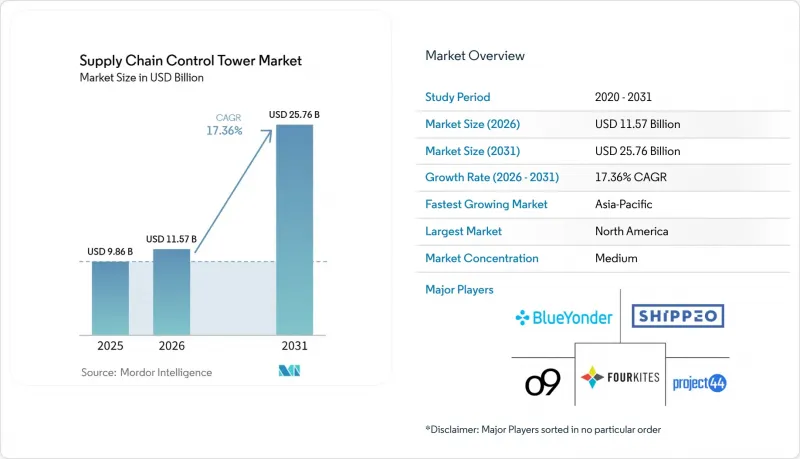
This report is Segmented by Control Tower Type (Operational Control Towers, Analytical and Decision Support Control Towers, and More), Component (Software, and Services), Deployment Mode (Cloud, On-Premise, and More), End Use Enterprise Size (Large Enterprises, and More), End-User Industry (Retail and E-Commerce, and More), and Geography. The Market Forecasts are Provided in Terms of Value (USD).
Global Supply Chain Control Tower Market Trends and Insights
Demand for Real-Time End-to-End Supply Chain Visibility
The supply chain control tower market is benefiting from the shift from periodic reporting to continuous visibility across supply networks. Many companies still lack a complete view of risks across suppliers, transport partners, and distribution points. This gap makes it difficult to identify the source and likely effect of a delay before customer service is affected. Continuous inventory and shipment information can help companies reduce excess stock while lowering the risk of unavailable products. The result is a business case that includes both operational resilience and improved working capital use. Providers with ready connections to ERP, warehouse, transport, and supplier systems can shorten deployment work for buyers. Their advantage is stronger where customers cannot afford a long program of custom integration and process redesign.
Intensifying Supply Chain Disruptions and Resilience Investment
The supply chain control tower market is also supported by resilience programs that now focus on early action rather than recovery after a disruption. Resilinc issued 26,225 disruption alerts in 2025, up 38% from the prior year, across geopolitical enforcement, restructuring, labor issues, and climate-related events. These events make static supplier lists and manual escalation practices less sufficient for complex networks. Companies that change sourcing locations or add suppliers need clearer visibility across several tiers of the network. This requirement increases the value of systems that can assess alternative supply routes and quickly flag affected materials. It also shifts purchase decisions toward platforms that combine supplier data, transportation events, and planning information. The supply chain control tower industry, therefore, has an opportunity to tie resilience spending to protecting service levels and operational continuity.
Legacy-System Integration and Data Harmonization Costs
Older ERP environments can delay supply chain control tower market adoption because system connectivity is only one part of the work. Supplier records, product definitions, transport lanes, and location data often use different formats across business units. Poor data quality can weaken the recommendations produced by prediction models. Companies may need months of data cleanup before they can rely on exception alerts or automated decisions. The challenge becomes larger when a program needs to connect many suppliers and carriers with different data practices. These relationships also require agreements on access rights, data ownership, and error responsibility. Companies that prepare their data structures before selecting a platform are better positioned to achieve meaningful outcomes sooner.
Other drivers and restraints analyzed in the detailed report include:
- AI-Enabled Predictive Exception Management
- Cloud Migration and Multi-Enterprise Collaboration
- Cybersecurity, Data Sovereignty, and Third-Party Data Exposure
For complete list of drivers and restraints, kindly check the Table Of Contents.
Segment Analysis
End-to-End Intelligent Control Towers are projected to grow at a 19.58% CAGR from 2026 to 2031, the highest rate among control tower types. Operational Control Towers held 53.84% of the supply chain control tower market share in 2025. They remain relevant for companies that are building basic visibility across transportation, inventory, and suppliers. These buyers can gain value from current operational information without implementing advanced automation at the start. Analytical and Decision Support Control Towers sit between monitoring and full orchestration. They support scenario analysis, root-cause review, and more informed planning choices. This category can provide a practical transition for companies that are strengthening their data foundation. Many vendors now include more predictive features in standard offerings. That change can reduce the appeal of separate capability layers for buyers who need a system that can expand over time.
Demand for intelligent platforms is supported by a single vendor relationship that extends from visibility to execution. Blue Yonder reported in May 2026 that it had shifted fully to its cognitive portfolio, added 30 customer logos, and appeared in 24 industry analyst reports during the first quarter of 2026. The announcement reflects demand for platforms that do not require customers to replace their operating model each time they add automation. Buyers can begin with monitoring and later apply recommendation or execution features to the same data. This path can lower the disruption associated with moving between separate products. It also gives providers opportunities to expand within current customer accounts. Vendors that only provide passive tracking face pressure to show how they will support guided actions and automated exception handling. The supply chain control tower market favors providers whose data coverage and product design can support that progression.
Software accounted for 62.13% of the supply chain control tower market size in 2025. This position underscores the importance of subscription platforms that organize visibility, workflows, and analysis in a single environment. Software revenue is concentrated among providers with established enterprise platforms and broad partner connections. Services are projected to grow at a 18.51% CAGR through 2031. The faster pace reflects demand for integration work, model tuning, and support for process changes. These needs differ from traditional implementation work because AI systems must be tailored to customer data and operating practices. Service teams can help users interpret exceptions and set rules for automated actions. Their work can influence whether a platform delivers reliable results after the first deployment.
The supply chain control tower market is moving toward service relationships that continue after the initial software go-live. O9 Solutions introduced its APEX model in March 2026 and reported 130+ successful go-lives and 28 consecutive quarters of ARR growth. Its deployment at Hormel Foods covered more than 70 manufacturing sites and linked demand and supply planning across dry and refrigerated networks. Such programs show why customers may view ongoing model work as part of operating a control tower rather than as a one-time project. Providers can use these engagements to improve data quality and adjust decision rules. Buyers should assess how service needs affect cost, internal skills, and the ability to change vendors. They should also separate work that builds reusable internal capability from work that creates continuing dependence on a provider. Clear service scope can help retain the benefits of a tailored platform without obscuring total ownership costs.
Complete Report Scope:
- By Control Tower Type
- Operational Control Towers
- Analytical and Decision Support Control Towers
- End-to-End Intelligent Control Towers
- By Component
- Software
- Services
- By Deployment Mode
- Cloud
- On-Premise
- Hybrid
- By End Use Enterprise Size
- Large Enterprises
- Small and Medium-Sized Enterprises
- By End-User Industry
- Retail and E-Commerce
- Automotive and Industrial Manufacturing
- Electronics and High Technology
- Healthcare and Life Sciences
- Food and Beverages
- Chemicals
- Aerospace and Defense
- Third-Party Logistics and Freight Services
- Pharmaceuticals
- Consumer Goods
- By Geography
- North America
- United States
- Canada
- Mexico
- South America
- Brazil
- Argentina
- Colombia
- Rest of South America
- Europe
- Germany
- United Kingdom
- France
- Italy
- Spain
- Russia
- Nordics
- Rest of Europe
- Asia-Pacific
- China
- India
- Japan
- South Korea
- Australia
- Southeast Asia
- New Zealand
- Rest of Asia-Pacific
- Middle East
- Saudi Arabia
- United Arab Emirates
- Israel
- Turkey
- Rest of Middle East
- Africa
- South Africa
- Egypt
- Nigeria
- Kenya
- Rest of Africa
- North America
Geography Analysis
North America held 37.04% of the supply chain control tower market share in 2025. The region benefits from early adoption of cloud-based supply chain tools and the presence of several AI-focused platform providers. United States-headquartered multinationals manage complex international supplier, manufacturing, and logistics networks. That scale creates many exceptions and data relationships that can justify investment in a broad control tower. Buyers in the region also have experience with digital supply chain programs that started during the 2020 to 2022 pandemic period. South America remains an emerging geography with growing interest from omnichannel retailers in Brazil and Colombia. These companies want better coordination across fragmented, multimodal transport networks. Data infrastructure limitations and integration costs can still delay mid-market users' ability to realize value.
Europe has a more regulation-driven demand pattern for the supply chain control tower market. The Corporate Sustainability Reporting Directive and the Corporate Sustainability Due Diligence Directive were amended in March 2026. Their requirements strengthen the importance of supply-chain traceability and Scope 3 emissions information for affected companies. Control towers can help connect supplier data, shipment information, and product records needed for such reporting. Germany is a major source of regional demand because of its large industrial base. More than 50% of German logistics and manufacturing firms were actively scaling AI integration in supply chain operations during 2025 and 2026. Saudi Arabia and the United Arab Emirates are also investing in supply chain modernization around logistics hubs and multimodal trade flows.
Asia-Pacific is projected to grow at a 19.36% CAGR through 2031, the fastest regional rate. Manufacturing nearshoring, domestic platform development, and digital infrastructure investment in China, India, and Southeast Asia support this expansion. China has local technology companies that build proprietary supply chain orchestration layers, creating strong competition for international providers. India is attracting investment from multinationals developing supplier networks and from domestic manufacturers seeking stronger export capabilities. Nippon Express Holdings launched NX Lead Logistics Solutions with control tower functionality in 2025. Yamaha implemented a Domo-powered global logistics control tower system in January 2026. Africa is still at an early stage, where smartphone-based visibility tools and regional third-party logistics partnerships are building the data foundation for more extensive adoption.
- Blue Yonder Group, Inc.
- project44, Inc.
- FourKites, Inc.
- o9 Solutions, Inc.
- Shippeo SAS
- Wakeo SAS
- Everstream Analytics GmbH
- Interos Inc.
- Resilinc Corporation
- Altana Technologies, Inc.
- Infor (US), LLC
- SAP SE
- GEP Worldwide
- International Business Machines Corporation
Additional Benefits:
- The market estimate (ME) sheet in Excel format
- 3 months of analyst support
TABLE OF CONTENTS
1 INTRODUCTION
- 1.1 Study Assumptions and Market Definition
- 1.2 Scope of the Study
2 RESEARCH METHODOLOGY
3 EXECUTIVE SUMMARY
4 MARKET LANDSCAPE
- 4.1 Market Overview
- 4.2 Market Drivers
- 4.2.1 Demand for Real-Time End-to-End Supply Chain Visibility
- 4.2.2 Intensifying Supply Chain Disruptions and Resilience Investment
- 4.2.3 AI-Enabled Predictive Exception Management
- 4.2.4 Cloud Migration and Multi-Enterprise Collaboration
- 4.2.5 Product-Level Traceability and Carbon-Data Requirements
- 4.2.6 Autonomous Execution Through Digital Twins and AI Agents
- 4.3 Market Restraints
- 4.3.1 Legacy-System Integration and Data Harmonization Costs
- 4.3.2 Cybersecurity, Data Sovereignty, and Third-Party Data Exposure
- 4.3.3 Explainability and Accountability Gaps in AI Recommendations
- 4.3.4 Shortage of Supply Chain Data and Change-Management Specialists
- 4.4 Impact of Macroeconomic Factors on the Market
- 4.5 Industry Value Chain Analysis
- 4.6 Regulatory Landscape
- 4.7 Technological Outlook
- 4.8 Porter's Five Forces Analysis
- 4.8.1 Threat of New Entrants
- 4.8.2 Bargaining Power of Suppliers
- 4.8.3 Bargaining Power of Buyers
- 4.8.4 Threat of Substitutes
- 4.8.5 Competitive Rivalry
- 4.9 Functional Capbility and Application Assessment
- 4.9.1 Transportation and Logistics Visibility
- 4.9.2 Inventory Visibility and Allocation
- 4.9.3 Order Visibility and Fulfillment Monitoring
- 4.9.4 Supply Chain Monitoring and Exception Management
- 4.9.5 Supplier Risk and Procurement Visibility
- 4.9.6 Compliance, Traceability and Sustainability
- 4.9.7 Production and Manufacturing Visibility
- 4.9.8 Returns and Reverse Logistics Visibility
5 MARKET SIZE AND GROWTH FORECASTS (VALUE)
- 5.1 By Control Tower Type
- 5.1.1 Operational Control Towers
- 5.1.2 Analytical and Decision Support Control Towers
- 5.1.3 End-to-End Intelligent Control Towers
- 5.2 By Component
- 5.2.1 Software
- 5.2.2 Services
- 5.3 By Deployment Mode
- 5.3.1 Cloud
- 5.3.2 On-Premise
- 5.3.3 Hybrid
- 5.4 By End Use Enterprise Size
- 5.4.1 Large Enterprises
- 5.4.2 Small and Medium-Sized Enterprises
- 5.5 By End-User Industry
- 5.5.1 Retail and E-Commerce
- 5.5.2 Automotive and Industrial Manufacturing
- 5.5.3 Electronics and High Technology
- 5.5.4 Healthcare and Life Sciences
- 5.5.5 Food and Beverages
- 5.5.6 Chemicals
- 5.5.7 Aerospace and Defense
- 5.5.8 Third-Party Logistics and Freight Services
- 5.5.9 Pharmaceuticals
- 5.5.10 Consumer Goods
- 5.6 By Geography
- 5.6.1 North America
- 5.6.1.1 United States
- 5.6.1.2 Canada
- 5.6.1.3 Mexico
- 5.6.2 South America
- 5.6.2.1 Brazil
- 5.6.2.2 Argentina
- 5.6.2.3 Colombia
- 5.6.2.4 Rest of South America
- 5.6.3 Europe
- 5.6.3.1 Germany
- 5.6.3.2 United Kingdom
- 5.6.3.3 France
- 5.6.3.4 Italy
- 5.6.3.5 Spain
- 5.6.3.6 Russia
- 5.6.3.7 Nordics
- 5.6.3.8 Rest of Europe
- 5.6.4 Asia-Pacific
- 5.6.4.1 China
- 5.6.4.2 India
- 5.6.4.3 Japan
- 5.6.4.4 South Korea
- 5.6.4.5 Australia
- 5.6.4.6 Southeast Asia
- 5.6.4.7 New Zealand
- 5.6.4.8 Rest of Asia-Pacific
- 5.6.5 Middle East
- 5.6.5.1 Saudi Arabia
- 5.6.5.2 United Arab Emirates
- 5.6.5.3 Israel
- 5.6.5.4 Turkey
- 5.6.5.5 Rest of Middle East
- 5.6.6 Africa
- 5.6.6.1 South Africa
- 5.6.6.2 Egypt
- 5.6.6.3 Nigeria
- 5.6.6.4 Kenya
- 5.6.6.5 Rest of Africa
- 5.6.1 North America
6 COMPETITIVE LANDSCAPE
- 6.1 Market Concentration
- 6.2 Strategic Moves
- 6.3 Market Share Analysis
- 6.4 Company Profiles (includes Global Level Overview, Market Level Overview, Core Segments, Financials as available, Strategic Information, Market Rank/Share, Products and Services, Recent Developments)
- 6.4.1 Blue Yonder Group, Inc.
- 6.4.2 project44, Inc.
- 6.4.3 FourKites, Inc.
- 6.4.4 o9 Solutions, Inc.
- 6.4.5 Shippeo SAS
- 6.4.6 Wakeo SAS
- 6.4.7 Everstream Analytics GmbH
- 6.4.8 Interos Inc.
- 6.4.9 Resilinc Corporation
- 6.4.10 Altana Technologies, Inc.
- 6.4.11 Infor (US), LLC
- 6.4.12 SAP SE
- 6.4.13 GEP Worldwide
- 6.4.14 International Business Machines Corporation
7 MARKET OPPORTUNITIES AND FUTURE OUTLOOK
- 7.1 White-Space and Unmet-Need Assessment

