PUBLISHER: Mordor Intelligence | PRODUCT CODE: 2117603

PUBLISHER: Mordor Intelligence | PRODUCT CODE: 2117603
Creative Automation Software - Market Share Analysis, Industry Trends & Statistics, Growth Forecasts (2026 - 2031)
According to Mordor Intelligence, the creative automation software market size is projected to expand from USD 2.18 billion in 2025 and USD 2.51 billion in 2026 to USD 5.51 billion by 2031, registering a CAGR of 17.03% between 2026 and 2031.
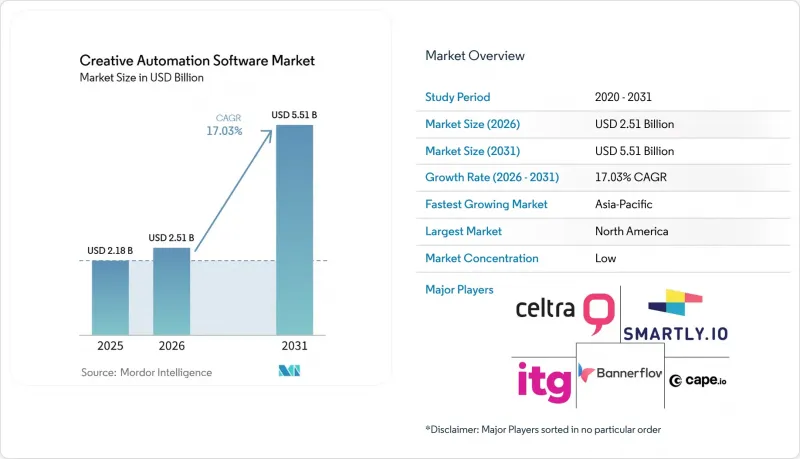
This report is Segmented by Component (Software, and Services), Deployment Mode (Cloud, On-Premise, and Hybrid), Creative Capability (Creative Generation, and More), Enterprise Size (Large Enterprises, and Small and Medium Enterprises), End-User Industry (BFSI, and More), Buyer Type (Brands and Advertisers, and More), and Geography. The Market Forecasts are Provided in Terms of Value (USD).
Global Creative Automation Software Market Trends and Insights
Rising Omnichannel Creative Production Requirements
Brand teams manage an average of 6 retail media networks in 2026, and that number is projected to reach 8 by year-end. Each network uses different requirements for display, video, and performance formats. A single campaign can therefore require hundreds of versions across social platforms, connected TV, programmatic display, and retail media. The creative automation software market benefits because manual teams cannot consistently deliver this volume at campaign speed. The 2025 State of Creative Ops report found that 53% of marketing and creative professionals said AI tools had accelerated their workflows. Companies without automated versioning can face delayed launches and lower media efficiency, particularly in FMCG, retail, and media campaigns with short cycles and varied formats.
Generative AI Integration Into Creative Workflows
Generative AI is changing creative automation from template population to the production of new assets from prompts and briefs. This can reduce the time between a campaign brief and usable creative output. Adobe introduced Firefly Design Intelligence, a no-code Workflow Builder, and a Content Production Agent in October 2025 to support brand-compliant content production at scale. Adobe stated that nearly 90% of its top 50 enterprise accounts had adopted its AI-first innovations, while 99% of Fortune 100 companies had used AI within an Adobe application. Germany's Bitkom found that 84% of surveyed enterprises ranked AI as the most influential trend, and 76% expected marketing automation to gain strategic importance. The creative automation software market is therefore absorbing work that once sat between the briefing, production, and media teams, thereby changing how agencies and brands organize campaign delivery.
Data Privacy and Intellectual Property Uncertainty
Legal rules for AI-generated content remain unsettled across major purchasing markets, which can extend software buying cycles. The U.S. Copyright Office's reports on copyright and AI state that copyright protection requires human authorship, creating ownership questions for content created with heavily automated workflows. The EU AI Act's Article 53 requirements on copyright compliance and training-data disclosures also affect providers using general-purpose AI models for brand customers. These rules are particularly relevant to BFSI and healthcare advertisers, where legal review is closely tied to campaign approvals. Procurement teams must also consider GDPR Article 22, the EU Digital Single Market Directive, and the UK Data (Use and Access) Act 2025. The creative automation software market must demonstrate clear controls over training data, asset rights, human review, and data handling to limit this friction.
Other drivers and restraints analyzed in the detailed report include:
- Growing Demand for Personalized Advertising Content
- Cloud-Based Adoption by Small and Medium Enterprises
- Commoditization of Basic Creative Generation Features
For complete list of drivers and restraints, kindly check the Table Of Contents.
Segment Analysis
Software held 72.41% of the creative automation software market share in 2025, reflecting enterprise preference for centralized software-as-a-service platforms. Platform selection and integration remained the main early investment because buyers need common templates, approved assets, review stages, and delivery formats. These systems support repeatable work across brands, campaign teams, media channels, and locations, which makes high-volume production more consistent. The creative automation software industry depends on this shared operating layer to connect design, marketing, compliance, and media operations without relying on disconnected handoffs. Enterprise customers also value the ability to apply brand rules across a broad portfolio of campaigns while retaining oversight of who can change or approve an asset.
Services are projected to expand at an 18.82% CAGR through 2031, making them the fastest-growing component. They include implementation, API integration, custom model training, managed creative operations, and ongoing optimization, which many internal teams cannot support alone. Rocketium's managed service model, used by Amazon, Walmart, General Mills, and Colgate-Palmolive for visual content production, demonstrates the demand for support that extends beyond a software subscription. Vendors can add professional services to annual contracts, while agencies can provide managed delivery using established software stacks and their existing client relationships. This creates a split between software providers defending retention through platform capabilities and service providers competing on workflow depth, delivery support, and accountable creative outcomes, especially where customers need help translating broad campaign requirements into repeatable production rules, approval stages, and finished assets that media teams can use without further rework.
Cloud deployment held 74.18% of the market in 2025 because it lets brands add production capacity without purchasing their own infrastructure. It is useful during retail periods, new product launches, and campaign events that require rapid versioning. Cloud systems also enable dispersed teams and agencies to use the same approved assets, controls, and workflow history. The creative automation software market size for cloud delivery is tied to the operational need for shared production tools that can generate, adapt, and distribute content quickly. Its lead reflects the value of flexible capacity, centralized access, and recurring updates when pricing, products, or promotional information changes.
Hybrid deployment is projected to expand at a 17.69% CAGR through 2031, making it the fastest-growing model. Financial services, healthcare, and government advertisers can keep sensitive data in controlled environments while using cloud services for selected production workloads. This arrangement addresses data governance and sovereignty requirements without giving up access to cloud-scale creative generation and workflow capabilities. On-premises systems remain relevant in markets with strict data-residency rules, including Germany and the wider European Union. GDPR, EU AI Act transparency requirements, and national data localization rules are making deployment architecture a practical business requirement for regulated buyers, since the location of data, the review of generated content, and the separation of audience information from finished creative can affect procurement decisions, operating processes, and the way a platform is configured.
Complete Report Scope:
- By Component
- Software
- Services
- By Deployment Mode
- Cloud
- On-Premise
- Hybrid
- By Creative Capability
- Creative Generation
- Creative Adaptation and Asset Versioning
- Creative Localization and Personalization
- Dynamic Creative Optimization
- Creative Analytics and Testing
- Creative Workflow and Approval Automation
- By Enterprise Size
- Large Enterprises
- Small and Medium Enterprises
- By End-User Industry
- IT and Telecommunication
- BFSI
- Healthcare and Life Sciences
- Retail and E-Commerce
- Industrial Manufacturing
- Education and Research Institutions
- Media and Entertainment
- Government and Administration
- Travel and Hospitality
- By Buyer Type
- Brands and Advertisers
- Advertising Agencies
- Publishers and Media Owners
- E-Commerce Merchants
- In-House Creative Teams
- By Geography
- North America
- United States
- Canada
- Mexico
- South America
- Brazil
- Argentina
- Rest of South America
- Europe
- Germany
- United Kingdom
- France
- Russia
- Spain
- Rest of Europe
- Asia-Pacific
- China
- Japan
- India
- South Korea
- Southeast Asia
- Rest of Asia-Pacific
- Middle East and Africa
- Middle East
- Saudi Arabia
- United Arab Emirates
- Rest of Middle East
- Africa
- South Africa
- Nigeria
- Rest of Africa
- Middle East
- North America
Geography Analysis
North America held 36.73% of the market in 2025, supported by extensive programmatic advertising activity and a dense base of vendors and large buyers. U.S. retail media spending reached USD 107.6 billion in 2025, accounting for 30% of U.S. digital advertising spend. Brand teams in the region manage an average of 6 retail media networks in 2026, and that count is projected to reach 8 by year-end. Each network requires distinct creative formats, which increases demand for automated production and asset versioning. Canada and Mexico add to regional demand through cross-border campaigns, expanding digital retail activity, and growing access to platform-native creative tools for smaller businesses.
Europe is the second-largest regional market, with the United Kingdom, Germany, and France supporting enterprise adoption. Bitkom reported that 84% of surveyed German companies ranked AI as the most influential trend, and 76% expected marketing automation to become more important. European data protection requirements encourage hybrid deployments that preserve data sovereignty while using cloud services for production. Asia-Pacific is projected to expand at a 20.83% CAGR through 2031, the fastest regional rate. India, China, Japan, South Korea, and Southeast Asia are increasing digital advertising activity and need content that can serve varied languages and local audiences.
The Middle East, Africa, and South America are earlier-stage markets, but both show conditions that can support wider adoption. Saudi Arabia and the United Arab Emirates are investing in digital advertising infrastructure as part of economic diversification programs. Brazil leads South American activity through a mature digital advertising environment and rising social commerce use, while Argentina and other South American countries have lower enterprise adoption but can use cloud platforms without local technology infrastructure. India's 22 official languages and varied consumer behavior create demand for localization, while Dentsu Japan's AI For Growth Creative Lines combines branded content, performance advertising, and process transformation through a unified AI infrastructure.
- Celtra, Inc.
- Smartly.io Solutions Oy
- Bannerflow AB
- Inspired Thinking Group (ITG) Limited
- Cape.io Limited
- The Brief AI, Inc.
- Rocketium Technologies Private Limited
- Marpipe, Inc.
- Hunch Insights Private Limited
- Ziflow, Inc.
- Mediawide Systems Limited
- Jivox Corporation
- RevJet, Inc.
- Pencil Technologies, Inc.
- Typeface, Inc.
- Omneky, Inc.
- VidMob, Inc.
- Shuttlerock Limited
- AdCreative.ai
- Madgicx Ltd.
- Inmagine Group Pte. Ltd.
- Lumen5 Technologies Inc.
Additional Benefits:
- The market estimate (ME) sheet in Excel format
- 3 months of analyst support
TABLE OF CONTENTS
1 INTRODUCTION
- 1.1 Study Assumptions and Market Definition
- 1.2 Scope of the Study
2 RESEARCH METHODOLOGY
3 EXECUTIVE SUMMARY
4 MARKET LANDSCAPE
- 4.1 Market Overview
- 4.2 Market Drivers
- 4.2.1 Rising Omnichannel Creative Production Requirements
- 4.2.2 Generative AI Integration Into Creative Workflows
- 4.2.3 Growing Demand for Personalized Advertising Content
- 4.2.4 Cloud-Based Creative Automation Adoption by Small and Medium Enterprises
- 4.2.5 Creative-Media Feedback Loops Becoming Core Performance Infrastructure
- 4.2.6 Retail Media Catalog Volatility Increasing Automated Creative Demand
- 4.3 Market Restraints
- 4.3.1 Data Privacy and Intellectual Property Uncertainty
- 4.3.2 Commoditization of Basic Creative Generation Features
- 4.3.3 Structural Disconnect Between Creative and Media Teams
- 4.3.4 Platform Rejection, Brand Authenticity, and Quality-Control Risk
- 4.4 Impact of Macroeconomic Factors on the Market
- 4.5 Industry Value-Chain Analysis
- 4.6 Technology Outlook
- 4.7 Regulatory Landscape
- 4.8 Porter's Five Forces Analysis
- 4.8.1 Threat of New Entrants
- 4.8.2 Bargaining Power of Suppliers
- 4.8.3 Bargaining Power of Buyers
- 4.8.4 Threat of Substitutes
- 4.8.5 Intensity of Competitive Rivalry
5 MARKET SIZE AND GROWTH FORECASTS (VALUE)
- 5.1 By Component
- 5.1.1 Software
- 5.1.2 Services
- 5.2 By Deployment Mode
- 5.2.1 Cloud
- 5.2.2 On-Premise
- 5.2.3 Hybrid
- 5.3 By Creative Capability
- 5.3.1 Creative Generation
- 5.3.2 Creative Adaptation and Asset Versioning
- 5.3.3 Creative Localization and Personalization
- 5.3.4 Dynamic Creative Optimization
- 5.3.5 Creative Analytics and Testing
- 5.3.6 Creative Workflow and Approval Automation
- 5.4 By Enterprise Size
- 5.4.1 Large Enterprises
- 5.4.2 Small and Medium Enterprises
- 5.5 By End-User Industry
- 5.5.1 IT and Telecommunication
- 5.5.2 BFSI
- 5.5.3 Healthcare and Life Sciences
- 5.5.4 Retail and E-Commerce
- 5.5.5 Industrial Manufacturing
- 5.5.6 Education and Research Institutions
- 5.5.7 Media and Entertainment
- 5.5.8 Government and Administration
- 5.5.9 Travel and Hospitality
- 5.6 By Buyer Type
- 5.6.1 Brands and Advertisers
- 5.6.2 Advertising Agencies
- 5.6.3 Publishers and Media Owners
- 5.6.4 E-Commerce Merchants
- 5.6.5 In-House Creative Teams
- 5.7 By Geography
- 5.7.1 North America
- 5.7.1.1 United States
- 5.7.1.2 Canada
- 5.7.1.3 Mexico
- 5.7.2 South America
- 5.7.2.1 Brazil
- 5.7.2.2 Argentina
- 5.7.2.3 Rest of South America
- 5.7.3 Europe
- 5.7.3.1 Germany
- 5.7.3.2 United Kingdom
- 5.7.3.3 France
- 5.7.3.4 Russia
- 5.7.3.5 Spain
- 5.7.3.6 Rest of Europe
- 5.7.4 Asia-Pacific
- 5.7.4.1 China
- 5.7.4.2 Japan
- 5.7.4.3 India
- 5.7.4.4 South Korea
- 5.7.4.5 Southeast Asia
- 5.7.4.6 Rest of Asia-Pacific
- 5.7.5 Middle East and Africa
- 5.7.5.1 Middle East
- 5.7.5.1.1 Saudi Arabia
- 5.7.5.1.2 United Arab Emirates
- 5.7.5.1.3 Rest of Middle East
- 5.7.5.2 Africa
- 5.7.5.2.1 South Africa
- 5.7.5.2.2 Nigeria
- 5.7.5.2.3 Rest of Africa
- 5.7.5.1 Middle East
- 5.7.1 North America
6 COMPETITIVE LANDSCAPE
- 6.1 Market Concentration
- 6.2 Strategic Moves
- 6.3 Market Share Analysis
- 6.4 Company Profiles (includes Global Level Overview, Market Level Overview, Core Segments, Financials as available, Strategic Information, Market Rank/Share, Products and Services, Recent Developments)
- 6.4.1 Celtra, Inc.
- 6.4.2 Smartly.io Solutions Oy
- 6.4.3 Bannerflow AB
- 6.4.4 Inspired Thinking Group (ITG) Limited
- 6.4.5 Cape.io Limited
- 6.4.6 The Brief AI, Inc.
- 6.4.7 Rocketium Technologies Private Limited
- 6.4.8 Marpipe, Inc.
- 6.4.9 Hunch Insights Private Limited
- 6.4.10 Ziflow, Inc.
- 6.4.11 Mediawide Systems Limited
- 6.4.12 Jivox Corporation
- 6.4.13 RevJet, Inc.
- 6.4.14 Pencil Technologies, Inc.
- 6.4.15 Typeface, Inc.
- 6.4.16 Omneky, Inc.
- 6.4.17 VidMob, Inc.
- 6.4.18 Shuttlerock Limited
- 6.4.19 AdCreative.ai
- 6.4.20 Madgicx Ltd.
- 6.4.21 Inmagine Group Pte. Ltd.
- 6.4.22 Lumen5 Technologies Inc.
7 MARKET OPPORTUNITIES AND FUTURE OUTLOOK
- 7.1 White-Space and Unmet-Need Assessment

