PUBLISHER: Mordor Intelligence | PRODUCT CODE: 2117615

PUBLISHER: Mordor Intelligence | PRODUCT CODE: 2117615
Artificial Blood Substitutes - Market Share Analysis, Industry Trends & Statistics, Growth Forecasts (2026 - 2031)
According to Mordor Intelligence, the artificial blood substitutes market size was valued at USD 11.87 billion in 2025 and is estimated to grow from USD 14.71 billion in 2026 to reach USD 55.73 billion by 2031, at a CAGR of 30.53% during the forecast period (2026-2031).
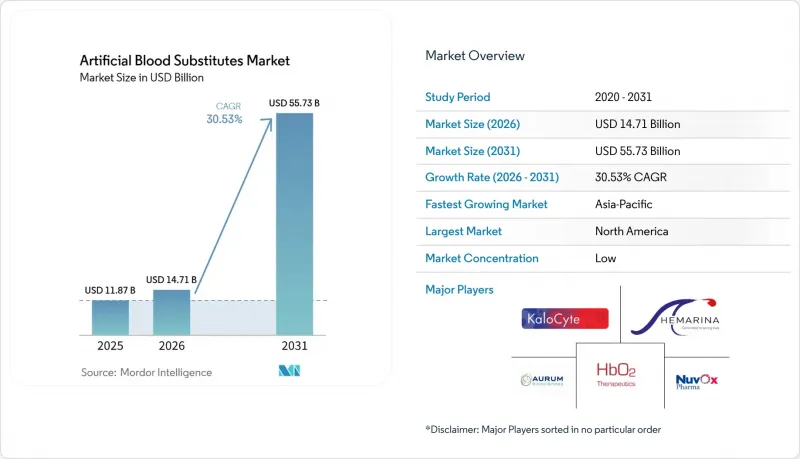
This report is Segmented by Product Type (HBOCs, Pfcs, and More), Form (Injectable, IV Infusion, and More), Source (Human, Bovine, Recombinant, and More), Technology (Biotechnology, Recombinant DNA, and More), Application (Surgical Procedures and More), End User (Hospitals and More), and Geography (North America, Europe, and More). The Market Forecasts are Provided in Terms of Value (USD).
Global Artificial Blood Substitutes Market Trends and Insights
Persistent Blood Shortages and Donor Supply Gaps
Blood supply shortfalls remain structural, and that keeps the artificial blood substitutes market tied to a long-term need rather than a short-term imbalance. In June 2026, the WHO reported that global blood collections increased 19% between 2013 and 2023, yet donation rates still ranged from 0.4 to 53 per 1,000 population, and 55 countries continued to collect fewer than 10 donations per 1,000 people. This uneven supply base matters for the artificial blood substitutes market because it shows that donor campaigns alone are not closing access gaps in many health systems.
The issue is also visible in China, where academic work has continued to describe recurring regional and seasonal shortages that sustain demand for red blood cell substitutes even in stronger urban care settings. That pattern supports the artificial blood substitutes market in both emergency medicine and planned hospital use, because the problem is rooted in supply reliability rather than temporary demand spikes.
Battlefield, Trauma, and Mass Casualty Readiness Needs
Defense spending is accelerating the artificial blood substitutes market by moving blood analog systems through development steps that civilian programs often take much longer to complete. DARPA launched the RAPIID program in June 2026 to advance shelf-stable oxygen carriers, platelet-derived products, and dried plasma toward clinical trials, regulatory approval, and manufacturing scale-up for battlefield care. That work builds on the earlier FSHARP initiative, which drew more than USD 46 million in support and combined KaloCyte's ErythroMer, Haima Therapeutics' SynthoPlate, and Teleflex freeze-dried plasma into a broader resuscitation framework. The artificial blood substitutes market benefits because standards developed under defense programs are also becoming reference points for civilian manufacturing quality and regulatory preparation.
Safety Concerns from Hemodynamic and Oxidative Side Effects
Safety remains the most important restraint on the artificial blood substitutes market because older cell-free hemoglobin systems were linked to vasoconstriction and higher cardiovascular risk. A 2025 review in Frontiers in Physiologyconnected increased myocardial infarction risk after HBOC infusion to intravascular reactions that amplify oxidative stress. Those findings continue to shape the artificial blood substitutes market by forcing developers to emphasize PEGylation, encapsulation, and genetic modification when designing newer products.
Regulatory agencies have responded by demanding longer and larger trials, especially for products that still rely on unmodified or lightly modified hemoglobin platforms. The pressure is not uniform across the artificial blood substitutes market, which is why perfluorocarbon carriers and stem cell-derived substitutes continue to attract attention as alternatives to earlier HBOC formats.
Other drivers and restraints analyzed in the detailed report include:
- Rising Surgical Volume and Transfusion Dependency
- Longer Shelf Life and Ambient Storage Advantage
- Long Clinical Validation and Regulatory Approval Cycles
For complete list of drivers and restraints, kindly check the Table Of Contents.
Segment Analysis
Hemoglobin-Based Oxygen Carriers held 56.3% of artificial blood substitutes market share in 2025, which kept them in the leading product position. Their lead reflects scalable production from human-donated or bovine hemoglobin, familiar oxygen dissociation behavior, and compatibility with existing IV-based care routines. A focused 2025 review in the International Journal of Molecular Sciences described steady progress in PEGylation, polymer encapsulation, and genetic modification, all aimed at reducing nitric oxide scavenging and improving safety.
Stem Cell-Derived Red Blood Cell Substitutes are forecast to grow at 35.5% CAGR through 2031, which makes them the fastest-growing product category in the artificial blood substitutes market. Scarlet Therapeutics reported in May 2026 that its universal lab-grown red blood cells showed in vivo survival with a half-life comparable to donated blood, and the company also raised GBP 3.2 million, or USD 4 million, to advance manufacturing and regulatory work.
Injectable solutions accounted for 62.2% of the artificial blood substitutes market size in 2025 within the form segment, which reflects how acute care still depends on direct IV administration. Liquid formulations fit current hospital protocols, and that lowers disruption when clinicians evaluate oxygen carrier products for emergency use. A 2026 study in the Journal of Pharmaceutical Investigation showed that plasma volume expanders can improve stabilization of perfluorocarbon nanoemulsions for artificial blood applications.
Lyophilized formulations are forecast to grow at 36.5% CAGR through 2031, making them the fastest-moving form in the artificial blood substitutes market. The shift is strongly tied to defense procurement, because programs such as RAPIID and FSHARP require products that can remain stable for long periods without refrigeration.
Complete Report Scope:
- By Product Type
- Hemoglobin-Based Oxygen Carriers (HBOCs)
- Perfluorocarbon-Based Oxygen Carriers (PFCs)
- Stem Cell-Derived Red Blood Cell Substitutes
- Plasma Substitutes / Plasma Volume Expanders
- Platelet Substitutes
- Other Product Types (Synthetic Platelets, Encapsulated Hemoglobin Systems)
- By Form
- Injectable Solutions
- Intravenous Infusion Solutions
- Emulsion Formulations
- Lyophilized (Freeze-Dried) Formulations
- By Source
- Human-Derived Hemoglobin
- Bovine-Derived Hemoglobin
- Recombinant Hemoglobin
- Stem Cell-Derived Sources
- Others (Microorganism-Based Production, Synthetic/Chemical Sources)
- By Technology
- Biotechnology Solutions
- Recombinant DNA & Protein Engineering
- Nanotechnology-Based Solutions
- Encapsulation Technologies
- PEGylation Technologies
- Stem Cell Engineering Technologies
- By Application
- Trauma and Emergency Medicine
- Surgical Procedures
- Organ Transplant Support
- Hemorrhagic Shock Management
- Critical Care and Intensive Care
- Cardiovascular Surgery
- Others (Battlefield and Defense Medicine, Severe Anemia Management)
- By End User
- Hospitals
- Trauma Centers
- Blood Banks and Transfusion Services
- Specialty Clinics
- Ambulatory Surgical Centers
- Others (Emergency Medical Services (EMS), Research Laboratories and Academic Institutes, Military and Defense Medical Units)
- By Geography
- North America
- United States
- Canada
- Mexico
- Europe
- Germany
- United Kingdom
- France
- Italy
- Spain
- Rest of Europe
- Asia-Pacific
- China
- India
- Japan
- Australia
- South Korea
- Rest of Asia-Pacific
- Middle East and Africa
- GCC
- South Africa
- Rest of Middle East and Africa
- South America
- Brazil
- Argentina
- Rest of South America
- North America
Geography Analysis
North America held 43.7% of the artificial blood substitutes market share in 2025, which made it the leading regional market. The region's position reflects the depth of the U.S. defense funding system and the concentration of clinical-stage biotech programs working on HBOCs, cell-derived red blood cells, and other oxygen therapeutic platforms. DARPA's FSHARP and RAPIID initiatives directed more than USD 46 million toward field-deployable blood analog development, and that support created spillover value for companies such as KaloCyte, NuvOx Therapeutics, and Prolong Pharmaceuticals that operate across civilian and defense pathways.
Europe remains important to the artificial blood substitutes market because the region combines active clinical research, transplant expertise, and a tighter policy focus on blood traceability and safety. The United Kingdom's RESTORE program is the first clinical effort comparing lab-grown red blood cells with donated blood in human volunteers, which keeps Europe visible in cell-derived product development. Asia-Pacific is projected to grow at 35.7% CAGR through 2031, which gives it the fastest regional expansion in the artificial blood substitutes market. Japan is central to that growth, with Nara Medical University running a Phase Ib trial of NMU-HbV and the government-backed NEDO program funding iPS-derived platelet manufacturing through 2028.
- Alliance Pharmaceutical Corp.
- Aurum Biosciences Ltd.
- Baxter
- Biopure Corporation
- HbO2 Therapeutics, Inc.
- HEMARINA SA
- HemoBioTech, Inc.
- KaloCyte, Inc.
- Northfield Laboratories, Inc.
- NuvOx Pharma, LLC
- OPK Biotech LLC
- Prolong Pharmaceuticals, LLC
- Safi Biotherapeutics, Inc.
- Sangart, Inc.
- SpheriTech Ltd.
- SynZyme Technologies LLC
- Tenax Therapeutics, Inc.
- VirTech Bio, Inc.
Additional Benefits:
- The market estimate (ME) sheet in Excel format
- 3 months of analyst support
TABLE OF CONTENTS
1 Introduction
- 1.1 Study Assumptions & Market Definition
- 1.2 Scope of the Study
2 Research Methodology
3 Executive Summary
4 Market Landscape
- 4.1 Market Overview
- 4.2 Market Drivers
- 4.2.1 Persistent Blood Shortages and Donor Supply Gaps
- 4.2.2 Battlefield, Trauma, and Mass Casualty Readiness Needs
- 4.2.3 Rising Surgical Volume and Transfusion Dependency
- 4.2.4 Longer Shelf Life and Ambient Storage Advantage
- 4.2.5 Regulatory Pressure on Conventional Blood Safety and Traceability
- 4.2.6 Expansion of R and D in Oxygen Carrier Bioengineering
- 4.3 Market Restraints
- 4.3.1 Safety Concerns from Hemodynamic and Oxidative Side Effects
- 4.3.2 Long Clinical Validation and Regulatory Approval Cycles
- 4.3.3 Limited Clotting, Immune, and Multi-Function Blood Replication
- 4.3.4 High CMC, Scale-Up, and Manufacturing Cost Burden
- 4.4 Supply-Chain Analysis
- 4.5 Regulatory Landscape
- 4.6 Technological Outlook
- 4.7 Porter's Five Forces Analysis
- 4.7.1 Threat of New Entrants
- 4.7.2 Bargaining Power of Suppliers
- 4.7.3 Bargaining Power of Buyers
- 4.7.4 Threat of Substitutes
- 4.7.5 Industry Rivalry
5 Market Size & Growth Forecasts (Value, USD)
- 5.1 By Product Type
- 5.1.1 Hemoglobin-Based Oxygen Carriers (HBOCs)
- 5.1.2 Perfluorocarbon-Based Oxygen Carriers (PFCs)
- 5.1.3 Stem Cell-Derived Red Blood Cell Substitutes
- 5.1.4 Plasma Substitutes / Plasma Volume Expanders
- 5.1.5 Platelet Substitutes
- 5.1.6 Other Product Types (Synthetic Platelets, Encapsulated Hemoglobin Systems)
- 5.2 By Form
- 5.2.1 Injectable Solutions
- 5.2.2 Intravenous Infusion Solutions
- 5.2.3 Emulsion Formulations
- 5.2.4 Lyophilized (Freeze-Dried) Formulations
- 5.3 By Source
- 5.3.1 Human-Derived Hemoglobin
- 5.3.2 Bovine-Derived Hemoglobin
- 5.3.3 Recombinant Hemoglobin
- 5.3.4 Stem Cell-Derived Sources
- 5.3.5 Others (Microorganism-Based Production, Synthetic/Chemical Sources)
- 5.4 By Technology
- 5.4.1 Biotechnology Solutions
- 5.4.2 Recombinant DNA & Protein Engineering
- 5.4.3 Nanotechnology-Based Solutions
- 5.4.4 Encapsulation Technologies
- 5.4.5 PEGylation Technologies
- 5.4.6 Stem Cell Engineering Technologies
- 5.5 By Application
- 5.5.1 Trauma and Emergency Medicine
- 5.5.2 Surgical Procedures
- 5.5.3 Organ Transplant Support
- 5.5.4 Hemorrhagic Shock Management
- 5.5.5 Critical Care and Intensive Care
- 5.5.6 Cardiovascular Surgery
- 5.5.7 Others (Battlefield and Defense Medicine, Severe Anemia Management)
- 5.6 By End User
- 5.6.1 Hospitals
- 5.6.2 Trauma Centers
- 5.6.3 Blood Banks and Transfusion Services
- 5.6.4 Specialty Clinics
- 5.6.5 Ambulatory Surgical Centers
- 5.6.6 Others (Emergency Medical Services (EMS), Research Laboratories and Academic Institutes, Military and Defense Medical Units)
- 5.7 By Geography
- 5.7.1 North America
- 5.7.1.1 United States
- 5.7.1.2 Canada
- 5.7.1.3 Mexico
- 5.7.2 Europe
- 5.7.2.1 Germany
- 5.7.2.2 United Kingdom
- 5.7.2.3 France
- 5.7.2.4 Italy
- 5.7.2.5 Spain
- 5.7.2.6 Rest of Europe
- 5.7.3 Asia-Pacific
- 5.7.3.1 China
- 5.7.3.2 India
- 5.7.3.3 Japan
- 5.7.3.4 Australia
- 5.7.3.5 South Korea
- 5.7.3.6 Rest of Asia-Pacific
- 5.7.4 Middle East and Africa
- 5.7.4.1 GCC
- 5.7.4.2 South Africa
- 5.7.4.3 Rest of Middle East and Africa
- 5.7.5 South America
- 5.7.5.1 Brazil
- 5.7.5.2 Argentina
- 5.7.5.3 Rest of South America
- 5.7.1 North America
6 Competitive Landscape
- 6.1 Market Concentration
- 6.2 Market Share Analysis
- 6.3 Company Profiles {(includes Global level Overview, Market level overview, Core Segments, Financials as available, Strategic Information, Market Rank/Share for key companies, Products & Services, and Recent Developments)}
- 6.3.1 Alliance Pharmaceutical Corp.
- 6.3.2 Aurum Biosciences Ltd.
- 6.3.3 Baxter Healthcare Corporation
- 6.3.4 Biopure Corporation
- 6.3.5 HbO2 Therapeutics, Inc.
- 6.3.6 HEMARINA SA
- 6.3.7 HemoBioTech, Inc.
- 6.3.8 KaloCyte, Inc.
- 6.3.9 Northfield Laboratories, Inc.
- 6.3.10 NuvOx Pharma, LLC
- 6.3.11 OPK Biotech LLC
- 6.3.12 Prolong Pharmaceuticals, LLC
- 6.3.13 Safi Biotherapeutics, Inc.
- 6.3.14 Sangart, Inc.
- 6.3.15 SpheriTech Ltd.
- 6.3.16 SynZyme Technologies LLC
- 6.3.17 Tenax Therapeutics, Inc.
- 6.3.18 VirTech Bio, Inc.
7 Market Opportunities & Future Outlook
- 7.1 White-space & unmet-need assessment

