PUBLISHER: Mordor Intelligence | PRODUCT CODE: 2117975

PUBLISHER: Mordor Intelligence | PRODUCT CODE: 2117975
Low Smoke Zero Halogen (LSZH) Cables - Market Share Analysis, Industry Trends & Statistics, Growth Forecasts (2026 - 2031)
According to Mordor Intelligence, the low smoke zero halogen (LSZH) cables market size is expected to increase from USD 4.08 billion in 2025 to USD 4.37 billion in 2026 and reach USD 6.13 billion by 2031, growing at a CAGR of 6.98% over 2026-2031.
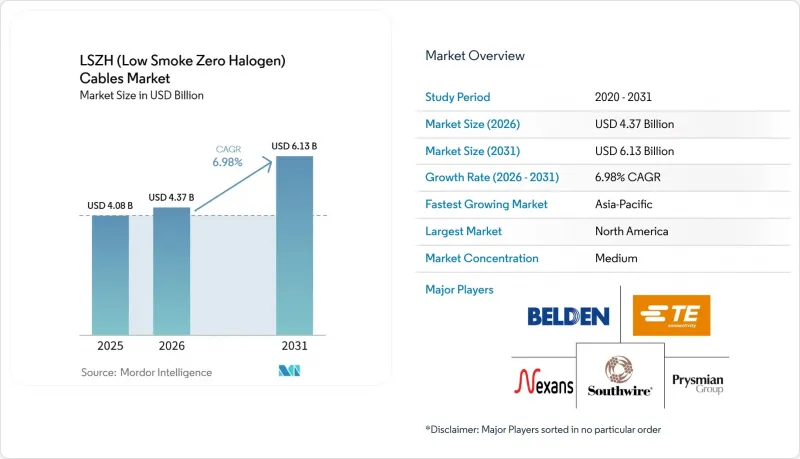
This report is Segmented by Cable Type (Power, Control and Instrumentation, Data and Communication, Fiber Optic, Building Wires, and More), Voltage Rating (Less Than 1 KV, 1-35 KV, and More), Insulation Material (PVC, XLPE, PE, and More), End User (Commercial Buildings, Data Centers, Renewable Energy, and More), and Geography. The Market Forecasts are Provided in Terms of Value (USD).
Global Low Smoke Zero Halogen (LSZH) Cables Market Trends and Insights
Stringent Fire Safety and Building Code Compliance
France required Low Smoke Zero Halogen (LSZH) cables market at minimum CPR class Cca-s2,d2,a2 for public-access buildings and high-rise structures, with enforcement starting on 23 May 2025, which made halogenated PVC far harder to specify in these settings. That change also raised project costs in France because LSZH products carried a 15% to 30% premium in the commercial construction channel. China added another compliance trigger when 3C certification for flame-retardant cables became mandatory from 1 July 2025, which increased substitution pressure in a very large domestic market. The June 2025 edition of IEC 60332-1-2 also tightened flame-propagation testing, raising the minimum performance bar for enclosed installations in the LSZH cables market. Public building, transit, and high-occupancy rules in several regions are narrowing the cases in which buyers can still accept PVC without incurring additional compliance risk. Each regulatory revision also creates follow-on replacement demand because older installations that once passed provisional approval often need certified halogen-free replacements during upgrades.
Hyperscale Data Center Buildouts
Data center projects are driving demand for Low Smoke Zero Halogen cable because plenum spaces, raised floors, and dense cable routes all require stronger smoke control and cleaner fire performance than older cable systems. AI-focused server rooms are also changing cable demand because much denser fiber layouts are required than in earlier compute environments, increasing cabling intensity within each facility. CommScope's March 2026 Rapid Fiber Connect launch directly targeted super-high-density AI sites with pre-terminated LSZH connectivity, reducing on-site installation time and deployment errors. The June 2026 FastSelfClean connector introduction points to the same buying pattern, where operators want dense fiber systems that are quicker to install and easier to keep reliable at scale. These product moves show that buyers are valuing deployment speed, uptime, and cable management efficiency alongside material compliance in the Low Smoke Zero Halogen cables market. That keeps data center demand structural rather than short-lived because expansions now come from both new halls and retrofits within existing campuses.
Premium Pricing Versus Conventional PVC Cables
LSZH cables are expected to carry a 15% to 30% premium over comparable PVC products in France's commercial construction channel by mid-2025, and similar price gaps are expected to continue hindering adoption in markets where halogen-free use remains discretionary. This cost burden is most pronounced in South America, Africa, and parts of the emerging Asia-Pacific, where project budgets are tighter, and code enforcement is less consistent. Smaller contractors in these markets often continue to use PVC for non-critical circuits, as they cannot secure the same discounts as large engineering and procurement groups. This trend slows conversion in the segments that could contribute the largest new volumes to the Low Smoke Zero Halogen (LSZH) cables market over time. The restraint is expected to ease gradually as more jurisdictions shift from optional to mandatory use, reducing the scope for lower-cost substitution.
Other drivers and restraints analyzed in the detailed report include:
- Electrification of Transportation and Critical Infrastructure
- Renewable Power Grid Expansion and Battery Storage Integration
- Volatility In Halogen-Free Compounding Inputs
For complete list of drivers and restraints, kindly check the Table Of Contents.
Segment Analysis
Data and communication cables are expected to hold the largest share by cable type in 2025, at 23.45%, giving this category the clearest lead in the Low Smoke Zero Halogen cables market share within the cable type mix. Structured cabling upgrades in offices, hyperscale server halls, and indoor 5G installations drive this position, as these applications require stronger smoke performance in enclosed spaces. The category also benefits from faster design acceptance because consultants and installers already understand the fire safety requirements for these applications. As a result, communication-heavy projects convert specifications into procurement more smoothly than some industrial and utility applications in the Low Smoke Zero Halogen (LSZH) cables market. Fiber optic cables are projected to record the fastest CAGR, at 7.13%, through 2031, as AI-oriented facilities shift toward 400G and 800G optical links with denser fiber layouts.
LSZH power cables continue to represent a large installed base because commercial buildings, industrial sites, and data facilities require compliant distribution paths alongside communication links. Control and instrumentation cables support automation, process control, and smart systems where smoke reduction matters for workers and sensitive equipment. Building wires keep the segment closely tied to occupied structures, while specialty products serve wind nacelles, marine routes, and harsher industrial settings where standard constructions are insufficient. In the low smoke zero halogen (LSZH) cables industry, this mix positions communication products as the volume anchor, while specialty cables add premium value and keep the segment broad.
Low-voltage cables rated below 1 kV are expected to account for 31.11% of the LSZH cable market in 2025, confirming that building wiring, structured cabling, and control circuits remain the largest-volume foundations. This part of the market remains linked to commercial buildings, public infrastructure, telecom rooms, and other enclosed sites where smoke control rules are more difficult to avoid. The scale of low-voltage demand also explains why suppliers continue to defend this category with local manufacturing and broad distributor coverage. The 1-35 kV segment is projected to expand at a CAGR of 6.54% through 2031, as solar parks, urban distribution upgrades, and storage-related connections increasingly require halogen-free primary cables. Updated testing rules are reinforcing this shift by prompting stakeholders to evaluate fire performance more closely across a wider range of installations.
The 36-65 kV range serves airports, large campuses, industrial estates, and urban substations, where both electrical performance and public safety matter. The above-65 kV category remains a smaller niche, but it is relevant in underground transmission and offshore energy links, where operators closely monitor outer-sheath performance. IEC 60502 product standards and the updated IEC 60332-1-2 fire test framework are gradually raising the acceptance threshold across these voltage classes. This combination is pushing the LSZH cables market toward a more infrastructure-heavy demand mix, even as low-voltage applications remain the largest volume source.
Complete Report Scope:
- By Cable Type
- LSZH Power Cables
- LSZH Control and Instrumentation Cables
- LSZH Data and Communication Cables
- LSZH Fiber Optic Cables
- LSZH Building Wires
- Specialty LSZH Cables
- By Voltage Rating
- Less Than 1 kV
- 1 - 35 kV
- 36 - 65 kV
- above 65KV
- By Insulation Material
- PVC (Polyvinyl Chloride)
- XLPE (Cross-linked Polyethylene)
- PE (Polyethylene)
- Other Insulation Materials
- By End User
- Commercial Buildings
- Industrial Manufacturing
- Data Centers
- Energy and Utilities
- Transportation Infrastructure
- Telecommunications
- Renewable Energy
- Others End User Industries
- By Geography
- North America
- South America
- Europe
- Asia-Pacific
- Middle East and Africa
Geography Analysis
North America is expected to account for 27.65% of the Low Smoke Zero Halogen (LSZH) cables market demand in 2025, making it the largest LSZH cable market by geography. This position reflects the region's high concentration of commercial buildings, transit systems, and data centers, where smoke-control standards limit the use of conventional PVC alternatives. Nexans is expected to complete the acquisition of Republic Wire in June 2026, establishing a strategic manufacturing and distribution platform in the United States to meet residential, commercial, and data center demand. South America remains a smaller market. However, urban infrastructure projects and renewable energy installations in countries such as Brazil and Colombia are gradually expanding the regional market for LSZH cables.
Europe remains the most regulation-led region in the LSZH cables market, as building safety rules are more mature and more directly enforced. France's update requiring CPR Cca-s2,d2,a2 LSZH cables in public-access buildings and high-rise structures from May 2025 is expected to influence product selection in renovation and new-build projects. The Middle East is following a similar path, with large project pipelines that increasingly reflect European fire safety expectations in new urban developments. Africa remains at an earlier stage of adoption, with demand concentrated in larger commercial buildings, mining sites, and telecom infrastructure rather than across the full building stock.
Asia-Pacific is projected to record the fastest regional CAGR of 7.17% through 2031, making it the primary growth engine for the LSZH cables market. China's LSZH cable material market exceeded CNY 18.5 billion, or USD 2.56 billion, in 2024 and is expected to exceed CNY 28 billion by 2030. LSZH cables are expected to account for more than 70% of Chinese rail transit, 5G infrastructure, and new energy procurement by 2025. Singapore's public building and transport specifications continue to influence procurement practices across Southeast Asia, especially in hospitals, government facilities, and metro systems. India, Japan, South Korea, and Southeast Asian countries are also adding demand through grid upgrades, stricter domestic safety codes, and export-oriented manufacturing requirements.
- Prysmian Group
- Nexans
- Southwire Company LLC
- Belden Inc.
- CommScope Holding Company Inc.
- Encore Wire Corporation
- Atkore Inc.
- TE Connectivity Ltd.
- Alpha Wire (LAPP)
- Superior Essex Inc.
- Leviton Manufacturing Co., Inc.
- HELUKABEL USA
- SAB North America
- Eland Cables
- RSCC Wire & Cable LLC
- Cerrowire (Marmon)
- Carlisle Interconnect Technologies
Additional Benefits:
- The market estimate (ME) sheet in Excel format
- 3 months of analyst support
TABLE OF CONTENTS
1 INTRODUCTION
- 1.1 Study Assumptions and Market Definition
- 1.2 Scope of the Study
2 RESEARCH METHODOLOGY
3 EXECUTIVE SUMMARY
4 MARKET LANDSCAPE
- 4.1 Market Overview
- 4.2 Market Drivers
- 4.2.1 Stringent Fire Safety and Building Code Compliance
- 4.2.2 Hyperscale Data Center Buildouts
- 4.2.3 Electrification of Transportation and Critical Infrastructure
- 4.2.4 Renewable Power Grid Expansion and Battery Storage Integration
- 4.2.5 Sustainability Requirements in Cable Material Selection
- 4.2.6 Industrial Automation, Smart Factory, and High-Density Cabling Demand
- 4.3 Market Restraints
- 4.3.1 Premium Pricing Versus Conventional PVC Cables
- 4.3.2 Volatility in Halogen-Free Compounding Inputs
- 4.3.3 Qualification, Testing, and Certification Complexity
- 4.3.4 Retrofit Replacement Cycles in Installed Base Infrastructure
- 4.4 Industry Value Chain Analysis
- 4.5 Porter's Five Forces Analysis
- 4.5.1 Threat of New Entrants
- 4.5.2 Bargaining Power of Suppliers
- 4.5.3 Bargaining Power of Buyers
- 4.5.4 Threat of Substitutes
- 4.5.5 Rivalry Among Existing Competitors
5 MARKET SIZE AND GROWTH FORECASTS (VALUE)
- 5.1 By Cable Type
- 5.1.1 LSZH Power Cables
- 5.1.2 LSZH Control and Instrumentation Cables
- 5.1.3 LSZH Data and Communication Cables
- 5.1.4 LSZH Fiber Optic Cables
- 5.1.5 LSZH Building Wires
- 5.1.6 Specialty LSZH Cables
- 5.2 By Voltage Rating
- 5.2.1 Less Than 1 kV
- 5.2.2 1 - 35 kV
- 5.2.3 36 - 65 kV
- 5.2.4 above 65KV
- 5.3 By Insulation Material
- 5.3.1 PVC (Polyvinyl Chloride)
- 5.3.2 XLPE (Cross-linked Polyethylene)
- 5.3.3 PE (Polyethylene)
- 5.3.4 Other Insulation Materials
- 5.4 By End User
- 5.4.1 Commercial Buildings
- 5.4.2 Industrial Manufacturing
- 5.4.3 Data Centers
- 5.4.4 Energy and Utilities
- 5.4.5 Transportation Infrastructure
- 5.4.6 Telecommunications
- 5.4.7 Renewable Energy
- 5.4.8 Others End User Industries
- 5.5 By Geography
- 5.5.1 North America
- 5.5.2 South America
- 5.5.3 Europe
- 5.5.4 Asia-Pacific
- 5.5.5 Middle East and Africa
6 COMPETITIVE LANDSCAPE
- 6.1 Market Concentration
- 6.2 Strategic Moves
- 6.3 Market Share Analysis
- 6.4 Company Profiles (includes Global Level Overview, Market Level Overview, Core Segments, Financials as available, Strategic Information, Market Rank/Share, Products and Services, Recent Developments)
- 6.4.1 Prysmian Group
- 6.4.2 Nexans
- 6.4.3 Southwire Company LLC
- 6.4.4 Belden Inc.
- 6.4.5 CommScope Holding Company Inc.
- 6.4.6 Encore Wire Corporation
- 6.4.7 Atkore Inc.
- 6.4.8 TE Connectivity Ltd.
- 6.4.9 Alpha Wire (LAPP)
- 6.4.10 Superior Essex Inc.
- 6.4.11 Leviton Manufacturing Co., Inc.
- 6.4.12 HELUKABEL USA
- 6.4.13 SAB North America
- 6.4.14 Eland Cables
- 6.4.15 RSCC Wire & Cable LLC
- 6.4.16 Cerrowire (Marmon)
- 6.4.17 Carlisle Interconnect Technologies
7 MARKET OPPORTUNITIES AND FUTURE OUTLOOK
- 7.1 White-Space and Unmet-Need Assessment

