PUBLISHER: Mordor Intelligence | PRODUCT CODE: 2117984

PUBLISHER: Mordor Intelligence | PRODUCT CODE: 2117984
East Africa Forage Seed - Market Share Analysis, Industry Trends & Statistics, Growth Forecasts (2026 - 2031)
According to Mordor Intelligence, the East Africa forage seed market size is projected to increase from USD 1.08 billion in 2025 to USD 1.15 billion in 2026 and reach USD 1.57 billion by 2031, growing at a CAGR of 6.42% over 2026-2031.
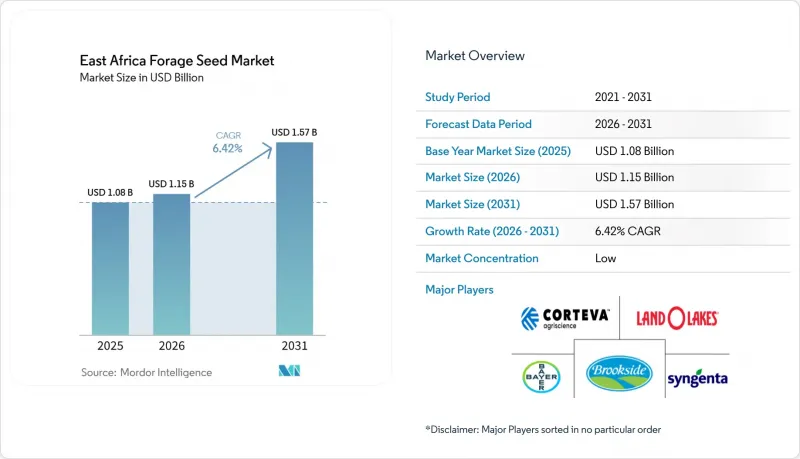
This report is Segmented by Breeding Technology (Hybrids and Open Pollinated Varieties and Hybrid Derivatives), by Crop Type (Alfalfa, Forage Corn, Forage Sorghum, and Other Forage Crops), and by Geography (Kenya, Ethiopia, Tanzania, Uganda, and the Rest of East Africa). The Market Forecasts are Provided in Terms of Value (USD) and Volume (Metric Tons).
East Africa Forage Seed Market Trends and Insights
Rising Dairy Feed Deficit in Kenya and Ethiopia
The East Africa forage seed market continues to grow because livestock systems still face a major structural feed shortage. According to the International Livestock Research Institute (ILRI) (2024), the regional annual feed demand reaches 353 million metric tons of dry matter, while current supply covers only 60% of this demand. In Ethiopia, cultivated forage deficit exceeds 8.8 million metric tons of dry matter each year, and the forage seed system remains weak, with nearly 70% of seeds still moving through informal channels. This gap keeps forage demand tied to a real operating need rather than discretionary spending, which gives the East Africa forage seed market a durable base. The same shortage also raises the value of varieties that can deliver more biomass and more stable feed output from limited land.
Expansion of Climate-Resilient Forage Seed Systems
Climate variability is pushing farmers and seed suppliers to favor varieties that can withstand moisture stress, land pressure, and less-predictable growing conditions. The East Africa forage seed market is responding through greater interest in improved grasses and legumes that fit mixed farming systems and can perform more reliably under field stress. Research on improved forages in Uganda and broader Sub-Saharan Africa also shows that feed security and livestock productivity improve when resilient forage options are matched with the right extension and market support. This means the East Africa forage seed market is expanding not only through more seed sales but also through a gradual shift toward species and formats that reduce production risk. Over time, that improves adoption consistency and helps suppliers justify local multiplication and distribution investments.
High Seed and Establishment Costs for Improved Forages
High seed cost remains one of the clearest barriers to faster adoption. In Kenya, Urochloa seed prices were reported at USD 40 to USD 50 per kg, compared with USD 15 to USD 30 per kg in South American supplier markets, which shows how limited local multiplication still raises costs in the East Africa forage seed market. The same pressure is visible in farmer behavior, since willingness to pay for improved forage varieties in Meru County remained below market prices for most products. Seed production costs also rose sharply in Kenya, with land cost for seed production plots moving from KES 4,000 (USD 26) to KES 20,000 (USD 130) per acre before the March 2025 planting season. This cost burden slows adoption most in smallholder systems, where the agronomic case for improved forage may be strong, but the upfront cash requirement remains difficult to absorb.
Other drivers and restraints analyzed in the detailed report include:
- Commercial Silage and Fodder Contracting Models
- Public and Donor De-Risking of Early Market Development
- Fragmented Seed Quality Assurance and Variety Registration
For complete list of drivers and restraints, kindly check the Table Of Contents.
Segment Analysis
Hybrids held the largest country segment, with a 46% share of the East Africa forage seed market in 2025. Their lead came from strong use in commercial maize silage systems and from the established distribution presence of large seed suppliers in Kenya and Ethiopia. Hybrids also meet the needs of dairy farms and commercial silage operators seeking higher biomass output, better disease tolerance, and more predictable field performance. In the East Africa forage industry, these traits matter because feed costs are judged against livestock output, not only seed price. That keeps hybrids well-positioned in higher-value dairy corridors, where consistent yield matters more than seed recycling.
Open Pollinated Varieties and Hybrid Derivatives are the fastest segment with a 7.6% CAGR from 2026 to 2031. Their growth is tied to lower unit cost, easier multiplication, and a better fit with smallholder systems that still dominate regional livestock production. In 2024, a Consultative Group on International Agricultural Research (CGIAR) publication found that Urochloa and Megathyrsus maximus are among the most widely traded improved forage varieties in Kenya and are projected to remain important over the next decade. The East Africa forage seed market is therefore developing along 2 lines at once, with hybrids anchoring commercial volume and open-pollinated options expanding reach. That balance matters because broad adoption in the East Africa forage seed market will depend on both premium yield segments and affordable seed formats that can move through local multiplication systems.
Complete Report Scope:
- Breeding Technology
- Hybrids
- Non-Transgenic Hybrids
- Transgenic Hybrids
- Herbicide Tolerant Hybrids
- Other Traits
- Open Pollinated Varieties and Hybrid Derivatives
- Hybrids
- Crop Type
- Alfalfa
- Forage Corn
- Forage Sorghum
- Other Forage Crops
- By Country
- Kenya
- Ethiopia
- Tanzania
- Uganda
- Rest of East Africa
List of Companies Covered in this Report:
- Advanta Seeds (UPL Ltd.)
- Bayer AG
- Land O'Lakes Inc.
- East African Seed Company Limited
- Groupe Limagrain
- Seed Co International Limited
- Brookside Dairy Limited (Brookside Holdings)
- Gatiko Company Ltd (Gatiko Company Ltd)
- Corteva Inc.
- Syngenta Limited
- Kenya Nut Company Limited
- New Kenya Co-operative Creameries Limited
- Balton CP Limited
- Shayashone PLC
Additional Benefits:
- The market estimate (ME) sheet in Excel format
- 3 months of analyst support
TABLE OF CONTENTS
1 INTRODUCTION
- 1.1 Study Assumptions and Market Definition
- 1.2 Scope of the Study
- 1.3 Research Methodology
2 REPORT OFFERS
3 EXECUTIVE SUMMARY AND KEY FINDINGS
4 KEY INDUSTRY TRENDS
- 4.1 Area Under Cultivation
- 4.1.1 Row Crops
- 4.2 Most Popular Traits
- 4.2.1 Alfalfa
- 4.3 Breeding Techniques
- 4.3.1 Row Crops
- 4.4 Regulatory Framework
- 4.5 Value Chain And Distribution Channel Analysis
- 4.6 Market Drivers
- 4.6.1 Rising dairy feed deficit in Kenya and Ethiopia
- 4.6.2 Expansion of climate-resilient forage seed systems
- 4.6.3 Commercial silage and fodder contracting models
- 4.6.4 Public and donor de-risking of early market development
- 4.6.5 Premiumization of certified forage for dairy and feed mills
- 4.6.6 Cross-border fodder trade from surplus highland zones
- 4.7 Market Restraints
- 4.7.1 High seed and establishment costs for improved forages
- 4.7.2 Fragmented seed quality assurance and variety registration
- 4.7.3 Land and water constraints in high-potential dairy corridors
- 4.7.4 Dry-season logistics losses and weak cold or covered storage
5 MARKET SIZE AND GROWTH FORECAST (VALUE AND VOLUME)
- 5.1 Breeding Technology
- 5.1.1 Hybrids
- 5.1.1.1 Non-Transgenic Hybrids
- 5.1.1.2 Transgenic Hybrids
- 5.1.1.2.1 Herbicide Tolerant Hybrids
- 5.1.1.3 Other Traits
- 5.1.2 Open Pollinated Varieties and Hybrid Derivatives
- 5.1.1 Hybrids
- 5.2 Crop Type
- 5.2.1 Alfalfa
- 5.2.2 Forage Corn
- 5.2.3 Forage Sorghum
- 5.2.4 Other Forage Crops
- 5.3 By Country
- 5.3.1 Kenya
- 5.3.2 Ethiopia
- 5.3.3 Tanzania
- 5.3.4 Uganda
- 5.3.5 Rest of East Africa
6 COMPETITIVE LANDSCAPE
- 6.1 Key Strategic Moves
- 6.2 Market Share Analysis
- 6.3 Company Landscape
- 6.4 Company Profiles (Includes Global Level Overview, Market Level Overview, Core Business Segments, Financials, Key Information, Market Rank, Market Share, Products and Services, and Analysis of Recent Developments).
- 6.4.1 Advanta Seeds (UPL Ltd.)
- 6.4.2 Bayer AG
- 6.4.3 Land O'Lakes Inc.
- 6.4.4 East African Seed Company Limited
- 6.4.5 Groupe Limagrain
- 6.4.6 Seed Co International Limited
- 6.4.7 Brookside Dairy Limited (Brookside Holdings)
- 6.4.8 Gatiko Company Ltd (Gatiko Company Ltd)
- 6.4.9 Corteva Inc.
- 6.4.10 Syngenta Limited
- 6.4.11 Kenya Nut Company Limited
- 6.4.12 New Kenya Co-operative Creameries Limited
- 6.4.13 Balton CP Limited
- 6.4.14 Shayashone PLC
7 KEY STRATEGIC QUESTIONS FOR CEOS

