PUBLISHER: Mordor Intelligence | PRODUCT CODE: 2118003

PUBLISHER: Mordor Intelligence | PRODUCT CODE: 2118003
Parcel Management and Multi-Carrier Shipping Software - Market Share Analysis, Industry Trends & Statistics, Growth Forecasts (2026 - 2031)
According to Mordor Intelligence, the parcel management and multi-carrier shipping software market size is projected to expand from USD 2.63 billion in 2025 and USD 2.93 billion in 2026 to USD 4.98 billion by 2031, registering a CAGR of 11.16% between 2026 to 2031.
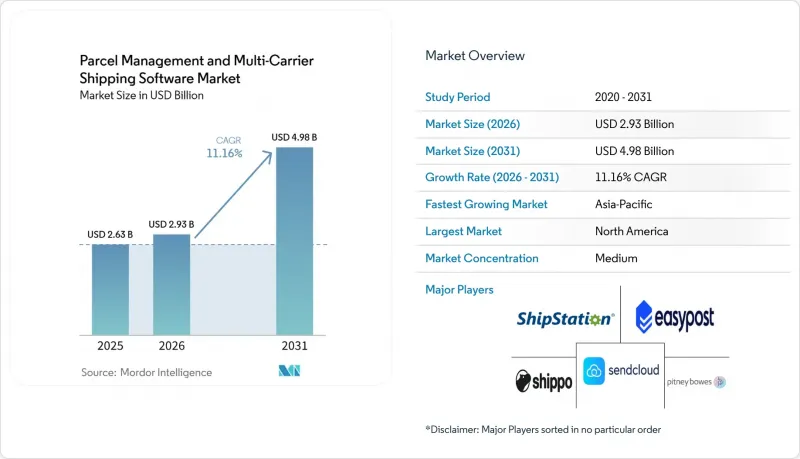
This report is Segmented by Component (Software, and Services), Deployment Mode (Cloud-Based, On-Premises, and Hybrid), End-User Enterprise Size (Small and Medium-Sized Enterprises, and Large Enterprises), End-User Industry (Retail and E-Commerce, Logistics and Transportation, and More), and Geography. The Market Forecasts are Provided in Terms of Value (USD).
Global Parcel Management and Multi-Carrier Shipping Software Market Trends and Insights
E-Commerce Parcel-Volume Expansion
E-commerce order growth is increasing parcel volumes and adding more delivery decisions to the shipping process. The parcel management and multi-carrier shipping software market benefits when merchants need to compare carrier options across size, weight, delivery speed, and destination. Germany illustrates this pattern, as Asian marketplace platforms such as Temu and Shein grew 27% faster than the overall German market in 2025, generating EUR 3.7 billion (USD 4.1 billion). These flows increase diversity in shipment origins and place added demands on carrier networks. A business that ships at a meaningful scale may need to choose among 3 to 30 carriers for an individual shipment. The resulting need for consistent carrier selection is strengthening demand for platforms that bring rate, service, and routing decisions into a single operating environment, particularly when a merchant must manage carrier contracts and delivery commitments across a diverse customer base.
AI-Enabled Rate Shopping and Carrier Routing
Machine learning is changing career selection from a simple rate comparison to a broader decision about delivery and performance. Shipium's Rating Engine uses data from more than 350 million shipments to consider both cost and delivery speed, while accounting for carrier performance. EasyPost's Luma AI Select evaluates shipments against carrier performance data by region and service category, and EasyPost processes more than 1 billion API calls annually. These capabilities enable placing greater weight on the probability of on-time delivery rather than the published rate alone. This can help shippers reduce customer contact and returns stemming from poor delivery experiences. C.H. Robinson launched Lean AI Engineer in June 2026, and the system autonomously handled 92% of its 4PL shipments globally from order creation through delivery and carrier payment. The parcel management and multi-carrier shipping software market is likely to face higher buyer expectations as larger shippers make AI-supported routing part of their standard logistics processes, enabling buyers to compare platforms on both service outcomes and shipping-cost control.
Legacy-System Integration Complexity
Legacy systems remain a practical barrier when a company tries to connect modern shipping software with established ERP, warehouse management, and order management environments. These environments can rely on batch processing, older programming languages, and database-level business rules that do not readily support real-time carrier requests or label generation. Each new connection can increase the effort required to maintain data and process consistency across the shipping workflow. For mid-market organizations, this requirement can preserve a single-carrier relationship because the middleware work for additional carriers competes with other technology priorities. The parcel management and multi-carrier shipping software market must therefore provide implementation support and integration tools that reduce disruption to existing operations. Companies that could realize the greatest value from broader carrier options may still delay adoption when the integration project requires scarce technology resources, leaving providers with a need to make deployment less disruptive to operations and internal teams.
Other drivers and restraints analyzed in the detailed report include:
- Cloud and SaaS Adoption by SMEs
- Cross-Border Customs and Documentation Digitization
- Cybersecurity and Data-Privacy Exposure
For complete list of drivers and restraints, kindly check the Table Of Contents.
Segment Analysis
Software held 72.06% of the parcel management and multi-carrier shipping software market share in 2025, which reflects the importance of recurring platform subscriptions in this field. The software layer is often the primary contractual link between a shipper and its carrier management provider. nShift Ship connects more than 1,000 carriers and more than 450 ERP, warehouse management, and e-commerce integrations. Once a platform is built into the warehouse and order processes, changing providers can involve substantial operational work. This gives established software platforms a durable role in enterprise customer relationships and makes the underlying operating workflow central to those relationships.
Services are projected to grow at a CAGR of 11.61% through 2031, supported by demand for implementation, integration, and managed logistics support. Service work becomes more important when a customer needs to bridge legacy systems or coordinate several carrier relationships. Managed-service contracts can also include carrier negotiation, compliance monitoring, and carrier onboarding. The June 2026 combination of WWEX Group and Auctane brought together freight brokerage across parcel, LTL, truckload, and global shipping with shipping software capabilities. The transaction reflects the value of combining software subscriptions with services that can broaden customer relationships and make them harder to replace, particularly when customers use one provider across multiple shipping needs. This positioning gives the parcel management and multi-carrier shipping software market a service-led route to address complex deployment requirements.
Cloud deployment held 64.89% of revenue in 2025 and is projected to grow at a CAGR of 12.33% through 2031. Cloud systems can quickly update carrier rates, support real-time AI functions, and connect more directly with e-commerce platforms. These features reduce the manual technology work that can slow changes in an on-premises setting. In 2026, Metapack stated that 90% of global retailers planned to increase AI investment for operational optimization. The continuing shift toward cloud delivery supports the wider use of carrier data and automated decision tools across shipping operations, while enabling product updates to reach users without the same level of local technology effort and keeping the parcel management and multi-carrier shipping software market aligned with retailers that want new operational functions without a full infrastructure refresh.
On-premises systems remain relevant for defense, pharmaceuticals, and financial services, where data sovereignty requirements can limit the use of shared infrastructure. Some organizations need to retain tighter control over shipping records because of regulatory or internal audit requirements. Hybrid deployment combines cloud-based rate shopping and label generation with on-premises data storage. This structure gives large enterprises access to cloud functions while keeping selected data within their own environments. The approach is especially relevant in Europe, where vendor security assessment requirements raise attention to how logistics data is stored and managed, and where businesses need to balance operating speed with internal control, while giving the parcel management and multi-carrier shipping software market a practical option for organizations that cannot move all operational records to a shared environment.
Complete Report Scope:
- By Component
- Software
- Services
- By Deployment Mode
- Cloud-Based
- On-Premises
- Hybrid
- By End Use Enterprise Size
- Small and Medium-Sized Enterprises
- Large Enterprises
- By End-User Industry
- Retail and E-Commerce
- Logistics and Transportation
- Industrial Manufacturing
- Healthcare and Life Sciences
- Consumer Packaged Goods
- Other End-User Industries
- By Geography
- North America
- United States
- Canada
- Mexico
- South America
- Brazil
- Argentina
- Rest of South America
- Europe
- Germany
- United Kingdom
- France
- Italy
- Russia
- Rest of Europe
- Asia-Pacific
- China
- India
- Japan
- South Korea
- Australia
- Rest of Asia-Pacific
- Middle East
- United Arab Emirates
- Saudi Arabia
- Turkey
- Rest of Middle East
- Africa
- South Africa
- Egypt
- Nigeria
- Rest of Africa
- North America
Geography Analysis
North America accounted for 39.12% of global revenue in 2025, the largest regional share in the parcel management and multi-carrier shipping software market. The United States has a complex carrier landscape that includes UPS, FedEx, USPS, DHL, and many regional last-mile providers, creating a broad set of options for the parcel management and multi-carrier shipping software market. This mix results in frequent carrier-selection decisions for each shipment, including decisions that must account for service availability, pricing, delivery expectations, and the terms of individual carrier contracts. Amazon Freight extended its Less-Than-Truckload service to eligible United States shippers in June 2026, which added to the technology connections needed across the domestic logistics environment. Canada and Mexico also support regional demand through cross-border manufacturing and retail trade under the USMCA framework.
Europe has a different operating pattern because carrier networks are fragmented by country. DPD, GLS, DHL Parcel, Evri, PostNL, and many domestic providers use different API standards. Germany's KEP sector generated EUR 28.4 billion (USD 31.2 billion) in revenue in 2025, and grew 2.6% year over year, while B2C growth was 0.6%. This setting requires country-specific integration work and makes local carrier knowledge important. nShift, Sendcloud, and Metapack have developed carrier portfolios suited to this fragmented last-mile environment, while documentation changes are encouraging European retailers and logistics providers to review older platform capabilities.
Asia-Pacific is projected to grow at a CAGR of 13.38% through 2031, making it the fastest-growing regional area. Chinese manufacturers are expanding routes into Southeast Asia, Africa, and the Middle East, increasing the need for cross-border shipment coordination. India, Japan, and South Korea also offer growth opportunities through direct-to-consumer e-commerce and retailer-led digitization of last-mile operations. South America, the Middle East, and Africa remain smaller in absolute terms, but Brazil's maturing e-commerce activity and public logistics investments in the UAE and Saudi Arabia are supporting incremental software procurement.
- ShipStation Global
- EasyPost, Inc.
- Shippo, Inc.
- Sendcloud B.V.
- nShift Group AB
- ShipHawk, Inc.
- Scurri Web Services Limited
- Sorted Group Limited
- ShippyPro S.r.l.
- Shippit Pty Ltd
- Starshipit Limited
- Shipmondo ApS
- Easyship Global Pte. Ltd.
- V-Technologies, LLC
- ProShip, Inc.
- Pierbridge, Inc.
- Logistyx Technologies
- Metapack Limited
- ShipWorks, LLC
- FreightPOP, Inc.
- The Descartes Systems Group Inc.
- ShipperHQ
- Shipium Corp.
- Ehrhardt + Partner Group GmbH & Co. KG
Additional Benefits:
- The market estimate (ME) sheet in Excel format
- 3 months of analyst support
TABLE OF CONTENTS
1 INTRODUCTION
- 1.1 Study Assumptions and Market Definition
- 1.2 Scope of the Study
2 RESEARCH METHODOLOGY
3 EXECUTIVE SUMMARY
4 MARKET LANDSCAPE
- 4.1 Market Overview
- 4.2 Market Drivers
- 4.2.1 E-Commerce Parcel-Volume Expansion
- 4.2.2 Cloud and SaaS Adoption by SMEs
- 4.2.3 AI-Enabled Rate Shopping and Carrier Routing
- 4.2.4 Cross-Border Customs and Documentation Digitization
- 4.2.5 Carrier-API Abstraction for Regional Network Resilience
- 4.2.6 Parcel Data Exhaust Monetization
- 4.3 Market Restraints
- 4.3.1 Legacy-System Integration Complexity
- 4.3.2 Cybersecurity and Data-Privacy Exposure
- 4.3.3 Carrier API Throttling and Commercial Access Restrictions
- 4.3.4 Marketplace-Controlled Shipping Stack Disintermediation
- 4.4 Impact of Macroeconomic Factors on the Market
- 4.5 Industry Value Chain Analysis
- 4.6 Regulatory Landscape
- 4.7 Technological Outlook
- 4.8 Porter's Five Forces Analysis
- 4.8.1 Bargaining Power of Suppliers
- 4.8.2 Bargaining Power of Buyers
- 4.8.3 Threat of New Entrants
- 4.8.4 Threat of Substitutes
- 4.8.5 Intensity of Competitive Rivalry
- 4.9 Functional Capability and Application Assessment
- 4.9.1 Carrier Rate Shopping and Selection
- 4.9.2 Label Generation and Manifesting
- 4.9.3 Shipment Tracking and Delivery Visibility
- 4.9.4 Returns and Reverse Logistics
- 4.9.5 Address Validation and Shipping Compliance
- 4.9.6 Analytics, Billing and Claims Management
5 MARKET SIZE AND GROWTH FORECASTS (VALUE)
- 5.1 By Component
- 5.1.1 Software
- 5.1.2 Services
- 5.2 By Deployment Mode
- 5.2.1 Cloud-Based
- 5.2.2 On-Premises
- 5.2.3 Hybrid
- 5.3 By End Use Enterprise Size
- 5.3.1 Small and Medium-Sized Enterprises
- 5.3.2 Large Enterprises
- 5.4 By End-User Industry
- 5.4.1 Retail and E-Commerce
- 5.4.2 Logistics and Transportation
- 5.4.3 Industrial Manufacturing
- 5.4.4 Healthcare and Life Sciences
- 5.4.5 Consumer Packaged Goods
- 5.4.6 Other End-User Industries
- 5.5 By Geography
- 5.5.1 North America
- 5.5.1.1 United States
- 5.5.1.2 Canada
- 5.5.1.3 Mexico
- 5.5.2 South America
- 5.5.2.1 Brazil
- 5.5.2.2 Argentina
- 5.5.2.3 Rest of South America
- 5.5.3 Europe
- 5.5.3.1 Germany
- 5.5.3.2 United Kingdom
- 5.5.3.3 France
- 5.5.3.4 Italy
- 5.5.3.5 Russia
- 5.5.3.6 Rest of Europe
- 5.5.4 Asia-Pacific
- 5.5.4.1 China
- 5.5.4.2 India
- 5.5.4.3 Japan
- 5.5.4.4 South Korea
- 5.5.4.5 Australia
- 5.5.4.6 Rest of Asia-Pacific
- 5.5.5 Middle East
- 5.5.5.1 United Arab Emirates
- 5.5.5.2 Saudi Arabia
- 5.5.5.3 Turkey
- 5.5.5.4 Rest of Middle East
- 5.5.6 Africa
- 5.5.6.1 South Africa
- 5.5.6.2 Egypt
- 5.5.6.3 Nigeria
- 5.5.6.4 Rest of Africa
- 5.5.1 North America
6 COMPETITIVE LANDSCAPE
- 6.1 Market Concentration
- 6.2 Strategic Moves
- 6.3 Market Share Analysis
- 6.4 Company Profiles (includes Global Level Overview, Market Level Overview, Core Segments, Financials as available, Strategic Information, Market Rank/Share, Products and Services, Recent Developments)
- 6.4.1 ShipStation Global
- 6.4.2 EasyPost, Inc.
- 6.4.3 Shippo, Inc.
- 6.4.4 Sendcloud B.V.
- 6.4.5 nShift Group AB
- 6.4.6 ShipHawk, Inc.
- 6.4.7 Scurri Web Services Limited
- 6.4.8 Sorted Group Limited
- 6.4.9 ShippyPro S.r.l.
- 6.4.10 Shippit Pty Ltd
- 6.4.11 Starshipit Limited
- 6.4.12 Shipmondo ApS
- 6.4.13 Easyship Global Pte. Ltd.
- 6.4.14 V-Technologies, LLC
- 6.4.15 ProShip, Inc.
- 6.4.16 Pierbridge, Inc.
- 6.4.17 Logistyx Technologies
- 6.4.18 Metapack Limited
- 6.4.19 ShipWorks, LLC
- 6.4.20 FreightPOP, Inc.
- 6.4.21 The Descartes Systems Group Inc.
- 6.4.22 ShipperHQ
- 6.4.23 Shipium Corp.
- 6.4.24 Ehrhardt + Partner Group GmbH & Co. KG
7 MARKET OPPORTUNITIES AND FUTURE OUTLOOK
- 7.1 White-Space and Unmet-Need Assessment

