PUBLISHER: Mordor Intelligence | PRODUCT CODE: 2118011

PUBLISHER: Mordor Intelligence | PRODUCT CODE: 2118011
Bagel - Market Share Analysis, Industry Trends & Statistics, Growth Forecasts (2026 - 2031)
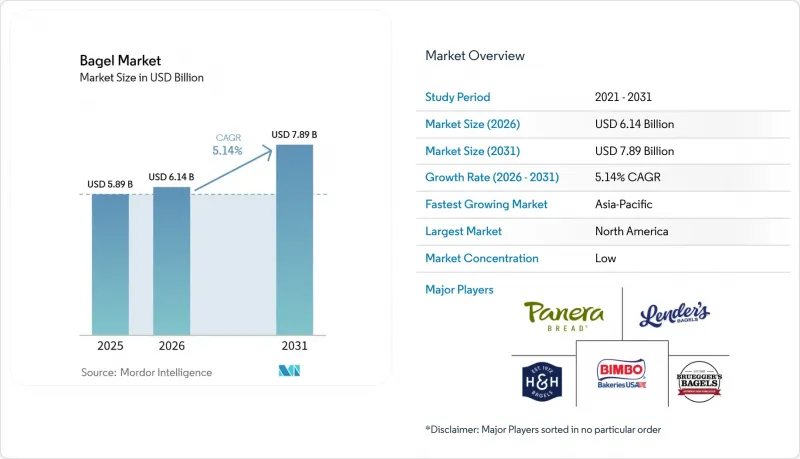
According to Mordor Intelligence, the bagel market size is expected to grow from USD 5.89 billion in 2025 to USD 6.14 billion in 2026 and is forecast to reach USD 7.89 billion by 2031 at 5.14% CAGR over 2026-2031.
This report is Segmented by Product Type (Plain, Flavored, Whole Grain, and Other Types), Form (Fresh and Frozen), Distribution Channel (Retail and Foodservice), and Geography (North America, Europe, Asia-Pacific, South America, and Middle East and Africa). The Market Forecasts are Provided in Terms of Value (USD) and Volume (Tons).
Global Bagel Market Trends and Insights
Growing Demand for Convenient Breakfast Foods
Dual-income households and longer urban commutes strengthen demand in the bagel market by reducing the time consumers have for breakfast preparation. Consumers choose bagels for occasions that require meal preparation in less than five minutes, especially when they can toast them or assemble them with spreads, proteins, or other toppings at home. In North America, consumers increasingly eat bagels beyond breakfast, including as snacks and quick meals during the day. Einstein Bros. Bagels reported that rewards members younger than 35 made 22% more store visits year over year in 2025, indicating broader use occasions among younger consumers. Frozen and packaged formats support this demand by allowing consumers to store bagels at home and reducing the need to visit specialty bakeries. Single-serve and resealable packages also encourage impulse purchases, improve convenience, and support online grocery orders in the bagel market.
Rising Popularity of Bakery and Ready-to-Eat Products
Changing consumer lifestyles, urbanization, and increasingly busy work schedules are driving demand for convenient food products that require little or no preparation. Bakery and ready-to-eat products are gaining popularity as consumers seek quick breakfast and snack solutions that fit easily into their daily routines. Bagels benefit from this trend because they can be consumed immediately or customized with spreads, fillings, and other ingredients to create convenient meals. Their availability across supermarkets, bakeries, cafes, quick-service restaurants, and online grocery platforms is further improving consumer accessibility. The growing popularity of fresh, packaged, and frozen bakery products is also expanding consumption occasions beyond traditional breakfast routines. In addition, consumers are increasingly exploring diverse bakery products as alternatives to conventional bread and other staple foods.
High Competition from Alternative Breakfast Products
The bagel market competes with a broad range of portable breakfast foods, not only bakery products. Greek yogurt, overnight oats, protein bars, breakfast burritos, croissants, and private-label bagels all target similar morning consumption occasions and attract consumers seeking convenience, value, or specific nutritional benefits. Private-label products compete strongly in supermarket fresh sections, as they often use lower prices to influence purchase decisions. Branded producers can defend shelf space and consumer loyalty by emphasizing product quality, broader flavor variety, and nutritional differentiation. This pace of product development highlights why participants in the bagel market need to invest in regular innovation to maintain shelf visibility, address changing consumer preferences, and compete across multiple breakfast formats.
Other drivers and restraints analyzed in the detailed report include:
- Increasing Demand for Premium and Artisanal Bakery Products
- Expansion of Cafe and Quick-Service Restaurant Chains
- Rising Prices of Wheat and Other Raw Materials
For complete list of drivers and restraints, kindly check the Table Of Contents.
Segment Analysis
Plain bagels represented the largest product type segment in the bagel market, accounting for 31.45% of the market share in 2025. Their leading position is supported by broad consumer acceptance and their suitability across different consumption occasions. Plain bagels are commonly preferred as breakfast items and can be paired with a wide range of spreads, toppings, and fillings. Their neutral flavor profile also makes them versatile for both sweet and savory applications, increasing their appeal among households and foodservice operators. In addition, plain bagels are generally perceived as a familiar and dependable option, supporting consistent demand across retail and foodservice channels. The segment is further strengthened by its availability across fresh, frozen, and packaged formats, enabling manufacturers and retailers to serve diverse consumer preferences.
Flavored bagels are projected to be the fastest-growing product type segment in the bagel market, registering a CAGR of 5.89% through 2031. The segment is benefiting from increasing consumer interest in variety, novel taste experiences, and differentiated bakery products. Manufacturers are expanding their portfolios with flavors that range from savory options, such as cheese, onion, and jalapeno, to sweet varieties incorporating fruits, cinnamon, chocolate, and other ingredients. This growing product innovation is helping flavored bagels appeal to younger consumers and customers seeking alternatives to traditional plain products. The segment is also gaining traction as consumers increasingly look for convenient breakfast and snack options with more distinctive taste profiles.
Complete Report Scope:
- By Product Type
- Plain Bagels
- Flavored Bagels
- Whole Grain Bagels
- Other Product Types
- By Form
- Fresh
- Frozen
- By Distribution Channel
- Retail
- Supermarkets/Hypermarkets
- Convenience Stores
- Online Retail Stores
- Other Distribution Channels
- Foodservice
- Retail
- By Geography
- North America
- United States
- Canada
- Mexico
- Rest of North America
- Europe
- Germany
- United Kingdom
- Italy
- France
- Spain
- Netherlands
- Poland
- Belgium
- Sweden
- Rest of Europe
- Asia-Pacific
- China
- India
- Japan
- Australia
- Indonesia
- South Korea
- Thailand
- Singapore
- Rest of Asia-Pacific
- South America
- Brazil
- Argentina
- Colombia
- Chile
- Peru
- Rest of South America
- Middle East & Africa
- South Africa
- Saudi Arabia
- United Arab Emirates
- Nigeria
- Egypt
- Morocco
- Turkey
- Rest of Middle East and Africa
- North America
Geography Analysis
North America held the dominant position in the bagel market, accounting for 55.47% of the global market share in 2025. The region benefits from the long-established popularity of bagels as a breakfast and snack food, particularly in the United States and Canada. Strong consumer familiarity, widespread bakery and cafe networks, and the presence of established bagel manufacturers support the region's market leadership. Bagels are also widely available through supermarkets, convenience stores, foodservice outlets, and online retail platforms, ensuring broad consumer access. In addition, product innovation across flavors, fillings, health-oriented formulations, and frozen formats is helping sustain demand.
Asia-Pacific is projected to be the fastest-growing regional market for bagels, registering a CAGR of 7.12% through 2031. Growth is being supported by increasing urbanization, rising disposable incomes, and the expansion of Western-style cafes, bakeries, and quick-service restaurants. Changing consumer lifestyles are also increasing demand for convenient breakfast and snack products, creating opportunities for bagels beyond their traditional markets. International bakery chains and local foodservice operators are introducing bagels in new formats and flavors to suit regional preferences.
Europe, South America, and the Middle East and Africa represent developing markets for bagels, with growth supported by expanding bakery and cafe cultures, urbanization, and rising interest in international food products. Europe benefits from its established bakery industry and strong demand for convenient breakfast products, while South America is gradually seeing greater adoption through modern retail and foodservice channels. The Middle East and Africa are also gaining opportunities from the growth of cafes, hotels, tourism, and Western-style foodservice concepts.
- Bimbo Bakeries USA, Inc.
- Panera Brands, Inc.
- Bruegger's Enterprises, Inc.
- Lender's Bagels, Inc.
- H&H Bagels, LLC
- Manhattan Bagel Company, Inc.
- Bagel Nash Limited
- New York Bakery Company Limited
- Just Bagels Manufacturing, Inc.
- Western Bagel Baking Corp.
- Davidovich Bakery, Inc.
- Vandemoortele UK Ltd.
- The Bagel Factory Ltd.
- Katz Bagel Bakery, Inc.
- Bagel Boss, LLC
- Kettleman's Bagel Co.
- Montreal Bagel Bakery Ltd.
- St-Viateur Bagel & Cafe, Inc.
- Fairmount Bagel, Inc.
- Bagel World International, Inc.
Additional Benefits:
- The market estimate (ME) sheet in Excel format
- 3 months of analyst support
TABLE OF CONTENTS
1 INTRODUCTION
- 1.1 Study Assumptions and Market Definition
- 1.2 Scope of the Study
2 RESEARCH METHODOLOGY
3 EXECUTIVE SUMMARY
4 MARKET LANDSCAPE
- 4.1 Market Overview
- 4.2 Market Drivers
- 4.2.1 Growing Demand for Convenient Breakfast Foods
- 4.2.2 Rising Popularity of Bakery and Ready-to-Eat Products
- 4.2.3 Increasing Demand for Premium and Artisanal Bakery Products
- 4.2.4 Expansion of Cafe and Quick-Service Restaurant Chains
- 4.2.5 Growing Popularity of Western-Style Foods
- 4.2.6 Rising Consumer Interest in High-Protein and Whole-Grain Products
- 4.3 Market Restraints
- 4.3.1 High Competition from Alternative Breakfast Products
- 4.3.2 Rising Prices of Wheat and Other Raw Materials
- 4.3.3 Limited Consumer Awareness in Emerging Markets
- 4.3.4 Supply Chain and Cold-Storage Challenges
- 4.4 Consumer Behavior Analysis
- 4.5 Regulatory Landscape
- 4.6 Technological Outlook
- 4.7 Porter's Five Forces Analysis
- 4.7.1 Bargaining Power of Suppliers
- 4.7.2 Bargaining Power of Buyers
- 4.7.3 Threat of New Entrants
- 4.7.4 Threat of Substitutes
- 4.7.5 Intensity of Competitive Rivalry
5 MARKET SIZE & GROWTH FORECASTS (VALUE AND VOLUME )
- 5.1 By Product Type
- 5.1.1 Plain Bagels
- 5.1.2 Flavored Bagels
- 5.1.3 Whole Grain Bagels
- 5.1.4 Other Product Types
- 5.2 By Form
- 5.2.1 Fresh
- 5.2.2 Frozen
- 5.3 By Distribution Channel
- 5.3.1 Retail
- 5.3.1.1 Supermarkets/Hypermarkets
- 5.3.1.2 Convenience Stores
- 5.3.1.3 Online Retail Stores
- 5.3.1.4 Other Distribution Channels
- 5.3.2 Foodservice
- 5.3.1 Retail
- 5.4 By Geography
- 5.4.1 North America
- 5.4.1.1 United States
- 5.4.1.2 Canada
- 5.4.1.3 Mexico
- 5.4.1.4 Rest of North America
- 5.4.2 Europe
- 5.4.2.1 Germany
- 5.4.2.2 United Kingdom
- 5.4.2.3 Italy
- 5.4.2.4 France
- 5.4.2.5 Spain
- 5.4.2.6 Netherlands
- 5.4.2.7 Poland
- 5.4.2.8 Belgium
- 5.4.2.9 Sweden
- 5.4.2.10 Rest of Europe
- 5.4.3 Asia-Pacific
- 5.4.3.1 China
- 5.4.3.2 India
- 5.4.3.3 Japan
- 5.4.3.4 Australia
- 5.4.3.5 Indonesia
- 5.4.3.6 South Korea
- 5.4.3.7 Thailand
- 5.4.3.8 Singapore
- 5.4.3.9 Rest of Asia-Pacific
- 5.4.4 South America
- 5.4.4.1 Brazil
- 5.4.4.2 Argentina
- 5.4.4.3 Colombia
- 5.4.4.4 Chile
- 5.4.4.5 Peru
- 5.4.4.6 Rest of South America
- 5.4.5 Middle East & Africa
- 5.4.5.1 South Africa
- 5.4.5.2 Saudi Arabia
- 5.4.5.3 United Arab Emirates
- 5.4.5.4 Nigeria
- 5.4.5.5 Egypt
- 5.4.5.6 Morocco
- 5.4.5.7 Turkey
- 5.4.5.8 Rest of Middle East and Africa
- 5.4.1 North America
6 COMPETITIVE LANDSCAPE
- 6.1 Market Concentration
- 6.2 Strategic Moves
- 6.3 Market Share Analysis
- 6.4 Company Profiles (Includes Company Highlights, Strategic Information, Core Segments, Financials, Products & Services, Recent Developments)
- 6.4.1 Bimbo Bakeries USA, Inc.
- 6.4.2 Panera Brands, Inc.
- 6.4.3 Bruegger's Enterprises, Inc.
- 6.4.4 Lender's Bagels, Inc.
- 6.4.5 H&H Bagels, LLC
- 6.4.6 Manhattan Bagel Company, Inc.
- 6.4.7 Bagel Nash Limited
- 6.4.8 New York Bakery Company Limited
- 6.4.9 Just Bagels Manufacturing, Inc.
- 6.4.10 Western Bagel Baking Corp.
- 6.4.11 Davidovich Bakery, Inc.
- 6.4.12 Vandemoortele UK Ltd.
- 6.4.13 The Bagel Factory Ltd.
- 6.4.14 Katz Bagel Bakery, Inc.
- 6.4.15 Bagel Boss, LLC
- 6.4.16 Kettleman's Bagel Co.
- 6.4.17 Montreal Bagel Bakery Ltd.
- 6.4.18 St-Viateur Bagel & Cafe, Inc.
- 6.4.19 Fairmount Bagel, Inc.
- 6.4.20 Bagel World International, Inc.
7 MARKET OPPORTUNITIES AND FUTURE OUTLOOK

