PUBLISHER: Mordor Intelligence | PRODUCT CODE: 2118018

PUBLISHER: Mordor Intelligence | PRODUCT CODE: 2118018
Bio-imaging Technologies - Market Share Analysis, Industry Trends & Statistics, Growth Forecasts (2026 - 2031)
According to Mordor Intelligence, the bio-imaging technologies market size was valued at USD 11.73 billion in 2025 and is estimated to grow from USD 12.48 billion in 2026 to reach USD 17.73 billion by 2031, at a CAGR of 7.28% during the forecast period (2026-2031).
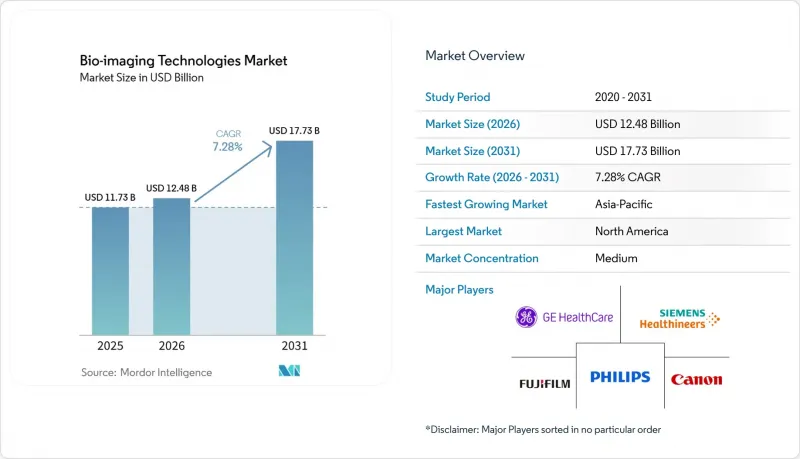
This report is Segmented by Technology Type (Medical Bio-Imaging, Molecular Bio-Imaging, Others), Modality (X-Ray, CT, Magnetic Resonance Imaging, and More), Application (Oncology, Neurology, Cardiology, and More), End User (Hospitals, Diagnostic Imaging Centers, and More), and Geography (North America, Europe, and More). The Market Forecasts are Provided in Terms of Value (USD).
Global Bio-imaging Technologies Market Trends and Insights
Growing Need for High-Resolution Biological Imaging in Early Disease Detection
Early cancer detection and neurodegenerative disease screening are changing what buyers expect from imaging systems. Hospitals increasingly seek sub-millimeter resolution and volumetric tissue characterization for routine clinical decisions. GE HealthCarestated that AIR Recon DL had been used in more than 80 million patient scans by mid-2025 and could reduce scan times by up to 50%.
Faster MRI examinations can improve scanner throughput, although they shift more pressure to image reporting and interpretation capacity. Photon-counting CT also offers tissue information that conventional CT cannot provide, supporting earlier assessment of lesions. In neurology and oncology, the use of 7T MRI and PET-MRI supports broader demand for high-resolution and multimodal imaging.
Rising AI-Enabled Image Reconstruction and Quantitative Analysis
The bio-imaging technologies market is seeing AI reconstruction shift competition from detector hardware toward software performance and clinical workflow value. Siemens Healthineers reported that Deep Resolve supported an MRI scan-time reduction of more than 20% at NHS Fife, which created capacity for 1,900 additional appointments in 6 months. Philipsreceived FDA 510(k) clearance for Verida, a detector-based spectral CT system that uses an AI reconstruction engine. Philips stated that the system reconstructs 145 images per second and can support up to 270 examinations daily. Software updates can improve the performance of legacy scanner fleets without a capital replacement. This reduces barriers to adoption for hospitals while increasing the importance of software integration and procurement standards.
High Capital Cost of Advanced Imaging Systems and Software Upgrades
The bio-imaging technologies market faces a cost barrier because acquiring an advanced imaging platform extends beyond the scanner purchase price. A 1.5T or 3.0T MRI system can start at USD 900,000, while installation, service contracts, and software licenses increase lifecycle expenditure. The input data indicates installation costs of USD 150,000 to USD 500,000 and annual service costs of USD 42,000 to USD 134,000. These costs can delay approvals at community hospitals and diagnostic centers, especially in markets with limited financing. A 2026 study across 46 European countries also identified infrastructure, training, and reimbursement as barriers to equitable cardiovascular MRI access. Refurbished systems can reduce capital outlay by 30% to 60%, but buyers must weigh those savings against software compatibility and warranty limitations.
Other drivers and restraints analyzed in the detailed report include:
- Expanding Biopharma Use in Drug Discovery, Companion Diagnostics, and Translational Research
- Procurement Shift toward Portable, Cloud-Connected, and Workflow-Integrated Imaging Platforms
- Reimbursement Pressure, Validation Requirements, and Workforce Constraints
For complete list of drivers and restraints, kindly check the Table Of Contents.
Segment Analysis
Medical Bio-Imaging held 62.34% of the revenue share in 2025, reflecting its central role in hospital radiology, diagnostic imaging centers, and emergency care. Its position rests on established clinical workflows and regulated modalities used in everyday diagnostic decisions.
Molecular Bio-Imaging is projected to record the highest growth at a 10.56% CAGR through 2031. The segment benefits from theranostics, where an imaging agent is linked to a therapeutic radiopharmaceutical for patient selection and treatment monitoring. Lantheus received FDA approval for PYLARIFY TruVu in 2026, a reformulated PSMA PET imaging agent that is intended to improve manufacturing efficiency and supply flexibility.
Within the bio-imaging technologies market, Magnetic Resonance Imaging held 22.36% of the bio-imaging technologies market size in 2025. MRI remains important in soft-tissue oncology, neurological assessment, cardiology, and clinical pathways where avoiding ionizing radiation has value. Nuclear Imaging is forecast to grow at a 9.54% CAGR through 2031.
The segment is supported by radiopharmaceutical approvals, theranostic care models, and broader clinical use in oncology and neurology. Lantheus received FDA tentative approval for PNT2003 in March 2026, a radioequivalent to Lutetium Lu 177 Dotatate for gastroenteropancreatic neuroendocrine tumors. The approval points to a generic pathway that could broaden access to radioligand procedures.
Complete Report Scope:
- By Technology Type
- Medical Bio-Imaging
- Molecular Bio-Imaging
- Others (Functional Bio-Imaging, Preclinical Bio-Imaging and More)
- By Modality
- X-Ray
- Computed Tomography
- Magnetic Resonance Imaging
- Ultrasound Imaging
- Nuclear Imaging
- Optical Imaging
- Others (Positron Emission Tomography, Photoacoustic Imaging, and More)
- By Application
- Oncology
- Neurology
- Cardiology
- Orthopedics
- Gastroenterology
- Others (Precision Medicine, Regenerative Medicine, and More)
- By End User
- Hospitals And Clinics
- Diagnostic Imaging Centers
- Academic And Research Institutes
- Pharmaceutical And Biotechnology Companies
- Contract Research Organizations
- By Geography
- North America
- United States
- Canada
- Mexico
- Europe
- Germany
- United Kingdom
- France
- Italy
- Spain
- Rest of Europe
- Asia-Pacific
- China
- India
- Japan
- Australia
- South Korea
- Rest of Asia-Pacific
- Middle East and Africa
- GCC
- South Africa
- Rest of Middle East and Africa
- South America
- Brazil
- Argentina
- Rest of South America
- North America
Geography Analysis
North America held 41.34% of the revenue share in 2025. The region has a large installed base of clinical imaging equipment, major cancer centers using multimodal protocols, and an evolving reimbursement environment. The CMS-FDA RAPID pathway announced in April 2026 may better align regulatory authorization and Medicare coverage for eligible devices. The United States represents the largest share within the region. Canada and Mexico are smaller markets where cloud imaging and teleradiology can extend diagnostic services into underserved areas.
Asia-Pacific is projected to expand at a 10.32% CAGR through 2031, the fastest regional pace in the supplied data. The growth is linked to policy direction, domestic technology investment, and an expanding private diagnostic sector. China's November 2025 directive called for AI-assisted medical imaging diagnosis in all secondary-level and higher hospitals by 2030.
- Agilent Technologies
- Bayer
- Bracco Imaging S.p.A.
- Bruker
- Canon
- Carestream Health
- Esaote S.p.A.
- FUJIFILM
- GE Healthcare
- Hologic
- Koninklijke Philips
- Lantheus Holdings, Inc.
- Mediso
- Revvity, Inc.
- Samsung Group
- Shimadzu
- Siemens Healthineers
- Thermo Fisher Scientific
Additional Benefits:
- The market estimate (ME) sheet in Excel format
- 3 months of analyst support
TABLE OF CONTENTS
1 Introduction
- 1.1 Study Assumptions & Market Definition
- 1.2 Scope of the Study
2 Research Methodology
3 Executive Summary
4 Market Landscape
- 4.1 Market Overview
- 4.2 Market Drivers
- 4.2.1 Growing Need for High-Resolution Biological Imaging in Early Disease Detection
- 4.2.2 Rising AI-Enabled Image Reconstruction and Quantitative Analysis
- 4.2.3 Expanding Biopharma Use in Drug Discovery, Companion Diagnostics, and Translational Research
- 4.2.4 Procurement Shift Toward Portable, Cloud-Connected, and Workflow-Integrated Imaging Platforms
- 4.2.5 Increasing Clinical Need for Multimodal Imaging in Oncology, Neurology, and Cardiovascular Care
- 4.2.6 Growing Installed Base of Research-Grade Microscopy and Preclinical Imaging Systems in Emerging Labs
- 4.3 Market Restraints
- 4.3.1 High Capital Cost of Advanced Imaging Systems and Software Upgrades
- 4.3.2 Reimbursement Pressure and Slow Clinical Validation for Novel Imaging Workflows
- 4.3.3 Data Interoperability Gaps Across Hardware, AI Models, and Laboratory Information Systems
- 4.3.4 Shortage of Imaging Scientists, AI Trained Radiology Staff, and Advanced Application Specialists
- 4.4 Supply Chain Analysis
- 4.5 Regulatory Landscape
- 4.6 Technological Outlook
- 4.7 Porter's Five Forces
- 4.7.1 Threat of New Entrants
- 4.7.2 Bargaining Power of Suppliers
- 4.7.3 Bargaining Power of Buyers
- 4.7.4 Threat of Substitutes
- 4.7.5 Industry Rivalry
5 Market Size & Growth Forecasts (Value, USD)
- 5.1 By Technology Type
- 5.1.1 Medical Bio-Imaging
- 5.1.2 Molecular Bio-Imaging
- 5.1.3 Others (Functional Bio-Imaging, Preclinical Bio-Imaging and More)
- 5.2 By Modality
- 5.2.1 X-Ray
- 5.2.2 Computed Tomography
- 5.2.3 Magnetic Resonance Imaging
- 5.2.4 Ultrasound Imaging
- 5.2.5 Nuclear Imaging
- 5.2.6 Optical Imaging
- 5.2.7 Others (Positron Emission Tomography, Photoacoustic Imaging, and More)
- 5.3 By Application
- 5.3.1 Oncology
- 5.3.2 Neurology
- 5.3.3 Cardiology
- 5.3.4 Orthopedics
- 5.3.5 Gastroenterology
- 5.3.6 Others (Precision Medicine, Regenerative Medicine, and More)
- 5.4 By End User
- 5.4.1 Hospitals And Clinics
- 5.4.2 Diagnostic Imaging Centers
- 5.4.3 Academic And Research Institutes
- 5.4.4 Pharmaceutical And Biotechnology Companies
- 5.4.5 Contract Research Organizations
- 5.5 By Geography
- 5.5.1 North America
- 5.5.1.1 United States
- 5.5.1.2 Canada
- 5.5.1.3 Mexico
- 5.5.2 Europe
- 5.5.2.1 Germany
- 5.5.2.2 United Kingdom
- 5.5.2.3 France
- 5.5.2.4 Italy
- 5.5.2.5 Spain
- 5.5.2.6 Rest of Europe
- 5.5.3 Asia-Pacific
- 5.5.3.1 China
- 5.5.3.2 India
- 5.5.3.3 Japan
- 5.5.3.4 Australia
- 5.5.3.5 South Korea
- 5.5.3.6 Rest of Asia-Pacific
- 5.5.4 Middle East and Africa
- 5.5.4.1 GCC
- 5.5.4.2 South Africa
- 5.5.4.3 Rest of Middle East and Africa
- 5.5.5 South America
- 5.5.5.1 Brazil
- 5.5.5.2 Argentina
- 5.5.5.3 Rest of South America
- 5.5.1 North America
6 Competitive Landscape
- 6.1 Market Concentration
- 6.2 Market Share Analysis
- 6.3 Company Profiles {(includes Global level Overview, Market level overview, Core Segments, Financials as available, Strategic Information, Market Rank/Share for key companies, Products & Services, and Recent Developments)}
- 6.3.1 Agilent Technologies, Inc.
- 6.3.2 Bayer AG
- 6.3.3 Bracco Imaging S.p.A.
- 6.3.4 Bruker Corporation
- 6.3.5 Canon Inc.
- 6.3.6 Carestream Health, Inc.
- 6.3.7 Esaote S.p.A.
- 6.3.8 FUJIFILM Holdings Corporation
- 6.3.9 GE HealthCare
- 6.3.10 Hologic, Inc.
- 6.3.11 Koninklijke Philips N.V.
- 6.3.12 Lantheus Holdings, Inc.
- 6.3.13 Mediso Ltd.
- 6.3.14 Revvity, Inc.
- 6.3.15 Samsung Medison Co., Ltd.
- 6.3.16 Shimadzu Corporation
- 6.3.17 Siemens Healthineers AG
- 6.3.18 Thermo Fisher Scientific Inc.
7 Market Opportunities & Future Outlook
- 7.1 White-space & unmet-need assessment

