PUBLISHER: Mordor Intelligence | PRODUCT CODE: 2118033

PUBLISHER: Mordor Intelligence | PRODUCT CODE: 2118033
OTT For Corporate Communications - Market Share Analysis, Industry Trends & Statistics, Growth Forecasts (2026 - 2031)
According to Mordor Intelligence, the OTT for corporate communications market size is projected to expand from USD 2.93 billion in 2025 and USD 3.23 billion in 2026 to USD 5.59 billion by 2031, registering a CAGR of 11.59% between 2026 and 2031.
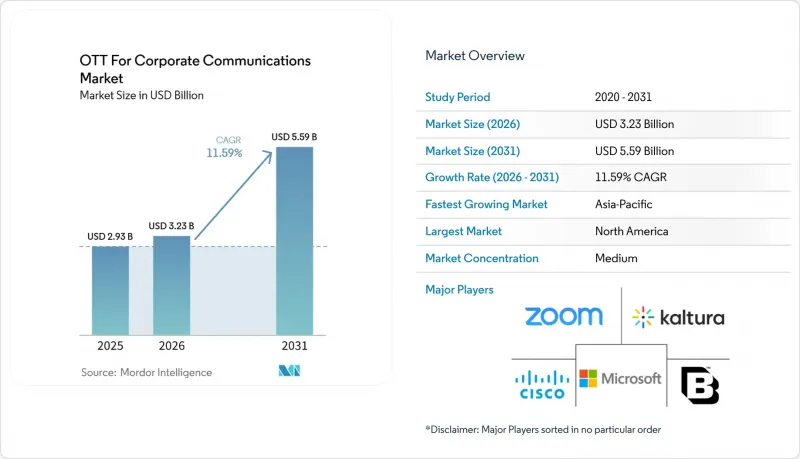
This report is Segmented by Device Type (Smartphones and Tablets, Smart TVs, Laptops and Desktops, and More), Content Type (Live Streaming, On-Demand Video, and Archived Video Libraries), End User Industry (Healthcare and Life Sciences, Information Technology and Telecommunications, Manufacturing, Education, and More), and Geography. The Market Forecasts are Provided in Terms of Value (USD).
Global OTT For Corporate Communications Market Trends and Insights
Rising Demand for Secure Internal and External Video Communications
Security has become a core buying factor in the OTT for corporate communications market, as regulated enterprises now expect video systems to meet the same standards as other controlled business records. Financial firms covered by MiFID II must record relevant electronic communications, retain them for at least 5 years, and keep them searchable and accessible for regulators. The same compliance logic is expanding the addressable base for the OTT corporate communications market, as healthcare, legal, and professional services teams also need stronger access controls, audit logs, and defined retention rules. Digital Samba states that compliant deployments require encryption at rest and in transit, role-based access control, audit logging, and archival integration, thereby enhancing the value of specialized enterprise platforms. This is also pushing the OTT for corporate communications market toward private cloud, sovereign hosting, and on-premises options, as many enterprises do not want all sensitive internal video traffic to reside in a standard multi-tenant setup.
Growth of Hybrid and Distributed Workforce Communication Needs
Hybrid work remains a structural demand driver for the OTT corporate communications market, as remote-capable employees continue to work across a mix of office and remote work patterns. Gallup reported that 53% of remote-capable U.S. employees worked in hybrid arrangements in 2026, which underscores the importance of asynchronous internal video for communication across time zones and schedules. The OTT for corporate communications market benefits from this pattern because live attendance is no longer the only expectation for all-hands meetings, onboarding, and executive updates. Microsoft also shows that AI adoption at work is tied closely to system integration and manager support, which means video tools now need to fit naturally into daily workflows rather than stand apart as isolated channels. As a result, enterprises are spending more on persistent video hubs that support both live events and replay access, which gives the OTT for corporate communications market a steadier usage pattern than one-time event software.
Integration Complexity with Legacy Enterprise Systems
Integration work remains a major brake on the OTT for corporate communications market because video platforms need to connect with identity systems, HR tools, learning systems, and archiving environments. Microsoft shows that successful AI adoption depends heavily on how well tools integrate with existing systems, reinforcing the need for deep workflow integration rather than isolated deployment. This slows the OTT for the corporate communications market when enterprises lack the technical resources to link SSO, compliance archives, and employee directories into a single experience. It is a sharper issue for mid-sized companies because they often want enterprise-grade capabilities but lack the same internal integration teams as large global buyers. Vendors can reduce some of this friction with prebuilt connectors, but the OTT for corporate communications market still faces slower rollouts wherever legacy environments remain heavily customized.
Other drivers and restraints analyzed in the detailed report include:
- AI-Enabled Video Search, Transcription, and Summarization
- Expansion of Branded Corporate Video Portals and Apps
- Data Privacy, Security, and Access Control Challenges
For complete list of drivers and restraints, kindly check the Table Of Contents.
Segment Analysis
Laptops and desktops accounted for 47.16% of OTT for corporate communications market in 2025, indicating that managed workstations remained the primary access point for enterprise video. In the OTT for corporate communications market, these devices still suit on-demand training, replay viewing, policy updates, and routine internal communications because they fit established office workflows. Smartphones and tablets formed the second access tier, especially for frontline teams in manufacturing, logistics, and retail that do not rely on assigned desktop setups. This keeps the OTT for corporate communications market relevant outside desk-based roles, even when viewing sessions are shorter and more task-driven.
Smart TVs are projected to grow at a 12.57% CAGR from 2026 to 2031, and the OTT for corporate communications market for this device segment is growing as enterprises extend video to conference rooms, executive briefing spaces, and shared employee areas. The shift matters because smart TVs enable companies to distribute leadership messages and corporate news to groups without requiring individual logins at every moment. In the OTT for corporate communications market, this also supports a broader move from personal viewing to shared-screen communication in operational settings. Vendors that optimize app delivery, device management, and playback consistency across multiple screen types are likely to strengthen their position as enterprise viewing habits become more mixed.
Complete Report Scope:
- By Device Type
- Smartphones and Tablets
- Smart TVs
- Laptops and Desktops
- Other Device Types
- By Content Type
- Live Streaming
- On-Demand Video
- Archived Video Libraries
- By End User Industry
- BFSI
- Healthcare and Life Sciences
- Information Technology and Telecommunications
- Manufacturing
- Retail and Consumer Goods
- Education
- Other End User Industries
- By Geography
- North America
- United States
- Canada
- Mexico
- South America
- Brazil
- Argentina
- Chile
- Rest of South America
- Europe
- Germany
- United Kingdom
- France
- Italy
- Spain
- Rest of Europe
- Asia-Pacific
- China
- Japan
- India
- South Korea
- Australia
- Rest of Asia-Pacific
- Middle East
- Saudi Arabia
- United Arab Emirates
- Qatar
- Rest of Middle East
- Africa
- South Africa
- Egypt
- Nigeria
- Rest of Africa
- North America
Geography Analysis
North America held 38.14% of the OTT for corporate communications market share in 2025, which made it the largest regional contributor. The region benefits from a dense base of large enterprises, broad hybrid work adoption, and stronger demand for formal governance around internal video. Gallup and Microsoft both point to persistent hybrid work and growing AI-enabled workflows, which help explain why enterprises in this region continue to invest in video systems that support both live and asynchronous communication. In the OTT for corporate communications market, the United States remains the main source of demand because financial services, healthcare, and technology buyers have both budget capacity and compliance pressure. The OTT for corporate communications market in Canada and Mexico is smaller, but it still benefits from cross-border enterprise operations and distributed team structures that require stable internal video delivery.
Europe remained the second-largest region, and the OTT for corporate communications market there is shaped strongly by GDPR and video recording obligations in regulated settings. Digital Samba states that compliant financial video deployments need clear retention, audit logging, and EU-centered infrastructure controls, which supports demand for region-specific hosting and governance features. The OTT for corporate communications market in Germany, the United Kingdom, and France is supported by enterprise buyers that place more weight on data control, certification, and formal archiving practices. This makes European procurement more compliance-led than convenience-led, which can favor vendors with stronger data residency and policy frameworks.
Asia-Pacific is projected to grow at a 12.08% CAGR through 2031, and the OTT for corporate communications market size for this region is strengthening as large service hubs and multinational employers scale internal video across dispersed workforces. The OTT for corporate communications market in India is supported by technology services and outsourcing activity that depends on rapid onboarding, training, and team alignment across locations. In several Asia-Pacific countries, mobile viewing matters more than desktop-first delivery, which affects design priorities such as lighter apps and adaptive streaming. The OTT for corporate communications market in the Middle East and Africa is earlier in development, but Mangomolo reported continued enhancement of its OTT platform in 2026 with AI personalization and workflow integration for clients across Europe, the Middle East, and Africa. That kind of platform expansion shows that regional infrastructure is becoming more capable, which should gradually improve the enterprise case for internal streaming across newer adoption markets.
- Microsoft Corporation
- Zoom Video Communications, Inc.
- Cisco Systems, Inc.
- Kaltura, Inc.
- Brightcove, Inc.
- Panopto, Inc.
- Vimeo, Inc.
- Vidyard, Inc.
- Haivision Systems Inc.
- Kollective Technology, Inc.
- Vbrick Systems, Inc.
- MediaPlatform, Inc.
- Wistia, Inc.
- Dacast, Inc.
- IBM Corporation
- Adobe Inc.
- Amazon Web Services, Inc.
- Google LLC
- RingCentral, Inc.
- Staffbase GmbH
- Firstup, Inc.
- Poppulo
- Simpplr Inc.
- LumApps
- Workvivo Limited
Additional Benefits:
- The market estimate (ME) sheet in Excel format
- 3 months of analyst support
TABLE OF CONTENTS
1 INTRODUCTION
- 1.1 Study Assumptions and Market Definition
- 1.2 Scope of The Study
2 RESEARCH METHODOLOGY
3 EXECUTIVE SUMMARY
4 MARKET LANDSCAPE
- 4.1 Market Overview
- 4.2 Market Drivers
- 4.2.1 Rising Demand for Secure Internal and External Video Communications
- 4.2.2 Growth of Hybrid and Distributed Workforce Communication Needs
- 4.2.3 Expansion of Branded Corporate Video Portals and Apps
- 4.2.4 AI-Enabled Video Search, Transcription, and Summarization
- 4.2.5 Content Governance, Archiving, and Compliance Requirements
- 4.2.6 Shift Toward Measurable Communications Analytics
- 4.3 Market Restraints
- 4.3.1 Integration Complexity With Legacy Enterprise Systems
- 4.3.2 Data Privacy, Security, and Access Control Challenges
- 4.3.3 High Cost of Managed Streaming and Broadcast-Grade Workflows
- 4.3.4 User Adoption Friction Across Multiple Communication Channels
- 4.4 Industry Value Chain Analysis
- 4.5 Regulatory Landscape
- 4.6 Technological Outlook
- 4.7 Porter's Five Forces Analysis
- 4.7.1 Bargaining Power of Buyers
- 4.7.2 Bargaining Power of Suppliers
- 4.7.3 Threat of New Entrants
- 4.7.4 Threat of Substitutes
- 4.7.5 Intensity of Competitive Rivalry
- 4.8 Impact of Macroeconomic Factors on the Market
5 MARKET SIZE AND GROWTH FORECASTS (VALUE)
- 5.1 By Device Type
- 5.1.1 Smartphones and Tablets
- 5.1.2 Smart TVs
- 5.1.3 Laptops and Desktops
- 5.1.4 Other Device Types
- 5.2 By Content Type
- 5.2.1 Live Streaming
- 5.2.2 On-Demand Video
- 5.2.3 Archived Video Libraries
- 5.3 By End User Industry
- 5.3.1 BFSI
- 5.3.2 Healthcare and Life Sciences
- 5.3.3 Information Technology and Telecommunications
- 5.3.4 Manufacturing
- 5.3.5 Retail and Consumer Goods
- 5.3.6 Education
- 5.3.7 Other End User Industries
- 5.4 By Geography
- 5.4.1 North America
- 5.4.1.1 United States
- 5.4.1.2 Canada
- 5.4.1.3 Mexico
- 5.4.2 South America
- 5.4.2.1 Brazil
- 5.4.2.2 Argentina
- 5.4.2.3 Chile
- 5.4.2.4 Rest of South America
- 5.4.3 Europe
- 5.4.3.1 Germany
- 5.4.3.2 United Kingdom
- 5.4.3.3 France
- 5.4.3.4 Italy
- 5.4.3.5 Spain
- 5.4.3.6 Rest of Europe
- 5.4.4 Asia-Pacific
- 5.4.4.1 China
- 5.4.4.2 Japan
- 5.4.4.3 India
- 5.4.4.4 South Korea
- 5.4.4.5 Australia
- 5.4.4.6 Rest of Asia-Pacific
- 5.4.5 Middle East
- 5.4.5.1 Saudi Arabia
- 5.4.5.2 United Arab Emirates
- 5.4.5.3 Qatar
- 5.4.5.4 Rest of Middle East
- 5.4.6 Africa
- 5.4.6.1 South Africa
- 5.4.6.2 Egypt
- 5.4.6.3 Nigeria
- 5.4.6.4 Rest of Africa
- 5.4.1 North America
6 COMPETITIVE LANDSCAPE
- 6.1 Market Concentration
- 6.2 Strategic Moves
- 6.3 Vendor Positioning Analysis
- 6.4 Company Profiles (includes Global Level Overview, Market Level Overview, Core Segments, Financials as available, Strategic Information, Market Rank/Share, Products and Services, Recent Developments)
- 6.4.1 Microsoft Corporation
- 6.4.2 Zoom Video Communications, Inc.
- 6.4.3 Cisco Systems, Inc.
- 6.4.4 Kaltura, Inc.
- 6.4.5 Brightcove, Inc.
- 6.4.6 Panopto, Inc.
- 6.4.7 Vimeo, Inc.
- 6.4.8 Vidyard, Inc.
- 6.4.9 Haivision Systems Inc.
- 6.4.10 Kollective Technology, Inc.
- 6.4.11 Vbrick Systems, Inc.
- 6.4.12 MediaPlatform, Inc.
- 6.4.13 Wistia, Inc.
- 6.4.14 Dacast, Inc.
- 6.4.15 IBM Corporation
- 6.4.16 Adobe Inc.
- 6.4.17 Amazon Web Services, Inc.
- 6.4.18 Google LLC
- 6.4.19 RingCentral, Inc.
- 6.4.20 Staffbase GmbH
- 6.4.21 Firstup, Inc.
- 6.4.22 Poppulo
- 6.4.23 Simpplr Inc.
- 6.4.24 LumApps
- 6.4.25 Workvivo Limited
7 MARKET OPPORTUNITIES AND FUTURE OUTLOOK
- 7.1 White-Space and Unmet-Need Assessment

