PUBLISHER: Mordor Intelligence | PRODUCT CODE: 2118060

PUBLISHER: Mordor Intelligence | PRODUCT CODE: 2118060
Medical Devices Machine Tools - Market Share Analysis, Industry Trends & Statistics, Growth Forecasts (2026 - 2031)
According to Mordor Intelligence, the medical devices machine tools market size is projected to be USD 3.11 billion in 2025, USD 3.36 billion in 2026, and reach USD 4.82 billion by 2031, growing at a CAGR of 7.48% from 2026 to 2031.
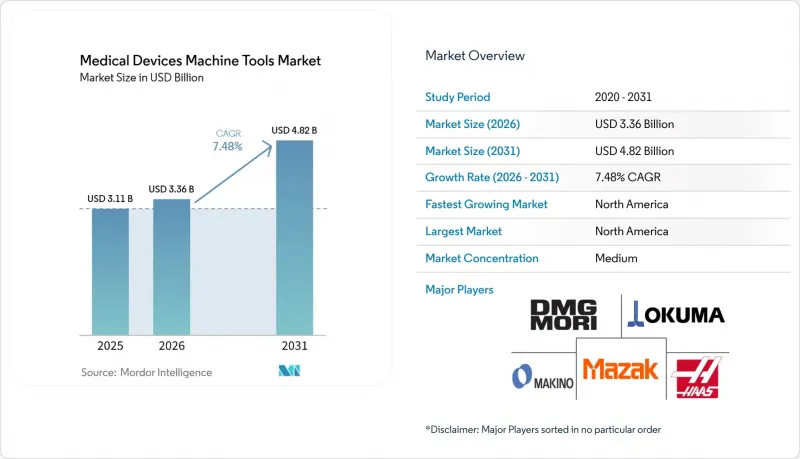
This report is Segmented by Machine Type (CNC Turning Machines, CNC Machining Centers, and More), by Application (Surgical and Robotic Instruments, Orthopedic and Trauma Devices, and More), by End-User (Medical Device OEMs, and More), and by Geography (North America, Asia-Pacific, Europe, and More). The Report Offers Market Size and Forecasts in Value (USD) for all the Above Segments.
Global Medical Devices Machine Tools Market Trends and Insights
Rising Demand for Ultra-Precision 5-Axis Machining in Implant and Surgical Component Production
Patient-specific hip stems, tibial trays, and spinal fusion cages require complex machining and tightly controlled surfaces. Five-axis milling reduces the need to reposition workpieces during production. Fewer setups can reduce the number of records that manufacturers must validate under ISO 13485 requirements. This supports demand for CNC platforms with in-process metrology, tool wear compensation, and process traceability in the medical devices machine tools market. Makino's N2-5XA uses a dry-chip-less design intended to address contamination control in implant production. Machine specifications are therefore increasingly shaped by cleanliness and documentation needs as well as geometric capability.
FDA QMSR and ISO 13485 Alignment Increasing Demand for Validation-Ready Machine Tools
The QMSR Final Rule became effective on February 2, 2026, and aligned 21 CFR Part 820 with ISO 13485:2016. Medical device manufacturers now need stronger documentation, risk management, and traceability across production steps.Buyers of new equipment need installation, operational, and processing qualification documents that fit these requirements. Existing facilities that used legacy Quality System Regulation procedures may need to revalidate machines or replace them. Suppliers with dedicated medical compliance support can reduce the implementation burden on buyers. This increases the value of validation-ready equipment in the medical devices machine tools market.
High Qualification, Validation, and Revalidation Burden Slowing Machine Deployment
New CNC cells must undergo qualification before they can produce regulated medical components. Factory acceptance testing, coolant validation, cleanroom installation, and manufacturing execution system integration can lengthen the deployment process. Software updates, major modifications, and process changes can also trigger partial or full requalification. Class III implant and patient-contact component manufacturers must maintain capable processes on critical features, which limits the range of equipment suitable for some programs. These requirements can concentrate demand at the premium end of the medical device machine tool market. They can also delay the ramp-up of new production lines even when manufacturers have demand for additional capacity.
Other drivers and restraints analyzed in the detailed report include:
- Expansion of Contract Medical Device Manufacturing Capacity
- Rapid Adoption of Hybrid Additive-Subtractive Workflows for Near-Net Medical Parts
- Elevated Tooling, Coolant, and Maintenance Costs for Titanium and Cobalt-Chromium Machining
For complete list of drivers and restraints, kindly check the Table Of Contents.
Segment Analysis
CNC machining centers held 28.5% of the 2025 medical device machine tool market. Their position reflects their use in high-volume implant and instrument production, where complex geometry and documented processes are both required. Five-axis centers support contoured surfaces and simultaneous machining on orthopedic and spinal parts. Laser cutting and micromachining machines are forecast to grow at an 8.8% CAGR from 2026 to 2031. These systems serve stent cutting, device marking, and ablation work on components that can be damaged by conventional cutting. TRUMPF introduced the TruMicro 9010 in June 2025 for high-productivity ultra-short pulse processing of larger surfaces.
CNC turning machines play a substantial role in the production of bone screws, cannulated fasteners, and shafts. Swiss-type and turn-mill configurations can produce high volumes of titanium and stainless-steel parts with close concentricity. CNC grinding and finishing machines support implant surface preparation and other applications that need fine surface finishes. EDM remains necessary for hardened tooling and microfeatures that are difficult to produce by milling without burrs. Other systems, including ultrasonic, broaching, and drilling machines, handle specialized work for PEEK implants and catheter tooling. Each of these technologies serves a different production need in the medical device machine tools market. Laser parameter qualification is especially important because process settings must be documented and controlled under the QMSR framework.
Complete Report Scope:
- By Machine Type
- CNC Turning Machines (Including Swiss-Type, Sliding-Headstock and Turn-Mill Machines)
- CNC Machining Centers (Including 3-Axis, 4-Axis and 5-Axis Machines)
- CNC Grinding & Finishing Machines (Including Grinding, Honing, Lapping and Polishing Machines)
- Electrical Discharge Machining (EDM) Machines
- Laser Cutting and Micromachining Systems
- Other Machine Types (Drilling, Broaching, Ultrasonic, Sawing, etc.)
- By Application
- Surgical and Robotic Instruments
- Orthopedic and Trauma Devices
- Dental Devices
- Implantable Medical Devices (Cardiovascular, Neurovascular and Minimally Invasive Devices)
- Diagnostic, Medical Imaging and Endoscopy Equipment
- Ophthalmic and Hearing Devices
- Drug-Delivery and Other Medical Devices
- By End User
- Medical Device OEMs
- Contract Development and Manufacturing Organizations (CDMO)
- Contract Manufacturing Organizations (CMO) & Precision Job Shops
- Others (Research Institutes, Prototyping/ Medical Technology Centers)
- By Geography
- North America
- United States
- Canada
- Mexico
- South America
- Brazil
- Costa Rica
- Rest of South America
- Europe
- United Kingdom
- Ireland
- Germany
- France
- Italy
- Spain
- Switzerland
- BENELUX (Belgium, Netherlands, and Luxembourg)
- NORDICS (Denmark, Finland, Iceland, Norway, and Sweden)
- Rest of Europe
- Asia-Pacific
- China
- India
- Japan
- South Korea
- Malaysia
- Taiwan
- Australia
- Rest of Asia-Pacific
- Middle East and Africa
- Saudi Arabia
- Israel
- Turkey
- Egypt
- South Africa
- Rest of Middle East and Africa
- North America
Geography Analysis
North America held 31.6% of the medical devices machine tools market size in 2025 and is forecast to grow at an 8.9% CAGR through 2031. The region benefits from QMSR-driven qualification work at OEM and contract manufacturing facilities. Near-shoring also supports investment in the United States, Canadian, and Costa Rica. Aging populations continue to support orthopedic and cardiovascular device volumes. This combination links compliance spending with demand for additional qualified capacity. Freudenberg Medical expanded its Costa Rica operations in 2025 to produce electrophysiology and structural heart catheters.
Europe remains a major demand base, supported by Germany's machine tool ecosystem and medical technology production. Germany's medical technology sector generated EUR 41.4 billion (USD 46.63 billion) in 2024, equivalent to USD 45 billion (USD 50.79 billion), and had an export ratio of 68%. VDW reported that German machine tool production fell 8% in 2025, while medical technology provided demand support alongside defense, aerospace, and electronics. Switzerland, Ireland, and the United Kingdom add to the regional production base. European buyers must also consider cybersecurity requirements for networked machinery under the EU Machinery Regulation. These factors support replacement and capability investments in the medical devices machine tools market.
Asia-Pacific is the main growth area outside North America, with Japan, South Korea, China, Malaysia, Thailand, and India providing manufacturing capacity. Japan's machine tool orders reached JPY 1.6 trillion (USD 10.6 billion) in 2025, and the Japan Machine Tool Builders' Association expected JPY 1.7 trillion (USD 11.36 billion) in orders for 2026. Japan's automation base supports demand across medical, semiconductor, and defense applications. FANUC reported JPY 857.8 billion (USD 5.73 billion) in fiscal 2025 revenue and announced a USD 90 million investment in North American robot production capacity in April 2026.South America, the Middle East, and Africa remain smaller medical machining markets. Costa Rica has become an important location for precision manufacturing due to its proximity to North American OEMs and its growing pool of qualified contract manufacturers.
- DMG MORI Co., Ltd.
- Yamazaki Mazak Corporation
- Okuma Corporation
- Makino Milling Machine Co., Ltd.
- Haas Automation, Inc.
- FANUC Corporation
- GF Machining Solutions Management SA
- TRUMPF SE + Co. KG
- Doosan Machine Tools Co., Ltd.
- Hyundai WIA Corporation
- CHIRON Group SE
- EMAG GmbH & Co. KG
- Hermle AG
- HARDINGE INC.
- JTEKT Corporation
- Fives Group
- Siemens AG
- Mitsubishi Electric Corporation
- Hurco Companies, Inc.
- Rollomatic SA
Additional Benefits:
- The market estimate (ME) sheet in Excel format
- 3 months of analyst support
TABLE OF CONTENTS
1 INTRODUCTION
- 1.1 Study Assumptions and Market Definition
- 1.2 Scope of the Study
2 RESEARCH METHODOLOGY
3 EXECUTIVE SUMMARY
4 MARKET LANDSCAPE
- 4.1 Market Overview
- 4.2 Market Drivers
- 4.2.1 Rising Demand for Ultra-Precision 5-Axis Machining in Implant and Surgical Component Production
- 4.2.2 FDA QMSR and ISO 13485 Alignment Increasing Demand for Validation-Ready Machine Tools
- 4.2.3 Expansion of Contract Medical Device Manufacturing Capacity
- 4.2.4 Rapid Adoption of Hybrid Additive-Subtractive Workflows for Near-Net Medical Parts
- 4.2.5 Acceleration of Lights-Out Production to Offset Skilled Machinist Shortages
- 4.2.6 Rising Need for In-Process Metrology, Tool Wear Compensation, and Digital Traceability
- 4.3 Market Restraints
- 4.3.1 High Qualification, Validation, and Revalidation Burden Slowing Machine Deployment
- 4.3.2 Elevated Tooling, Coolant, and Maintenance Costs for Titanium and Cobalt-Chromium Machining
- 4.3.3 Long Lead Times for Cleanroom-Compatible Installation and MES Integration
- 4.3.4 Cybersecurity and Data-Integrity Risks in connected CNC Cells
- 4.4 Value and Supply-Chain Analysis
- 4.5 Regulatory Landscape
- 4.6 Technology Trends and Innovation Outlook
- 4.7 Purchasing Criteria and Vendor Selection Factors
- 4.8 Insights on Aftermarket/ Retrofit Market Segment
- 4.9 Medical Devices Market Overview & Insights
- 4.10 Impact of Macroeconomic, Trade and Geopolitical Factors on the Market (Tariffs, export controls, Critical-material supply risks, tariffs, etc.)
5 MARKET SIZE AND GROWTH FORECASTS (Values, In USD Billion)
- 5.1 By Machine Type
- 5.1.1 CNC Turning Machines (Including Swiss-Type, Sliding-Headstock and Turn-Mill Machines)
- 5.1.2 CNC Machining Centers (Including 3-Axis, 4-Axis and 5-Axis Machines)
- 5.1.3 CNC Grinding & Finishing Machines (Including Grinding, Honing, Lapping and Polishing Machines)
- 5.1.4 Electrical Discharge Machining (EDM) Machines
- 5.1.5 Laser Cutting and Micromachining Systems
- 5.1.6 Other Machine Types (Drilling, Broaching, Ultrasonic, Sawing, etc.)
- 5.2 By Application
- 5.2.1 Surgical and Robotic Instruments
- 5.2.2 Orthopedic and Trauma Devices
- 5.2.3 Dental Devices
- 5.2.4 Implantable Medical Devices (Cardiovascular, Neurovascular and Minimally Invasive Devices)
- 5.2.5 Diagnostic, Medical Imaging and Endoscopy Equipment
- 5.2.6 Ophthalmic and Hearing Devices
- 5.2.7 Drug-Delivery and Other Medical Devices
- 5.3 By End User
- 5.3.1 Medical Device OEMs
- 5.3.2 Contract Development and Manufacturing Organizations (CDMO)
- 5.3.3 Contract Manufacturing Organizations (CMO) & Precision Job Shops
- 5.3.4 Others (Research Institutes, Prototyping/ Medical Technology Centers)
- 5.4 By Geography
- 5.4.1 North America
- 5.4.1.1 United States
- 5.4.1.2 Canada
- 5.4.1.3 Mexico
- 5.4.2 South America
- 5.4.2.1 Brazil
- 5.4.2.2 Costa Rica
- 5.4.2.3 Rest of South America
- 5.4.3 Europe
- 5.4.3.1 United Kingdom
- 5.4.3.2 Ireland
- 5.4.3.3 Germany
- 5.4.3.4 France
- 5.4.3.5 Italy
- 5.4.3.6 Spain
- 5.4.3.7 Switzerland
- 5.4.3.8 BENELUX (Belgium, Netherlands, and Luxembourg)
- 5.4.3.9 NORDICS (Denmark, Finland, Iceland, Norway, and Sweden)
- 5.4.3.10 Rest of Europe
- 5.4.4 Asia-Pacific
- 5.4.4.1 China
- 5.4.4.2 India
- 5.4.4.3 Japan
- 5.4.4.4 South Korea
- 5.4.4.5 Malaysia
- 5.4.4.6 Taiwan
- 5.4.4.7 Australia
- 5.4.4.8 Rest of Asia-Pacific
- 5.4.5 Middle East and Africa
- 5.4.5.1 Saudi Arabia
- 5.4.5.2 Israel
- 5.4.5.3 Turkey
- 5.4.5.4 Egypt
- 5.4.5.5 South Africa
- 5.4.5.6 Rest of Middle East and Africa
- 5.4.1 North America
6 COMPETITIVE LANDSCAPE
- 6.1 Market Concentration
- 6.2 Strategic Moves
- 6.3 Market Share Analysis
- 6.4 Company Profiles (includes Global Level Overview, Market Level Overview, Core Segments, Financials as available, Strategic Information, Products and Services, Recent Developments)
- 6.4.1 DMG MORI Co., Ltd.
- 6.4.2 Yamazaki Mazak Corporation
- 6.4.3 Okuma Corporation
- 6.4.4 Makino Milling Machine Co., Ltd.
- 6.4.5 Haas Automation, Inc.
- 6.4.6 FANUC Corporation
- 6.4.7 GF Machining Solutions Management SA
- 6.4.8 TRUMPF SE + Co. KG
- 6.4.9 Doosan Machine Tools Co., Ltd.
- 6.4.10 Hyundai WIA Corporation
- 6.4.11 CHIRON Group SE
- 6.4.12 EMAG GmbH & Co. KG
- 6.4.13 Hermle AG
- 6.4.14 HARDINGE INC.
- 6.4.15 JTEKT Corporation
- 6.4.16 Fives Group
- 6.4.17 Siemens AG
- 6.4.18 Mitsubishi Electric Corporation
- 6.4.19 Hurco Companies, Inc.
- 6.4.20 Rollomatic SA
7 MARKET OPPORTUNITIES AND FUTURE OUTLOOK
- 7.1 White-Space and Unmet-Need Assessment

