PUBLISHER: Mordor Intelligence | PRODUCT CODE: 2118064

PUBLISHER: Mordor Intelligence | PRODUCT CODE: 2118064
Digital Audio Platforms - Market Share Analysis, Industry Trends & Statistics, Growth Forecasts (2026 - 2031)
According to Mordor Intelligence, the digital audio platforms market size is expected to increase from USD 18.80 billion in 2025 to USD 21.07 billion in 2026 and reach USD 42.49 billion by 2031, growing at a CAGR of 15.06% over 2026-2031.
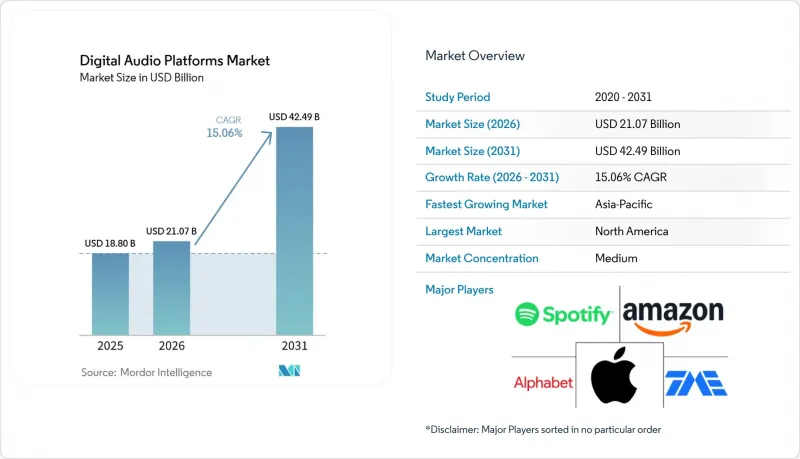
This report is Segmented by Format Type (On-Demand Music Streaming, Live Internet Radio, Podcast Hosting, and More), Monetization Model (Subscription-Based, Advertising-Based, Transaction-Based, Hybrid, and More), Device (Smartphones and Tablets, Laptops and Desktops, Smart Speakers and Smart Displays, Connected Cars, and More), and Geography. The Market Forecasts are Provided in Terms of Value (USD).
Global Digital Audio Platforms Market Trends and Insights
Subscription Price Rationalization in Emerging Economies
India had 14.4 million paid music subscribers in 2025, compared with an internet user base of more than 700 million people. Paid music subscriptions in the country increased 37% during the year, while audio subscription revenue exceeded INR 10.3 billion (USD 118.2 million). Annual revenue per user in India ranged from USD 4 to USD 10, compared with USD 100 to USD 140 in the United States. Lower prices can therefore build listening habits among large groups before household incomes rise. This approach treats lower-priced tiers as a longer-term engagement investment rather than a short-lived discount. India's paid subscriber base is forecast to more than double by 2028, with revenue forecast to reach INR 22 billion (USD 236 million).
Telco OTT Bundling Pushes Paid Uptake
Telecom operators have become important subscriber channels for the digital audio platforms market where card use limits direct digital payments. In May 2026, Reliance Jio launched an INR 200 (USD 2.40) OTT pass with 15 streaming platforms, 30 GB of data, and unlimited 5G access for 28 days. In June 2026, CelcomDigi introduced StreamMORE plans in Malaysia from MYR 19.90 (USD 4.50) per month. Vodafone Idea also became the first Indian carrier to include Spotify Premium in eligible postpaid plans during June 2026. This model follows earlier carrier relationships involving JioSaavn Pro and Apple Music. Subscribers acquired through a mobile plan can have lower churn because their billing is tied to the plan renewal cycle.
Royalty-Rate Inflation Exceeding ARPU Growth
Content royalties consumed 65% to 68% of major platform revenue in 2025, limiting the room for higher gross margins. Spotify reported paying more than USD 11 billion in royalties during 2025, which was more than 10% higher than the prior year. Spotify's fourth-quarter 2025 gross margin was 32.2%, meaning content and platform costs represented a large share of revenue. The U.S. Phonorecords IV framework continues to increase songwriting royalty costs through its 2027 peak. Major labels are also using consumer segmentation and higher revenue per user as priorities in licensing discussions. Pressure is greatest in lower-priced parts of the digital audio platforms market because revenue per listener grows more slowly than total listening and royalty obligations.
Other drivers and restraints analyzed in the detailed report include:
- Rapid Smart Speaker Install Base Expansion
- OEM-Level In-Car Streaming Integrations
- Content-License Windowing by Major Labels
For complete list of drivers and restraints, kindly check the Table Of Contents.
Segment Analysis
On-demand music streaming held 52.53% of market value in 2025. The digital audio platforms market has benefited as listeners shift from radio and downloads to personalized, on-demand services. Paid music streaming accounts reached 837 million worldwide by the end of 2025. Subscription streaming revenue increased 8.8% during 2025, which supported continuing monetization even as subscriber growth slowed in North America and Europe. Live internet radio has declined in volume across several Western markets but still serves smartphone users in emerging economies.
Audiobook streaming is projected to record a 15.16% CAGR between 2026 and 2031. U.S. audiobook sales increased 9% to USD 2.43 billion in 2025, and more than 750,000 active titles were available. Spotify stated in May 2026 that audiobook listening hours had increased 60% year over year. Audiobooks+ reached 1 million subscribers and was tracking toward USD 100 million in annualized recurring revenue. Existing smartphone and smart speaker infrastructure lowers the added cost of reaching audio listeners who already use a music platform.
Complete Report Scope:
- By Format Type
- On-Demand Music Streaming
- Live Internet Radio
- Podcast Hosting
- Audiobook Streaming
- Other Format Types
- By Monetization Model
- Subscription-Based
- Advertising-Based
- Transaction-Based
- Hybrid Model
- Freemium Model
- By Device
- Smartphones and Tablets
- Laptops and Desktops
- Smart TVs
- Smart Speakers and Smart Displays
- Connected Cars
- Other Devices (Wearable devices, IoT, etc.)
- By Geography
- North America
- United States
- Canada
- Mexico
- South America
- Brazil
- Argentina
- Rest of South America
- Europe
- Germany
- United Kingdom
- France
- Italy
- Spain
- Russia
- Rest of Europe
- Asia-Pacific
- China
- India
- Japan
- South Korea
- Australia and New Zealand
- Rest of Asia-Pacific
- Middle East
- Saudi Arabia
- United Arab Emirates
- Turkey
- Rest of Middle East
- Africa
- South Africa
- Nigeria
- Rest of Africa
- North America
Geography Analysis
North America held 38.40% of global market value in 2025. The region has high revenue per user and mature paid subscriber bases in the United States and Canada. Mexico's recorded-music market grew 13.3% in 2025. Spotify, Apple Music, Amazon Music, and YouTube Music use exclusive podcasts, hardware integration, and personalized features to compete in the United States. General Motors' multiyear Apple Music offer, Toyota's native Spotify access, and Volvo's Apple Music rollout link platform access to vehicle ownership. South America remains smaller, but Brazil grew 14.1% in 2025. Claro Musica uses carrier bundling and regional catalogs across Brazil, Argentina, and nearby markets.
Asia-Pacific is projected to be the fastest-growing region in the digital audio platforms market, with a 16.11% CAGR through 2031. India's paid music subscriber base grew 37% to 14.4 million in 2025 as lower prices and carrier bundles supported conversion. China grew 20.1% in 2025 and became the fourth-largest recorded-music market globally. Tencent Music Entertainment completed its USD 2.4 billion acquisition of Ximalaya in June 2026, extending its position in podcasts and audiobooks. Japan grew 8.9% in 2025, with demand for high-resolution audio supporting premium positioning. South Korea is also expanding the connected-car listening channel through Hyundai's platform. Europe grew 5.6% in 2025, while privacy rules are changing the design of advertising-supported offers.
The Middle East and Africa region grew, with Saudi Arabia and the UAE supporting consumption growth. Smartphone penetration above 90% across Gulf Cooperation Council markets supports direct app-based use. Regional carriers increasingly include audio services in premium postpaid packages. Anghami has used this carrier model to develop a regional subscriber base alongside global services. Boomplay has built a regional position through African catalogs, data-efficient streaming, and mobile money payments. Low revenue per user remains a constraint, but younger mobile-first users support longer-term volume growth for the digital audio platforms market.
- Spotify Technology S.A.
- Apple Inc.
- Amazon.com, Inc.
- Alphabet Inc.
- Tencent Music Entertainment Group
- Sirius XM Holdings Inc.
- Deezer S.A.
- SoundCloud Global Limited and Co. KG
- iHeartMedia, Inc.
- Anghami Plc
- JioSaavn LLC
- Gaana Media Private Limited
- NetEase Cloud Music Inc.
- TIDAL Music AS
- Qobuz SAS
- KKBOX Inc.
- Boomplay Music Group
- Claro Musica
- Napster Group PLC
- Yandex Music
Additional Benefits:
- The market estimate (ME) sheet in Excel format
- 3 months of analyst support
TABLE OF CONTENTS
1 INTRODUCTION
- 1.1 Study Assumptions and Market Definition
- 1.2 Scope of the Study
2 RESEARCH METHODOLOGY
3 EXECUTIVE SUMMARY
4 MARKET LANDSCAPE
- 4.1 Market Overview
- 4.2 Market Drivers
- 4.2.1 Subscription Price Rationalization in Emerging Economies
- 4.2.2 Telco OTT Bundling Pushes Paid Uptake
- 4.2.3 Rapid Smart Speaker Install Base Expansion
- 4.2.4 OEM-Level In-Car Streaming Integrations
- 4.2.5 AI Voice DJ and Generative Playlists Extend Daily Listening Time
- 4.2.6 Blockchain-Based Royalty Settlement Attracts Independent Catalogs
- 4.3 Market Restraints
- 4.3.1 Royalty-Rate Inflation Exceeding ARPU Growth
- 4.3.2 Content-License Windowing by Major Labels
- 4.3.3 Data-Privacy Regulations Limiting Ad-Targeting
- 4.3.4 Algorithmic Discovery Bias Marginalizing Long-Tail Creators
- 4.4 Industry Value Chain Analysis
- 4.5 Impact of Macroeconomic Factors on the Market
- 4.6 Regulatory Landscape
- 4.7 Technological Outlook
- 4.8 Porter's Five Forces Analysis
- 4.8.1 Bargaining Power of Suppliers
- 4.8.2 Bargaining Power of Buyers
- 4.8.3 Threat of New Entrants
- 4.8.4 Threat of Substitutes
- 4.8.5 Competitive Rivalry
5 MARKET SIZE AND GROWTH FORECASTS (VALUE)
- 5.1 By Format Type
- 5.1.1 On-Demand Music Streaming
- 5.1.2 Live Internet Radio
- 5.1.3 Podcast Hosting
- 5.1.4 Audiobook Streaming
- 5.1.5 Other Format Types
- 5.2 By Monetization Model
- 5.2.1 Subscription-Based
- 5.2.2 Advertising-Based
- 5.2.3 Transaction-Based
- 5.2.4 Hybrid Model
- 5.2.5 Freemium Model
- 5.3 By Device
- 5.3.1 Smartphones and Tablets
- 5.3.2 Laptops and Desktops
- 5.3.3 Smart TVs
- 5.3.4 Smart Speakers and Smart Displays
- 5.3.5 Connected Cars
- 5.3.6 Other Devices (Wearable devices, IoT, etc.)
- 5.4 By Geography
- 5.4.1 North America
- 5.4.1.1 United States
- 5.4.1.2 Canada
- 5.4.1.3 Mexico
- 5.4.2 South America
- 5.4.2.1 Brazil
- 5.4.2.2 Argentina
- 5.4.2.3 Rest of South America
- 5.4.3 Europe
- 5.4.3.1 Germany
- 5.4.3.2 United Kingdom
- 5.4.3.3 France
- 5.4.3.4 Italy
- 5.4.3.5 Spain
- 5.4.3.6 Russia
- 5.4.3.7 Rest of Europe
- 5.4.4 Asia-Pacific
- 5.4.4.1 China
- 5.4.4.2 India
- 5.4.4.3 Japan
- 5.4.4.4 South Korea
- 5.4.4.5 Australia and New Zealand
- 5.4.4.6 Rest of Asia-Pacific
- 5.4.5 Middle East
- 5.4.5.1 Saudi Arabia
- 5.4.5.2 United Arab Emirates
- 5.4.5.3 Turkey
- 5.4.5.4 Rest of Middle East
- 5.4.6 Africa
- 5.4.6.1 South Africa
- 5.4.6.2 Nigeria
- 5.4.6.3 Rest of Africa
- 5.4.1 North America
6 COMPETITIVE LANDSCAPE
- 6.1 Market Concentration
- 6.2 Strategic Moves
- 6.3 Market Share Analysis
- 6.4 Company Profiles (includes Global Level Overview, Market Level Overview, Core Segments, Financials as available, Strategic Information, Market Rank/Share, Products and Services, Recent Developments)
- 6.4.1 Spotify Technology S.A.
- 6.4.2 Apple Inc.
- 6.4.3 Amazon.com, Inc.
- 6.4.4 Alphabet Inc.
- 6.4.5 Tencent Music Entertainment Group
- 6.4.6 Sirius XM Holdings Inc.
- 6.4.7 Deezer S.A.
- 6.4.8 SoundCloud Global Limited and Co. KG
- 6.4.9 iHeartMedia, Inc.
- 6.4.10 Anghami Plc
- 6.4.11 JioSaavn LLC
- 6.4.12 Gaana Media Private Limited
- 6.4.13 NetEase Cloud Music Inc.
- 6.4.14 TIDAL Music AS
- 6.4.15 Qobuz SAS
- 6.4.16 KKBOX Inc.
- 6.4.17 Boomplay Music Group
- 6.4.18 Claro Musica
- 6.4.19 Napster Group PLC
- 6.4.20 Yandex Music
7 MARKET OPPORTUNITIES AND FUTURE OUTLOOK
- 7.1 White-Space and Unmet-Need Assessment

