PUBLISHER: Mordor Intelligence | PRODUCT CODE: 2118080

PUBLISHER: Mordor Intelligence | PRODUCT CODE: 2118080
Software As A Medical Device (SaMD) For Respiratory Care - Market Share Analysis, Industry Trends & Statistics, Growth Forecasts (2026 - 2031)
According to Mordor Intelligence, the software as a medical device for respiratory care market size was valued at USD 5.35 billion in 2025 and is estimated to grow from USD 5.86 billion in 2026 to reach USD 9.23 billion by 2031, at a CAGR of 9.52% during the forecast period (2026-2031).
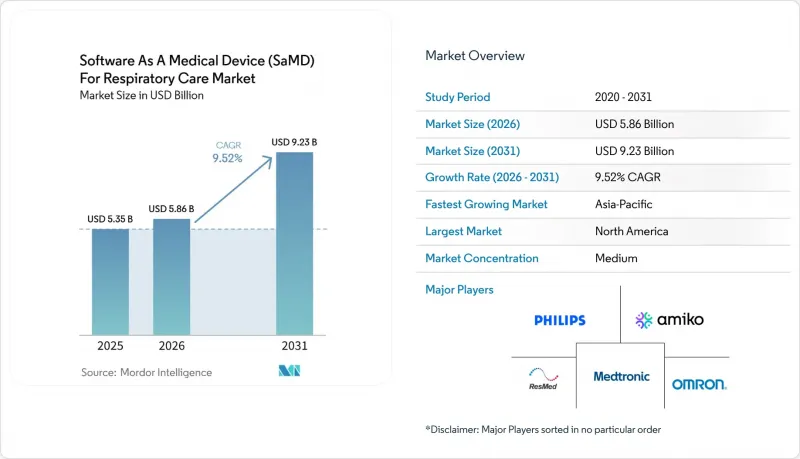
This report is Segmented by Component (Software, Services), Deployment Mode (Cloud-Based, On-Premises), Application (Diagnosis, Monitoring, Therapy Management, Exacerbation Prediction, Inhaler Adherence), End User (Hospitals, Homecare, Diagnostic Centers, Ambulatory Care, Pulmonary Rehabilitation), and Geography (North America, Europe, Asia-Pacific, MEA, South America). Forecasts in Value (USD).
Global Software As A Medical Device (SaMD) For Respiratory Care Market Trends and Insights
Rising Adoption of AI-Enabled Respiratory Decision Support
AI-enabled respiratory decision support is moving beyond pilots and into routine clinical procurement in the software as a medical device (SaMD) for respiratory care market. A randomized controlled trial published in 2024 showed that AI-assisted spirometry interpretation improved COPD diagnosis prediction among primary care clinicians, particularly in cases that clinicians might otherwise have missed. A 2025 blinded diagnostic accuracy study reported an area under the curve of 0.914 for AI spirometry software in a primary care dataset of 1,113 patients. In July 2026, Autonomous Healthcare received FDA De Novo marketing authorization for Syncron-E, creating a new device classification for ventilator waveform analysis software and supporting a clearer regulatory path for focused respiratory algorithms. Clinical validation and clearer review pathways are shortening commercialization timelines and attracting more capital and product development into the software as a medical device (SaMD) for respiratory care market.
Shift From Episodic to Continuous Home-Based Respiratory Monitoring
The shift from clinic-based checks to continuous home-based monitoring is reshaping product design and purchasing priorities across the software as a medical device (SaMD) for respiratory care market. Connected spirometers, inhalers, and wearables generate large patient data streams, while software converts these signals into alerts, trends, and care actions. This shift is one reason homecare settings are growing faster than other end-user categories, with a projected CAGR of 12.33% through 2031. In June 2026, PanopticAI received FDA 510(k) clearance for contactless respiratory rate measurement through a smartphone camera, reinforcing the move toward software subscriptions, monitoring intelligence, and scalable remote care workflows.
Regulatory Reclassification Risk for Signal-Processing Software
Regulatory classification remains a key uncertainty for parts of the software as a medical device (SaMD) for respiratory care market. A tool that starts as low-risk decision support can shift into a regulated device category once its outputs become more treatment-directed or clinically decisive. The FDA's December 2024 guidance on AI-enabled device software clarified that lifecycle controls, update plans, and performance documentation mattered throughout the product life of regulated software, not only at launch. In April 2026, Philips issued a Class I product correction related to Trilogy Evo ventilator software, affecting more than 113,700 devices globally and highlighting how software faults in respiratory care escalated into patient safety and recall issues. Across Europe, the Cyber Resilience Act added another layer of cybersecurity responsibility on top of medical device compliance, increasing cost and complexity for companies operating across multiple jurisdictions.
Other drivers and restraints analyzed in the detailed report include:
- Expansion of Reimbursement-Ready Remote Patient Monitoring Workflows
- Higher Clinical Demand for Exacerbation Prediction and Therapy Adherence
- Weak Prospective Evidence and Reimbursement Fragmentation
For complete list of drivers and restraints, kindly check the Table Of Contents.
Segment Analysis
Software held 69.55% of revenue in 2025, keeping it the core revenue engine in the software as a medical device (SaMD) for respiratory care market. This leadership reflected strong demand for diagnostic software, monitoring platforms, and decision support tools across institutional and home-based respiratory workflows. The software as a medical device (SaMD) for respiratory care market size for services is forecast to expand at a CAGR of 11.93% through 2031, placing services ahead of the broader category growth pace.
This faster growth showed that buyers were moving beyond software licenses and investing in deployment, validation, support, and managed service layers. Health systems increasingly required vendor support for integration, staff onboarding, and post-deployment monitoring. The shift also reflected the need for respiratory software to prove clinical performance over time, not only at the point of initial sale.
Cloud-based deployment held 64.22% of revenue in 2025, making it the largest deployment model in the software as a medical device (SaMD) for respiratory care market. Its lead came from centralized updates, easier storage expansion, cross-site access, and a simpler path to continuous algorithm improvement. The software as a medical device (SaMD) for respiratory care market share for cloud platforms stayed strong due to demand from homecare and ambulatory workflows.
On-premises deployment is projected to grow at a CAGR of 12.67% through 2031, making it the fastest-growing deployment mode despite the broader shift toward cloud architecture. This growth reflected demand from large hospital systems, intensive care settings, and organizations requiring stricter control over sensitive respiratory data. Some use cases required very low latency and uninterrupted processing, making local or tightly controlled private environments more practical for waveform-driven software such as ventilator analysis tools.
Complete Report Scope:
- By Component
- Software
- Diagnostic Software
- Monitoring Software
- Decision Support Software
- Disease Management Software
- Digital Therapeutics Software
- Services
- Implementation and Integration Services
- Clinical Validation Services
- Training and Support Services
- Managed and Subscription Services
- Software
- By Deployment Mode
- Cloud-Based
- On-Premises
- By Application
- Diagnosis and Screening
- Monitoring and Alerting
- Therapy Management
- Exacerbation Prediction
- Inhaler Technique Coaching and Adherence
- By End User
- Hospitals and Clinics
- Homecare Settings
- Diagnostic Centers
- Ambulatory Care Centers
- Pulmonary Rehabilitation Centers
- By Geography
- North America
- United States
- Canada
- Mexico
- Europe
- Germany
- United Kingdom
- France
- Italy
- Spain
- Rest of Europe
- Asia-Pacific
- China
- India
- Japan
- Australia
- South Korea
- Rest of Asia-Pacific
- Middle East and Africa
- GCC
- South Africa
- Rest of Middle East and Africa
- South America
- Brazil
- Argentina
- Rest of South America
- North America
Geography Analysis
North America accounted for 42.25% of global revenue in 2025, maintaining its position as the largest regional bloc in the software as a medical device (SaMD) for respiratory care market. The region benefited from mature remote care infrastructure, established respiratory device usage, and a regulatory framework that continued to guide updates and oversight for AI-enabled medical software. Supportive reimbursement policies also improved adoption, especially for respiratory monitoring workflows with clearer coding routes and lower billing barriers.
Europe remained a major region in the software as a medical device (SaMD) for respiratory care market, supported by strong public health systems and well-defined digital and regulatory standards. The European Health Data Space advanced interoperability and data exchange, supporting broader adoption of connected health software across member states. This gave respiratory software vendors clearer long-term direction on product integration with clinical systems. Europe's stricter compliance, cybersecurity, and certification requirements benefited firms with the resources to manage regulatory and product operations across countries.
Asia-Pacific was the fastest-growing region, with the software as a medical device (SaMD) for respiratory care market size in the region projected to register a CAGR of 13.95% through 2031. High respiratory disease burden, rising digital health investment, and stronger commercialization of locally developed clinical software supported growth. In June 2026, Nozomi MedAlliance and Yamaguchi University began overseas commercialization work for an AI asthma individualized treatment platform, signaling a more outward-facing phase for Japanese respiratory SaMD development.
- Adherium
- AireHealth, Inc.
- Amiko Digital Health
- AptarGroup, Inc.
- BreatheSuite
- Cognita Labs
- Findair
- Fisher & Paykel Healthcare
- GlaxoSmithKline
- Inogen
- Koninklijke Philips
- Medtronic
- NIOX Group plc
- OMRON Healthcare Co., Ltd.
- Pulmonx Corporation
- Resmed
Additional Benefits:
- The market estimate (ME) sheet in Excel format
- 3 months of analyst support
TABLE OF CONTENTS
1 INTRODUCTION
- 1.1 Study Assumptions and Market Definition
- 1.2 Scope of the Study
2 RESEARCH METHODOLOGY
3 EXECUTIVE SUMMARY
4 MARKET LANDSCAPE
- 4.1 Market Overview
- 4.2 Market Drivers
- 4.2.1 Rising Adoption of AI-Enabled Respiratory Decision Support
- 4.2.2 Shift From Episodic to Continuous Home-Based Respiratory Monitoring
- 4.2.3 Expansion of Reimbursement-Ready Remote Patient Monitoring Workflows
- 4.2.4 Interoperability With EHR and Connected Inhaler Ecosystems
- 4.2.5 Rising Regulatory Clarity for Device Software Functions and CDS
- 4.2.6 Higher Clinical Demand for Exacerbation Prediction and Therapy Adherence
- 4.3 Market Restraints
- 4.3.1 Regulatory Reclassification Risk for Signal-Processing Software
- 4.3.2 Weak Prospective Evidence and Reimbursement Fragmentation
- 4.3.3 Cybersecurity and Health Data Privacy Exposure
- 4.3.4 Algorithm Bias Across Diverse Respiratory Phenotypes
- 4.4 Supply/Value Chain Analysis
- 4.5 Regulatory Landscape
- 4.6 Technological Outlook
- 4.7 Porter's Five Forces Analysis
- 4.7.1 Threat of New Entrants
- 4.7.2 Bargaining Power of Suppliers
- 4.7.3 Bargaining Power of Buyers
- 4.7.4 Threat of Substitutes
- 4.7.5 Industry Rivalry
5 MARKET SIZE AND GROWTH FORECASTS
- 5.1 By Component
- 5.1.1 Software
- 5.1.1.1 Diagnostic Software
- 5.1.1.2 Monitoring Software
- 5.1.1.3 Decision Support Software
- 5.1.1.4 Disease Management Software
- 5.1.1.5 Digital Therapeutics Software
- 5.1.2 Services
- 5.1.2.1 Implementation and Integration Services
- 5.1.2.2 Clinical Validation Services
- 5.1.2.3 Training and Support Services
- 5.1.2.4 Managed and Subscription Services
- 5.1.1 Software
- 5.2 By Deployment Mode
- 5.2.1 Cloud-Based
- 5.2.2 On-Premises
- 5.3 By Application
- 5.3.1 Diagnosis and Screening
- 5.3.2 Monitoring and Alerting
- 5.3.3 Therapy Management
- 5.3.4 Exacerbation Prediction
- 5.3.5 Inhaler Technique Coaching and Adherence
- 5.4 By End User
- 5.4.1 Hospitals and Clinics
- 5.4.2 Homecare Settings
- 5.4.3 Diagnostic Centers
- 5.4.4 Ambulatory Care Centers
- 5.4.5 Pulmonary Rehabilitation Centers
- 5.5 By Geography
- 5.5.1 North America
- 5.5.1.1 United States
- 5.5.1.2 Canada
- 5.5.1.3 Mexico
- 5.5.2 Europe
- 5.5.2.1 Germany
- 5.5.2.2 United Kingdom
- 5.5.2.3 France
- 5.5.2.4 Italy
- 5.5.2.5 Spain
- 5.5.2.6 Rest of Europe
- 5.5.3 Asia-Pacific
- 5.5.3.1 China
- 5.5.3.2 India
- 5.5.3.3 Japan
- 5.5.3.4 Australia
- 5.5.3.5 South Korea
- 5.5.3.6 Rest of Asia-Pacific
- 5.5.4 Middle East and Africa
- 5.5.4.1 GCC
- 5.5.4.2 South Africa
- 5.5.4.3 Rest of Middle East and Africa
- 5.5.5 South America
- 5.5.5.1 Brazil
- 5.5.5.2 Argentina
- 5.5.5.3 Rest of South America
- 5.5.1 North America
6 COMPETITIVE LANDSCAPE
- 6.1 Market Concentration
- 6.2 Market Share Analysis
- 6.3 Company Profiles (includes Global Level Overview, Market Level Overview, Core Segments, Financials as available, Strategic Information, Market Rank/Share, Products and Services, Recent Developments)
- 6.3.1 Adherium Limited
- 6.3.2 AireHealth, Inc.
- 6.3.3 Amiko Digital Health Limited
- 6.3.4 AptarGroup, Inc.
- 6.3.5 BreatheSuite Inc.
- 6.3.6 Cognita Labs
- 6.3.7 Findair Sp. z o.o.
- 6.3.8 Fisher & Paykel Healthcare Limited
- 6.3.9 GlaxoSmithKline plc
- 6.3.10 Inogen, Inc.
- 6.3.11 Koninklijke Philips N.V.
- 6.3.12 Medtronic plc
- 6.3.13 NIOX Group plc
- 6.3.14 OMRON Healthcare Co., Ltd.
- 6.3.15 Pulmonx Corporation
- 6.3.16 ResMed Inc.
7 MARKET OPPORTUNITIES AND FUTURE OUTLOOK
- 7.1 White-Space and Unmet-Need Assessment

