PUBLISHER: Mordor Intelligence | PRODUCT CODE: 2118099

PUBLISHER: Mordor Intelligence | PRODUCT CODE: 2118099
Generative AI In Automation - Market Share Analysis, Industry Trends & Statistics, Growth Forecasts (2026 - 2031)
According to Mordor Intelligence, the generative AI in automation market size is projected to expand from USD 9.84 billion in 2025 and USD 12.43 billion in 2026 to USD 43.29 billion by 2031, registering a CAGR of 28.35% between 2026 and 2031.
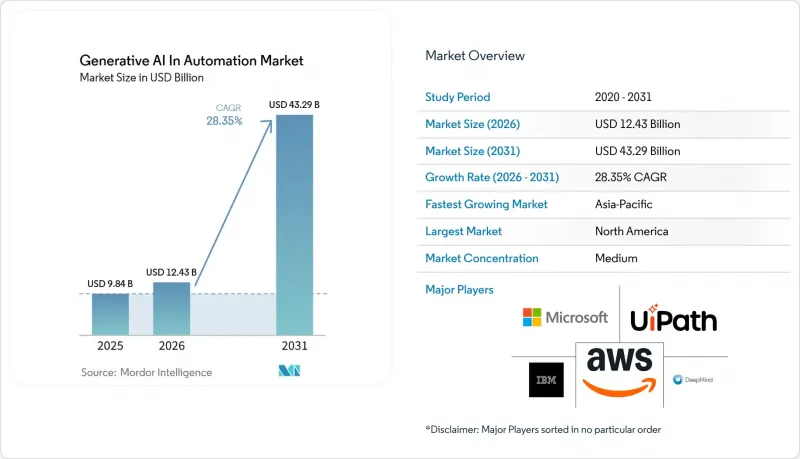
This report is Segmented by Solution (Generative AI Platforms, Automation Copilots, Services, and More), Deployment (Cloud, On-Premises, and Hybrid), Application (Gen AI RPA, Process Optimization, Conversational, Other Applications), End User (BFSI, Manufacturing, IT and Telecom, Healthcare, Retail, Government, and More), and Geography. The Market Forecasts are Provided in Terms of Value (USD).
Global Generative AI In Automation Market Trends and Insights
Rapid Shift From Rule-Based Automation to Generative Copilots
The generative AI in automation market is benefiting as enterprises replace rigid logic engines with copilots that can work with contextual information. Older automation systems often required specialists to script, test, and maintain each process path. Agentic AI reached 35% enterprise adoption within 2 years, while traditional AI reached 72% over 8 years, according to MIT Sloan Management Review. This adoption pattern supports demand for tools that simplify process design and reduce specialist bottlenecks. UiPath released UiPath for Coding Agents in May 2026, enabling enterprise coding agents to generate, test, deploy, and govern automations through natural-language conversation. The change can shorten the time required to place new processes into operation and make automation creation accessible to a wider group of employees.
Rising Demand for Process Efficiency and Workflow Orchestration
Organizations increasingly need automation that coordinates agents, bots, and employees across several business systems. Isolated bots can complete routine tasks, but they do not manage the handoffs, exceptions, and approvals within broader workflows. Salesforce launched Agentforce Operations in April 2026 for back-office process agents used across procurement, compliance, and approval workflows. The company reported that early adopters reduced cycle times by 50-70% and manual data-entry errors by 80%. These results explain why buyers are looking for orchestration layers rather than adding separate automation products for each task. The generative AI in automation market, therefore, favors platforms that can work across business applications while retaining process visibility and human review.
Integration Complexity Across Legacy OT, IT, and Edge Systems
Legacy operational technology often uses industrial communication protocols that predate current API designs. This makes it more difficult to connect to newer generative AI tools in production environments. UiPath found that 52% of nearly 600 C-suite and IT practitioners at organizations with more than USD 1 billion in revenue operated hybrid process environments that mixed static and dynamic processes across disconnected systems. Organizations may need middleware, protocol translators, and custom connectors to bridge these environments. These additions can raise project costs, increase latency, and introduce additional operational risks. Buyers with extensive ERP and operational technology stacks may favor established providers with pre-built connectors and deeper implementation support.
Other drivers and restraints analyzed in the detailed report include:
- Generative AI for Automation Development, Troubleshooting, and Maintenance
- Intelligent RPA Across Back-Office and Shop-Floor Workflows
- Data Privacy, IP Leakage, and Hallucination Risk in Operational Environments
For complete list of drivers and restraints, kindly check the Table Of Contents.
Segment Analysis
Generative AI Platforms held 31.84% of the generative AI in automation market share in 2025. Enterprises used orchestration-layer APIs from hyperscalers and independent software vendors as a common foundation for automation programs. Their early position reflects the value of having model APIs already embedded in enterprise stacks. Services formed the next large category because implementation, customization, and managed automation needs rise with platform complexity. Automation Copilots also retained an important role for buyers who wanted to extend familiar workflow products with limited disruption. Other solution types, including process mining and discovery tools, supported upstream work to identify suitable processes before deployment.
AI Agents and Agentic Automation Platforms are projected to expand at a CAGR of 31.08% through 2031. The segment's generative AI in automation market size is supported by the move from assistive tools to systems that can perform multi-step work across applications. Copilots generally recommend actions, while agents can complete actions under defined controls. IBM presented the next generation of watsonx Orchestrate in May 2026 as an agentic control plane that can deploy agents from different sources with consistent policy enforcement. This design addresses the need to govern agents that come from several technology suppliers. Demand for governance, monitoring, and interoperability should rise as enterprises place agents in more business processes. Providers with policy controls and integration capabilities are better positioned to serve this requirement. The generative AI in automation market is therefore shifting toward platforms that balance autonomous work with accountable management.
Cloud deployment commanded 75.42% of the generative AI in automation market share in 2025. Enterprises used hyperscaler infrastructure to access advanced models, elastic compute capacity, and frequent product updates without incurring capital costs for local infrastructure. Cloud services also reduced the time needed to begin a pilot or add new users. The on-premises segment was smaller, but it remained important for organizations that could not move workflow data outside controlled environments. Government agencies and regulated businesses often require stronger control over data location and system access. These needs kept on-premises deployment relevant even as cloud services remained the main delivery model.
Hybrid deployment is projected to grow at a CAGR of 29.76% from 2026 to 2031. Organizations are using hybrid designs to keep sensitive training data and fine-tuning work in controlled environments while using public endpoints for general inference. This structure does not represent a broad withdrawal from cloud services. Instead, it allows firms to separate workloads according to data sensitivity and operational requirements. UiPath updated Automation Suite in May 2026 to provide on-premises agentic AI capabilities across AWS, Azure, and OpenShift environments. The product targets public-sector and regulated users that cannot route workflow data through external cloud APIs. Asia-Pacific and Middle East buyers may place more weight on hybrid and on-premises deployments where data-sovereignty policies are more directive. The generative AI in automation market will continue to use cloud infrastructure widely, while hybrid systems address security and compliance needs.
Complete Report Scope:
- By Solution Type
- Generative AI Platforms
- Automation Copilots
- AI Agents and Agentic Automation Platforms
- Services
- Other Solution Types
- By Deployment
- Cloud
- On-premises
- Hybrid
- By Application
- Generative AI-Enabled Robotic Process Automation
- Process Optimization and Workflow Orchestration
- Conversational and Natural-Language Automation
- Other Applications
- By End User
- BFSI
- Manufacturing
- IT and Telecommunications
- Healthcare and Life Sciences
- Retail and E-commerce
- Government and Public Sector
- Energy and Utilities
- Transportation and Logistics
- Media and Entertainment
- Other End users
- By Geography
- North America
- United States
- Canada
- Mexico
- South America
- Brazil
- Argentina
- Rest of South America
- Europe
- Germany
- United Kingdom
- France
- Italy
- Spain
- Russia
- Rest of Europe
- Asia-Pacific
- China
- Japan
- India
- South Korea
- Australia
- Rest of Asia-Pacific
- Middle East
- Saudi Arabia
- United Arab Emirates
- Turkey
- Rest of Middle East
- Africa
- South Africa
- Egypt
- Rest of Africa
- North America
Geography Analysis
North America held 40.52% of the generative AI in automation market share in 2025, supported by its concentration of hyperscale computing infrastructure, enterprise software suppliers, and early adopters in BFSI and technology. The United States remains the region's main demand center because financial services, technology, and government organizations can use AI automation through established enterprise platforms. Microsoft announced native Windows Agent Framework support for desktop AI orchestration and expanded Copilot Studio connectors during Build 2026, which broadens the generative AI in automation market across enterprise worker tools. Canada and Mexico contribute through IT modernization and nearshore service delivery, including cost-sensitive back-office automation. These conditions preserve the region's leading position while creating a large installed base for newer agentic capabilities.
Asia-Pacific is projected to grow at a CAGR of 30.83% between 2026 and 2031, with government-led industrial AI plans, growing digital infrastructure, and uneven automation maturity shaping demand. China's AI+Manufacturing action plan directs the development of 1,000 high-level industrial AI agents by 2027 and gives the generative AI in automation market a policy-led source of manufacturing demand. Japan is applying generative AI to quality management, predictive maintenance, and supply-chain coordination, while India combines a growing user base with a technology-services sector that deploys and delivers automation solutions. National differences in implementation capacity, data rules, and industrial structures will determine how quickly individual countries convert interest into scaled use. Asia-Pacific therefore has a wider range of growth conditions than North America, but a strong outlook for both industrial and enterprise applications.
Europe retained a significant regional position, with Germany, the United Kingdom, and France supporting adoption across manufacturing, financial services, and public-sector applications, while high-risk AI requirements can lengthen procurement and increase demand for governance automation. Middle East markets, especially Saudi Arabia and the United Arab Emirates, are expanding through sovereign AI programs, smart-government projects, and industrial diversification, which adds new deployment settings for the generative AI in automation market. Africa remains at an earlier stage, led by financial-services and telecommunications applications in South Africa and Egypt, as infrastructure gaps and readiness constraints limit wider uptake. South America, led by Brazil and Argentina, is seeing demand in BFSI and e-commerce automation, although limited high-performance computing access and developing regulatory frameworks may slow adoption compared with other emerging regions.
- Microsoft Corporation
- Amazon Web Services, Inc.
- UiPath Inc.
- International Business Machines Corporation
- Google DeepMind Technologies Limited
- Oracle Corporation
- Salesforce, Inc.
- Siemens AG
- Automation Anywhere, Inc.
- C3.ai, Inc.
- SAP SE
- Schneider Electric SE
- Rockwell Automation, Inc.
- Honeywell International Inc.
- GE Vernova Inc.
- ServiceNow, Inc.
- Pegasystems Inc.
- Databricks, Inc.
- OpenAI, L.L.C.
- NVIDIA Corporation
Additional Benefits:
- The market estimate (ME) sheet in Excel format
- 3 months of analyst support
TABLE OF CONTENTS
1 Introduction
- 1.1 Study Assumptions and Market Definition
- 1.2 Scope of the Study
2 Research Methodology
3 Executive Summary
4 MARKET LANDSCAPE
- 4.1 Market Overview
- 4.2 Market Drivers
- 4.2.1 Rapid Shift From Rule-Based Automation to Generative Copilots
- 4.2.2 Rising Demand for Process Efficiency and Workflow Orchestration
- 4.2.3 Growing Adoption of Generative AI for Automation Development, Troubleshooting, and Maintenance Assistance
- 4.2.4 Growing Adoption of Intelligent RPA Across Back-Office and Shop-Floor Workflows
- 4.2.5 Growing Enterprise Demand for AI-Powered Process Discovery and Automation Creation
- 4.2.6 Need for Human-in-the-Loop Auditability in Regulated Automation Use Cases
- 4.3 Market Restraints
- 4.3.1 High Integration Complexity Across Legacy OT, IT, and Edge Systems
- 4.3.2 Data Privacy, IP Leakage, and Hallucination Risk in Operational Environments
- 4.3.3 Unclear Return on Investment for Small and Mid-Sized Plants
- 4.3.4 Compute, Latency, Scalability, and Model Deployment Constraints
- 4.4 Value and Supply Chain Analysis
- 4.5 Regulatory Landscape
- 4.6 Technological Outlook
- 4.7 Porter's Five Forces Analysis
- 4.7.1 Bargaining Power of Suppliers
- 4.7.2 Bargaining Power of Buyers
- 4.7.3 Threat of New Entrants
- 4.7.4 Threat of Substitutes
- 4.7.5 Competitive Rivalry
5 MARKET SIZE AND GROWTH FORECASTS (VALUE)
- 5.1 By Solution Type
- 5.1.1 Generative AI Platforms
- 5.1.2 Automation Copilots
- 5.1.3 AI Agents and Agentic Automation Platforms
- 5.1.4 Services
- 5.1.5 Other Solution Types
- 5.2 By Deployment
- 5.2.1 Cloud
- 5.2.2 On-premises
- 5.2.3 Hybrid
- 5.3 By Application
- 5.3.1 Generative AI-Enabled Robotic Process Automation
- 5.3.2 Process Optimization and Workflow Orchestration
- 5.3.3 Conversational and Natural-Language Automation
- 5.3.4 Other Applications
- 5.4 By End User
- 5.4.1 BFSI
- 5.4.2 Manufacturing
- 5.4.3 IT and Telecommunications
- 5.4.4 Healthcare and Life Sciences
- 5.4.5 Retail and E-commerce
- 5.4.6 Government and Public Sector
- 5.4.7 Energy and Utilities
- 5.4.8 Transportation and Logistics
- 5.4.9 Media and Entertainment
- 5.4.10 Other End users
- 5.5 By Geography
- 5.5.1 North America
- 5.5.1.1 United States
- 5.5.1.2 Canada
- 5.5.1.3 Mexico
- 5.5.2 South America
- 5.5.2.1 Brazil
- 5.5.2.2 Argentina
- 5.5.2.3 Rest of South America
- 5.5.3 Europe
- 5.5.3.1 Germany
- 5.5.3.2 United Kingdom
- 5.5.3.3 France
- 5.5.3.4 Italy
- 5.5.3.5 Spain
- 5.5.3.6 Russia
- 5.5.3.7 Rest of Europe
- 5.5.4 Asia-Pacific
- 5.5.4.1 China
- 5.5.4.2 Japan
- 5.5.4.3 India
- 5.5.4.4 South Korea
- 5.5.4.5 Australia
- 5.5.4.6 Rest of Asia-Pacific
- 5.5.5 Middle East
- 5.5.5.1 Saudi Arabia
- 5.5.5.2 United Arab Emirates
- 5.5.5.3 Turkey
- 5.5.5.4 Rest of Middle East
- 5.5.6 Africa
- 5.5.6.1 South Africa
- 5.5.6.2 Egypt
- 5.5.6.3 Rest of Africa
- 5.5.1 North America
6 COMPETITIVE LANDSCAPE
- 6.1 Market Concentration
- 6.2 Strategic Moves
- 6.3 Market Share Analysis
- 6.4 Company Profiles (includes Global Level Overview, Market Level Overview, Core Segments, Financials as available, Strategic Information, Market Rank/Share, Products and Services, Recent Developments)
- 6.4.1 Microsoft Corporation
- 6.4.2 Amazon Web Services, Inc.
- 6.4.3 UiPath Inc.
- 6.4.4 International Business Machines Corporation
- 6.4.5 Google DeepMind Technologies Limited
- 6.4.6 Oracle Corporation
- 6.4.7 Salesforce, Inc.
- 6.4.8 Siemens AG
- 6.4.9 Automation Anywhere, Inc.
- 6.4.10 C3.ai, Inc.
- 6.4.11 SAP SE
- 6.4.12 Schneider Electric SE
- 6.4.13 Rockwell Automation, Inc.
- 6.4.14 Honeywell International Inc.
- 6.4.15 GE Vernova Inc.
- 6.4.16 ServiceNow, Inc.
- 6.4.17 Pegasystems Inc.
- 6.4.18 Databricks, Inc.
- 6.4.19 OpenAI, L.L.C.
- 6.4.20 NVIDIA Corporation
7 MARKET OPPORTUNITIES AND FUTURE OUTLOOK
- 7.1 White-space and Unmet-Need Assessment

