PUBLISHER: Mordor Intelligence | PRODUCT CODE: 2118113

PUBLISHER: Mordor Intelligence | PRODUCT CODE: 2118113
Generative AI In Game Environment and Narrative Design - Market Share Analysis, Industry Trends & Statistics, Growth Forecasts (2026 - 2031)
According to Mordor Intelligence, the generative AI in game environment and narrative design market size is projected to expand from USD 2.41 billion in 2025 and USD 3.05 billion in 2026 to USD 10.84 billion by 2031, registering a CAGR of 28.87% between 2026 and 2031.
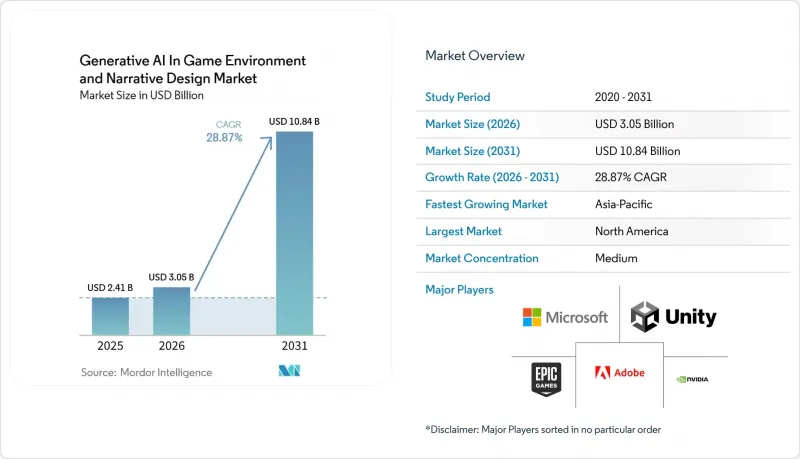
This report is Segmented by Offering (Platforms and Software and Services), Deployment Mode (Cloud Based, On-Premises, and Hybrid), Application (Environment Generation, Narrative Design and Storyline Generation, and More), End User (AAA Studios, SME Studios, Independent Developers, and More), and Geography. The Market Forecasts are Provided in Terms of Value (USD).
Global Generative AI In Game Environment and Narrative Design Market Trends and Insights
Accelerating Studio Adoption of Generative AI for World Building
World-building has historically taken 30-40% of total game pre-production time. Generative AI is helping studios shorten that process across larger content pipelines. Perforce reported that 70% of respondents used generative AI in their workflows in 2025, up from 65% the previous year. Content creation remained the highest-volume use case in that survey. Studios can produce more environment variants, allowing teams to assess creative options that manual asset pipelines could not support at the same scale. Epic Games said Unreal Engine 6 will integrate models, including Claude and Gemini, as creativity and productivity tools for content authoring. The generative AI in game environment and narrative design market is therefore becoming more closely connected to engine-level workflows rather than separate production systems.
Demand for Adaptive NPC Dialogue and Memory-Driven Characters
Player expectations are shifting toward NPCs that respond to context and remember earlier interactions. In a 2025 Google Cloud and Harris Poll study, 34% of developers said players explicitly wanted smarter and more adaptive NPCs. Static dialogue trees can become less effective in live-service games where players spend many hours with the same characters. NVIDIA expanded its ACE platform at CES 2025 to support autonomous game characters that perceive game states, plan actions, and adapt to player tactics. NVIDIA later announced the ACE Game Agent SDK Beta for Unreal Engine 5, including on-device speech recognition, small language models, and text-to-speech components. The generative AI in game environment and narrative design market increasingly rewards vendors that can integrate dialogue, memory, and runtime performance within existing development workflows.
Copyright, IP Ownership, and Training Data Liability Risks
The legal status of training data is a material constraint on commercial deployment. The U.S. Copyright Office stated in its 2025 report that training on copyrighted works may require permission from rights holders when outputs risk reproducing protected material. This position is relevant to studios using tools trained on commercially available game assets. EU AI Act Article 53 obligations have been in effect since August 2025 and have increased focus on transparency of training data. Established companies can use licensed, proprietary, or synthetic datasets and dedicate resources to documentation. Smaller studios can face greater exposure through third-party tool dependencies and vendor review requirements. The generative AI in game environment and narrative design market is likely to favor suppliers that can provide clear provenance and contractual support.
Other drivers and restraints analyzed in the detailed report include:
- Need for Faster Pre-Production and Iteration Cycles
- Rising Live-Service Content Refresh Requirements
- Inconsistent Narrative Quality and Gameplay Coherence in AI-Generated Content
For complete list of drivers and restraints, kindly check the Table Of Contents.
Segment Analysis
Platforms and software accounted for 74.12% of the generative AI in game environment and narrative design market share within the offering segment in 2025. Studios favor cloud-hosted and integration-ready tools that fit established Unity or Unreal Engine workflows. These systems reduce the engineering work required to connect separate AI products with game engines. Unity introduced Unity AI in Unity 6.2 during August 2025, providing generators for several asset types and an AI Assistant. Unreal Engine 6 is planned to embed AI models within its content-authoring environment. Platform offerings are setting a baseline capability that can reach developers across studio sizes.
Services are projected to grow at a 29.54% CAGR through 2031. This offering supports studios that need more than standard tools can provide. Demand is linked to model fine-tuning, proprietary workflow support, and managed inference at scale. Services can also assist with model auditing, training-data provenance, and documentation. These needs are becoming more relevant as the EU AI Act transparency obligations affect studio procurement and legal review. Platforms capture broad deployment volume, while services support higher-value, customized requirements within the generative AI in game environment and narrative design market.
Cloud-based deployment held 71.43% of the deployment segment in 2025. Cloud systems offer a relatively simple implementation and scalable capacity for live-service production. They are useful where high concurrent-user volumes require flexible inference resources. Large providers have also invested heavily in cloud infrastructure to support these workloads. Private GPU clusters can create capital costs that many studios cannot justify. Cloud deployment remains important for pre-production content generation and other work that benefits from centralized computing resources.
Hybrid deployment is projected to expand at a 30.12% CAGR through 2031. This model is supported by small language models that can run real-time NPC functions on consumer-grade RTX hardware. NVIDIA's ACE Game Agent SDK Beta supports local AI character pipelines through Unreal Engine 5 plugins. The generative AI in game environment and narrative design market size for hybrid deployment is shaped by the division between cloud-based production tasks and local runtime inference. Vendors that support both modes with a single software development kit can better meet studio requirements. On-premises systems remain relevant for studios with strict data sovereignty needs or persistent connectivity and latency concerns.
Complete Report Scope:
- By Offering
- Platforms and Software
- Services
- By Deployment Mode
- Cloud Based
- On-Premises
- Hybrid
- By Application
- Environment Generation
- Narrative Design and Storyline Generation
- NPC Behavior and Dialogue Generation
- Quest and Mission Generation
- By End User
- AAA and Large Game Studios
- Small and Mid-Sized Game Studios
- Independent Developers
- Game Publishers
- Other End Users
- By Geography
- North America
- United States
- Canada
- Mexico
- South America
- Brazil
- Argentina
- Rest of South America
- Europe
- Germany
- United Kingdom
- France
- Italy
- Spain
- Russia
- Rest of Europe
- Asia-Pacific
- China
- Japan
- India
- South Korea
- Australia
- Rest of Asia-Pacific
- Middle East
- Saudi Arabia
- United Arab Emirates
- Turkey
- Rest of Middle East
- Africa
- South Africa
- Egypt
- Rest of Africa
- North America
Geography Analysis
North America held 38.74% of the generative AI in game environment and narrative design market share in 2025. The region includes major game engines, AI hardware suppliers, and high-budget AAA publishers. This concentration supports early adoption across development tools, infrastructure, and production teams. Microsoft published the Muse World and Human Action Model in Nature during May 2026. The model can produce game visuals and player controller actions simultaneously. Microsoft also continued its work with Inworld AI on AI-powered narrative and quest-design tools for Xbox developers.
Asia-Pacific is projected to grow at a 30.85% CAGR through 2031. The region combines a high baseline of AI adoption with a large live-service game economy. The Japan Online Game Association reported 100% adoption of generative AI among surveyed online game companies in its 2026 research. Google Gemini was used by 94% of those respondents. Tencent and NetEase are investing in AI-assisted game creation, while Tencent Cloud announced a partnership with Inworld AI for real-time voice AI capabilities in June 2026.
Europe has a more deliberate adoption profile because the EU AI Act adds transparency requirements for generated content and training-data provenance. South America is at an earlier stage, with Brazil's mobile development sector and Argentina's development talent using globally available cloud tools. The Middle East has emerging demand as Saudi Arabia and the United Arab Emirates invest in gaming and digital entertainment infrastructure. Africa remains the most nascent region, with usage concentrated among independent and mobile-first developers. Cloud-native platforms can lower infrastructure requirements in both regions. These patterns extend the generative AI in game environment and narrative design market beyond its established North American and Asia-Pacific centers.
- Unity Technologies SF
- Epic Games, Inc.
- Microsoft Corporation
- NVIDIA Corporation
- Adobe Inc.
- Google LLC
- Tencent Holdings Limited
- NetEase, Inc.
- Ubisoft Entertainment SA
- Electronic Arts Inc.
- Rosebud AI, Inc.
- Meshy AI, Inc.
- Ludo AI Ltd.
- Charisma Entertainment Ltd
- Inworld AI, Inc.
- Convai, Inc.
- Promethean AI, Inc.
- Latitude, Inc.
- Scenario, Inc.
- Hidden Door, Inc.
Additional Benefits:
- The market estimate (ME) sheet in Excel format
- 3 months of analyst support
TABLE OF CONTENTS
1 INTRODUCTION
- 1.1 Study Assumptions and Market Definition
- 1.2 Scope of the Study
2 RESEARCH METHODOLOGY
3 EXECUTIVE SUMMARY
4 MARKET LANDSCAPE
- 4.1 Market Overview
- 4.2 Market Drivers
- 4.2.1 Accelerating Studio Adoption of Generative AI for World Building
- 4.2.2 Demand for Adaptive NPC Dialogue and Memory-Driven Characters
- 4.2.3 Need for Faster Pre-Production and Iteration Cycles
- 4.2.4 Rising Live-Service Content Refresh Requirements
- 4.2.5 Expansion of Multimodal AI Toolchains for Text, Audio, and Visual Generation
- 4.2.6 Growing Use of AI-Assisted Narrative Localization and Branching Content
- 4.3 Market Restraints
- 4.3.1 Copyright, IP Ownership, and Training Data Liability Risks
- 4.3.2 Inconsistent Narrative Quality and Gameplay Coherence in AI-Generated Content
- 4.3.3 Compute Cost, Latency, and Runtime Integration Constraints
- 4.3.4 Developer and Player Trust Gaps Around Over-Automation
- 4.4 Value Chain Analysis
- 4.5 Regulatory Landscape
- 4.6 Technological Outlook
- 4.7 Porter's Five Forces Analysis
- 4.7.1 Bargaining Power of Suppliers
- 4.7.2 Bargaining Power of Buyers
- 4.7.3 Threat of New Entrants
- 4.7.4 Threat of Substitutes
- 4.7.5 Industry Rivalry
5 MARKET SIZE AND GROWTH FORECASTS (VALUE)
- 5.1 By Offering
- 5.1.1 Platforms and Software
- 5.1.2 Services
- 5.2 By Deployment Mode
- 5.2.1 Cloud Based
- 5.2.2 On-Premises
- 5.2.3 Hybrid
- 5.3 By Application
- 5.3.1 Environment Generation
- 5.3.2 Narrative Design and Storyline Generation
- 5.3.3 NPC Behavior and Dialogue Generation
- 5.3.4 Quest and Mission Generation
- 5.4 By End User
- 5.4.1 AAA and Large Game Studios
- 5.4.2 Small and Mid-Sized Game Studios
- 5.4.3 Independent Developers
- 5.4.4 Game Publishers
- 5.4.5 Other End Users
- 5.5 By Geography
- 5.5.1 North America
- 5.5.1.1 United States
- 5.5.1.2 Canada
- 5.5.1.3 Mexico
- 5.5.2 South America
- 5.5.2.1 Brazil
- 5.5.2.2 Argentina
- 5.5.2.3 Rest of South America
- 5.5.3 Europe
- 5.5.3.1 Germany
- 5.5.3.2 United Kingdom
- 5.5.3.3 France
- 5.5.3.4 Italy
- 5.5.3.5 Spain
- 5.5.3.6 Russia
- 5.5.3.7 Rest of Europe
- 5.5.4 Asia-Pacific
- 5.5.4.1 China
- 5.5.4.2 Japan
- 5.5.4.3 India
- 5.5.4.4 South Korea
- 5.5.4.5 Australia
- 5.5.4.6 Rest of Asia-Pacific
- 5.5.5 Middle East
- 5.5.5.1 Saudi Arabia
- 5.5.5.2 United Arab Emirates
- 5.5.5.3 Turkey
- 5.5.5.4 Rest of Middle East
- 5.5.6 Africa
- 5.5.6.1 South Africa
- 5.5.6.2 Egypt
- 5.5.6.3 Rest of Africa
- 5.5.1 North America
6 COMPETITIVE LANDSCAPE
- 6.1 Market Concentration
- 6.2 Strategic Moves
- 6.3 Market Share Analysis
- 6.4 Company Profiles (includes Global Level Overview, Market Level Overview, Core Segments, Financials as available, Strategic Information, Market Rank/Share, Products and Services, Recent Developments)
- 6.4.1 Unity Technologies SF
- 6.4.2 Epic Games, Inc.
- 6.4.3 Microsoft Corporation
- 6.4.4 NVIDIA Corporation
- 6.4.5 Adobe Inc.
- 6.4.6 Google LLC
- 6.4.7 Tencent Holdings Limited
- 6.4.8 NetEase, Inc.
- 6.4.9 Ubisoft Entertainment SA
- 6.4.10 Electronic Arts Inc.
- 6.4.11 Rosebud AI, Inc.
- 6.4.12 Meshy AI, Inc.
- 6.4.13 Ludo AI Ltd.
- 6.4.14 Charisma Entertainment Ltd
- 6.4.15 Inworld AI, Inc.
- 6.4.16 Convai, Inc.
- 6.4.17 Promethean AI, Inc.
- 6.4.18 Latitude, Inc.
- 6.4.19 Scenario, Inc.
- 6.4.20 Hidden Door, Inc.
7 MARKET OPPORTUNITIES AND FUTURE OUTLOOK
- 7.1 White-Space and Unmet-Need Assessment

