PUBLISHER: Mordor Intelligence | PRODUCT CODE: 2118139

PUBLISHER: Mordor Intelligence | PRODUCT CODE: 2118139
Machine Learning Medical Software - Market Share Analysis, Industry Trends & Statistics, Growth Forecasts (2026 - 2031)
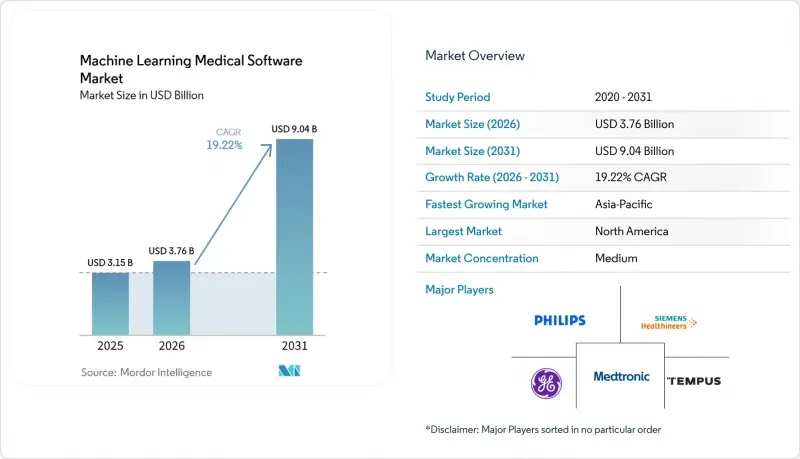
According to Mordor Intelligence, the machine learning medical software market size was valued at USD 3.15 billion in 2025 and is estimated to grow from USD 3.76 billion in 2026 to reach USD 9.04 billion by 2031, at a CAGR of 19.22% during the forecast period (2026-2031).
This report is Segmented by Software Type (Diagnostic, Therapeutic, Decision Support, Monitoring, Workflow), Clinical Specialty (Radiology, Cardiology, Oncology, and More), Technology (ML, Deep Learning, and More), Deployment (Cloud, On-Premises, Hybrid/Edge), End User (Hospitals, Ambulatory Centers, and More), and Geography (North America, Europe, Asia-Pacific, and More). Value (USD).
Global Machine Learning Medical Software Market Trends and Insights
Clinical Workflow Automation and Documentation Burden Reduction
Administrative work continues to reduce clinician time for patient-facing activities, making documentation and workflow software an accessible entry point for the machine learning medical software market. Providers can deploy ambient documentation, clinical coding, and clinical documentation improvement tools within established electronic health record processes. These tools deliver clear value by reducing repetitive work while preserving clinician review and accountability. Adoption can become more durable when software captures structured feedback during routine encounters and supports defined governance processes.
Regulatory and Reimbursement Maturation for AI-Enabled SaMD
Clearer regulation and payment pathways help providers evaluate purchases in the machine learning medical software market more effectively. Vendors that document how they will monitor, update, and validate a model after launch are better positioned to meet procurement requirements. Quality systems have become a competitive requirement, as hospitals require evidence of change control, risk management, and accountability before large-scale deployment. This environment favors companies with resources to maintain regulatory files across several jurisdictions and raises market entry barriers for smaller developers with limited compliance capacity.
Cybersecurity, Privacy, and Data-Integrity Exposure
Clinical software that handles protected health information must secure data across model development, inference, storage, and system integration. These requirements can extend contracting and implementation timelines, as providers need clarity on data residency, access rights, model updates, and deletion obligations. A June 2026 paper in Scientific Reports found that healthcare AI cloud architectures required layered controls designed for clinical operations. Smaller vendors may find these requirements harder to meet across multiple regulatory jurisdictions. Model drift adds risk, as software performance can decline when patient populations, equipment, or clinical practices change. Organizations must clearly allocate liability among the vendor, provider, and clinician before deploying high-stakes tools more broadly.
Other drivers and restraints analyzed in the detailed report include:
- Shortage of Clinicians and Diagnostic Specialists
- Multimodal Healthcare Data Expansion
- Clinical Validation and Generalizability Across Populations
For complete list of drivers and restraints, kindly check the Table Of Contents.
Segment Analysis
Diagnostic Software held 31.25% of the machine learning medical software market in 2025, supported by strong use in imaging interpretation, pathology analysis, and laboratory evaluation. Labeled data, established review processes, and integration with hospital imaging systems support segment adoption. Providers assess these tools through familiar metrics, including reading time, triage effectiveness, and diagnostic workflow fit.
Monitoring and Predictive Analytics Software is forecast to expand at a CAGR of 21.93% through 2031, the highest rate in this segmentation. Demand comes from intensive care monitoring, deterioration alerts, sepsis prediction, and risk scores based on continuous patient data. Therapeutic and Treatment-Planning Software is gaining relevance in oncology and robotic surgery. GE HealthCare received FDA 510(k) clearance in June 2026 for MIM Contour ProtegeAI+ 2.0, adding MRI brain and updated CT pelvic models for radiation oncology planning. Workflow, Documentation, and Revenue-Cycle Software also remains relevant due to its role in administrative efficiency and financial operations.
Radiology and Medical Imaging accounted for a 35.35% share in 2025, supported by large annotated image datasets and mature picture archiving and communication systems. These factors help providers integrate algorithms into routine imaging workflows across the machine learning medical software market. The segment remains important for triage, image review, reporting support, and quality control.
Neurology is projected to record a CAGR of 22.67% through 2031, the fastest growth rate among clinical specialties. Growth opportunities include diagnostic aids, epilepsy monitoring, and neuroimaging analysis for specialist review. NeuroPace received FDA approval in May 2026 for ECoG Assistant, an AI-driven clinician feature built on 124,450 epileptologist-labeled intracranial EEG records. Abbott received FDA clearance and CE Mark in April 2026 for Ultreon 3.0, which combines real-time AI plaque assessment with guidance for coronary intervention.
Complete Report Scope:
- By Software Type
- Diagnostic Software
- Therapeutic and Treatment-Planning Software
- Clinical Decision Support Software
- Monitoring and Predictive Analytics Software
- Workflow, Documentation, and Revenue-Cycle Software
- By Clinical Specialty
- Radiology and Medical Imaging
- Cardiology
- Oncology
- Neurology
- Pathology and Laboratory Medicine
- Ophthalmology
- Women's Health and Obstetrics
- Emergency Medicine and Critical Care
- Other Clinical Specialties
- By Technology
- Machine Learning and Predictive Models
- Deep Learning and Neural Networks
- Natural Language Processing
- Computer Vision
- Generative AI and Large Language Models
- Others
- By Deployment
- Cloud-Based
- On-Premises
- Hybrid and Edge-Enabled
- By End User
- Hospitals and Health Systems
- Ambulatory Surgical Centers and Physician Groups
- Diagnostic Laboratories and Imaging Centers
- Pharmaceutical and Biotechnology Companies
- Others
- By Geography
- North America
- United States
- Canada
- Mexico
- Europe
- Germany
- United Kingdom
- France
- Italy
- Spain
- Rest of Europe
- Asia-Pacific
- China
- India
- Japan
- Australia
- South Korea
- Rest of Asia-Pacific
- Middle East and Africa
- GCC
- South Africa
- Rest of Middle East and Africa
- South America
- Brazil
- Argentina
- Rest of South America
- North America
Geography Analysis
North America accounted for 39.99% of the machine learning medical software market in 2025. The region benefited from strong hospital IT infrastructure, established imaging workflows, and health systems capable of purchasing enterprise software. The United States remained the primary demand center, with providers using AI in documentation, diagnostics, monitoring, and clinical operations. Canada offered a smaller opportunity, while Mexico and other Latin American markets remained at an earlier stage, driven by hospital modernization and diagnostic capacity.
Europe held a meaningful position in the machine learning medical software market, supported by advanced hospital systems and strong clinical research networks in Germany, the United Kingdom, and France. Procurement decisions increasingly depended on privacy protections, technical documentation, and evidence of compliance with medical-device requirements. Italy and Spain added demand as hospital digitalization strengthened infrastructure. The region's commercial pace depended on vendors' ability to meet compliance requirements without slowing clinical implementation.
Asia-Pacific is forecast to grow at a CAGR of 21.77% through 2031, the highest rate among geographic segments. Government programs, hospital modernization, and specialist shortages supported AI-assisted diagnostics and clinical decision tools. South Korea built a growing digital health ecosystem, while China remained important as public hospitals evaluated software for local workflow and data needs. India offered opportunities in private diagnostic networks, Singapore invested in national AI capabilities, and the Middle East and Africa remained earlier-stage markets led by Gulf health system investments.
- Abbott Laboratories
- Aidoc Medical Ltd.
- Alphabet Inc.
- Butterfly Network, Inc.
- GE HealthCare Technologies Inc.
- Guardant Health, Inc.
- HeartFlow, Inc.
- IBM
- Intuitive Surgical, Inc.
- IQVIA
- iRhythm Technologies
- Koninklijke Philips
- Medidata Solutions, Inc.
- Medtronic
- Microsoft
- Natera, Inc.
- NVIDIA
- Oracle
- PathAI, Inc.
- Qure.ai Technologies Private Limited
- Roche Holdings, Inc.
- Siemens Healthineers
- Stryker
- Tempus AI, Inc.
- Viz.ai, Inc.
Additional Benefits:
- The market estimate (ME) sheet in Excel format
- 3 months of analyst support
TABLE OF CONTENTS
1 INTRODUCTION
- 1.1 Study Assumptions and Market Definition
- 1.2 Scope of the Study
2 RESEARCH METHODOLOGY
3 EXECUTIVE SUMMARY
4 MARKET LANDSCAPE
- 4.1 Market Overview
- 4.2 Market Drivers
- 4.2.1 Clinical Workflow Automation and Documentation Burden Reduction
- 4.2.2 Multimodal Healthcare Data Expansion
- 4.2.3 Shortage of Clinicians and Diagnostic Specialists
- 4.2.4 Regulatory and Reimbursement Maturation for AI-Enabled SaMD
- 4.2.5 AI-Ready Data Infrastructure From Hospital Modernization
- 4.2.6 Narrow-Workflow AI With Faster Evidence-to-Deployment Cycles
- 4.3 Market Restraints
- 4.3.1 Cybersecurity, Privacy, and Data-Integrity Exposure
- 4.3.2 Clinical Validation and Generalizability Across Populations
- 4.3.3 Model Drift and Silent Performance Decay After Deployment
- 4.3.4 Liability Allocation Across Vendor, Provider, and Clinician
- 4.4 Value / Supply-Chain Analysis
- 4.5 Regulatory Landscape
- 4.6 Technological Outlook
- 4.7 Porter's Five Forces Analysis
- 4.7.1 Bargaining Power of Suppliers
- 4.7.2 Bargaining Power of Buyers
- 4.7.3 Threat of New Entrants
- 4.7.4 Threat of Substitutes
- 4.7.5 Competitive Rivalry
5 MARKET SIZE AND GROWTH FORECASTS (VALUE, USD)
- 5.1 By Software Type
- 5.1.1 Diagnostic Software
- 5.1.2 Therapeutic and Treatment-Planning Software
- 5.1.3 Clinical Decision Support Software
- 5.1.4 Monitoring and Predictive Analytics Software
- 5.1.5 Workflow, Documentation, and Revenue-Cycle Software
- 5.2 By Clinical Specialty
- 5.2.1 Radiology and Medical Imaging
- 5.2.2 Cardiology
- 5.2.3 Oncology
- 5.2.4 Neurology
- 5.2.5 Pathology and Laboratory Medicine
- 5.2.6 Ophthalmology
- 5.2.7 Women's Health and Obstetrics
- 5.2.8 Emergency Medicine and Critical Care
- 5.2.9 Other Clinical Specialties
- 5.3 By Technology
- 5.3.1 Machine Learning and Predictive Models
- 5.3.2 Deep Learning and Neural Networks
- 5.3.3 Natural Language Processing
- 5.3.4 Computer Vision
- 5.3.5 Generative AI and Large Language Models
- 5.3.6 Others
- 5.4 By Deployment
- 5.4.1 Cloud-Based
- 5.4.2 On-Premises
- 5.4.3 Hybrid and Edge-Enabled
- 5.5 By End User
- 5.5.1 Hospitals and Health Systems
- 5.5.2 Ambulatory Surgical Centers and Physician Groups
- 5.5.3 Diagnostic Laboratories and Imaging Centers
- 5.5.4 Pharmaceutical and Biotechnology Companies
- 5.5.5 Others
- 5.6 By Geography
- 5.6.1 North America
- 5.6.1.1 United States
- 5.6.1.2 Canada
- 5.6.1.3 Mexico
- 5.6.2 Europe
- 5.6.2.1 Germany
- 5.6.2.2 United Kingdom
- 5.6.2.3 France
- 5.6.2.4 Italy
- 5.6.2.5 Spain
- 5.6.2.6 Rest of Europe
- 5.6.3 Asia-Pacific
- 5.6.3.1 China
- 5.6.3.2 India
- 5.6.3.3 Japan
- 5.6.3.4 Australia
- 5.6.3.5 South Korea
- 5.6.3.6 Rest of Asia-Pacific
- 5.6.4 Middle East and Africa
- 5.6.4.1 GCC
- 5.6.4.2 South Africa
- 5.6.4.3 Rest of Middle East and Africa
- 5.6.5 South America
- 5.6.5.1 Brazil
- 5.6.5.2 Argentina
- 5.6.5.3 Rest of South America
- 5.6.1 North America
6 COMPETITIVE LANDSCAPE
- 6.1 Market Concentration
- 6.2 Market Share Analysis
- 6.3 Company Profiles (includes Global Level Overview, Market Level Overview, Core Segments, Financials as available, Strategic Information, Market Rank/Share, Products and Services, Recent Developments)
- 6.3.1 Abbott Laboratories
- 6.3.2 Aidoc Medical Ltd.
- 6.3.3 Alphabet Inc.
- 6.3.4 Butterfly Network, Inc.
- 6.3.5 GE HealthCare Technologies Inc.
- 6.3.6 Guardant Health, Inc.
- 6.3.7 HeartFlow, Inc.
- 6.3.8 International Business Machines Corporation
- 6.3.9 Intuitive Surgical, Inc.
- 6.3.10 IQVIA Holdings Inc.
- 6.3.11 iRhythm Technologies, Inc.
- 6.3.12 Koninklijke Philips N.V.
- 6.3.13 Medidata Solutions, Inc.
- 6.3.14 Medtronic plc
- 6.3.15 Microsoft Corporation
- 6.3.16 Natera, Inc.
- 6.3.17 NVIDIA Corporation
- 6.3.18 Oracle Corporation
- 6.3.19 PathAI, Inc.
- 6.3.20 Qure.ai Technologies Private Limited
- 6.3.21 Roche Holdings, Inc.
- 6.3.22 Siemens Healthineers AG
- 6.3.23 Stryker Corporation
- 6.3.24 Tempus AI, Inc.
- 6.3.25 Viz.ai, Inc.
7 MARKET OPPORTUNITIES AND FUTURE OUTLOOK
- 7.1 White-Space and Unmet-Need Assessment

