PUBLISHER: Mordor Intelligence | PRODUCT CODE: 2118142

PUBLISHER: Mordor Intelligence | PRODUCT CODE: 2118142
AI Training Data Lineage Software - Market Share Analysis, Industry Trends & Statistics, Growth Forecasts (2026 - 2031)
According to Mordor Intelligence, the AI training data lineage software market size is projected to expand from USD 2.86 billion in 2025, USD 3.48 billion in 2026 to USD 10.84 billion by 2031, registering a CAGR of 25.51% between 2026 and 2031.
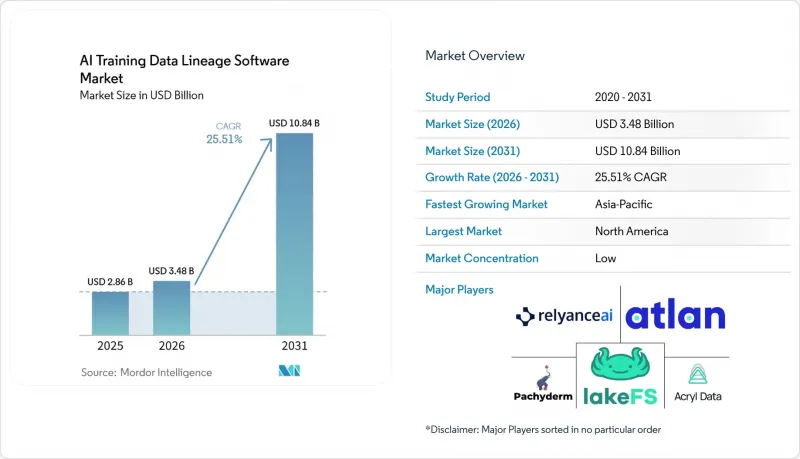
This report is Segmented by Component (Software, and Services), Deployment Model (Cloud, Hybrid, and On-Premises), Enterprise Size (Large Enterprises, and More), Application (Model Development and Experiment Reproducibility, and More), Data Modality (Text and Code, and More), End User (Energy and Utilities, and More), and Geography. The Market Forecasts are Provided in Terms of Value (USD).
Global AI Training Data Lineage Software Market Trends and Insights
Rising Regulatory Demand for Traceable AI Training Data
The EU AI Act has shifted the provenance of training data from a recommended practice to a compliance obligation for high-risk systems. Article 10 requires governance measures covering data origin, collection methods, processing, labeling, and bias examination for training, validation, and testing datasets. EUR-LEX Article 53 also requires general-purpose AI providers to prepare training content documentation under an EU AI Office template. These requirements encourage buyers to capture provenance during development instead of trying to assemble records during an audit. The same need extends beyond Europe, as U.S. state rules and sector-specific obligations increase attention to transparency in training data. The AI Training Data Lineage Software Market therefore benefits when compliance and technical teams need a single, usable record of data handling.
Growth of Multimodal and Agentic AI Pipelines
Robotics, autonomous vehicles, and industrial automation generate sensor data that is more complex than conventional tabular data. These workflows combine video, LiDAR, telemetry, and other inputs that must remain connected to their transformations and labels. Encord reported that data volumes on its multimodal platform increased from 1 petabyte to 5 petabytes over 1 year, with physical AI customer revenue increasing 10-fold. Agentic systems pose a related challenge because autonomous agents can read, write, and modify data without human intervention at each step. LakeFS introduced its Agentic AI offering in June 2026 with isolated data branches, controlled merges, and records that link agent identity and execution details to data actions. This raises demand for tools that record work at the level of each agent run as well as at the dataset level.
High Integration Complexity Across Fragmented Toolchains
AI training environments often include data lakes, orchestration tools, feature stores, experiment tracking software, and model registries. Connecting these systems into a single, traceable record can require custom work, especially when firms use older or specialized applications. The 2025 ISG study reported that 38% of enterprises believed the cost of harmonizing data management outweighed the likely benefit. The study also found that 43% had created a consistent data structure across their organizations. Existing deployments can require additional work when vendors retire older collectors or change how a platform connects to customer systems. Collibra stated that its legacy CLI lineage harvester would reach end of life on July 31, 2026, requiring self-hosted customers to move to its Edge-based architecture.
Other drivers and restraints analyzed in the detailed report include:
- Expansion of Cloud and Hybrid AI Infrastructure
- Data Quality as a Model Performance Differentiator
- Privacy, Sovereignty, and Consent Constraints
For complete list of drivers and restraints, kindly check the Table Of Contents.
Segment Analysis
Software held 74.18% of the AI Training Data Lineage Software Market share in 2025, making the AI Training Data Lineage Software Market primarily platform-led at this stage. Buyers favor platforms that bring lineage, metadata management, audit records, and compliance functions into existing AI development environments. The category includes provenance tools, catalog products, pipeline monitoring systems, and governance applications. Organizations increasingly prefer fewer connections between separate systems when they need traceability across the full lifecycle. This preference supports platforms that can connect technical metadata with policy information. It also reflects the need to preserve the path from raw material through preparation, labeling, testing, approval, and later review without moving records between separate applications.
Services are projected to grow at a 28.41% CAGR from 2026 to 2031. Implementation work remains necessary because enterprise environments contain custom SQL, proprietary data processes, and varied access rules. Service providers help configure connections, map existing records, and support operational adoption across business and technical teams. Collibra's OpenLineage support for AWS Glue and Apache Airflow reduced connector work by enabling open integration. Even so, tailored implementation work is likely to remain important where buyers need coverage across multiple clouds and older systems.
Cloud deployment accounted for 71.24% of the AI Training Data Lineage Software Market share in 2025, underscoring the strong link between the AI Training Data Lineage Software Market and hosted training environments. Cloud-based training pipelines create metadata events that a hosted platform can capture with limited delay. This model can simplify updates and support centralized administration for organizations with distributed teams. Collibra and Atlan have moved lineage collection toward cloud-connected edge architectures as enterprise use has expanded. Cloud deployment is especially suited to AI groups that already use hyperscaler services for training and data storage. It gives distributed teams a shared view of pipeline activity, while platform updates can be applied without each customer having to maintain a separate local installation.
Hybrid deployment is projected to expand at a 27.69% CAGR from 2026 to 2031. Banking, defense, and healthcare organizations often need records across cloud systems and air-gapped or local environments. Collibra released Data Lineage for self-hosted deployments in 2026 for customers who need end-to-end visibility in such settings. Local deployment also remains relevant where national rules limit cloud processing of training data. Vendors that maintain consistent records across these locations can reduce the need for duplicate governance work.
Complete Report Scope:
- By Component
- Software
- Data Lineage and Provenance Software
- Metadata and Catalog Management Software
- Data Transformation and Pipeline Observability Software
- Governance, Audit and Compliance Software
- Services
- Software
- By Deployment Model
- Cloud
- Hybrid
- On-Premises
- By Enterprise Size
- Large Enterprises
- Small and Medium-Sized Enterprises
- By Application
- Model Development and Experiment Reproducibility
- Dataset Versioning and Release Management
- Data Governance and Metadata Management
- Regulatory Compliance and AI Audit
- Data Quality and Data Drift Analysis
- By Data Modality
- Text and Code
- Image and Video
- Audio and Speech
- Multimodal and Sensor-Rich Data
- Structured and Tabular Data
- By End User
- IT and Telecommunication
- BFSI
- Automotive and Transportation
- Healthcare and Life Sciences
- Retail and E-Commerce
- Industrial Manufacturing
- Education and Research Institutions
- Government and Administration
- Energy and Utilities
- Other End Users
- By Geography
- North America
- United States
- Canada
- Mexico
- South America
- Brazil
- Argentina
- Rest of South America
- Europe
- Germany
- United Kingdom
- France
- Russia
- Spain
- Rest of Europe
- Asia-Pacific
- China
- Japan
- India
- South Korea
- Southeast Asia
- Rest of Asia-Pacific
- Middle East and Africa
- Middle East
- Saudi Arabia
- United Arab Emirates
- Rest of Middle East
- Africa
- South Africa
- Nigeria
- Rest of Africa
- Middle East
- North America
Geography Analysis
North America held 34.62% of the AI Training Data Lineage Software Market share in 2025. The region has a large concentration of AI-focused businesses, cloud providers, and enterprise buyers with established governance programs. The United States drives much of the demand through healthcare, financial services, public-sector programs, and large technology firms. The 2025 draft guidance increased the need for lifecycle documentation for AI-enabled medical devices, while state-level requirements also emphasize responsible use and documentation. Canada and Mexico are developing from a smaller base, with financial services and public-sector uses contributing to demand.
Asia-Pacific is projected to expand at a 29.74% CAGR from 2026 to 2031. China, India, Japan, South Korea, and Southeast Asian countries are expanding AI training activity alongside data-protection rules. Japan's automotive and robotics sectors create demand for tools that can record sensor-fusion data and perform labeling work, and Encord identified Woven by Toyota as a physical AI user with data curation capabilities. China and South Korea also have large domestic AI development programs, and the region's differing legal requirements increase the value of flexible controls for consent, location, safety, and accountability.
Europe holds a significant position because the EU AI Act requires detailed data governance for high-risk AI systems. France, Germany, and the United Kingdom are important national markets, while Germany's industrial sector supports demand related to automation. South America remains smaller in revenue, although Brazil's LGPD provides a related basis for data-processing documentation, while the Middle East and Africa are emerging, with Saudi Arabia and the UAE investing in AI and data infrastructure. South Africa and Nigeria show early demand for financial services applications. The AI Training Data Lineage Software Market offers broader regional opportunities where local data rules and AI investment mature together.
- Acryl Data, Inc.
- Alation, Inc.
- Ataccama Corporation
- Atlan Pte. Ltd.
- Bigeye, Inc.
- Collibra NV
- Data.World, Inc.
- Dataloop Ltd.
- Encord, Inc.
- Informatica Inc.
- lakeFS Ltd.
- Monte Carlo Data, Inc.
- Octopai Ltd.
- Pachyderm, Inc.
- Relyance AI, Inc.
- Secoda, Inc.
- Sifflet, Inc.
- Snorkel AI, Inc.
- Solidatus Limited
- SuperAnnotate AI, Inc.
- V7 Labs Limited
- WhyLabs, Inc.
Additional Benefits:
- The market estimate (ME) sheet in Excel format
- 3 months of analyst support
TABLE OF CONTENTS
1 INTRODUCTION
- 1.1 Study Assumptions and Market Definition
- 1.2 Scope of the Study
2 RESEARCH METHODOLOGY
3 EXECUTIVE SUMMARY
4 MARKET LANDSCAPE
- 4.1 Market Overview
- 4.2 Market Drivers
- 4.2.1 Rising Regulatory Demand for Traceable AI Training Data
- 4.2.2 Growth of Multimodal and Agentic AI Pipelines
- 4.2.3 Expansion of Cloud and Hybrid AI Infrastructure
- 4.2.4 Data Quality as a Model-Performance Differentiator
- 4.2.5 Synthetic and Simulation Data Provenance
- 4.2.6 Lineage-Aware Data Contracts for Agentic AI
- 4.3 Market Restraints
- 4.3.1 High Integration Complexity Across Fragmented Toolchains
- 4.3.2 Privacy, Sovereignty, and Consent Constraints
- 4.3.3 Shortage of Data Governance and MLOps Skills
- 4.3.4 Provenance Gaps in Synthetic and Web-Sourced Data
- 4.4 Impact of Macroeconomic Factors on the Market
- 4.5 Industry Value-Chain Analysis
- 4.6 Technology Outlook
- 4.7 Regulatory Landscape
- 4.8 Porter's Five Forces Analysis
- 4.8.1 Threat of New Entrants
- 4.8.2 Bargaining Power of Suppliers
- 4.8.3 Bargaining Power of Buyers
- 4.8.4 Threat of Substitutes
- 4.8.5 Intensity of Competitive Rivalry
5 MARKET SIZE AND GROWTH FORECASTS (VALUE)
- 5.1 By Component
- 5.1.1 Software
- 5.1.1.1 Data Lineage and Provenance Software
- 5.1.1.2 Metadata and Catalog Management Software
- 5.1.1.3 Data Transformation and Pipeline Observability Software
- 5.1.1.4 Governance, Audit and Compliance Software
- 5.1.2 Services
- 5.1.1 Software
- 5.2 By Deployment Model
- 5.2.1 Cloud
- 5.2.2 Hybrid
- 5.2.3 On-Premises
- 5.3 By Enterprise Size
- 5.3.1 Large Enterprises
- 5.3.2 Small and Medium-Sized Enterprises
- 5.4 By Application
- 5.4.1 Model Development and Experiment Reproducibility
- 5.4.2 Dataset Versioning and Release Management
- 5.4.3 Data Governance and Metadata Management
- 5.4.4 Regulatory Compliance and AI Audit
- 5.4.5 Data Quality and Data Drift Analysis
- 5.5 By Data Modality
- 5.5.1 Text and Code
- 5.5.2 Image and Video
- 5.5.3 Audio and Speech
- 5.5.4 Multimodal and Sensor-Rich Data
- 5.5.5 Structured and Tabular Data
- 5.6 By End User
- 5.6.1 IT and Telecommunication
- 5.6.2 BFSI
- 5.6.3 Automotive and Transportation
- 5.6.4 Healthcare and Life Sciences
- 5.6.5 Retail and E-Commerce
- 5.6.6 Industrial Manufacturing
- 5.6.7 Education and Research Institutions
- 5.6.8 Government and Administration
- 5.6.9 Energy and Utilities
- 5.6.10 Other End Users
- 5.7 By Geography
- 5.7.1 North America
- 5.7.1.1 United States
- 5.7.1.2 Canada
- 5.7.1.3 Mexico
- 5.7.2 South America
- 5.7.2.1 Brazil
- 5.7.2.2 Argentina
- 5.7.2.3 Rest of South America
- 5.7.3 Europe
- 5.7.3.1 Germany
- 5.7.3.2 United Kingdom
- 5.7.3.3 France
- 5.7.3.4 Russia
- 5.7.3.5 Spain
- 5.7.3.6 Rest of Europe
- 5.7.4 Asia-Pacific
- 5.7.4.1 China
- 5.7.4.2 Japan
- 5.7.4.3 India
- 5.7.4.4 South Korea
- 5.7.4.5 Southeast Asia
- 5.7.4.6 Rest of Asia-Pacific
- 5.7.5 Middle East and Africa
- 5.7.5.1 Middle East
- 5.7.5.1.1 Saudi Arabia
- 5.7.5.1.2 United Arab Emirates
- 5.7.5.1.3 Rest of Middle East
- 5.7.5.2 Africa
- 5.7.5.2.1 South Africa
- 5.7.5.2.2 Nigeria
- 5.7.5.2.3 Rest of Africa
- 5.7.5.1 Middle East
- 5.7.1 North America
6 COMPETITIVE LANDSCAPE
- 6.1 Market Concentration
- 6.2 Strategic Moves
- 6.3 Market Share Analysis
- 6.4 Company Profiles (includes Global Level Overview, Market Level Overview, Core Segments, Financials as available, Strategic Information, Market Rank/Share, Products and Services, Recent Developments)
- 6.4.1 Acryl Data, Inc.
- 6.4.2 Alation, Inc.
- 6.4.3 Ataccama Corporation
- 6.4.4 Atlan Pte. Ltd.
- 6.4.5 Bigeye, Inc.
- 6.4.6 Collibra NV
- 6.4.7 Data.World, Inc.
- 6.4.8 Dataloop Ltd.
- 6.4.9 Encord, Inc.
- 6.4.10 Informatica Inc.
- 6.4.11 lakeFS Ltd.
- 6.4.12 Monte Carlo Data, Inc.
- 6.4.13 Octopai Ltd.
- 6.4.14 Pachyderm, Inc.
- 6.4.15 Relyance AI, Inc.
- 6.4.16 Secoda, Inc.
- 6.4.17 Sifflet, Inc.
- 6.4.18 Snorkel AI, Inc.
- 6.4.19 Solidatus Limited
- 6.4.20 SuperAnnotate AI, Inc.
- 6.4.21 V7 Labs Limited
- 6.4.22 WhyLabs, Inc.
7 MARKET OPPORTUNITIES AND FUTURE OUTLOOK
- 7.1 White-Space and Unmet-Need Assessment

