PUBLISHER: Mordor Intelligence | PRODUCT CODE: 2118144

PUBLISHER: Mordor Intelligence | PRODUCT CODE: 2118144
Digital Provenance Platform - Market Share Analysis, Industry Trends & Statistics, Growth Forecasts (2026 - 2031)
According to Mordor Intelligence, the digital provenance platform market size is projected to expand from USD 1.24 billion in 2025 and USD 1.45 billion in 2026 to USD 3.61 billion by 2031, registering a CAGR of 20.01% between 2026 and 2031.
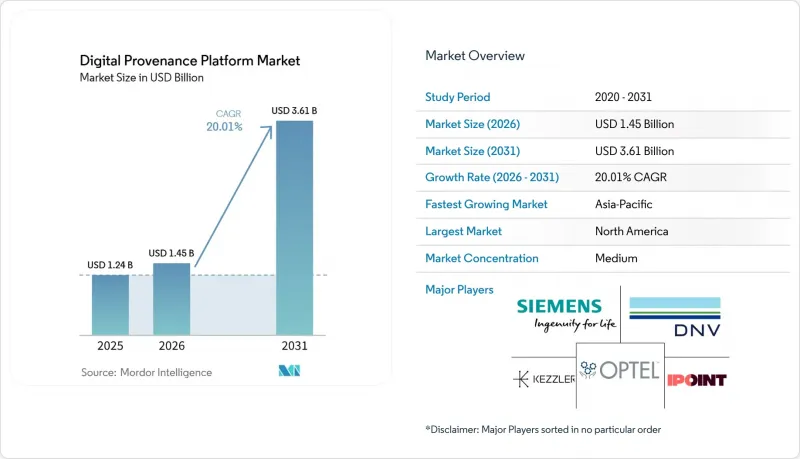
This report is Segmented by Component (Software, and Services), Deployment Model (Cloud, Hybrid, and On-Premises), Enterprise Size (Large Enterprises, and Small and Medium-Sized Enterprises), End User (IT and Telecommunication, Automotive and Transportation, Healthcare and Life Sciences, Retail and E-Commerce, and More), and Geography. The Market Forecasts are Provided in Terms of Value (USD).
Global Digital Provenance Platform Market Trends and Insights
EU Ecodesign and Battery Passport Compliance Mandates
The EU Digital Product Passport Registry became operational on July 20, 2026, under Commission Implementing Regulation (EU) 2026/1778. It gives economic operators an infrastructure for registering unique product identifiers in regulated categories, including large batteries, construction products, toys, and detergents. Six harmonized CEN standards issued simultaneously cover identifiers, data carriers, application programming interfaces, data exchange, and storage. The February 18, 2027, battery passport deadline makes reliable provenance data a condition of continued access to the European Union for affected products. The later schedules for iron and steel, textiles, electronics, and furniture mean that a Digital provenance platform market purchase for batteries can establish the architecture for several product categories. The same obligations apply to non-European Union exporters, making the regime important to supply chains well beyond Europe.
Supply Chain Transparency and Product Claims Verification
Buyers and regulators increasingly require evidence of recycled content, deforestation-free sourcing, and lower-carbon production, rather than relying solely on supplier declarations. The United Nations Transparency Protocol defines interoperable digital credentials for product passports, traceability events, and conformity records. These credentials are designed to support verification across complex supply chains without relying on one central authority. The protocol establishes a common technical foundation for the Digital provenance platform market, where organizations must exchange data with many suppliers and customers. ISO 32120:2024 also provides guidance on sharing quality-assurance traceability information in e-commerce supply chains through a who, what, when, where, and why data model. The combined direction of these standards supports platforms that collect evidence once and reuse it across product, trade, and sustainability records.
High Implementation and Data Onboarding Costs
Implementation and supplier onboarding costs remain a major limit on adoption, especially for smaller companies that face the same information requests as large original equipment manufacturers. Research presented at ECIS 2026 described how small and medium-sized enterprises may move through assessment, temporary withdrawal from constrained supply chains, and later digital adoption. This pattern shows that limited funding, expertise, and staff can delay participation rather than merely slow technology selection. The Digital provenance platform market must therefore support service models that reduce the need for costly internal development. The European Union-funded CIRPASS-2 project is testing Digital Product Passport service models in textiles, electronics, tires, and construction. These pilots recognize that accessible subscriptions and shared implementation resources are important before regulatory deadlines affect more suppliers.
Other drivers and restraints analyzed in the detailed report include:
- Item-Level Serialization and Digital Identity Economics
- Consumer Demand for Product Authenticity and Sustainability Data
- Fragmented Standards and Legacy-System Integration
For complete list of drivers and restraints, kindly check the Table Of Contents.
Segment Analysis
Software held 71.24% of the Digital provenance platform market in 2025. It provides the core functions for identity issuance, credential management, traceability-event recording, and Digital Product Passport publication. The software position reflects the platform-centered design of most deployments across regulated and voluntary product categories. Services are projected to grow at a 23.82% CAGR from 2026 to 2031. This service category includes system integration, data onboarding, implementation support, and managed compliance operations.
Supplier data collection requires process design, supplier engagement, and data-quality controls that software licensing alone does not provide. This requirement explains why companies are allocating material effort to implementation and data governance after selecting a platform. Gaia-X's COMPLIANCE4DPP initiative is developing ways to integrate compliance verification into provenance infrastructure. The initiative points to a closer connection between software and managed services over the forecast period. Providers that can deliver both parts of the work may be better placed to retain customers as reporting needs widen.
Cloud deployment held 68.41% of the Digital provenance platform market in 2025. Organizations use cloud systems for scalable application programming interfaces and for the high data volumes generated by item-level serialization. Hybrid deployment is projected to grow at a 22.69% CAGR from 2026 to 2031. Commission Implementing Regulation (EU) 2026/1778 requires detailed product data to remain with the responsible economic operator rather than in the central registry.
This arrangement supports a hybrid design where company-controlled data stores connect to a cloud-accessible identity and registry layer. On-premises systems retain a role in defense supply chains, regulated utilities, and some healthcare settings where data residency rules or procurement policies limit cloud use. The regulatory design means that data hosting and registry identification are separate responsibilities. A purely cloud-based or purely on-premises design may not meet every operating need. The Digital provenance platform market can benefit from providers that make these connections easier to manage as compliance decisions become urgent.
Complete Report Scope:
- By Component
- Software
- Services
- By Deployment Model
- Cloud
- Hybrid
- On-Premises
- By Enterprise Size
- Large Enterprises
- Small and Medium-Sized Enterprises
- By End-User
- IT and Telecommunication
- BFSI
- Automotive and Transportation
- Healthcare and Life Sciences
- Retail and E-Commerce
- Industrial Manufacturing
- Education and Research Institutions
- Government and Administration
- Energy and Utilities
- Other End Users
- By Geography
- North America
- United States
- Canada
- Mexico
- South America
- Brazil
- Argentina
- Rest of South America
- Europe
- Germany
- United Kingdom
- France
- Russia
- Spain
- Rest of Europe
- Asia-Pacific
- China
- Japan
- India
- South Korea
- Southeast Asia
- Rest of Asia-Pacific
- Middle East and Africa
- Middle East
- Saudi Arabia
- United Arab Emirates
- Rest of Middle East
- Africa
- South Africa
- Nigeria
- Rest of Africa
- Middle East
- North America
Geography Analysis
North America accounted for 34.62% of the Digital provenance platform market in 2025. Pharmaceutical serialization under the Drug Supply Chain Security Act, food traceability under FSMA 204, and financial document verification created demand in several sectors. The United States led regional adoption, while Canada and Mexico became more relevant through integrated supply chains. The region benefits from platform vendors that serve customers in domestic and international markets. This diverse demand base gives North America support beyond any single product regulation.
Europe is the leading regulatory center for Digital Product Passport adoption. The EU registry became operational in July 2026 and created a product-level registration infrastructure for regulated categories. Germany, the United Kingdom, and France have active adoption, with Germany facing particular urgency in battery-related manufacturing. Pilot activity in Spain, France, and the Benelux region covers fashion, food, and pharmaceuticals. The Digital provenance platform market in Europe is moving from compliance preparation toward product, supplier, and commercial use cases.
Asia-Pacific is projected to grow at a 24.19% CAGR from 2026 to 2031. China, India, South Korea, and Southeast Asian manufacturing hubs must provide data to European Union-regulated supply chains. China's GB/T 46881-2025 standard sets out a framework for digital supply chain traceability. India's 2026 Bharat-Tex deployment showed that export companies are using Digital Product Passports to provide product-level material and environmental information. South America, the Middle East, and Africa remain at an earlier stage, although industrial digitalization in Saudi Arabia and battery-mineral supply chains in South Africa are creating specific data needs.
- Arianee SAS
- Billon Group Limited
- Circularise B.V.
- Circulor Limited
- Det Norske Veritas Group AS
- EON Group Holding Inc.
- Everledger Limited
- iPoint-systems GmbH
- Kezzler AS
- Minespider GmbH
- Narravero GmbH
- OPTEL GROUP
- Protokol Group B.V.
- Qliktag Software Inc.
- Scantrust SA
- Spherity GmbH
- THE ID FACTORY S.R.L.
- TrusTrace Technologies AB
- ubloquity Ltd.
- Weafs Ltd.
Additional Benefits:
- The market estimate (ME) sheet in Excel format
- 3 months of analyst support
TABLE OF CONTENTS
1 INTRODUCTION
- 1.1 Study Assumptions and Market Definition
- 1.2 Scope of the Study
2 RESEARCH METHODOLOGY
3 EXECUTIVE SUMMARY
4 MARKET LANDSCAPE
- 4.1 Market Overview
- 4.2 Market Drivers
- 4.2.1 EU Ecodesign and Battery Passport Compliance Mandates
- 4.2.2 Supply Chain Transparency and Product Claims Verification
- 4.2.3 Circular Economy, Repair, Resale, and Recycling Enablement
- 4.2.4 Consumer Demand for Product Authenticity and Sustainability Data
- 4.2.5 Item-Level Serialization and Digital Identity Economics
- 4.2.6 Cross-Border Provenance Data Spaces and Verifiable Credentials
- 4.3 Market Restraints
- 4.3.1 High Implementation and Data Onboarding Costs
- 4.3.2 Fragmented Standards and Legacy-System Integration
- 4.3.3 Supplier Data Quality and Evidence-Verification Gaps
- 4.3.4 Confidentiality Risks from Granular Product and Supplier Data
- 4.4 Impact of Macroeconomic Factors on the Market
- 4.5 Industry Value-Chain Analysis
- 4.6 Technology Outlook
- 4.7 Regulatory Landscape
- 4.8 Porter's Five Forces Analysis
- 4.8.1 Threat of New Entrants
- 4.8.2 Bargaining Power of Suppliers
- 4.8.3 Bargaining Power of Buyers
- 4.8.4 Threat of Substitutes
- 4.8.5 Intensity of Competitive Rivalry
5 MARKET SIZE AND GROWTH FORECASTS (VALUE)
- 5.1 By Component
- 5.1.1 Software
- 5.1.2 Services
- 5.2 By Deployment Model
- 5.2.1 Cloud
- 5.2.2 Hybrid
- 5.2.3 On-Premises
- 5.3 By Enterprise Size
- 5.3.1 Large Enterprises
- 5.3.2 Small and Medium-Sized Enterprises
- 5.4 By End-User
- 5.4.1 IT and Telecommunication
- 5.4.2 BFSI
- 5.4.3 Automotive and Transportation
- 5.4.4 Healthcare and Life Sciences
- 5.4.5 Retail and E-Commerce
- 5.4.6 Industrial Manufacturing
- 5.4.7 Education and Research Institutions
- 5.4.8 Government and Administration
- 5.4.9 Energy and Utilities
- 5.4.10 Other End Users
- 5.5 By Geography
- 5.5.1 North America
- 5.5.1.1 United States
- 5.5.1.2 Canada
- 5.5.1.3 Mexico
- 5.5.2 South America
- 5.5.2.1 Brazil
- 5.5.2.2 Argentina
- 5.5.2.3 Rest of South America
- 5.5.3 Europe
- 5.5.3.1 Germany
- 5.5.3.2 United Kingdom
- 5.5.3.3 France
- 5.5.3.4 Russia
- 5.5.3.5 Spain
- 5.5.3.6 Rest of Europe
- 5.5.4 Asia-Pacific
- 5.5.4.1 China
- 5.5.4.2 Japan
- 5.5.4.3 India
- 5.5.4.4 South Korea
- 5.5.4.5 Southeast Asia
- 5.5.4.6 Rest of Asia-Pacific
- 5.5.5 Middle East and Africa
- 5.5.5.1 Middle East
- 5.5.5.1.1 Saudi Arabia
- 5.5.5.1.2 United Arab Emirates
- 5.5.5.1.3 Rest of Middle East
- 5.5.5.2 Africa
- 5.5.5.2.1 South Africa
- 5.5.5.2.2 Nigeria
- 5.5.5.2.3 Rest of Africa
- 5.5.5.1 Middle East
- 5.5.1 North America
6 COMPETITIVE LANDSCAPE
- 6.1 Market Concentration
- 6.2 Strategic Moves
- 6.3 Market Share Analysis
- 6.4 Company Profiles (includes Global Level Overview, Market Level Overview, Core Segments, Financials as available, Strategic Information, Market Rank/Share, Products and Services, Recent Developments)
- 6.4.1 Arianee SAS
- 6.4.2 Billion Group Limited
- 6.4.3 Circularise B.V.
- 6.4.4 Circulor Limited
- 6.4.5 Det Norske Veritas Group AS
- 6.4.6 EON Group Holding Inc.
- 6.4.7 Everledger Limited
- 6.4.8 iPoint-systems GmbH
- 6.4.9 Kezzler AS
- 6.4.10 Minespider GmbH
- 6.4.11 Narravero GmbH
- 6.4.12 OPTEL GROUP
- 6.4.13 Protokol Group B.V.
- 6.4.14 Qliktag Software Inc.
- 6.4.15 Scantrust SA
- 6.4.16 Spherity GmbH
- 6.4.17 THE ID FACTORY S.R.L.
- 6.4.18 TrusTrace Technologies AB
- 6.4.19 ubloquity Ltd.
- 6.4.20 Weafs Ltd.
7 MARKET OPPORTUNITIES AND FUTURE OUTLOOK
- 7.1 White-Space and Unmet-Need Assessment

