PUBLISHER: Mordor Intelligence | PRODUCT CODE: 2118164

PUBLISHER: Mordor Intelligence | PRODUCT CODE: 2118164
India Palm Oil - Market Share Analysis, Industry Trends & Statistics, Growth Forecasts (2026 - 2031)
According to Mordor Intelligence, the indian palm oil market size is expected to increase from USD 14.86 billion in 2025 to USD 15.56 billion in 2026 and reach USD 19.08 billion by 2031, growing at a CAGR of 5.12% over 2026-2031.
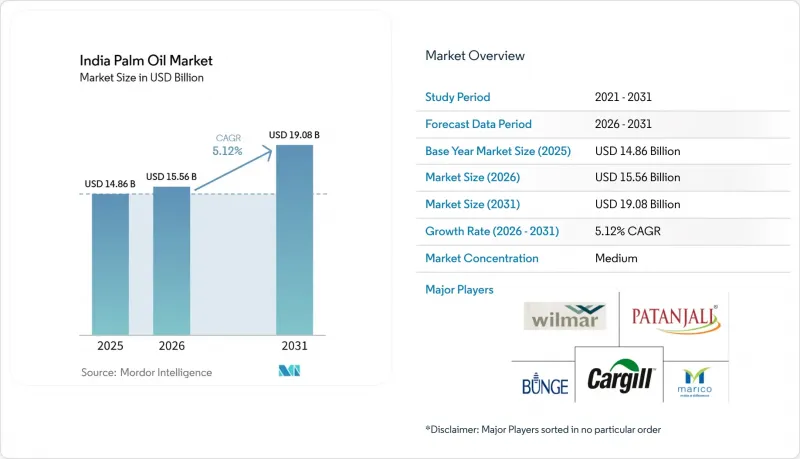
This report is Segmented by Product Type (Crude Palm Oil, Palm Kernel Oil, and More), Nature (Organic and Conventional), End Use (Industrial, Retail, and Foodservice/HoReCa). The Market Forecasts are Provided in Terms of Value (USD) and Volume (Tons).
India Palm Oil Market Trends and Insights
Affordability advantage versus competing edible oils
Palm oil's sustained price competitiveness against alternative edible oils, such as soybean and sunflower oil, remains one of the strongest structural drivers of demand in the Indian market. Crude palm oil frequently trades at a clear discount, making it the most economical major vegetable oil for refiners, food processors, and bulk buyers. When this price advantage widens, Indian importers and manufacturers quickly increase palm oil purchases, and when the discount narrows or reverses, buyers reduce palm oil imports and shift to alternatives. For example, in 2025, India's Customs reduced the basic import duty on crude edible oils, including crude palm oil, from 20% to 10%. This reduction lowered the effective total import duty from 27.5% to 16.5% and widened the duty gap with refined palm oil from 8.25% to 19.25% in May 2025, which would nearly eliminate refined oil imports and redirect demand toward domestic refiners. As a result, relative pricing against competing oils remains a key swing factor influencing month-to-month import patterns, refining margins, and overall consumption levels across India's edible oil complex.
Expansion of packaged food, foodservice and HoReCa demand
The rapid expansion of India's hotels, restaurants, and catering (HoReCa) sector, along with the steady growth of the organized packaged food industry, is driving strong secondary demand for palm oil. Rising urbanization, higher disposable incomes, and the proliferation of quick-service restaurants, cloud kitchens, and food delivery platforms have increased commercial frying and cooking volumes outside the home. High-volume kitchens widely prefer palm olein for its high oxidative stability, neutral taste, and resistance to repeated heating, making it a practical and economical option. At the same time, India's packaged food segment, particularly biscuits, namkeens, etc., continues to scale production to meet domestic and export demand. Manufacturers rely heavily on refined palm oil for deep-fat frying, dough shortening, and shelf-life extension. The functional advantages of palm-based oils, along with cost competitiveness, is promoting its large-scale industrial applications.
High dependence on imported crude palm oil
India's heavy reliance on imported palm oil remains a structural restraint on the domestic market. The country meets a significant share of its edible oil requirements through imports, with palm oil representing the largest component of these purchases, primarily sourced from Indonesia and Malaysia. This concentrated dependence exposes the supply chain to policy changes, production fluctuations, and logistical disruptions in the two major exporting countries. Limited domestic production further increases this vulnerability, as it cannot serve as a rapid buffer during supply disruptions. Although India is implementing programs to expand oil palm cultivation, domestic crude palm oil output still accounts for only a modest share of total consumption. Consequently, any sustained disruption in import flows directly increases wholesale and retail prices, requiring industrial users and household consumers to absorb the impact or switch to alternative oils when relative prices permit.
Other drivers and restraints analyzed in the detailed report include:
- National Mission on Edible Oils - oil palm and domestic cultivation
- Growth of palm-based oleochemicals and biofuel applications
- Exposure to international palm oil prices, freight costs and currency movements
For complete list of drivers and restraints, kindly check the Table Of Contents.
Segment Analysis
Crude palm oil held the largest share of the palm oil market in 2025, accounting for 73.48%, primarily because of policy incentives that favor domestic refining and the structure of the local processing industry primarily supports this position. India maintains a deliberate duty differential between crude and refined palm oil. Crude palm oil attracts a significantly lower effective import duty than refined, bleached, and deodorized (RBD) palm oil or palm olein. As a result, importers and refiners prefer to import crude palm oil and process it locally into RBD palm oil, olein, stearin, and other fractions.
Fractioned palm oil is expected to grow at a compound annual growth rate (CAGR) of 4.97% through 2031, driven by rising demand from higher-value, application-specific segments within the food industry. Fractionation separates palm oil into solid (stearin) and liquid (olein) components, along with mid-fractions that offer tailored melting points and functional properties. Food manufacturers increasingly use these specialized fractions in bakery shortenings, confectionery fats, chocolate compounds, coatings, fillings, and dairy alternatives.
Complete Report Scope:
- By Product Type
- Crude Palm Oil
- Palm Kernel Oil
- RBD Palm Oil
- Fractioned Palm Oil
- Palm Olein
- Palm Stearin
- By Nature
- Organic
- Conventional
- By End Use
- Industrial
- Food Processing
- Bakery and Confectionery
- Dairy and Dairy Alternatives Products
- RTE/RTC Food Products
- Snacks
- Others
- Personal Care and Cosmetics
- Animal Feed
- Biofuel
- Others
- Food Processing
- Foodservice/HoReCa
- Retail
- Supermarkets/Hypermarket
- Convenience Stores
- Online Retail Stores
- Others
- Industrial
List of Companies Covered in this Report:
- Adani Wilmar Ltd
- Patanjali Foods Ltd
- Cargill India Pvt Ltd
- Bunge India Pvt Ltd
- Marico Ltd
- Emami Agrotech Ltd
- Godrej Agrovet Ltd
- 3F Oil Palm Pvt. Ltd.
- Gokul Group
- K.S. Oils Ltd
- Liberty Oil Mills Ltd
- Oil Palm India Ltd
- Gemini Edibles & Fats India Ltd
- ITC Ltd
- Gokul Agro Resources Limited (GARL)
- Manorama Industries Limited
- Shri Venkatesh Refineries Limited
- NCS Industries Pvt Ltd
- Halder Venture Limited
- Hometeader Industries (OPC) Private Limited
Additional Benefits:
- The market estimate (ME) sheet in Excel format
- 3 months of analyst support
TABLE OF CONTENTS
1 INTRODUCTION
- 1.1 Study Assumptions and Market Definition
- 1.2 Scope of the Study
2 RESEARCH METHODOLOGY
3 EXECUTIVE SUMMARY
4 MARKET LANDSCAPE
- 4.1 Market Overview
- 4.2 Market Drivers
- 4.2.1 Affordability Advantage Versus Competing Edible Oils
- 4.2.2 Expansion of Packaged Food, Foodservice and HoReCa Demand
- 4.2.3 National Mission on Edible Oils - Oil Palm and Domestic Cultivation
- 4.2.4 Growth of Palm-Based Oleochemicals and Biofuel Applications
- 4.2.5 Digitized Smallholder Aggregation and Mill-Level Procurement
- 4.2.6 Processing Yield Improvements and Import-Substitution Economics
- 4.3 Market Restraints
- 4.3.1 High Dependence on Imported Crude Palm Oil
- 4.3.2 Exposure to International Palm Oil Prices, Freight Costs and Currency Movements
- 4.3.3 Long Gestation Period and Water-Management Requirements for Domestic Plantations
- 4.3.4 Health Concerns and Negative Consumer Perception of Palm Oil
- 4.4 Supply-Chain Analysis
- 4.5 Regulatory Outlook
- 4.6 Technological 'Framework
- 4.7 Porters Five Forces
- 4.7.1 Threat of New Entrants
- 4.7.2 Bargaining Power of Buyers
- 4.7.3 Bargaining Power of Suppliers
- 4.7.4 Threat of Substitutes
- 4.7.5 Competitive Rivalry
5 MARKET SIZE AND GROWTH FORECASTS (VALUE AND VOLUME)
- 5.1 By Product Type
- 5.1.1 Crude Palm Oil
- 5.1.2 Palm Kernel Oil
- 5.1.3 RBD Palm Oil
- 5.1.4 Fractioned Palm Oil
- 5.1.5 Palm Olein
- 5.1.6 Palm Stearin
- 5.2 By Nature
- 5.2.1 Organic
- 5.2.2 Conventional
- 5.3 By End Use
- 5.3.1 Industrial
- 5.3.1.1 Food Processing
- 5.3.1.1.1 Bakery and Confectionery
- 5.3.1.1.2 Dairy and Dairy Alternatives Products
- 5.3.1.1.3 RTE/RTC Food Products
- 5.3.1.1.4 Snacks
- 5.3.1.1.5 Others
- 5.3.1.2 Personal Care and Cosmetics
- 5.3.1.3 Animal Feed
- 5.3.1.4 Biofuel
- 5.3.1.5 Others
- 5.3.1.1 Food Processing
- 5.3.2 Foodservice/HoReCa
- 5.3.3 Retail
- 5.3.3.1 Supermarkets/Hypermarket
- 5.3.3.2 Convenience Stores
- 5.3.3.3 Online Retail Stores
- 5.3.3.4 Others
- 5.3.1 Industrial
6 COMPETITIVE LANDSCAPE
- 6.1 Market Concentration
- 6.2 Strategic Moves
- 6.3 Market Positioning Analysis
- 6.4 Company Profiles (includes Global level Overview, Market level overview, Core Segments, Financials as available, Strategic Information, Market Rank/Share, Products and Services, Recent Developments)
- 6.4.1 Adani Wilmar Ltd
- 6.4.2 Patanjali Foods Ltd
- 6.4.3 Cargill India Pvt Ltd
- 6.4.4 Bunge India Pvt Ltd
- 6.4.5 Marico Ltd
- 6.4.6 Emami Agrotech Ltd
- 6.4.7 Godrej Agrovet Ltd
- 6.4.8 3F Oil Palm Pvt. Ltd.
- 6.4.9 Gokul Group
- 6.4.10 K.S. Oils Ltd
- 6.4.11 Liberty Oil Mills Ltd
- 6.4.12 Oil Palm India Ltd
- 6.4.13 Gemini Edibles & Fats India Ltd
- 6.4.14 ITC Ltd
- 6.4.15 Gokul Agro Resources Limited (GARL)
- 6.4.16 Manorama Industries Limited
- 6.4.17 Shri Venkatesh Refineries Limited
- 6.4.18 NCS Industries Pvt Ltd
- 6.4.19 Halder Venture Limited
- 6.4.20 Hometeader Industries (OPC) Private Limited
7 MARKET OPPORTUNITIES AND FUTURE OUTLOOK

