PUBLISHER: Mordor Intelligence | PRODUCT CODE: 2118216

PUBLISHER: Mordor Intelligence | PRODUCT CODE: 2118216
AI Content Provenance Software - Market Share Analysis, Industry Trends & Statistics, Growth Forecasts (2026 - 2031)
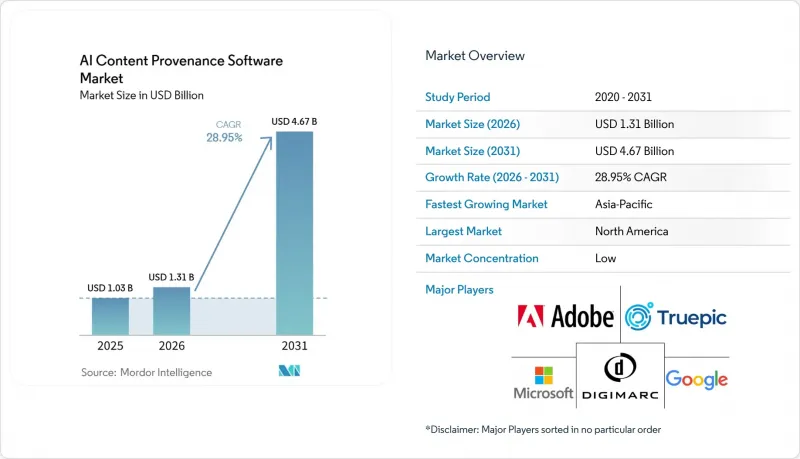
According to Mordor Intelligence, the AI content provenance software market size is expected to grow from USD 1.03 billion in 2025 to USD 1.31 billion in 2026 and is forecast to reach USD 4.67 billion by 2031 at 28.95% CAGR over 2026-2031.
This report is Segmented by Offering (Software, and Services), Deployment Model (Cloud, Hybrid, and On-Premises), Content Type (Image, Video, Audio, and More), Enterprise Size (Large Enterprises, and Small and Mid-Sized Enterprises), End Users (IT and Telecommunication, BFSI, Automotive and Transportation, and More), and Geography. The Market Forecasts are Provided in Terms of Value (USD).
Global AI Content Provenance Software Market Trends and Insights
Machine-Readable AI Disclosure Requirements
The European Union's AI Act, Article 50, transparency obligations take effect on August 2, 2026, and require providers to mark certain AI-generated or manipulated content in a machine-readable format. The European Commission published related guidance on July 20, 2026, which places significant emphasis on the implementation choices made by providers and deployers. The rules make content labeling a legal and operational consideration for organizations that use generative tools at scale. The AI Content Provenance Software Market benefits from the fact that signing, labeling, and verification functions can be built into publishing and review workflows. C2PA is being considered as ISO 22144 and provides an interoperable route for organizations that need to document content origin and changes. This common technical foundation can reduce the burden of supporting different requirements across jurisdictions.
Deepfake and Synthetic-Media Fraud
The FBI recorded 22,364 complaints involving AI-enabled fraud and USD 893 million in adjusted losses in its 2025 annual report, which was published in 2026. These cases show why financial institutions, insurers, and enterprises are treating content authenticity as an operational control. Research has also found that people have difficulty identifying sophisticated deepfake videos without technical support. The AI Content Provenance Software Market, therefore, addresses a gap that manual review cannot reliably close. Detection systems help identify suspicious content after creation, while provenance records can provide evidence of trusted creation and modification. This combination is becoming more relevant in workflows involving payments, customer service, executive communications, and patient-facing information.
Metadata Stripping and Credential Loss on Platforms
Content credentials can be lost when platforms recompress files or convert them to new formats during upload. This creates a break between the point where an asset is signed and the channels where audiences later view it. The issue limits the value of a provenance record when organizations distribute content through open social platforms. The AI Content Provenance Software Market is responding with layered approaches that pair cryptographic manifests with pixel-level or other durable signals. Those signals can help link altered or recompressed files back to a source record through verification services. Until preservation becomes more consistent across distribution channels, provenance controls remain strongest inside managed enterprise publishing environments.
Other drivers and restraints analyzed in the detailed report include:
- C2PA Standardization and Interoperability
- Trusted Enterprise Content Workflows
- Adversarial Watermark Removal and Model Evasion
For complete list of drivers and restraints, kindly check the Table Of Contents.
Segment Analysis
Software held 72.41% of the AI Content Provenance Software Market share in 2025, supported by early deployments of C2PA signing software development kits, watermarking application programming interfaces, and deepfake detection platforms. Large media organizations, financial services firms, and enterprise IT teams adopted these tools to add checks to established content workflows. In many cases, provenance began with a focused technical decision, such as integrating a signing library, deploying a verification interface, or subscribing to a cloud watermarking service. The C2PA Conformance Program reduced part of the vendor review burden by creating a public registry of tested implementations. Software remains the operating layer for creating, storing, inspecting, and verifying content records.
Services are projected to grow at a 30.82% CAGR from 2026 to 2031, as organizations recognize that end-to-end provenance requires more than a standalone product installation. They need to connect capture, signing, storage, editing, publication, and downstream verification without breaking records along the way. Managed signing, certificate lifecycle support, workflow design, and integration consulting address this requirement. The AI content provenance software industry is seeing recurring engagements that combine subscriptions with specialized implementation support across the AI Content Provenance Software Market. This service demand is strongest where internal teams lack experience with cryptographic records, governance processes, or cross-platform content operations.
Cloud deployment held 68.19% of the AI Content Provenance Software Market share in 2025, supported by lower initial setup requirements, flexible capacity for changing signing volumes, and vendor-managed certificate infrastructure. Cloud delivery helps teams deploy verification and detection capabilities without maintaining every part of the technical stack. It supports rapid onboarding, central control across distributed users, and updates to detection models without lengthy local deployment cycles. These advantages made cloud systems the primary route for initial software adoption. The model remains useful for organizations that can use external verification services within their data governance policies.
Hybrid deployment is projected to grow at a 29.74% CAGR from 2026 to 2031. Financial services, healthcare, and government users often face data residency, sovereignty, or chain-of-custody conditions that limit full reliance on external services. Hardware-backed capture also introduces a local component, as signing keys can be generated and protected on the device. Truepic stated that its secure media library was embedded in Qualcomm's Snapdragon 8 Elite Gen 5 platform, allowing device-level C2PA Content Credentials at capture. Records can then be checked against cloud certificate authorities, providing the AI Content Provenance Software Market with a hybrid approach for regulated users and a controlled option for defense, intelligence, and legal settings.
Complete Report Scope:
- By Offering
- Software
- Services
- By Deployment Model
- Cloud
- Hybrid
- On-Premises
- By Content Type
- Image
- Video
- Audio
- Documents
- Text and Code
- By Enterprise Size
- Large Enterprises
- Small and Mid-sized Enterprises
- By End Users
- IT and Telecommunication
- BFSI
- Automotive and Transportation
- Healthcare and Life Sciences
- Retail and E-Commerce
- Industrial Manufacturing
- Other End-Users
- By Geography
- North America
- United States
- Canada
- Mexico
- South America
- Brazil
- Argentina
- Rest of South America
- Europe
- Germany
- United Kingdom
- France
- Russia
- Spain
- Rest of Europe
- Asia-Pacific
- China
- Japan
- India
- South Korea
- Southeast Asia
- Rest of Asia-Pacific
- Middle East and Africa
- Middle East
- Saudi Arabia
- United Arab Emirates
- Rest of Middle East
- Africa
- South Africa
- Nigeria
- Rest of Africa
- Middle East
- North America
Geography Analysis
North America accounted for 34.62% revenue share in 2025. The region has early commercial deployments in media, insurance, and financial services, where content fraud can have direct financial consequences. The FBI reported USD 893 million in adjusted losses connected to AI-enabled fraud in its 2025 annual report. This risk has supported procurement by firms that manage high-value digital assets and customer interactions. Truepic announced an integration with Cotality in June 2026 to enable verified virtual property inspections for home and construction lending.
Europe is a major demand center because the European Union AI Act creates a direct transparency requirement for certain AI-generated content. Article 50 obligations take effect on August 2, 2026, and the Commission published implementation guidance in July 2026. Germany's implementation process has established the Federal Network Agency as the central authority for the enforcement of the AI Act. In France, dpa Picture Alliance selected IMATAG as its preferred invisible watermarking technology in May 2026. The United Kingdom's AI Safety Institute and sector regulators are developing voluntary work that aligns with C2PA.
Asia-Pacific is projected to grow at a 31.24% CAGR from 2026 to 2031. Japan's AI Promotion Act, enacted on May 28, 2025, established an AI Strategic Headquarters and a national AI strategy. Japan's Ministry of Economy, Trade, and Industry began a Digital Trustmark pilot for business-to-business platforms on July 15, 2026. India, South Korea, Southeast Asia, South America, and the Middle East and Africa are at different stages of interest in AI transparency and content disclosure.
- Truepic, Inc.
- Attestiv, Inc.
- OriginStamp GmbH
- Serelay Ltd
- Digimarc Corporation
- Reality Defender, Inc.
- Sensity AI
- Hive Technology, Inc.
- Copyleaks, Inc.
- GPTZero, Inc.
- Originality.ai Inc.
- Turnitin, LLC
- Imatag SAS
- Verimatrix, Inc.
- Irdeto B.V.
- Synamedia Limited
- Nagra Kudelski SA
- Pindrop Security, Inc.
- Sightengine SAS
- DeepMedia AI, Inc.
- Polygraf AI, Inc.
- Veraquo GmbH
Additional Benefits:
- The market estimate (ME) sheet in Excel format
- 3 months of analyst support
TABLE OF CONTENTS
1 INTRODUCTION
- 1.1 Study Assumptions and Market Definition
- 1.2 Scope of the Study
2 RESEARCH METHODOLOGY
3 EXECUTIVE SUMMARY
4 MARKET LANDSCAPE
- 4.1 Market Overview
- 4.2 Market Drivers
- 4.2.1 Rising Deepfake and Synthetic-Media Fraud
- 4.2.2 Regulatory Requirements for Machine-Readable AI Disclosure
- 4.2.3 Enterprise Adoption of Trusted Content Workflows
- 4.2.4 C2PA Standardization and Interoperability
- 4.2.5 Upstream Provenance in Generative-AI Pipelines
- 4.2.6 Hardware-Backed Capture and Attestation
- 4.3 Market Restraints
- 4.3.1 Metadata Stripping and Credential Loss on Platforms
- 4.3.2 Adversarial Watermark Removal and Model Evasion
- 4.3.3 Integration Cost and Provenance Governance Complexity
- 4.3.4 Privacy, Consent, and Cross-Border Data Constraints
- 4.4 Impact of Macroeconomic Factors on the Market
- 4.5 Industry Value-Chain Analysis
- 4.6 Technology Outlook
- 4.7 Regulatory Landscape
- 4.8 Porter's Five Forces Analysis
- 4.8.1 Threat of New Entrants
- 4.8.2 Bargaining Power of Suppliers
- 4.8.3 Bargaining Power of Buyers
- 4.8.4 Threat of Substitutes
- 4.8.5 Intensity of Competitive Rivalry
5 MARKET SIZE AND GROWTH FORECASTS (VALUE)
- 5.1 By Offering
- 5.1.1 Software
- 5.1.2 Services
- 5.2 By Deployment Model
- 5.2.1 Cloud
- 5.2.2 Hybrid
- 5.2.3 On-Premises
- 5.3 By Content Type
- 5.3.1 Image
- 5.3.2 Video
- 5.3.3 Audio
- 5.3.4 Documents
- 5.3.5 Text and Code
- 5.4 By Enterprise Size
- 5.4.1 Large Enterprises
- 5.4.2 Small and Mid-sized Enterprises
- 5.5 By End Users
- 5.5.1 IT and Telecommunication
- 5.5.2 BFSI
- 5.5.3 Automotive and Transportation
- 5.5.4 Healthcare and Life Sciences
- 5.5.5 Retail and E-Commerce
- 5.5.6 Industrial Manufacturing
- 5.5.7 Other End-Users
- 5.6 By Geography
- 5.6.1 North America
- 5.6.1.1 United States
- 5.6.1.2 Canada
- 5.6.1.3 Mexico
- 5.6.2 South America
- 5.6.2.1 Brazil
- 5.6.2.2 Argentina
- 5.6.2.3 Rest of South America
- 5.6.3 Europe
- 5.6.3.1 Germany
- 5.6.3.2 United Kingdom
- 5.6.3.3 France
- 5.6.3.4 Russia
- 5.6.3.5 Spain
- 5.6.3.6 Rest of Europe
- 5.6.4 Asia-Pacific
- 5.6.4.1 China
- 5.6.4.2 Japan
- 5.6.4.3 India
- 5.6.4.4 South Korea
- 5.6.4.5 Southeast Asia
- 5.6.4.6 Rest of Asia-Pacific
- 5.6.5 Middle East and Africa
- 5.6.5.1 Middle East
- 5.6.5.1.1 Saudi Arabia
- 5.6.5.1.2 United Arab Emirates
- 5.6.5.1.3 Rest of Middle East
- 5.6.5.2 Africa
- 5.6.5.2.1 South Africa
- 5.6.5.2.2 Nigeria
- 5.6.5.2.3 Rest of Africa
- 5.6.5.1 Middle East
- 5.6.1 North America
6 COMPETITIVE LANDSCAPE
- 6.1 Market Concentration
- 6.2 Strategic Moves
- 6.3 Market Share Analysis
- 6.4 Company Profiles (includes Global Level Overview, Market Level Overview, Core Segments, Financials as available, Strategic Information, Market Rank/Share, Products and Services, Recent Developments)
- 6.4.1 Truepic, Inc.
- 6.4.2 Attestiv, Inc.
- 6.4.3 OriginStamp GmbH
- 6.4.4 Serelay Ltd
- 6.4.5 Digimarc Corporation
- 6.4.6 Reality Defender, Inc.
- 6.4.7 Sensity AI
- 6.4.8 Hive Technology, Inc.
- 6.4.9 Copyleaks, Inc.
- 6.4.10 GPTZero, Inc.
- 6.4.11 Originality.ai Inc.
- 6.4.12 Turnitin, LLC
- 6.4.13 Imatag SAS
- 6.4.14 Verimatrix, Inc.
- 6.4.15 Irdeto B.V.
- 6.4.16 Synamedia Limited
- 6.4.17 Nagra Kudelski SA
- 6.4.18 Pindrop Security, Inc.
- 6.4.19 Sightengine SAS
- 6.4.20 DeepMedia AI, Inc.
- 6.4.21 Polygraf AI, Inc.
- 6.4.22 Veraquo GmbH
7 MARKET OPPORTUNITIES AND FUTURE OUTLOOK
- 7.1 White-Space and Unmet-Need Assessment

