PUBLISHER: Mordor Intelligence | PRODUCT CODE: 2118220

PUBLISHER: Mordor Intelligence | PRODUCT CODE: 2118220
Biotech Flavor - Market Share Analysis, Industry Trends & Statistics, Growth Forecasts (2026 - 2031)
According to Mordor Intelligence, the biotech flavor market size is valued at USD 2.75 billion in 2026, growing from the 2025 value of USD 2.56 billion, and is forecast to reach USD 3.67 billion by 2031, advancing at a 5.94% CAGR during the forecast period.
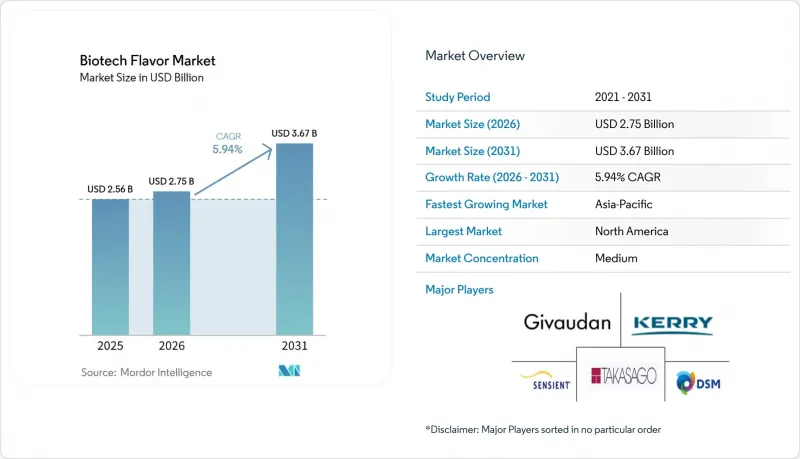
This report is Segmented by Production Technology (Microbial Fermentation, and Others), Label Claim (Natural, Nature-Identical, and Others), Flavor Profile (Sweet, Fruity, and Others), Application (Beverages, Pharmaceuticals, and Others), and Geography (North America, Europe, Asia-Pacific, South America, and Middle East and Africa). The Market Forecasts are Provided in Terms of Value (USD).
Global Biotech Flavor Market Trends and Insights
Clean-Label Reformulation and Ingredient Transparency Drive Biotech Flavor Adoption
Clean-label formulation has shifted from a premium product feature to a broader commercial requirement. Ingredient transparency, retailer policies, and scrutiny of food additives are increasing the need for simpler ingredient declarations across mainstream packaged food, beverage, snack, and nutrition categories. Food labeling regulations in major markets, such as the European Union and the United States, reinforce this trend by requiring manufacturers to clearly disclose food ingredients and additives while holding them responsible for ingredient safety and compliance. The biotech flavors market is well positioned to benefit, as fermentation-derived compounds can support natural flavor claims while delivering consistent sensory performance. Botanical extracts may vary in supply and quality, whereas fermentation routes can offer a more controlled production process and a more consistent target profile across batches. This gives product developers a practical way to preserve flavor performance, meet internal specifications, and avoid extensive reformulation across foods and beverages. Manufacturers that delay reformulation may face greater difficulty meeting retailer requirements and maintaining established product positions in the biotech flavors market.
Precision Fermentation and Synthetic Biology Cost Curve Improvement Enable Market Expansion
Precision fermentation can become more economical as production scale and yields improve. Government-supported industrial biotechnology programs indicate that advances in strain engineering, fermentation efficiency, and process scale-up are expected to reduce manufacturing costs and improve process productivity over time. The biotech flavors market has an opportunity to serve larger-volume molecules as equipment utilization, feedstock selection, and downstream processing become more efficient. Commercial-scale operations can shift competition away from basic production volume and toward molecules that require precise sensory control, consistent quality, and a defensible technical route. Enzyme and fermentation routes are particularly useful for compounds in which molecular form affects flavor quality, ingredient performance, and the ability to reproduce a desired sensory profile at low use levels. This dynamic exposes conventional high-volume molecules to price pressure while protecting more specialized flavor compounds that customers may find harder to source, reformulate, or replicate through traditional chemistry. Lower development barriers may also allow more companies to target narrow applications, although production capacity remains a practical constraint.
High Fermentation, Purification, and Scale-Up Costs Limit Addressable Market Reach
Fermentation scale-up remains a near-term constraint for the biotech flavors market. Costs increase when producers build dedicated facilities, validate purification steps, and maintain strict food-grade production controls. Media and feedstock choices affect economics, while titer and yield optimization require sustained technical work, repeated trials, process monitoring, and reliable access to suitable manufacturing equipment. A failed run can waste inputs, delay supply, and add documentation requirements. These demands favor companies with established manufacturing partners, experienced technical teams, validated quality systems, or substantial capital to support long development cycles. Smaller producers can still compete in specialized compounds, but they face a more limited path to large-volume supply in the biotech flavors market.
Other drivers and restraints analyzed in the detailed report include:
- Plant-Based and Alternative-Protein Off-Note Masking Creates a Structural Pull Market
- Supply Security for Climate-Exposed Vanilla, Citrus, Cocoa, and Hop Aromas Accelerates Biotech Substitution
- Non-Harmonized GMO, Natural-Label, and Novel-Food Approvals Restrict Global Commercialization
For complete list of drivers and restraints, kindly check the Table Of Contents.
Segment Analysis
Microbial fermentation accounted for 41.28% in 2025. This position reflects its long-standing industrial use in the production of amino acids, esters, and organic acid flavor compounds. Producers benefit from established bioreactor operations, proven purification systems, trained operating teams, and a documented history of food use, which supports regulatory submissions across several jurisdictions. The others category includes plant cell culture and algal bioconversion, which remain relevant when traditional microbial routes do not deliver the required product, titer, or aroma complexity. This category continues to focus on high-value niche aromas, such as saffron-equivalent safranal and exotic sesquiterpenes.
Enzyme catalysis is projected to expand at a CAGR of 6.37% through 2031, making it the fastest-growing production technology in the biotech flavors market. Enzymatic routes may require lower upfront capital than full fermentation infrastructure, giving mid-sized producers a path into high-value lactone-based dairy notes and chiral terpene alcohols without the same infrastructure commitment as fermentation-led competitors. Enzymatic stereospecificity plays an important role in molecules where the correct molecular form determines sensory quality. It can eliminate chemical resolution steps and reduce the cost burden of complex synthesis. Food-grade enzyme sourcing and process validation are becoming increasingly important in procurement, especially when customers require detailed records for supplier qualification, food safety reviews, and ongoing product consistency checks. These requirements can favor suppliers that integrate quality systems, ingredient traceability, and customer documentation support into product development from the outset.
Natural flavors are projected to account for 47.48% of the biotech flavors market size in 2025. This leadership reflects the link between ingredient literacy and demand for natural declarations. Fermentation-derived vanillin, nootkatone, and raspberry ketone can support this positioning when their production methods meet relevant requirements. This makes biotechnology a label-claim asset rather than a regulatory disadvantage, particularly when manufacturers need to maintain familiar product declarations while changing ingredient supply. Synthetic label flavors remain useful where stability and cost-in-use matter more than consumer-facing claims, including selected pharmaceutical excipient and industrial savory applications with limited consumer label exposure. However, consumer food and beverage categories continue to exert gradual substitution pressure on these flavors.
Nature-identical flavors are expected to register a 5.67% CAGR from 2026 to 2031. Their chemical equivalence to naturally occurring compounds can support direct use in established formulations. This is particularly useful for pharmaceutical taste masking, where ingredient identity plays an important role in product documentation, formulation change control, and sensory performance evaluation in oral products. Companies that prepare regulatory submissions before completing scale-up can strengthen their position in a specific compound category, reduce customer uncertainty, and shorten the period between technical readiness and commercial use.
Complete Report Scope:
- By Production Technology
- Microbial Fermentation
- Enzyme Catalysis
- Others
- By Label Claim
- Natural
- Nature-identical
- Synthetic
- By Flavor Profile
- Sweet
- Fruity
- Citrus
- Dairy
- Brown
- Others
- By Application
- Beverages
- Bakery and Confectionery
- Dairy and Plant-Based Alternatives
- Savory Foods and Snacks
- Nutraceuticals and Functional Foods
- Pharmaceuticals
- Cosmetics and Personal Care
- By Geography
- North America
- United States
- Canada
- Mexico
- Rest of North America
- Europe
- Germany
- France
- United Kingdom
- Italy
- Spain
- Russia
- Netherlands
- Sweden
- Rest of Europe
- Asia-Pacific
- China
- Japan
- India
- Australia
- Rest of Asia-Pacific
- South America
- Brazil
- Argentina
- Chile
- Colombia
- Peru
- Rest of South America
- Middle East and Africa
- United Arab Emirates
- South Africa
- Nigeria
- Saudi Arabia
- Egypt
- Morocco
- Turkey
- Rest of Middle East and Africa
- North America
Geography Analysis
North America held a 41.18% share in 2025. The region benefits from a dense biotechnology base and a regulatory pathway that can support faster commercialization than in some other regions. These advantages give local suppliers more opportunities to establish customer relationships early, support product trials, and become embedded in the formulation work of large food and beverage accounts. Increasing scrutiny of food additives and ongoing disclosure discussions also encourage manufacturers to review traditional synthetic ingredients, redesign product labels, and identify alternatives that preserve taste and maintain a familiar consumer proposition. Canada's processed food market and Mexico's beverage manufacturing base further support regional demand. Mexico also offers a potential contract manufacturing location for mid-scale fermentation flavor compounds serving Latin American brands that require shorter supply routes and closer technical support.
Europe held the second-largest revenue share in 2025. Germany, France, the Netherlands, and the United Kingdom remain important markets because retailers, foodservice operators, brand owners, and many informed consumers have well-established awareness of clean-label rules and ingredients. France plays a role in solid-state fermentation and upcycled flavor work by connecting ingredient innovation with raw-material efficiency and regional sustainability priorities. Russia faces short-term constraints due to supply disruptions and import substitution. Sweden and the Netherlands hold specialized positions in enzymatic flavor modification due to their established fermentation research ecosystems, technical talent bases, and links between research and food ingredient development.
Asia-Pacific is projected to record a 5.12% CAGR from 2026 to 2031, the highest regional rate in the biotech flavors market. China is the region's largest contributor, supported by biotechnology policy and a large beverage sector. Japan, India, and Australia add demand through food processing and innovation, with opportunities in packaged foods, beverage development, and premium products that require reliable specialty ingredients. India's expansion of processed food production and its biotechnology development strategy can support regional demand over time, especially as local manufacturers seek new flavors for packaged foods, beverages, and nutrition products. South America offers a future opportunity as food processing expands in Brazil, Argentina, and Chile. The Middle East and Africa remain emerging regions, with the UAE and Saudi Arabia serving as import hubs for premium ingredients used in functional foods, nutraceuticals, and higher-value beverage formulations.
- Givaudan SA
- International Flavors & Fragrances Inc.
- dsm-firmenich AG
- Symrise AG
- Sensient Technologies Corporation
- Kerry Group PLC
- BASF SE
- Takasago International Corporation
- Bell Flavors and Fragrances, Inc.
- T. Hasegawa Co., Ltd.
- Archer Daniels Midland Company
- Ajinomoto Co., Inc.
- CJ CheilJedang Corporation
- Lallemand Inc.
- Jeneil Bioproducts GmbH
- EvodiaBio ApS
- Ennolys SAS
- Conagen Inc.
- Insempra GmbH
- Solvay SA
Additional Benefits:
- The market estimate (ME) sheet in Excel format
- 3 months of analyst support
TABLE OF CONTENTS
1 INTRODUCTION
- 1.1 Study Assumptions and Market Definition
- 1.2 Scope of the Study
2 RESEARCH METHODOLOGY
3 EXECUTIVE SUMMARY
4 MARKET LANDSCAPE
- 4.1 Market Overview
- 4.2 Market Drivers
- 4.2.1 Clean-label reformulation and ingredient transparency
- 4.2.2 Precision fermentation and synthetic biology cost curve improvement
- 4.2.3 Plant-based and alternative-protein off-note masking
- 4.2.4 Supply security for climate-exposed vanilla, citrus, cocoa, and hop aromas
- 4.2.5 Upcycled feedstocks enabling circular flavor production
- 4.2.6 Digital strain design and AI-assisted flavor molecule discovery
- 4.3 Market Restraints
- 4.3.1 High fermentation, purification, and scale-up costs
- 4.3.2 Non-harmonized GMO, natural-label, and novel-food approvals
- 4.3.3 Batch-to-batch yield variability and sensory equivalence risk
- 4.3.4 Feedstock competition with food, fuel, and pharmaceutical fermentation
- 4.4 Supply-Chain Analysis
- 4.5 Regulatory Framework
- 4.6 Technological Outlook
- 4.7 Porter's Five Forces
- 4.7.1 Threat of New Entrants
- 4.7.2 Bargaining Power of Buyers
- 4.7.3 Bargaining Power of Suppliers
- 4.7.4 Threat of Substitutes
- 4.7.5 Competitive Rivalry
5 MARKET SIZE AND GROWTH FORECASTS (VALUE)
- 5.1 By Production Technology
- 5.1.1 Microbial Fermentation
- 5.1.2 Enzyme Catalysis
- 5.1.3 Others
- 5.2 By Label Claim
- 5.2.1 Natural
- 5.2.2 Nature-identical
- 5.2.3 Synthetic
- 5.3 By Flavor Profile
- 5.3.1 Sweet
- 5.3.2 Fruity
- 5.3.3 Citrus
- 5.3.4 Dairy
- 5.3.5 Brown
- 5.3.6 Others
- 5.4 By Application
- 5.4.1 Beverages
- 5.4.2 Bakery and Confectionery
- 5.4.3 Dairy and Plant-Based Alternatives
- 5.4.4 Savory Foods and Snacks
- 5.4.5 Nutraceuticals and Functional Foods
- 5.4.6 Pharmaceuticals
- 5.4.7 Cosmetics and Personal Care
- 5.5 By Geography
- 5.5.1 North America
- 5.5.1.1 United States
- 5.5.1.2 Canada
- 5.5.1.3 Mexico
- 5.5.1.4 Rest of North America
- 5.5.2 Europe
- 5.5.2.1 Germany
- 5.5.2.2 France
- 5.5.2.3 United Kingdom
- 5.5.2.4 Italy
- 5.5.2.5 Spain
- 5.5.2.6 Russia
- 5.5.2.7 Netherlands
- 5.5.2.8 Sweden
- 5.5.2.9 Rest of Europe
- 5.5.3 Asia-Pacific
- 5.5.3.1 China
- 5.5.3.2 Japan
- 5.5.3.3 India
- 5.5.3.4 Australia
- 5.5.3.5 Rest of Asia-Pacific
- 5.5.4 South America
- 5.5.4.1 Brazil
- 5.5.4.2 Argentina
- 5.5.4.3 Chile
- 5.5.4.4 Colombia
- 5.5.4.5 Peru
- 5.5.4.6 Rest of South America
- 5.5.5 Middle East and Africa
- 5.5.5.1 United Arab Emirates
- 5.5.5.2 South Africa
- 5.5.5.3 Nigeria
- 5.5.5.4 Saudi Arabia
- 5.5.5.5 Egypt
- 5.5.5.6 Morocco
- 5.5.5.7 Turkey
- 5.5.5.8 Rest of Middle East and Africa
- 5.5.1 North America
6 COMPETITIVE LANDSCAPE
- 6.1 Market Concentration
- 6.2 Strategic Moves
- 6.3 Market Positioning Analysis
- 6.4 Company Profiles (includes Global level Overview, Market level overview, Core Segments, Financials as available, Strategic Information, Market Rank/Share, Products and Services, Recent Developments)
- 6.4.1 Givaudan SA
- 6.4.2 International Flavors & Fragrances Inc.
- 6.4.3 dsm-firmenich AG
- 6.4.4 Symrise AG
- 6.4.5 Sensient Technologies Corporation
- 6.4.6 Kerry Group PLC
- 6.4.7 BASF SE
- 6.4.8 Takasago International Corporation
- 6.4.9 Bell Flavors and Fragrances, Inc.
- 6.4.10 T. Hasegawa Co., Ltd.
- 6.4.11 Archer Daniels Midland Company
- 6.4.12 Ajinomoto Co., Inc.
- 6.4.13 CJ CheilJedang Corporation
- 6.4.14 Lallemand Inc.
- 6.4.15 Jeneil Bioproducts GmbH
- 6.4.16 EvodiaBio ApS
- 6.4.17 Ennolys SAS
- 6.4.18 Conagen Inc.
- 6.4.19 Insempra GmbH
- 6.4.20 Solvay SA
7 MARKET OPPORTUNITIES AND FUTURE OUTLOOK

