PUBLISHER: Mordor Intelligence | PRODUCT CODE: 2118221

PUBLISHER: Mordor Intelligence | PRODUCT CODE: 2118221
AI Training Data Provenance Software - Market Share Analysis, Industry Trends & Statistics, Growth Forecasts (2026 - 2031)
According to Mordor Intelligence, the AI training data provenance software market size is projected to expand from USD 3.18 billion in 2025 and USD 4.03 billion in 2026 to USD 12.46 billion by 2031, registering a CAGR of 26.54% between 2026 and 2031.
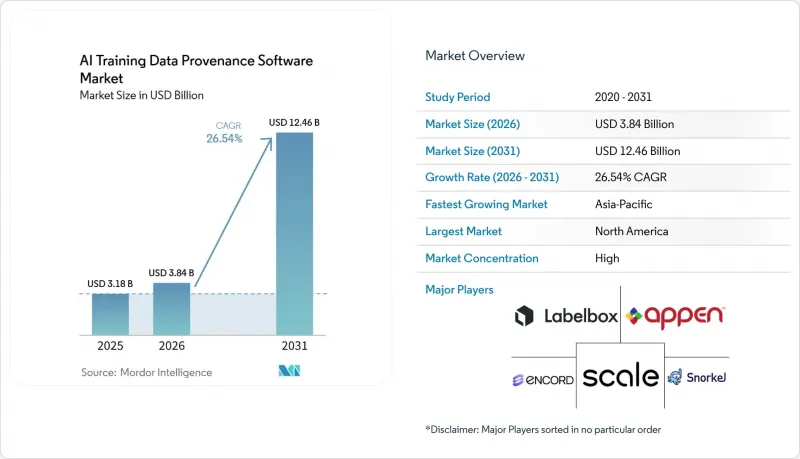
This report is Segmented by Product Type (Provenance and Lineage Management Software, and More), Deployment Model (Cloud, Hybrid, and On-Premises), Enterprise Size (Large Enterprises, and Small and Medium-Sized Enterprises), End User (IT and Telecommunication, BFSI, Automotive and Transportation, and More), and Geography. The Market Forecasts are Provided in Terms of Value (USD).
Global AI Training Data Provenance Software Market Trends and Insights
EU AI Act Data Governance Evidence Requirements
The AI Training Data Provenance Software Market is gaining support from rules requiring high-risk AI providers to document data origin, collection, labeling, bias review, and corrective action. These obligations move documentation into the training process rather than allowing teams to assemble records after deployment. General-purpose model transparency requirements also make training-data summaries a more visible governance matter. This timing shifts spending priorities because organizations need lineage tools while curating data, not only when an audit begins. Research on provenance disclosure found that complete records covering origin, transformation history, and rights status remained uncommon across public model repositories. The AI Training Data Provenance Software Market therefore benefits when organizations seek one workflow that supports data governance, deletion obligations, and operational logging.
Copyright and License Traceability for Training Data
Copyright disputes are increasing the value of records that identify the source and license status of each training item. Organizations need to know whether an item was licensed, subject to an opt-out, or restricted by a later rights request. The U.S. Copyright Office identified attribution and recordkeeping issues as material questions in determining how generative AI training relates to copyright law. This makes rights information important at the point where data is acquired and prepared. It also creates demand for systems that can preserve a clear record when content changes hands across teams or vendors. In the AI Training Data Provenance Software Market, rights, license, and copyright management tools help buyers connect individual content items to their permitted use at the time of training.
Shortage of AI Governance and Data Engineering Skills
The AI Training Data Provenance Software Market faces a deployment constraint because implementation requires data engineering, ML operations, and regulatory knowledge. Teams must configure data capture, connect it to training pipelines, and make the resulting record usable for review. This work is difficult when organizations assign governance duties to staff who lack experience with data systems. The shortage is especially important for smaller buyers who cannot maintain dedicated technical and compliance teams. It can leave organizations with software that has been purchased but not fully configured, leaving them without the evidence an auditor may request. Vendors can reduce this barrier through prebuilt templates, guided deployment, and automated evidence collection, thereby limiting the amount of specialist work required.
Other drivers and restraints analyzed in the detailed report include:
- Enterprise Scaling of Generative AI and Fine-Tuning Workloads
- Demand for Rights-Cleared Multimodal Datasets
- Fragmented Legal Standards Across Jurisdictions
For complete list of drivers and restraints, kindly check the Table Of Contents.
Segment Analysis
Provenance and Lineage Management Software held 28.41% of the market in 2025. This category meets the basic need to follow data from collection through preparation and training. Organizations use it to record source information, collection methods, annotations, and preprocessing steps. The category is important because foundational records support later rights review, quality checks, and compliance reporting. Rights, License, and Copyright Management Software and AI Data Governance, Quality, and Compliance Software form the next part of the product mix. BFSI and healthcare buyers are using these products as their model risk practices increasingly focus on training data documentation.
AI Unlearning and Takedown Management Software is projected to expand at a 28.42% CAGR through 2031, contributing to the AI Training Data Provenance Software Market. The category addresses requests to remove data and demonstrates that the request was handled. The European Data Protection Board made the right to erasure a coordinated enforcement priority for 2025 and 2026. Removing a training item requires a record of where it was used and how it affected later processes. Research presented at NeurIPS identified per-example training provenance as a central barrier to verifying regulatory-grade erasure. The category, therefore, depends on the same records that underpin lineage management, rather than operating as an isolated compliance function.
Cloud deployment accounted for 72.18% of the market in 2025. Cloud systems fit enterprise ML environments because they can connect through APIs to managed training and fine-tuning services. They also give development teams a common governance layer across distributed projects. This approach remains useful for organizations that need rapid access to compute and collaboration tools. The market position does not mean every dataset or provenance record can leave the organization's own environment. Data residency, sector rules, and internal security policies still influence where sensitive records are stored.
Hybrid deployment is projected to expand at a CAGR of 27.83% through 2031. It enables organizations to retain sensitive training data and lineage records in private environments while using public cloud resources for demanding compute tasks. This model is relevant to BFSI, healthcare, government, and other organizations with strict custody requirements. It can also support developer control of the documentation that regulators or customers may need to review. The AI Training Data Provenance Software Market is seeing this architecture gain attention as organizations balance cloud efficiency against the need to maintain control over data records. On-premises options continue to serve sovereign AI programs where national boundaries determine where training data documentation must remain.
Complete Report Scope:
- By Product Type
- Provenance and Lineage Management Software
- Rights, License, and Copyright Management Software
- Dataset Lifecycle, Versioning and Reproducibility Software
- AI Data Governance, Quality and Compliance Software
- AI Unlearning and Takedown Management Software
- By Deployment Model
- Cloud
- Hybrid
- On-Premises
- By Enterprise Size
- Large Enterprises
- Small and Medium-Sized Enterprises
- By End User
- IT and Telecommunication
- BFSI
- Automotive and Transportation
- Healthcare and Life Sciences
- Retail and E-Commerce
- Industrial Manufacturing
- Other End Users
- By Geography
- North America
- United States
- Canada
- Mexico
- South America
- Brazil
- Argentina
- Rest of South America
- Europe
- Germany
- United Kingdom
- France
- Russia
- Spain
- Rest of Europe
- Asia-Pacific
- China
- Japan
- India
- South Korea
- Southeast Asia
- Rest of Asia-Pacific
- Middle East and Africa
- Middle East
- Saudi Arabia
- United Arab Emirates
- Rest of Middle East
- Africa
- South Africa
- Nigeria
- Rest of Africa
- Middle East
- North America
Geography Analysis
North America held 34.62% of the market in 2025. The region combines a large base of generative AI development with early enterprise adoption of governance practices. Copyright litigation is making training-data records an operational issue for developers and legal teams. NIST AI RMF use and government procurement expectations also support demand for documented data provenance. Canada adds interest through its AI and data policy work, while Mexico benefits as technology supply chains extend governance expectations. The region's shortage of governance talent can slow deployments but also increases interest in software-led automation.
Europe was the second-largest geography in 2025. The AI Training Data Provenance Software Market is supported by EU AI Act requirements that encourage data documentation before high-risk systems enter the market. Germany, the United Kingdom, and France are the main demand centers. Germany's industrial base supports demand for versioning and reproducibility tools. The United Kingdom's financial services sector supports rights and license management needs. France's Health Data Hub and the EU AI Factories initiative add a public-sector channel for suppliers that can support government technology requirements.
Asia-Pacific is projected to expand at a CAGR of 28.31% through 2031. China's rules for generative AI services require providers to address the lawfulness and accuracy of their training data, which supports platform-level controls over provenance. India's data-governance direction is increasing interest in data residency and documented records among AI startups. South Korea and Japan have published governance frameworks that reference training-data documentation. Singapore is becoming a regional center for governance-focused AI work, and Scale AI formalized an AI evaluation research collaboration with Singapore's IMDA in April 2026. South America, led by Brazil, is emerging as privacy and AI policy measures create requirements in financial services and public administration. The Middle East and Africa are also early but important opportunities because Saudi Arabia and the UAE are developing sovereign AI programs that require documented data provenance for government systems.
- Scale AI, Inc.
- Appen Limited
- Labelbox, Inc.
- Encord Ltd.
- Snorkel AI, Inc.
- SuperAnnotate AI, Inc.
- Dataloop Ltd.
- V7 Labs, Inc.
- Toloka AI, Inc.
- Weights and Biases
- Iterative, Inc.
- Defined.ai, Inc.
- HumanSignal, Inc.
- Dataiku, Inc.
- Collibra, Inc.
- Alation, Inc.
- Atlan Pte. Ltd.
- Acryl Data, Inc.
- OneTrust Technology Limited
- Credo AI, Inc.
Additional Benefits:
- The market estimate (ME) sheet in Excel format
- 3 months of analyst support
TABLE OF CONTENTS
1 INTRODUCTION
- 1.1 Study Assumptions and Market Definition
- 1.2 Scope of the Study
2 RESEARCH METHODOLOGY
3 EXECUTIVE SUMMARY
4 MARKET LANDSCAPE
- 4.1 Market Overview
- 4.2 Market Drivers
- 4.2.1 EU AI Act Data-Governance Evidence Requirements
- 4.2.2 Copyright and License Traceability for Training Data
- 4.2.3 Enterprise Scaling of Generative AI and Fine-Tuning Workloads
- 4.2.4 Demand for Rights-Cleared Multimodal Datasets
- 4.2.5 Provenance-Linked Unlearning and Takedown Operations
- 4.2.6 Dataset Fingerprinting for Model Reproducibility
- 4.3 Market Restraints
- 4.3.1 Shortage of AI Governance and Data-Engineering Skills
- 4.3.2 Fragmented Legal Standards Across Jurisdictions
- 4.3.3 Proprietary Dataset Formats and Weak Cross-Platform Interoperability
- 4.3.4 Provenance Metadata Leakage and Adversarial Manipulation Risk
- 4.4 Impact of Macroeconomic Factors on the Market
- 4.5 Industry Value-Chain Analysis
- 4.6 Technology Outlook
- 4.7 Regulatory Landscape
- 4.8 Porter's Five Forces Analysis
- 4.8.1 Threat of New Entrants
- 4.8.2 Bargaining Power of Suppliers
- 4.8.3 Bargaining Power of Buyers
- 4.8.4 Threat of Substitutes
- 4.8.5 Intensity of Competitive Rivalry
5 MARKET SIZE AND GROWTH FORECASTS (VALUE)
- 5.1 By Product Type
- 5.1.1 Provenance and Lineage Management Software
- 5.1.2 Rights, License, and Copyright Management Software
- 5.1.3 Dataset Lifecycle, Versioning and Reproducibility Software
- 5.1.4 AI Data Governance, Quality and Compliance Software
- 5.1.5 AI Unlearning and Takedown Management Software
- 5.2 By Deployment Model
- 5.2.1 Cloud
- 5.2.2 Hybrid
- 5.2.3 On-Premises
- 5.3 By Enterprise Size
- 5.3.1 Large Enterprises
- 5.3.2 Small and Medium-Sized Enterprises
- 5.4 By End User
- 5.4.1 IT and Telecommunication
- 5.4.2 BFSI
- 5.4.3 Automotive and Transportation
- 5.4.4 Healthcare and Life Sciences
- 5.4.5 Retail and E-Commerce
- 5.4.6 Industrial Manufacturing
- 5.4.7 Other End Users
- 5.5 By Geography
- 5.5.1 North America
- 5.5.1.1 United States
- 5.5.1.2 Canada
- 5.5.1.3 Mexico
- 5.5.2 South America
- 5.5.2.1 Brazil
- 5.5.2.2 Argentina
- 5.5.2.3 Rest of South America
- 5.5.3 Europe
- 5.5.3.1 Germany
- 5.5.3.2 United Kingdom
- 5.5.3.3 France
- 5.5.3.4 Russia
- 5.5.3.5 Spain
- 5.5.3.6 Rest of Europe
- 5.5.4 Asia-Pacific
- 5.5.4.1 China
- 5.5.4.2 Japan
- 5.5.4.3 India
- 5.5.4.4 South Korea
- 5.5.4.5 Southeast Asia
- 5.5.4.6 Rest of Asia-Pacific
- 5.5.5 Middle East and Africa
- 5.5.5.1 Middle East
- 5.5.5.1.1 Saudi Arabia
- 5.5.5.1.2 United Arab Emirates
- 5.5.5.1.3 Rest of Middle East
- 5.5.5.2 Africa
- 5.5.5.2.1 South Africa
- 5.5.5.2.2 Nigeria
- 5.5.5.2.3 Rest of Africa
- 5.5.5.1 Middle East
- 5.5.1 North America
6 COMPETITIVE LANDSCAPE
- 6.1 Market Concentration
- 6.2 Strategic Moves
- 6.3 Market Share Analysis
- 6.4 Company Profiles (includes Global Level Overview, Market Level Overview, Core Segments, Financials as available, Strategic Information, Market Rank/Share, Products and Services, Recent Developments)
- 6.4.1 Scale AI, Inc.
- 6.4.2 Appen Limited
- 6.4.3 Labelbox, Inc.
- 6.4.4 Encord Ltd.
- 6.4.5 Snorkel AI, Inc.
- 6.4.6 SuperAnnotate AI, Inc.
- 6.4.7 Dataloop Ltd.
- 6.4.8 V7 Labs, Inc.
- 6.4.9 Toloka AI, Inc.
- 6.4.10 Weights and Biases
- 6.4.11 Iterative, Inc.
- 6.4.12 Defined.ai, Inc.
- 6.4.13 HumanSignal, Inc.
- 6.4.14 Dataiku, Inc.
- 6.4.15 Collibra, Inc.
- 6.4.16 Alation, Inc.
- 6.4.17 Atlan Pte. Ltd.
- 6.4.18 Acryl Data, Inc.
- 6.4.19 OneTrust Technology Limited
- 6.4.20 Credo AI, Inc.
7 MARKET OPPORTUNITIES AND FUTURE OUTLOOK
- 7.1 White-Space and Unmet-Need Assessment

