PUBLISHER: Mordor Intelligence | PRODUCT CODE: 2118231

PUBLISHER: Mordor Intelligence | PRODUCT CODE: 2118231
Coated Abrasive - Market Share Analysis, Industry Trends & Statistics, Growth Forecasts (2026 - 2031)
According to Mordor Intelligence, the coated abrasive market was valued at USD 14.92 billion in 2025 and is estimated to grow from USD 15.68 billion in 2026 to reach USD 20.26 billion by 2031, at a CAGR of 5.26% during the forecast period (2026-2031).
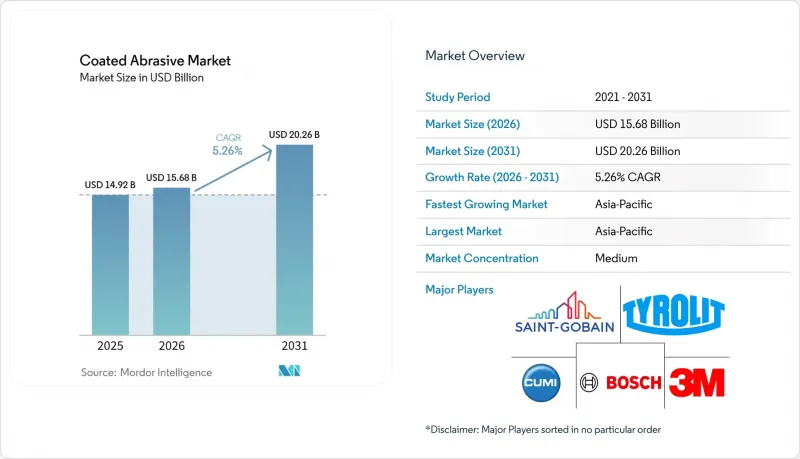
This report is Segmented by Product Type (Discs, Belts, Rolls, Sheets, and Other Product Types), Material Type (Aluminum Oxide, Silicon Carbide, and More), End-Use Industry (Metal Fabrication, Automotive, Woodworking & Furniture, and More), and Geography (Asia-Pacific, North America, Europe, South America, and Middle-East and Africa). The Market Forecasts are Provided in Value (USD).
Global Coated Abrasive Market Trends and Insights
Growing Demand for Precision Surface Finishing in Metalworking and Manufacturing Industries
Manufacturing modernization is raising performance requirements for surface finishing work across the coated abrasive market. Automated lines in aerospace, shipbuilding, and precision machining need abrasives that produce consistent finishes and dimensional accuracy. Fused aluminum oxide and silicon carbide are used downstream in bonded and coated abrasive products serving aerospace, automotive, furniture, and steel applications. Higher-alloy steels, titanium, and nickel superalloys need products that can work on hard materials without losing cutting performance. Structured abrasive formats are therefore more relevant in precision applications than basic paper products. Buyers can justify premium products when higher cut rates and longer tool life reduce downtime and rework.
Increasing Automotive Production and Aftermarket Repair Activities Driving Abrasive Consumption
Automotive production supports coated abrasive demand in paint preparation, body refinishing, drivetrain work, and component deburring. Electric and hybrid vehicles add finishing needs for battery housings, power electronics substrates, and aluminum structural parts. These applications use specifications that differ from conventional powertrain finishing work. Repair activity also supports demand because older vehicles remain in service longer in North America and Europe. Body shops require several sanding stages when repairing painted surfaces and body panels. This gives the coated abrasive market exposure to both vehicle production and replacement work.
Volatility in Raw Material Prices Affecting Abrasive Grain and Backing Material Costs
Raw material cost changes remain a margin risk across the coated abrasive value chain and the coated abrasive market. U.S. import prices for ground and refined fused aluminum oxide increased from USD 1,380 per metric ton in 2023 to USD 1,500 per metric ton in 2024. In the same period, crude silicon carbide prices declined from USD 905 per metric ton to USD 770 per metric ton. These movements show that manufacturers using both grains can face different cost pressures at the same time. China supplied 94% of U.S. crude fused aluminum oxide imports and 98% of U.S. crude silicon carbide imports, concentrating sourcing exposure. Tariff measures and export licensing pressures have made dual sourcing and procurement planning more important.
Other drivers and restraints analyzed in the detailed report include:
- Rising Adoption of High-Performance Ceramic and Zirconia Abrasives for Industrial Applications
- Increasing Use of Recyclable and Bio-Based Backing Materials
- Competition from Bonded Abrasives and Non-Woven Abrasive Products
For complete list of drivers and restraints, kindly check the Table Of Contents.
Segment Analysis
Discs held 34.86% of the coated abrasive market size in 2025. Their use with angle grinders, random orbital sanders, and robotic sanding heads supports demand in metal fabrication and automotive bodywork. Standard attachment systems and a broad grit range make discs useful for stock removal, sanding, and polishing. They are widely used in job shops and original equipment manufacturer finishing lines. The coated abrasive market continues to favor premium disc systems when they work with dust extraction equipment. In April 2026, 3M introduced Hookit Blue Net Abrasives with a ceramic and aluminum oxide blend and an open net structure that provides up to 95% dust extraction.
Belts are forecast to grow at a 5.94% CAGR from 2026 to 2031 in the coated abrasive market. Wide-belt lines support furniture production, engineered wood flooring, and continuous steel strip polishing. Their performance is closely linked to machine speed, workpiece throughput, and belt endurance. Mirka extended its Iridium range in February 2026 with flexible, dust-repellent handsanding sheets for wood, paint, and solid surfaces. Rolls retain a role in maintenance work and cut-to-length applications where format flexibility matters.
Complete Report Scope:
- By Product Type
- Discs
- Belts
- Rolls
- Sheets
- Other Product Types
- By Material Type
- Aluminum Oxide
- Silicon Carbide
- Zirconia Alumina
- Ceramic Alumina
- Garnet
- Emery
- Other Material Types
- By End-Use Industry
- Metal Fabrication
- Automotive
- Woodworking & Furniture
- Electronics & Semiconductor
- Aerospace & Defense
- Construction
- Machinery & Equipment
- Other End-Use Industries
- By Geography
- Asia-Pacific
- China
- India
- Japan
- South Korea
- Rest of Asia-Pacific
- North America
- United States
- Canada
- Mexico
- Europe
- Germany
- United Kingdom
- France
- Italy
- Russia
- Rest of Europe
- South America
- Brazil
- Argentina
- Rest of South America
- Middle-East and Africa
- Saudi Arabia
- South Africa
- Rest of Middle-East and Africa
- Asia-Pacific
Geography Analysis
Asia-Pacific held 45.41% of the coated abrasive market share in 2025 and is forecast to grow at a 6.02% CAGR through 2031. China's Yangtze River Delta concentrates machine tools and automated grinding cells. India is a secondary growth center, supported by its industrial base and automotive supply chain. Japan and South Korea generate demand through precision machinery, semiconductor equipment, and automotive parts finishing. China's Guobiao (GB) standards and Japan's Japanese Industrial Standards (JIS) certification requirements are tightening product specifications and favoring certified suppliers.
North America remains an important coated abrasive market because of automotive production, aerospace manufacturing, and construction activity. U.S. semiconductor fabrication investment is creating localized demand for high-specification products used in wafer and substrate work. China supplied 94% of U.S. crude fused aluminum oxide imports and 98% of U.S. crude silicon carbide imports, making supply chains vulnerable to changes in trade conditions. Mexico's automotive supply chain supports precision finishing for electric drivetrain components.
Europe's premium demand in the coated abrasive market is centered on Germany, France, and Italy, where precision machining, automotive production, and aerospace are well established. Eastern Europe broadens its regional footprint through automotive and electronics manufacturing investment. South America relies on Brazil's automotive and agricultural equipment sectors, while Argentina contributes through the light industry and machinery. Saudi industrial diversification and infrastructure projects support steel fabrication and construction finishing in the Middle-East and Africa. European ecodesign and producer responsibility rules are increasing buyer attention to lifecycle documentation, which Mirka addressed through its approved 2026 LCA tool.
- 3M
- Bibielle S.p.A.
- Carborundum Universal Limited
- Deerfos Co., Ltd.
- Hermes Schleifmittel GmbH
- Hubei Yuli Abrasive Belts Group Co., Ltd.
- Klingspor AG
- Kovax Corporation
- Mirka Ltd.
- Robert Bosch GmbH
- Saint-Gobain
- Sak Abrasives Limited
- Sia Abrasives Industries AG
- Smirdex S.A.
- Tyrolit AG
- VSM AG
Additional Benefits:
- The market estimate (ME) sheet in Excel format
- 3 months of analyst support
TABLE OF CONTENTS
1 Introduction
- 1.1 Study Assumptions and Market Definition
- 1.2 Scope of the Study
2 Research Methodology
3 Executive Summary
4 Market Landscape
- 4.1 Market Overview
- 4.2 Market Drivers
- 4.2.1 Growing Demand for Precision Surface Finishing in Metalworking and Manufacturing Industries
- 4.2.2 Increasing Automotive Production and Aftermarket Repair Activities Driving Abrasive Consumption
- 4.2.3 Expansion of Woodworking and Furniture Manufacturing Supporting Demand for Coated Abrasives
- 4.2.4 Rising Adoption of High-Performance Ceramic and Zirconia Abrasives for Industrial Applications
- 4.2.5 Increasing Use of Recyclable and Bio-Based Backing Materials
- 4.3 Market Restraints
- 4.3.1 Volatility in Raw Material Prices Affecting Abrasive Grain and Backing Material Costs
- 4.3.2 Competition from Bonded Abrasives and Non-Woven Abrasive Products
- 4.3.3 Frequent Replacement Requirements and Performance Variability Under Heavy-Duty Applications
- 4.4 Value Chain Analysis
- 4.5 Porter's Five Forces Analysis
- 4.5.1 Threat of New Entrants
- 4.5.2 Bargaining Power of Suppliers
- 4.5.3 Bargaining Power of Buyers
- 4.5.4 Threat of Substitutes
- 4.5.5 Competitive Rivalry
5 Market Size and Growth Forecasts (Value)
- 5.1 By Product Type
- 5.1.1 Discs
- 5.1.2 Belts
- 5.1.3 Rolls
- 5.1.4 Sheets
- 5.1.5 Other Product Types
- 5.2 By Material Type
- 5.2.1 Aluminum Oxide
- 5.2.2 Silicon Carbide
- 5.2.3 Zirconia Alumina
- 5.2.4 Ceramic Alumina
- 5.2.5 Garnet
- 5.2.6 Emery
- 5.2.7 Other Material Types
- 5.3 By End-Use Industry
- 5.3.1 Metal Fabrication
- 5.3.2 Automotive
- 5.3.3 Woodworking & Furniture
- 5.3.4 Electronics & Semiconductor
- 5.3.5 Aerospace & Defense
- 5.3.6 Construction
- 5.3.7 Machinery & Equipment
- 5.3.8 Other End-Use Industries
- 5.4 By Geography
- 5.4.1 Asia-Pacific
- 5.4.1.1 China
- 5.4.1.2 India
- 5.4.1.3 Japan
- 5.4.1.4 South Korea
- 5.4.1.5 Rest of Asia-Pacific
- 5.4.2 North America
- 5.4.2.1 United States
- 5.4.2.2 Canada
- 5.4.2.3 Mexico
- 5.4.3 Europe
- 5.4.3.1 Germany
- 5.4.3.2 United Kingdom
- 5.4.3.3 France
- 5.4.3.4 Italy
- 5.4.3.5 Russia
- 5.4.3.6 Rest of Europe
- 5.4.4 South America
- 5.4.4.1 Brazil
- 5.4.4.2 Argentina
- 5.4.4.3 Rest of South America
- 5.4.5 Middle-East and Africa
- 5.4.5.1 Saudi Arabia
- 5.4.5.2 South Africa
- 5.4.5.3 Rest of Middle-East and Africa
- 5.4.1 Asia-Pacific
6 Competitive Landscape
- 6.1 Market Concentration
- 6.2 Strategic Moves
- 6.3 Market Share (%)/Ranking Analysis
- 6.4 Company Profiles (includes Global Overview, Market Overview, Core Segments, Financials as available, Strategic Information, Products and Services, and Recent Developments)
- 6.4.1 3M
- 6.4.2 Bibielle S.p.A.
- 6.4.3 Carborundum Universal Limited
- 6.4.4 Deerfos Co., Ltd.
- 6.4.5 Hermes Schleifmittel GmbH
- 6.4.6 Hubei Yuli Abrasive Belts Group Co., Ltd.
- 6.4.7 Klingspor AG
- 6.4.8 Kovax Corporation
- 6.4.9 Mirka Ltd.
- 6.4.10 Robert Bosch GmbH
- 6.4.11 Saint-Gobain
- 6.4.12 Sak Abrasives Limited
- 6.4.13 Sia Abrasives Industries AG
- 6.4.14 Smirdex S.A.
- 6.4.15 Tyrolit AG
- 6.4.16 VSM AG
7 Market Opportunities and Future Outlook
- 7.1 White-Space and Unmet-Need Assessment

