PUBLISHER: Mordor Intelligence | PRODUCT CODE: 2118849

PUBLISHER: Mordor Intelligence | PRODUCT CODE: 2118849
Still Wine - Market Share Analysis, Industry Trends & Statistics, Growth Forecasts (2026 - 2031)
According to Mordor Intelligence, the still wine market was valued at USD 259.55 billion in 2025 and is estimated to reach USD 267.52 billion in 2026, growing to USD 326.89 billion by 2031, at a CAGR of 4.09% during the forecast period (2026-2031).
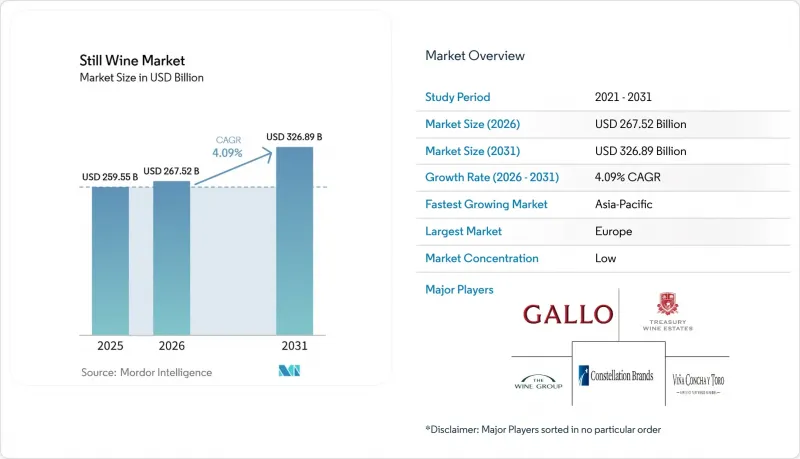
This report is Segmented by Product Type (Red Wine, White Wine, Rose Wine, and Others), End-User (Men and Women), Distribution Channel (On-Trade and Off-Trade), and Geography (North America, Europe, Asia-Pacific, South America, and Middle East & Africa). The Market Forecasts are Provided in Terms of Value (USD) and Volume (Liters).
Global Still Wine Market Trends and Insights
Expansion of wine tourism and vineyard experiences
The expansion of wine tourism and vineyard experiences is strengthening the still wine market by creating additional revenue streams and deepening consumer engagement with wineries and regional wine cultures. Vineyard tours, wine festivals, educational workshops, and estate hospitality experiences enable producers to enhance brand visibility, strengthen direct-to-consumer sales, and increase the perceived value of premium wine offerings. These experiences also encourage wineries to invest in visitor infrastructure and destination-based wine experiences that support long-term customer loyalty. According to the United Nations Tourism Global Wine Tourism Report 2025, more than 1,300 wineries from 47 countries participated in the global survey, providing comprehensive insights into the evolving wine tourism landscape and supporting evidence-based development of the market . The growing integration of tourism with wine production is reinforcing market expansion by creating new sales opportunities, strengthening winery revenues, and increasing global awareness of still wines.
Consumer preference for premium and artisanal wines
Growing consumer preference for premium and artisanal wines is driving the still wine market, as wineries increasingly focus on high-quality production, limited-edition labels, single-vineyard expressions, and distinctive grape varietals that emphasize craftsmanship and authenticity. Producers are expanding their portfolios with estate-grown wines, region-specific offerings, and carefully curated winemaking techniques to differentiate products and strengthen brand value. This shift toward premiumization enables wineries to build stronger consumer loyalty while reinforcing the perception of quality and exclusivity. For instance, Moet Hennessy offers Chandon Aurva, a premium 100% Shiraz still red wine crafted at Chandon India's Nashik estate, reflecting the company's focus on producing premium still wines that highlight regional terroir, meticulous winemaking, and artisanal craftsmanship.
Stringent regulations on alcohol production, labeling, and marketing
Stringent regulations on alcohol production, labeling, and marketing increase compliance requirements across manufacturing, packaging, distribution, and promotional activities, acting as a significant restraint on the still wine market. Wine producers must adhere to diverse country-specific regulations governing ingredient disclosures, geographical indications, alcohol content declarations, health warnings, labeling formats, advertising standards, and product traceability before entering domestic or international markets. Differences in regulatory frameworks across regions further complicate cross-border trade, requiring wineries to modify packaging, certifications, and marketing materials to meet local legal requirements. These compliance obligations increase operational complexity, extend product approval timelines, and limit promotional flexibility, posing challenges for both established producers and smaller wineries seeking to expand into new markets.
Other drivers and restraints analyzed in the detailed report include:
- Rising popularity of wine education and appreciation culture
- Increasing preference for food and wine pairing experiences
- Climate change affecting grape cultivation
For complete list of drivers and restraints, kindly check the Table Of Contents.
Segment Analysis
Red Wine dominated the still wine market, accounting for the largest share of 47.73% in 2025, driven by its strong premium positioning, extensive portfolio of geographically protected wines, and continued emphasis on quality-focused production across leading wine-producing regions. A substantial share of internationally recognized red wines is produced under Protected Designation of Origin (PDO) and Protected Geographical Indication (PGI) frameworks, strengthening consumer confidence in product authenticity, traceability, and regional heritage. Data from the Italian National Institute of Statistics (ISTAT) shows that in 2024, the export value of Italian PDO red wines reached approximately EUR 866 million, while PGI red wines recorded exports of around EUR 472 million, highlighting the robust international demand for certified premium red wines and reinforcing the segment's leadership in the global still wine market .
Rose Wine is the fastest-growing product type, projected to expand at a CAGR of 5.87% during 2026-2031, supported by increasing innovation in premium rose production, expanding availability of region-specific varietals, and growing recognition of rose as a distinct premium wine category. Wineries are introducing new grape blends, refining vinification techniques, and expanding portfolios with geographically certified rose wines to strengthen product differentiation and quality perception. The segment is also benefiting from greater emphasis on limited-edition vintages, sustainable vineyard practices, and premium packaging, which enhance brand positioning and consumer appeal. Furthermore, leading wine-producing countries are increasing investments in rose production to diversify export portfolios and capitalize on rising international demand, reinforcing rose wine's position as the fastest-growing product type in the global still wine market.
Complete Report Scope:
- By Product Type
- Red Wine
- White Wine
- Rose Wine
- Others
- By End-User
- Men
- Women
- By Distribution Channel
- On-Trade
- Off-Trade
- Specialty/Liquor Stores
- Other off-Trade Channels
- By Geography
- North America
- United States
- Canada
- Mexico
- Rest of North America
- Europe
- United Kingdom
- Germany
- France
- Italy
- Spain
- Netherlands
- Poland
- Belgium
- Sweden
- Rest of Europe
- Asia-Pacific
- China
- Japan
- India
- Australia
- Indonesia
- South Korea
- Thailand
- Singapore
- Rest of Asia-Pacific
- South America
- Brazil
- Argentina
- Colombia
- Chile
- Peru
- Rest of South America
- Middle East and Africa
- South Africa
- Saudi Arabia
- United Arab Emirates
- Nigeria
- Egypt
- Morocco
- Turkey
- Rest of Middle East and Africa
- North America
Geography Analysis
Europe dominated the still wine market, accounting for 42.34% of global revenue in 2025, supported by its long-established viticulture heritage, extensive vineyard acreage, and leadership in premium wine production. The region benefits from internationally recognized appellation systems, advanced winemaking expertise, and a high concentration of geographically protected wines that reinforce product authenticity and quality. According to the International Organisation of Vine and Wine (OIV), Italy, France, and Spain were the world's three largest wine producers in 2025, with France producing approximately 44.4 million hectoliters of wine . The strong production capacity of these countries ensures a consistent supply of high-quality still wines for both domestic consumption and international exports, reinforcing Europe's position in the global still wine market.
Asia-Pacific is the fastest-growing regional market, projected to expand at a CAGR of 5.65% during 2026-2031, driven by the rapid development of domestic wine industries, increasing investments in modern vineyard cultivation, and the expansion of premium wine production across several countries. Regional producers are adopting advanced viticulture practices, introducing new grape varietals suited to local climates, and improving winemaking technologies to enhance product quality and international competitiveness. The expansion of wine education, tasting culture, and premium retail infrastructure is further strengthening consumer awareness and supporting greater acceptance of still wines across the region.
North America, South America, and the Middle East & Africa continue to strengthen their presence in the global still wine market, supported by ongoing product innovation, vineyard modernization, and expanding premium wine portfolios. North America remains a key market due to continuous investments in sustainable viticulture, premiumization, and technologically advanced winemaking. South America benefits from favorable grape-growing conditions and increasing international recognition of wines from countries such as Chile and Argentina, supported by growing exports of premium varietals. The Middle East and Africa is witnessing gradual market expansion through the development of hospitality infrastructure, premium retail channels, and the growing international recognition of South Africa as a significant wine-producing nation, contributing to the region's increasing role in the global still wine market.
- E. & J. Gallo Winery
- The Wine Group
- Treasury Wine Estates Limited
- Constellation Brands, Inc.
- Vina Concha y Toro S.A.
- Casella Family Brands
- Vinarchy
- Castel Freres
- Pernod Ricard
- Diageo plc
- Bacardi Limited
- Bronco Wine Company
- Trinchero Family Estates
- Jackson Family Wines
- Grupo Penaflor
- Caviro Group
- Changyu Pioneer Wine Co., Ltd.
- LVMH Moet Hennessy Louis Vuitton SE
- Foley Family Wines
- Chapel Down Group plc
Additional Benefits:
- The market estimate (ME) sheet in Excel format
- 3 months of analyst support
TABLE OF CONTENTS
1 INTRODUCTION
- 1.1 Study Assumptions and Market Definition
- 1.2 Scope of the Study
2 RESEARCH METHODOLOGY
3 EXECUTIVE SUMMARY
4 MARKET LANDSCAPE
- 4.1 Market Overview
- 4.2 Market Drivers
- 4.2.1 Expansion of wine tourism and vineyard experiences
- 4.2.2 Consumer preference for premium and artisanal wines
- 4.2.3 Rising popularity of wine education and appreciation culture
- 4.2.4 Increasing preference for food and wine pairing experiences
- 4.2.5 Adoption of sustainable and innovative packaging formats
- 4.2.6 Innovation in grape varieties and winemaking techniques
- 4.3 Market Restraints
- 4.3.1 Stringent regulations on alcohol production, labeling, and marketing
- 4.3.2 Climate change affecting grape cultivation
- 4.3.3 High susceptibility to pests and vineyard diseases
- 4.3.4 Intense competition from alternative alcoholic beverages
- 4.4 Technological Outlook
- 4.5 Regulatory Landscape
- 4.6 Supply-Chain Analysis
- 4.7 Porter's Five Forces Analysis
- 4.7.1 Threat of New Entrants
- 4.7.2 Bargaining Power of Buyers
- 4.7.3 Bargaining Power of Suppliers
- 4.7.4 Threat of Substitutes
- 4.7.5 Intensity of Competitive Rivalry
5 MARKET SIZE AND GROWTH FORECASTS (VALUE AND VOLUME)
- 5.1 By Product Type
- 5.1.1 Red Wine
- 5.1.2 White Wine
- 5.1.3 Rose Wine
- 5.1.4 Others
- 5.2 By End-User
- 5.2.1 Men
- 5.2.2 Women
- 5.3 By Distribution Channel
- 5.3.1 On-Trade
- 5.3.2 Off-Trade
- 5.3.2.1 Specialty/Liquor Stores
- 5.3.2.2 Other off-Trade Channels
- 5.4 By Geography
- 5.4.1 North America
- 5.4.1.1 United States
- 5.4.1.2 Canada
- 5.4.1.3 Mexico
- 5.4.1.4 Rest of North America
- 5.4.2 Europe
- 5.4.2.1 United Kingdom
- 5.4.2.2 Germany
- 5.4.2.3 France
- 5.4.2.4 Italy
- 5.4.2.5 Spain
- 5.4.2.6 Netherlands
- 5.4.2.7 Poland
- 5.4.2.8 Belgium
- 5.4.2.9 Sweden
- 5.4.2.10 Rest of Europe
- 5.4.3 Asia-Pacific
- 5.4.3.1 China
- 5.4.3.2 Japan
- 5.4.3.3 India
- 5.4.3.4 Australia
- 5.4.3.5 Indonesia
- 5.4.3.6 South Korea
- 5.4.3.7 Thailand
- 5.4.3.8 Singapore
- 5.4.3.9 Rest of Asia-Pacific
- 5.4.4 South America
- 5.4.4.1 Brazil
- 5.4.4.2 Argentina
- 5.4.4.3 Colombia
- 5.4.4.4 Chile
- 5.4.4.5 Peru
- 5.4.4.6 Rest of South America
- 5.4.5 Middle East and Africa
- 5.4.5.1 South Africa
- 5.4.5.2 Saudi Arabia
- 5.4.5.3 United Arab Emirates
- 5.4.5.4 Nigeria
- 5.4.5.5 Egypt
- 5.4.5.6 Morocco
- 5.4.5.7 Turkey
- 5.4.5.8 Rest of Middle East and Africa
- 5.4.1 North America
6 COMPETITIVE LANDSCAPE
- 6.1 Market Concentration
- 6.2 Strategic Moves
- 6.3 Market Positioning Analysis
- 6.4 Company Profiles (includes Global level Overview, Market level overview, Core Segments, Financials as available, Strategic Information, Market Rank/Share for key companies, Products and Services, and Recent Developments)
- 6.4.1 E. & J. Gallo Winery
- 6.4.2 The Wine Group
- 6.4.3 Treasury Wine Estates Limited
- 6.4.4 Constellation Brands, Inc.
- 6.4.5 Vina Concha y Toro S.A.
- 6.4.6 Casella Family Brands
- 6.4.7 Vinarchy
- 6.4.8 Castel Freres
- 6.4.9 Pernod Ricard
- 6.4.10 Diageo plc
- 6.4.11 Bacardi Limited
- 6.4.12 Bronco Wine Company
- 6.4.13 Trinchero Family Estates
- 6.4.14 Jackson Family Wines
- 6.4.15 Grupo Penaflor
- 6.4.16 Caviro Group
- 6.4.17 Changyu Pioneer Wine Co., Ltd.
- 6.4.18 LVMH Moet Hennessy Louis Vuitton SE
- 6.4.19 Foley Family Wines
- 6.4.20 Chapel Down Group plc
7 MARKET OPPORTUNITIES AND FUTURE OUTLOOK

