PUBLISHER: Mordor Intelligence | PRODUCT CODE: 2118850

PUBLISHER: Mordor Intelligence | PRODUCT CODE: 2118850
Craft Rum - Market Share Analysis, Industry Trends & Statistics, Growth Forecasts (2026 - 2031)
According to Mordor Intelligence, the global craft rum market was valued at USD 1.50 billion in 2025, estimated at USD 1.56 billion in 2026, and projected to reach USD 1.98 billion by 2031, expanding at a CAGR of 4.86% during the 2026-2031 forecast period.
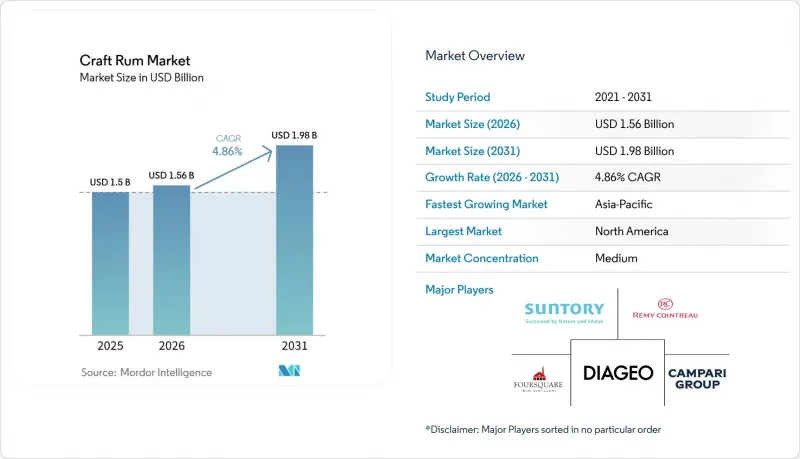
This report is Segmented by Product Type (White Craft Rum, Gold Craft Rum, and Dark Craft Rum), End-User (Men and Women), Aging (Unaged Rum, Aged Up To 3 Years, and More), Distribution Channel (On-Trade and Off-Trade), and Geography (North America, Europe, Asia-Pacific, South America, and Middle East and Africa). The Market Forecasts are Provided in Terms of Value (USD) and Volume (Liters).
Global Craft Rum Market Trends and Insights
Demand for unique flavor profiles and botanical-infused rum variants
Growing consumer interest in distinctive and premium tasting experiences is driving innovation across the craft rum market, encouraging producers to develop products with complex flavor profiles and natural botanical infusions. Rather than relying on traditional rum expressions, craft distillers are incorporating herbs, spices, citrus peels, tropical fruits, floral ingredients, and other plant-based botanicals during fermentation, distillation, or post-distillation maturation to create differentiated offerings. This focus on flavor innovation enables brands to cater to consumers seeking authenticity, experimentation, and artisanal craftsmanship, while expanding product portfolios with limited-edition and specialty expressions. The continuous introduction of botanical-infused craft rums is strengthening product differentiation, supporting premium positioning, and attracting consumers looking for novel, high-quality spirits.
Expansion of craft distilleries and small-batch production facilities
The expansion of craft distilleries and small-batch production facilities is driving growth in the craft rum market by increasing production capacity, product diversity, and innovation. Independent distillers are investing in artisanal distillation infrastructure that enables greater control over ingredient selection, fermentation, maturation, and quality, resulting in premium handcrafted rum expressions. Small-batch production allows manufacturers to experiment with different sugarcane sources, yeast strains, barrel-aging techniques, and limited-edition releases, creating differentiated products that appeal to consumers seeking authenticity and exclusivity. As more craft distilleries enter the market and expand their operational capabilities, the availability of premium craft rum continues to increase, strengthening market competitiveness and supporting category growth.
Stringent alcohol production and licensing regulations
Stringent alcohol production and licensing regulations restrain the craft rum market by increasing compliance costs and extending the time required to establish and expand production facilities. Craft rum producers must comply with requirements related to distillation permits, excise taxation, product approvals, labeling standards, quality control, storage, distribution, and periodic regulatory inspections. For small and independent distilleries, these regulatory obligations often require substantial financial investment and administrative resources, limiting production scalability and delaying new product introductions. Variations in alcohol regulations across countries further complicate market expansion, making it more difficult for craft rum producers to access new markets and maintain efficient cross-border distribution.
Other drivers and restraints analyzed in the detailed report include:
- Increasing popularity of premium cocktail culture and mixology
- Rising influence of rum tourism and distillery experiences
- Lengthy aging requirements for premium rum varieties
For complete list of drivers and restraints, kindly check the Table Of Contents.
Segment Analysis
Dark Craft Rum held the largest product-type share in 2025 at 43.56%, supported by increasing consumer appreciation for spirits that offer depth, maturity, and craftsmanship through extended barrel aging. The prolonged aging process naturally develops layered aromas and a fuller body, creating a distinctive sensory profile that differentiates dark craft rum from lighter variants. Consumers are increasingly seeking authentic spirits with visible production heritage, traditional distillation practices, and premium maturation techniques, all of which favor dark craft rum. The category also benefits from the growing popularity of small-batch and limited-release expressions, where longer maturation enhances perceived exclusivity and product value. Additionally, the emphasis on provenance, natural ingredient quality, and handcrafted production has positioned dark craft rum as a benchmark for premium artisanal spirits, reinforcing its dominant position within the product landscape.
Gold Craft Rum is the fastest-growing product-type segment, with a CAGR of 4.98% over the 2026-2031 forecast period. Growth is driven by evolving consumer preferences for premium spirits that balance freshness with oak-derived complexity. Its moderate maturation produces a smoother, more approachable taste while preserving the natural sugarcane character, making it increasingly attractive to consumers exploring premium craft rum. Producers are expanding this category through innovative maturation methods, specialty wood finishes, and controlled aging techniques that enhance flavor without overwhelming the spirit's original profile. Rising demand for versatile premium expressions with refined yet accessible taste characteristics has accelerated product innovation in this category, while growing consumer interest in different aging styles and flavor profiles continues to support the long-term growth outlook for gold craft rum.
Male consumers accounted for 67.82% of the craft rum end-user share in 2025, driven by a strong preference for premium spirits that emphasize heritage, craftsmanship, and flavor complexity. Consumers within this group demonstrate a greater inclination toward exploring artisanal distillation techniques, extended barrel maturation, and limited-production releases, resulting in sustained demand for high-quality craft rum. Interest in tasting notes, authenticity, production transparency, and traditional rum-making practices has encouraged continued engagement with premium expressions, while growing participation in spirits education, tasting events, and enthusiast communities has further reinforced purchasing frequency. The increasing appreciation for handcrafted beverages with distinctive character and premium positioning continues to support the dominance of male consumers within the craft rum market.
Women represent the fastest-growing end-user segment with a 6.83% CAGR over 2026-2031, driven by evolving preferences for premium alcoholic beverages that combine authenticity, refined taste, and artisanal production values. Increasing interest in craft spirits has encouraged greater exploration of products featuring balanced flavor profiles, natural ingredients, and distinctive production stories. Consumers are also placing greater importance on quality over quantity, seeking beverages that offer unique sensory experiences and premium craftsmanship. This shift has encouraged producers to broaden their premium portfolios with more diverse flavor expressions, sophisticated packaging, and heritage-focused branding, strengthening the participation of women in the craft rum market and supporting sustained growth throughout the forecast period.
Complete Report Scope:
- By Product Type
- White Craft Rum
- Gold Craft Rum
- Dark Craft Rum
- By End-User
- Men
- Women
- By Aging
- Unaged Rum
- Aged up to 3 Years
- Aged 3 - 7 Years
- Aged Above 7 Years
- Others
- By Distribution Channel
- On-Trade
- Off-Trade
- Specialty/Liquor Stores
- Other off-Trade Channels
- By Geography
- North America
- United States
- Canada
- Mexico
- Rest of North America
- Europe
- United Kingdom
- Germany
- France
- Italy
- Spain
- Netherlands
- Poland
- Belgium
- Sweden
- Rest of Europe
- Asia-Pacific
- China
- Japan
- India
- Australia
- Indonesia
- South Korea
- Thailand
- Singapore
- Rest of Asia-Pacific
- South America
- Brazil
- Argentina
- Colombia
- Chile
- Peru
- Rest of South America
- Middle East and Africa
- South Africa
- Saudi Arabia
- United Arab Emirates
- Nigeria
- Egypt
- Morocco
- Turkey
- Rest of Middle East and Africa
- North America
Geography Analysis
North America accounted for 38.76% of the global craft rum market in 2025, supported by its well-developed craft distilling ecosystem, strong consumer preference for premium artisanal spirits, and continuous innovation in small-batch rum production. The region benefits from an extensive network of independent distilleries that focus on authentic production methods, barrel-aging expertise, ingredient traceability, and premium-quality offerings. According to the Distilled Spirits Council of the United States (DISCUS), the United States had nearly 2,300 operating distilleries in 2025, reflecting a robust manufacturing base that continues to strengthen product diversity and premium craft spirit availability . Growing consumer interest in handcrafted spirits, heritage-inspired production techniques, and premium aged rum expressions further reinforces the region's position in the global craft rum market.
Asia-Pacific is the fastest-growing regional market, with a CAGR of 6.45% during 2026-2031, driven by the rapid evolution of premium drinking culture, increasing consumer exposure to international craft spirits, and growing appreciation for artisanal alcoholic beverages. The region is witnessing strong growth in premium spirit education, specialized tasting events, and sophisticated beverage experiences that encourage consumers to explore craft rum. The continued expansion of premium cocktail culture across major metropolitan areas, along with growing demand for authentic, high-quality imported and locally crafted spirits, has accelerated category adoption. Increasing product availability through modern retail channels, specialty beverage outlets, and premium hospitality establishments is also supporting broader consumer access to craft rum and sustaining long-term market expansion across the region.
Europe, South America, and the Middle East and Africa each contribute to the global craft rum market through distinct regional growth dynamics. Europe benefits from a mature premium spirits culture, strong consumer appreciation for artisanal production, and increasing demand for heritage-inspired, aged, and limited-edition rum expressions. South America is supported by its deep-rooted sugarcane cultivation, long-standing rum-making traditions, and a growing emphasis on premiumization, enabling producers to introduce high-quality craft offerings with distinctive regional identities. The Middle East & Africa is gradually emerging as a developing market, driven by the expansion of premium hospitality, luxury tourism, specialty beverage retail, and growing consumer interest in authentic imported craft spirits, creating new opportunities for premium craft rum brands to expand their presence.
- Diageo PLC
- Suntory Holdings Limited
- Remy Cointreau Group
- Foursquare Rum Distillery
- Campari Group (Appleton Estate)
- Brown-Forman Corporation
- Ron Zacapa
- Hampden Estate Distillery
- Privateer Rum
- K?loa Rum Company
- Wicked Dolphin Distillery
- Maine Craft Distilling LLC
- Richland Rum
- Arizona Craft Beverage, Inc.
- Charles Merser and Co.
- Drum and Black Rum Company Limited
- Rockstar Spirits Limited
- Belize Spirits Marketing, Inc.
- Devon Rum Company
- La Hechicera Company
Additional Benefits:
- The market estimate (ME) sheet in Excel format
- 3 months of analyst support
TABLE OF CONTENTS
1 INTRODUCTION
- 1.1 Study Assumptions and Market Definition
- 1.2 Scope of the Study
2 RESEARCH METHODOLOGY
3 EXECUTIVE SUMMARY
4 MARKET LANDSCAPE
- 4.1 Market Overview
- 4.2 Market Drivers
- 4.2.1 Demand for unique flavor profiles and botanical-infused rum variants
- 4.2.2 Expansion of craft distilleries and small-batch production facilities
- 4.2.3 Increasing popularity of premium cocktail culture and mixology
- 4.2.4 Rising influence of rum tourism and distillery experiences
- 4.2.5 Innovation in barrel-aging and cask-finishing techniques
- 4.2.6 Consumer interest in limited-edition and collectible spirits
- 4.3 Market Restraints
- 4.3.1 Stringent alcohol production and licensing regulations
- 4.3.2 Lengthy aging requirements for premium rum varieties
- 4.3.3 Supply variability of high-quality sugarcane and molasses
- 4.3.4 Storage and inventory requirements for barrel-aged products
- 4.4 Technological Outlook
- 4.5 Regulatory Landscape
- 4.6 Supply-Chain Analysis
- 4.7 Porter's Five Forces Analysis
- 4.7.1 Threat of New Entrants
- 4.7.2 Bargaining Power of Buyers
- 4.7.3 Bargaining Power of Suppliers
- 4.7.4 Threat of Substitutes
- 4.7.5 Intensity of Competitive Rivalry
5 MARKET SIZE AND GROWTH FORECASTS (VALUE AND VOLUME)
- 5.1 By Product Type
- 5.1.1 White Craft Rum
- 5.1.2 Gold Craft Rum
- 5.1.3 Dark Craft Rum
- 5.2 By End-User
- 5.2.1 Men
- 5.2.2 Women
- 5.3 By Aging
- 5.3.1 Unaged Rum
- 5.3.2 Aged up to 3 Years
- 5.3.3 Aged 3 - 7 Years
- 5.3.4 Aged Above 7 Years
- 5.3.5 Others
- 5.4 By Distribution Channel
- 5.4.1 On-Trade
- 5.4.2 Off-Trade
- 5.4.2.1 Specialty/Liquor Stores
- 5.4.2.2 Other off-Trade Channels
- 5.5 By Geography
- 5.5.1 North America
- 5.5.1.1 United States
- 5.5.1.2 Canada
- 5.5.1.3 Mexico
- 5.5.1.4 Rest of North America
- 5.5.2 Europe
- 5.5.2.1 United Kingdom
- 5.5.2.2 Germany
- 5.5.2.3 France
- 5.5.2.4 Italy
- 5.5.2.5 Spain
- 5.5.2.6 Netherlands
- 5.5.2.7 Poland
- 5.5.2.8 Belgium
- 5.5.2.9 Sweden
- 5.5.2.10 Rest of Europe
- 5.5.3 Asia-Pacific
- 5.5.3.1 China
- 5.5.3.2 Japan
- 5.5.3.3 India
- 5.5.3.4 Australia
- 5.5.3.5 Indonesia
- 5.5.3.6 South Korea
- 5.5.3.7 Thailand
- 5.5.3.8 Singapore
- 5.5.3.9 Rest of Asia-Pacific
- 5.5.4 South America
- 5.5.4.1 Brazil
- 5.5.4.2 Argentina
- 5.5.4.3 Colombia
- 5.5.4.4 Chile
- 5.5.4.5 Peru
- 5.5.4.6 Rest of South America
- 5.5.5 Middle East and Africa
- 5.5.5.1 South Africa
- 5.5.5.2 Saudi Arabia
- 5.5.5.3 United Arab Emirates
- 5.5.5.4 Nigeria
- 5.5.5.5 Egypt
- 5.5.5.6 Morocco
- 5.5.5.7 Turkey
- 5.5.5.8 Rest of Middle East and Africa
- 5.5.1 North America
6 COMPETITIVE LANDSCAPE
- 6.1 Market Concentration
- 6.2 Strategic Moves
- 6.3 Market Positioning Analysis
- 6.4 Company Profiles (includes Global level Overview, Market level overview, Core Segments, Financials as available, Strategic Information, Market Rank/Share for key companies, Products and Services, and Recent Developments)
- 6.4.1 Diageo PLC
- 6.4.2 Suntory Holdings Limited
- 6.4.3 Remy Cointreau Group
- 6.4.4 Foursquare Rum Distillery
- 6.4.5 Campari Group (Appleton Estate)
- 6.4.6 Brown-Forman Corporation
- 6.4.7 Ron Zacapa
- 6.4.8 Hampden Estate Distillery
- 6.4.9 Privateer Rum
- 6.4.10 K?loa Rum Company
- 6.4.11 Wicked Dolphin Distillery
- 6.4.12 Maine Craft Distilling LLC
- 6.4.13 Richland Rum
- 6.4.14 Arizona Craft Beverage, Inc.
- 6.4.15 Charles Merser and Co.
- 6.4.16 Drum and Black Rum Company Limited
- 6.4.17 Rockstar Spirits Limited
- 6.4.18 Belize Spirits Marketing, Inc.
- 6.4.19 Devon Rum Company
- 6.4.20 La Hechicera Company
7 MARKET OPPORTUNITIES AND FUTURE OUTLOOK

