PUBLISHER: Mordor Intelligence | PRODUCT CODE: 2118859

PUBLISHER: Mordor Intelligence | PRODUCT CODE: 2118859
Decision Intelligence Software - Market Share Analysis, Industry Trends & Statistics, Growth Forecasts (2026 - 2031)
According to Mordor Intelligence, the decision intelligence software market size is projected to expand from USD 10.18 billion in 2025 and USD 11.53 billion in 2026 to USD 24.99 billion by 2031, registering a CAGR of 16.73% between 2026 and 2031.
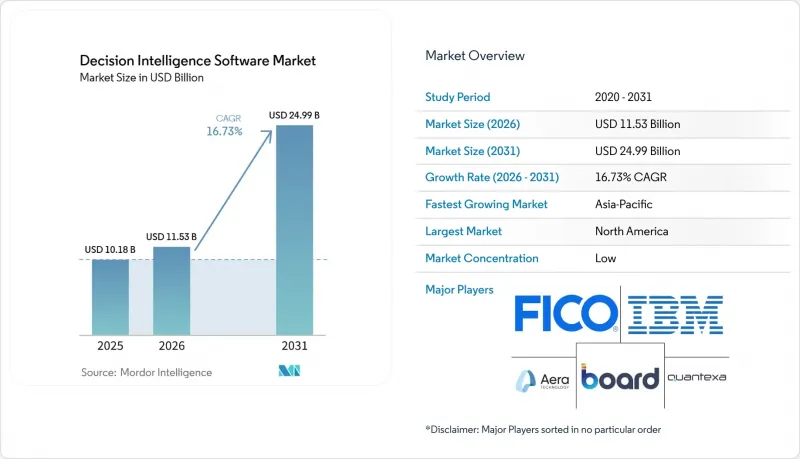
This report is Segmented by Offering (Software, and Services), Decision Type (Assisted Decision Support, and More), Deployment Model (Cloud, Hybrid, and On-Premises), Business Function (Finance and Accounting, Marketing and Sales, and More), Enterprise Size (Large Enterprises, and More), End Users (BFSI, and More), and Geography. The Market Forecasts are Provided in Terms of Value (USD).
Global Decision Intelligence Software Market Trends and Insights
Enterprise Adoption of AI and Machine Learning
Enterprise AI spending has moved beyond pilots, driving demand for platforms that convert model outputs into governed, auditable decisions. Organizations need tools that can apply policies consistently when AI is used across customer, operational, and risk-related workflows. The skills gap also favors vendor-managed platforms that reduce the technical burden for business users. IBM has introduced a natural-language Decision Assistant that converts policy text into auditable decision flows, showing how vendors are addressing this requirement. The Decision Intelligence Software Market, therefore, favors platforms that combine deployment support with clear governance rather than isolated machine-learning tools. This pattern supports suppliers that can make decision logic accessible without weakening oversight.
Demand for Real-Time Data-Driven Decision-Making
Organizations increasingly require decisions from live data rather than delayed reporting cycles. This is especially important when credit, fraud, inventory, and customer service decisions must be made quickly and consistently. Provenir reported that 60% of surveyed financial institutions identified AI and decision intelligence as their leading planned investment area in 2026. Real-time systems can process current signals and apply defined policies before a manual review becomes necessary. Banks also need clear decision trails for supervisory review, which makes speed and documentation equally important. The resulting demand strengthens the role of governed execution tools in financial services, supply chains, and digital commerce.
Data Security, Privacy, and Sovereignty Concerns
Data sovereignty has become a procurement requirement in jurisdictions that restrict the storage and processing of sensitive information. The EU AI Act applies to high-risk AI systems from August 2026 and establishes data governance duties for those systems. These requirements can delay projects that depend on personal data moving across organizational or national boundaries. HM Revenue and Customs selected Quantexa for a GBP 175 million (USD 221 million) contract to transform sovereign data and AI. The agreement shows that public buyers may prefer nationally contained systems instead of shared cloud services. Suppliers with sovereign deployment capabilities can therefore serve buyers that may not consider a multi-tenant architecture.
Other drivers and restraints analyzed in the detailed report include:
- Cloud Expansion and Scalable Decisioning Infrastructure
- Risk Reduction and Operational Cost Optimization
- Data Fragmentation and Legacy-System Integration Complexity
For complete list of drivers and restraints, kindly check the Table Of Contents.
Segment Analysis
Software held 69.74% of the Decision Intelligence Software Market share in 2025, reflecting demand for platforms that combine modeling, inference, governance, and outcome tracking. A unified platform helps organizations keep decision rules and model versions in a single, controlled environment. This structure reduces accountability gaps that can arise when multiple point products are assembled. FICO, SAS, IBM, Quantexa, and Aera Technology have expanded platform capabilities with generative AI and agentic functions during 2025 and 2026. Their platforms are designed to combine explicit decision models, AI augmentation, and operational governance. The Decision Intelligence Software Market continues to favor a common software layer for policies, execution, and records. These requirements support software-led commercial models across large enterprise deployments.
Services are projected to expand at a CAGR of 17.91% through 2031 as buyers seek help with integration, custom models, and managed governance. Many organizations cannot hire enough specialists to build and maintain those capabilities internally. Service providers can support data preparation, workflow design, testing, and ongoing changes after implementation. Sendero Consulting announced a partnership with Aera Technology in April 2026 to support clients in the energy, manufacturing, and consumer sectors. No-code functions may reduce some implementation work by allowing business users to build basic decision logic directly. Services will still matter in the Decision Intelligence Software Market, where customers need complex integrations or sector-specific governance. The two offerings remain linked because software adoption frequently requires continued configuration and operational support.
Assisted decision support held 38.42% of the Decision Intelligence Software Market in 2025, reflecting the broad use of recommendation engines and dashboards that support human judgment. Most organizations still use people as a formal checkpoint for high-impact decisions. This approach allows users to examine options, test assumptions, and override recommendations when needed. It is particularly established where the business needs greater insight but is not ready to delegate execution. Financial risk and supply chain teams have adopted augmented decision-making tools for trade-offs that require both speed and control. These tools can generate options while leaving the final action with an accountable employee. The Decision Intelligence Software Market retains this segment as a practical route to adopt AI within existing governance models.
Autonomous decision automation is projected to expand at a CAGR of 17.64% through 2031 as enterprises use AI agents for defined operational actions. These systems can place purchase orders, adjust prices, and escalate compliance alerts without individual approval for every event. The operating model depends on clear decision rights, escalation paths, and monitoring controls. ISO/IEC 42001 provides an AI management system framework that can support governance in regulated deployments. Vendors that can document how autonomous decisions are designed, applied, and reviewed have a stronger position in sensitive use cases. Adoption will depend on whether organizations can extend governance at the same pace as technical capability. The Decision Intelligence Software Market will continue to require human oversight for exceptions and policy changes.
Complete Report Scope:
- By Offering
- Software
- Services
- By Decision Type
- Assisted Decision Support
- Augmented Decision Making
- Autonomous Decision Automation
- By Deployment Model
- Cloud
- Hybrid
- On-Premises
- By Business Function
- Finance and Accounting
- Marketing and Sales
- Operations and Supply Chain
- Human Resources
- Research and Development
- Other Business Functions
- By Enterprise Size
- Large Enterprises
- Small and Mid-sized Enterprises
- By End Users
- IT and Telecommunication
- BFSI
- Automotive and Transportation
- Healthcare and Life Sciences
- Energy and Utilities
- Industrial Manufacturing
- Travel and Hospitality
- Other End Users
- By Geography
- North America
- United States
- Canada
- Mexico
- South America
- Brazil
- Argentina
- Rest of South America
- Europe
- Germany
- United Kingdom
- France
- Russia
- Spain
- Rest of Europe
- Asia-Pacific
- China
- Japan
- India
- South Korea
- Southeast Asia
- Rest of Asia-Pacific
- Middle East and Africa
- Middle East
- Saudi Arabia
- United Arab Emirates
- Rest of Middle East
- Africa
- South Africa
- Nigeria
- Rest of Africa
- Middle East
- North America
Geography Analysis
North America held 31.56% of the Decision Intelligence Software Market share in 2025, supported by large enterprises, experienced AI buyers, and a concentrated supplier ecosystem. The United States drives much of the regional demand across BFSI, healthcare, and technology. AT&T deployed H2O AI Super Agent in July 2026 across customer experience, fraud prevention, field operations, and research workflows. The company stated that the system processed 45 billion tokens daily and achieved cost reductions of up to 90%. The region also has established guidance for AI risk management through the NIST AI Risk Management Framework. Canada is emerging as a secondary center for sovereign decisioning tied to public-sector digital transformation needs.
Asia-Pacific is projected to expand at a CAGR of 18.21% through 2031, supported by digital transformation in China, India, Japan, South Korea, and Southeast Asia. China identified AI agents as a national priority in its 2026 government work program and targeted enterprise AI agent application penetration above 70% by 2027. The China Command and Control Society estimated that China's enterprise AI agent sector reached CNY 21.2 billion (USD 3.0 billion) in 2025. It projected CNY 44.9 billion (USD 6.2 billion) for 2026. The same source reported that AI adoption in manufacturing in China rose from 9.6% in 2024 to 47.5% in 2025. Cloud-first deployments in India, South Korea, and Southeast Asia can help buyers avoid some legacy integration constraints.
Europe accounted for a significant share of the Decision Intelligence Software Market in 2025, with Germany, the United Kingdom, and France as major adoption centers. Bitkom reported that AI use among German companies with 20 or more employees rose from 17% in 2025 to 41% in 2026. Quantexa's GBP 175 million contract, equivalent to USD 221 million, with HM Revenue and Customs reflects demand for sovereign data and AI systems in the United Kingdom. The EU AI Act adds a clear governance requirement for high-risk applications across the region. The Middle East and Africa are at an earlier stage but are advancing through public investment in Saudi Arabia and the UAE. South America is seeing demand from banks using credit decision platforms and agribusiness organizations using AI for supply chain and yield decisions.
- Quantexa Ltd
- Aera Technology, Inc.
- Fair Isaac Corporation
- Board International S.A.
- Pyramid Analytics BV
- H2O.ai, Inc.
- Provenir, Inc.
- Tellius, Inc.
- Rulex, Inc.
- Pecan AI, Inc.
- Diwo, Inc.
- Peak Technologies Ltd.
- Rainbird Technologies Ltd.
- Sparkling Logic, Inc.
- FlexRule, Inc.
- InRule Technology, Inc.
- Decisions, LLC
- Cogility Software Corporation
- Trisotech, Inc.
- Gurobi Optimization, LLC
- RelationalAI, Inc.
- Domo, Inc.
Additional Benefits:
- The market estimate (ME) sheet in Excel format
- 3 months of analyst support
TABLE OF CONTENTS
1 INTRODUCTION
- 1.1 Study Assumptions and Market Definition
- 1.2 Scope of the Study
2 RESEARCH METHODOLOGY
3 EXECUTIVE SUMMARY
4 MARKET LANDSCAPE
- 4.1 Market Overview
- 4.2 Market Drivers
- 4.2.1 Enterprise Adoption of AI and Machine Learning
- 4.2.2 Demand for Real-Time Data-Driven Decision-Making
- 4.2.3 Cloud Expansion and Scalable Decisioning Infrastructure
- 4.2.4 Risk Reduction and Operational Cost Optimization
- 4.2.5 Agentic Workflows Requiring Governed Decision Execution
- 4.2.6 Decision Provenance and Outcome Feedback Loops
- 4.3 Market Restraints
- 4.3.1 Data Security, Privacy, and Sovereignty Concerns
- 4.3.2 Data Fragmentation and Legacy-System Integration Complexity
- 4.3.3 Difficulty Demonstrating Decision-Level ROI and Accountability
- 4.3.4 Shortage of Decision Architects and Responsible-AI Specialists
- 4.4 Impact of Macroeconomic Factors on the Market
- 4.5 Industry Value-Chain Analysis
- 4.6 Technology Outlook
- 4.7 Regulatory Landscape
- 4.8 Porter's Five Forces Analysis
- 4.8.1 Threat of New Entrants
- 4.8.2 Bargaining Power of Suppliers
- 4.8.3 Bargaining Power of Buyers
- 4.8.4 Threat of Substitutes
- 4.8.5 Intensity of Competitive Rivalry
5 MARKET SIZE AND GROWTH FORECASTS (VALUE)
- 5.1 By Offering
- 5.1.1 Software
- 5.1.2 Services
- 5.2 By Decision Type
- 5.2.1 Assisted Decision Support
- 5.2.2 Augmented Decision Making
- 5.2.3 Autonomous Decision Automation
- 5.3 By Deployment Model
- 5.3.1 Cloud
- 5.3.2 Hybrid
- 5.3.3 On-Premises
- 5.4 By Business Function
- 5.4.1 Finance and Accounting
- 5.4.2 Marketing and Sales
- 5.4.3 Operations and Supply Chain
- 5.4.4 Human Resources
- 5.4.5 Research and Development
- 5.4.6 Other Business Functions
- 5.5 By Enterprise Size
- 5.5.1 Large Enterprises
- 5.5.2 Small and Mid-sized Enterprises
- 5.6 By End Users
- 5.6.1 IT and Telecommunication
- 5.6.2 BFSI
- 5.6.3 Automotive and Transportation
- 5.6.4 Healthcare and Life Sciences
- 5.6.5 Energy and Utilities
- 5.6.6 Industrial Manufacturing
- 5.6.7 Travel and Hospitality
- 5.6.8 Other End Users
- 5.7 By Geography
- 5.7.1 North America
- 5.7.1.1 United States
- 5.7.1.2 Canada
- 5.7.1.3 Mexico
- 5.7.2 South America
- 5.7.2.1 Brazil
- 5.7.2.2 Argentina
- 5.7.2.3 Rest of South America
- 5.7.3 Europe
- 5.7.3.1 Germany
- 5.7.3.2 United Kingdom
- 5.7.3.3 France
- 5.7.3.4 Russia
- 5.7.3.5 Spain
- 5.7.3.6 Rest of Europe
- 5.7.4 Asia-Pacific
- 5.7.4.1 China
- 5.7.4.2 Japan
- 5.7.4.3 India
- 5.7.4.4 South Korea
- 5.7.4.5 Southeast Asia
- 5.7.4.6 Rest of Asia-Pacific
- 5.7.5 Middle East and Africa
- 5.7.5.1 Middle East
- 5.7.5.1.1 Saudi Arabia
- 5.7.5.1.2 United Arab Emirates
- 5.7.5.1.3 Rest of Middle East
- 5.7.5.2 Africa
- 5.7.5.2.1 South Africa
- 5.7.5.2.2 Nigeria
- 5.7.5.2.3 Rest of Africa
- 5.7.5.1 Middle East
- 5.7.1 North America
6 COMPETITIVE LANDSCAPE
- 6.1 Market Concentration
- 6.2 Strategic Moves
- 6.3 Market Share Analysis
- 6.4 Company Profiles (includes Global Level Overview, Market Level Overview, Core Segments, Financials as available, Strategic Information, Market Rank/Share, Products and Services, Recent Developments)
- 6.4.1 Quantexa Ltd
- 6.4.2 Aera Technology, Inc.
- 6.4.3 Fair Isaac Corporation
- 6.4.4 Board International S.A.
- 6.4.5 Pyramid Analytics BV
- 6.4.6 H2O.ai, Inc.
- 6.4.7 Provenir, Inc.
- 6.4.8 Tellius, Inc.
- 6.4.9 Rulex, Inc.
- 6.4.10 Pecan AI, Inc.
- 6.4.11 Diwo, Inc.
- 6.4.12 Peak Technologies Ltd.
- 6.4.13 Rainbird Technologies Ltd.
- 6.4.14 Sparkling Logic, Inc.
- 6.4.15 FlexRule, Inc.
- 6.4.16 InRule Technology, Inc.
- 6.4.17 Decisions, LLC
- 6.4.18 Cogility Software Corporation
- 6.4.19 Trisotech, Inc.
- 6.4.20 Gurobi Optimization, LLC
- 6.4.21 RelationalAI, Inc.
- 6.4.22 Domo, Inc.
7 MARKET OPPORTUNITIES AND FUTURE OUTLOOK
- 7.1 White-Space and Unmet-Need Assessment

