PUBLISHER: Mordor Intelligence | PRODUCT CODE: 2118873

PUBLISHER: Mordor Intelligence | PRODUCT CODE: 2118873
Ethylene - Market Share Analysis, Industry Trends & Statistics, Growth Forecasts (2026 - 2031)
According to Mordor Intelligence, the ethylene market was valued at USD 188.52 billion in 2025 and is estimated to grow from USD 198.21 billion in 2026 to reach USD 264.84 billion by 2031, at a CAGR of 5.97% during the forecast period (2026-2031).
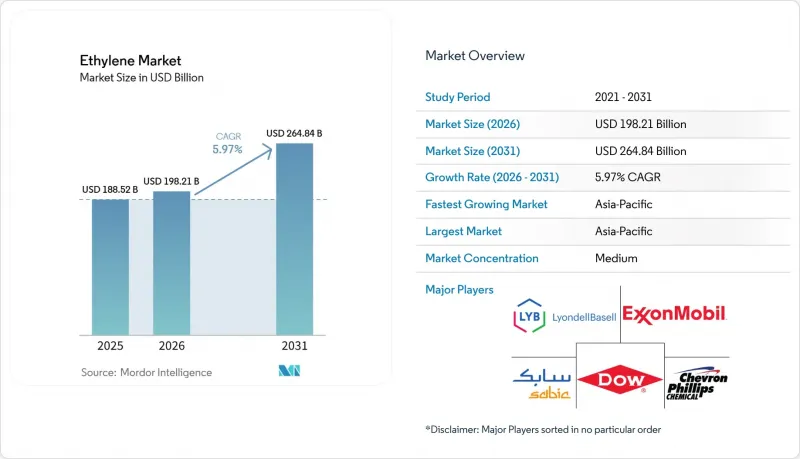
This report is Segmented by Feedstock (Naphtha, Ethane, Propane, and More), Application (Polyethylene, Ethylene Oxide, and More), End-Use Industry (Packaging, Building & Construction, Automotive, Textile, Chemicals, Agriculture, Consumer Goods, and More), and Geography (Asia-Pacific, North America, Europe, South America, and Middle-East and Africa). The Market Forecasts are Provided in Terms of Value (USD).
Global Ethylene Market Trends and Insights
Growing Demand for Polyethylene in Packaging Applications
Packaging demand continues to support the ethylene market because polyethylene is widely used in flexible films, containers, pallet wrap, and protective materials. E-commerce distribution requires more stretch film and pallet wrap, which raises polyethylene use in logistics. Food safety rules also support demand for materials that limit moisture transfer and protect packaged goods. The EU Packaging and Packaging Waste Regulation supports recyclable designs and can increase the use of mono-material polyethylene packaging. Borealis introduced Borcycle M CWT120CL in March 2025 for flexible non-food packaging, showing continued commercial activity in recycled linear low-density polyethylene. These changes support polyethylene demand while requiring producers to improve recycled-content and recyclability credentials.
Rising Focus on Circular Economy and Low-Carbon Ethylene Production
Low-carbon production is becoming more relevant to the ethylene market as customers assess emissions across their supply chains. China National Petroleum Corporation launched its full-chain green and low-carbon ethylene project in Korla in July 2026. The project combines photovoltaic electricity, carbon capture from cracker furnace flue gas, and hydrogen recycling. CNPC stated that the project uses 1 billion kWh of photovoltaic electricity each year and can reduce carbon emissions by 1.37 million metric tons annually. The Renewable Electrochemical Advanced Conversion of CO2 to Target products (REACT) program began in May 2026 to develop an electrolyzer that converts recycled carbon dioxide into ethylene. These projects show that producers are pursuing lower-emission routes alongside conventional cracking rather than treating them as separate businesses.
Volatility in Crude Oil and Natural Gas Liquid Feedstock Prices
Feedstock volatility can compress cracker margins even when downstream demand remains stable. Naphtha-based plants are particularly exposed when crude oil prices rise faster than polymer prices. Producers that rely on Middle Eastern cargoes also face greater risk when regional shipping routes are disrupted. The resulting margin changes can delay maintenance, reduce operating rates, or postpone new capacity decisions. Multi-feed crackers offer a practical response, but they require capital investment and suitable logistics. The ethylene market, therefore, benefits when operators can diversify supply arrangements and adjust feedstock use without interrupting production.
Other drivers and restraints analyzed in the detailed report include:
- Advancements in Feedstock Flexibility and Digital Optimization of Steam Cracking Operations
- Increasing Demand for Ethylene Glycol in Electric Vehicle Cooling and Thermal Management Systems
- Stringent Carbon Emission Regulations for Naphtha-Based Ethylene Production
For complete list of drivers and restraints, kindly check the Table Of Contents.
Segment Analysis
Naphtha accounted for 42.57% of the ethylene market share in 2025, reflecting the established naphtha cracker base in Europe and much of Asia. Ethane is the fastest-growing feedstock and is expected to expand at a 6.84% CAGR through 2031. United States Gulf Coast producers benefit from a substantial natural gas liquids supply and established ethane infrastructure. This gives ethane-based crackers a durable feedstock advantage when crude oil prices are elevated. The ethylene market size for ethane-based output is supported by growing import capacity in Asia and Europe. Ethane also has a lower reported production-emissions intensity than naphtha, which adds to its appeal where carbon compliance costs are material.
The cost difference between United States ethane cracking and European naphtha cracking was USD 123 per metric ton and USD 792 per metric ton, respectively. This difference encourages Asian and European buyers to secure longer-term ethane supplies. Naphtha remains necessary where refinery integration and legacy infrastructure favor oil-derived feedstocks. Propane and butane are also important for Middle Eastern producers with access to associated gas. Flexible crackers can choose among these feedstocks when relative prices change. This flexibility improves resilience, but it does not remove exposure to logistics limits and regional supply risks.
Complete Report Scope:
- By Feedstock
- Naphtha
- Ethane
- Propane
- Butane
- Other Feedstocks
- By Application
- Polyethylene
- Ethylene Oxide
- Ethyl Benzene
- Ethylene Dichloride (EDC)
- Vinyl Acetate Monomer (VAM)
- Other Applications
- By End-Use Industry
- Packaging
- Building & Construction
- Automotive
- Textile
- Chemicals
- Agriculture
- Healthcare & Pharmaceuticals
- Consumer Goods
- Other End-Use Industries
- By Geography
- Asia-Pacific
- China
- India
- Japan
- South Korea
- Rest of Asia-Pacific
- North America
- United States
- Canada
- Mexico
- Europe
- Germany
- United Kingdom
- France
- Italy
- Russia
- Rest of Europe
- South America
- Brazil
- Argentina
- Rest of South America
- Middle-East and Africa
- Saudi Arabia
- South Africa
- Rest of Middle-East and Africa
- Asia-Pacific
Geography Analysis
Asia-Pacific accounted for 46.72% of the ethylene market share in 2025 and is projected to grow at a 6.81% CAGR through 2031. BASF's Zhanjiang complex entered full operation in March 2026 and added a 1 million metric ton-per-year ethylene cracker. The region combines large demand centers with substantial new supply. India's packaging and construction activity supports further ethylene consumption. South Korea faces an uneven outlook because older naphtha crackers are under pressure while major new projects enter service.
S-OIL's Shaheen Project reached mechanical completion in July 2026 and is designed to produce 1.8 million metric tons of ethylene per year. The project uses crude-to-chemicals technology and is expected to begin commercial operations in 2027. Singapore is strengthening its logistics role after Aster's May 2026 investment decision to expand export capacity at Bukom. North America remains cost-competitive because shale production supports ethane supply. Canada is integrated with the United States supply chains, while Mexico is seeking to reactivate ethylene derivative production. Pemex allocated USD 4.2 billion in its 2025 to 2035 plan to revive output at the Cangrejera and Morelos complexes.
Europe is affected by high naphtha costs, carbon compliance, and utility costs. A weaker cost position constrains the ethylene market size in Europe more than in ethane-based regions. The European Commission's revised benchmark makes emissions performance more important for local assets. The Middle East has a more favorable feedstock position because Saudi Arabia, the United Arab Emirates, and Qatar can use competitively priced gas. Tasnee completed its Saudi Ethylene and Polyethylene Company expansion in July 2026, adding capacity at Al Jubail. South America has higher feedstock costs, but Braskem approved BRL 4.2 billion, USD 740 million, for a 220,000 metric tons-per-year expansion in Rio de Janeiro.
- SABIC
- Borealis AG
- Braskem
- Chevron Phillips Chemical Company LLC
- China Petrochemical Corporation
- Exxon Mobil Corporation
- Formosa Plastics Corporation
- INEOS Group Limited
- LG Chem Ltd.
- Lotte Chemical Corporation
- LyondellBasell Industries Holdings B.V.
- Mitsubishi Chemical Corporation
- NOVA Chemicals Corporation
- PetroChina Company Limited
- PTT Global Chemical Public Company Limited
- Reliance Industries Limited
- Sasol Limited
- Shell plc
- TotalEnergies
Additional Benefits:
- The market estimate (ME) sheet in Excel format
- 3 months of analyst support
TABLE OF CONTENTS
1 Introduction
- 1.1 Study Assumptions and Market Definition
- 1.2 Scope of the Study
2 Research Methodology
3 Executive Summary
4 Market Landscape
- 4.1 Market Overview
- 4.2 Market Drivers
- 4.2.1 Growing Demand for Polyethylene in Packaging Applications
- 4.2.2 Rising Focus on Circular Economy and Low-Carbon Ethylene Production
- 4.2.3 Advancements in Feedstock Flexibility and Digital Optimization of Steam Cracking Operations
- 4.2.4 Increasing Demand for Ethylene Glycol in Electric Vehicle Cooling and Thermal Management Systems
- 4.2.5 Increasing Investments in Integrated Petrochemical Complexes Across Asia-Pacific and the Middle East
- 4.3 Market Restraints
- 4.3.1 Volatility in Crude Oil and Natural Gas Liquid (NGL) Feedstock Prices
- 4.3.2 Stringent Carbon Emission Regulations for Naphtha-Based Ethylene Production
- 4.3.3 Lengthy Regulatory Approval and Permitting Processes for New Ethylene Production Facilities
- 4.4 Value Chain Analysis
- 4.5 Porter's Five Forces Analysis
- 4.5.1 Threat of New Entrants
- 4.5.2 Bargaining Power of Suppliers
- 4.5.3 Bargaining Power of Buyers
- 4.5.4 Threat of Substitutes
- 4.5.5 Competitive Rivalry
- 4.6 Production Capacity Analysis
5 Market Size and Growth Forecasts (Value)
- 5.1 By Feedstock
- 5.1.1 Naphtha
- 5.1.2 Ethane
- 5.1.3 Propane
- 5.1.4 Butane
- 5.1.5 Other Feedstocks
- 5.2 By Application
- 5.2.1 Polyethylene
- 5.2.2 Ethylene Oxide
- 5.2.3 Ethyl Benzene
- 5.2.4 Ethylene Dichloride (EDC)
- 5.2.5 Vinyl Acetate Monomer (VAM)
- 5.2.6 Other Applications
- 5.3 By End-Use Industry
- 5.3.1 Packaging
- 5.3.2 Building & Construction
- 5.3.3 Automotive
- 5.3.4 Textile
- 5.3.5 Chemicals
- 5.3.6 Agriculture
- 5.3.7 Healthcare & Pharmaceuticals
- 5.3.8 Consumer Goods
- 5.3.9 Other End-Use Industries
- 5.4 By Geography
- 5.4.1 Asia-Pacific
- 5.4.1.1 China
- 5.4.1.2 India
- 5.4.1.3 Japan
- 5.4.1.4 South Korea
- 5.4.1.5 Rest of Asia-Pacific
- 5.4.2 North America
- 5.4.2.1 United States
- 5.4.2.2 Canada
- 5.4.2.3 Mexico
- 5.4.3 Europe
- 5.4.3.1 Germany
- 5.4.3.2 United Kingdom
- 5.4.3.3 France
- 5.4.3.4 Italy
- 5.4.3.5 Russia
- 5.4.3.6 Rest of Europe
- 5.4.4 South America
- 5.4.4.1 Brazil
- 5.4.4.2 Argentina
- 5.4.4.3 Rest of South America
- 5.4.5 Middle-East and Africa
- 5.4.5.1 Saudi Arabia
- 5.4.5.2 South Africa
- 5.4.5.3 Rest of Middle-East and Africa
- 5.4.1 Asia-Pacific
6 Competitive Landscape
- 6.1 Market Concentration
- 6.2 Strategic Moves
- 6.3 Market Share (%)/Ranking Analysis
- 6.4 Company Profiles (includes Global Overview, Market Overview, Core Segments, Financials as available, Strategic Information, Products and Services, and Recent Developments)
- 6.4.1 SABIC
- 6.4.2 Borealis AG
- 6.4.3 Braskem
- 6.4.4 Chevron Phillips Chemical Company LLC
- 6.4.5 China Petrochemical Corporation
- 6.4.6 Exxon Mobil Corporation
- 6.4.7 Formosa Plastics Corporation
- 6.4.8 INEOS Group Limited
- 6.4.9 LG Chem Ltd.
- 6.4.10 Lotte Chemical Corporation
- 6.4.11 LyondellBasell Industries Holdings B.V.
- 6.4.12 Mitsubishi Chemical Corporation
- 6.4.13 NOVA Chemicals Corporation
- 6.4.14 PetroChina Company Limited
- 6.4.15 PTT Global Chemical Public Company Limited
- 6.4.16 Reliance Industries Limited
- 6.4.17 Sasol Limited
- 6.4.18 Shell plc
- 6.4.19 TotalEnergies
7 Market Opportunities and Future Outlook
- 7.1 White-Space and Unmet-Need Assessment

