PUBLISHER: Mordor Intelligence | PRODUCT CODE: 2118881

PUBLISHER: Mordor Intelligence | PRODUCT CODE: 2118881
Asia-Pacific 5G Infrastructure - Market Share Analysis, Industry Trends & Statistics, Growth Forecasts (2026 - 2031)
According to Mordor Intelligence, the Asia-Pacific 5G infrastructure market size is projected to expand from USD 32.95 billion in 2025 and USD 34.67 billion in 2026 to USD 56.32 billion by 2031, registering a CAGR of 10.19% from 2026 to 2031.
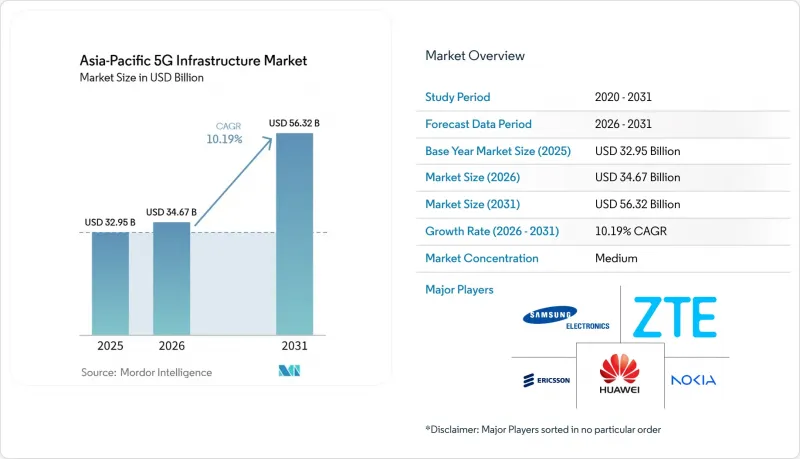
This report is Segmented by Communication Infrastructure (5G Radio Access Network (RAN), and More), Spectrum Band (Low-Band and More), Network Architecture (Non-Standalone (NSA), and Standalone (SA)), Core Network Technology (Software-Defined Networking (SDN), and More), End-User Vertical (Consumer Electronics and More), and Country. The Market Forecasts are Provided in Terms of Value (USD).
Asia-Pacific 5G Infrastructure Market Trends and Insights
Rising 5G Traffic Density and Low-Latency Demand
China had more than 1.204 billion 5G subscriptions and 2.888 billion mobile IoT terminal connections by the end of 2025. This scale requires operators to add capacity while also upgrading their standalone core networks. China's 5G-Advanced service covered 330 cities in March 2026, supported by active antenna systems that can manage beamforming at scale. The parallel buildout of dense radio sites and standalone architecture shortens the path to low-latency services, but it also increases early capital requirements for vendors and site specialists. Smart factories using 5G and industrial internet programs recorded 20.5% gains in product quality and 24.7% gains in production capacity. These operating results support wider demand for capacity and latency-sensitive industrial connectivity in the Asia-Pacific 5G infrastructure market.
Government-Led Spectrum Allocation and Rollout Programs
India's Telecom Regulatory Authority released auction recommendations in February 2026 for 11,789.15MHz across 9 frequency bands. The proposal carried a reserve value of INR 2.10 lakh crore (USD 23.1 billion). It also linked a 10% reduction in the reserve price to new base stations in coverage gaps, directing operator spending toward underserved areas. Vietnam paired spectrum discounts with equipment-cost support for operators that build 20,000 5G base stations, using policy to encourage infrastructure investment. South Korea required standalone upgrades by 2026 and used lower LTE reallocation fees to support operators that meet indoor coverage goals. Government measures now extend beyond spectrum allocation and shape the pace, location, and architecture of network investment across the Asia-Pacific 5G infrastructure market.
High Densification and Fiber Backhaul CAPEX
Dense small-cell networks require fiber links to each site, especially where operators use mmWave spectrum or add capacity layers. China's optical fiber network reached 74.99 million km by the end of 2025, providing a strong foundation for its large 5G rollout. Many Southeast Asian and South Asian markets have less last-mile fiber, which makes densification more expensive and slower to deliver. The wider region faced a USD 200 billion infrastructure investment shortfall through the end of the decade, including gaps in backhaul financing. Operators without strong fiber networks must choose between expensive wireless backhaul and delayed capacity expansion. Site acquisition, power access, and landlord negotiations can add 18-24 months to small-cell rollouts in markets such as India and Indonesia.
Other drivers and restraints analyzed in the detailed report include:
- Expansion of Private 5G for Industrial Automation
- Accelerating Open RAN and Cloud-Native Network Adoption
- Spectrum Cost Pressure and Uneven Mid-Band Availability
For complete list of drivers and restraints, kindly check the Table Of Contents.
Segment Analysis
5G Radio Access Network held 60.96% of the Asia-Pacific 5G infrastructure market share within communication infrastructure in 2025. RAN remains the main destination for capital spending as operators densify base stations across China, India, Japan, and Southeast Asia. China Tower deployed more than 900,000 base stations per year by mid-2026 and had helped build more than 5.6 million sites in total. This operating scale shows why radio equipment, antennas, and site infrastructure continue to account for a large part of spending. Transport/xHaul is the second-largest sub-segment because every new macro site and small cell requires fronthaul, midhaul, or backhaul links.
Core Network is projected to expand at a 14.80% CAGR through 2031, making it the fastest-growing sub-segment of communication infrastructure. The Asia-Pacific 5G infrastructure market size for cloud-native core systems is supported by the shift away from legacy packet gateways. NTT DOCOMO's commercial cloud-native core reduced power consumption by 70%, according to the company, offering an operating-cost benchmark for other operators. Nokia and Tune Talk completed an ASEAN cloud-native core deployment in January 2026, extending this architecture to a developing operator market. Cloud-native core platforms can help operators scale capacity, automate network functions, and support enterprise services. Open Telecom Ecosystem practices and 3GPP Release 17 and Release 18 requirements are also affecting vendor selection for these deployments.
Mid-band spectrum held 69.21% share of the spectrum band segment in 2025. It remains the primary coverage and capacity layer for macro 5G networks because regional regulators have broadly adopted plans for the 3.5 GHz band. The band offers a practical balance between propagation range and network capacity. Low-band spectrum below 1 GHz supports rural coverage and indoor service in countries with extensive underserved areas. India and Australia give policy priority to the 600 MHz and 700 MHz bands because those frequencies can extend coverage beyond major cities.
High-band/mmWave is projected to expand at a 17.22% CAGR through 2031. Japan's operators have commercial 28GHz deployments, while South Korea has enterprise licensing for 28GHz use. India also included 26GHz in its forthcoming spectrum auction framework. The Asia-Pacific 5G infrastructure market is likely to use mmWave first in factories, stadiums, transit facilities, and similar concentrated locations rather than broad consumer coverage. Samsung's live trial with KDDI showed a 52% increase in throughput on the 3.7GHz band using its AI-powered RAN Speed Optimizer. Equipment costs can improve as Japan and South Korea build more operational experience, which could support use in other regional markets after 2027.
Complete Report Scope:
- By Communication Infrastructure
- 5G Radio Access Network (RAN)
- Transport/xHaul (Front-Haul, Mid-Haul, Back-Haul)
- Core Network (Cloud-Native 5G Core)
- By Spectrum Band
- Low-Band (Less Than 1 GHz)
- Mid-Band (1-6 GHz)
- High-Band / mmWave (Above 24 GHz)
- By Network Architecture
- Non-Standalone (NSA)
- Standalone (SA)
- By Core Network Technology
- Software-Defined Networking (SDN)
- Network Function Virtualization (NFV)
- Multi-Access Edge Computing (MEC)
- Network Slicing
- By End-User Vertical
- Consumer Electronics
- Automotive and Mobility
- Industrial Manufacturing
- Healthcare and Life Sciences
- Energy and Utilities
- Public Safety and Defense
- Smart Cities and Infrastructure
- Other End-User Verticals (Retail, Media, Agriculture)
- By Country
- China
- Japan
- South Korea
- India
- Australia
- Rest of Asia-Pacific
List of Companies Covered in this Report:
- Huawei Technologies Co., Ltd.
- Telefonaktiebolaget LM Ericsson
- Nokia Corporation
- ZTE Corporation
- Samsung Electronics Co., Ltd.
- NEC Corporation
- Fujitsu Limited
- Cisco Systems, Inc.
- Hewlett Packard Enterprise Development LP
- Qualcomm Incorporated
- Intel Corporation
- Juniper Networks, Inc.
- Ciena Corporation
- Mavenir Systems, Inc.
- Rakuten Symphony, Inc.
- CommScope Holding Company, Inc.
- NVIDIA Corporation
- Oracle Corporation
- Broadcom Inc.
- Airspan Networks Inc.
Additional Benefits:
- The market estimate (ME) sheet in Excel format
- 3 months of analyst support
TABLE OF CONTENTS
1 INTRODUCTION
- 1.1 Study Assumptions and Market Definition
- 1.2 Scope of the Study
2 RESEARCH METHODOLOGY
3 EXECUTIVE SUMMARY
4 MARKET LANDSCAPE
- 4.1 Market Overview
- 4.2 Market Drivers
- 4.2.1 Rising 5G Traffic Density and Low-Latency Demand
- 4.2.2 Government-Led Spectrum Allocation and Rollout Programs
- 4.2.3 Expansion of Private 5G for Industrial Automation
- 4.2.4 Accelerating Open RAN and Cloud-Native Network Adoption
- 4.2.5 Cross-Border Semiconductor Supply Chain Diversification in Asia-Pacific
- 4.2.6 Edge-Driven Monetization for Ports, Mining, and Logistics Nodes
- 4.3 Market Restraints
- 4.3.1 High Densification and Fiber Backhaul CAPEX
- 4.3.2 Spectrum Cost Pressure and Uneven Mid-Band Availability
- 4.3.3 Multi-Vendor Interoperability and Integration Complexity
- 4.3.4 Power Availability and Site Acquisition Constraints in Dense Urban Markets
- 4.4 Industry Value Chain Analysis
- 4.5 Regulatory Landscape
- 4.6 Technological Outlook
- 4.7 Investment and Funding Trends
- 4.8 Porter's Five Forces Analysis
- 4.8.1 Bargaining Power of Suppliers
- 4.8.2 Bargaining Power of Buyers
- 4.8.3 Threat of New Entrants
- 4.8.4 Intensity of Competitive Rivalry
- 4.8.5 Threat of Substitute Products
5 MARKET SIZE AND GROWTH FORECASTS (VALUE)
- 5.1 By Communication Infrastructure
- 5.1.1 5G Radio Access Network (RAN)
- 5.1.2 Transport/xHaul (Front-Haul, Mid-Haul, Back-Haul)
- 5.1.3 Core Network (Cloud-Native 5G Core)
- 5.2 By Spectrum Band
- 5.2.1 Low-Band (Less Than 1 GHz)
- 5.2.2 Mid-Band (1-6 GHz)
- 5.2.3 High-Band / mmWave (Above 24 GHz)
- 5.3 By Network Architecture
- 5.3.1 Non-Standalone (NSA)
- 5.3.2 Standalone (SA)
- 5.4 By Core Network Technology
- 5.4.1 Software-Defined Networking (SDN)
- 5.4.2 Network Function Virtualization (NFV)
- 5.4.3 Multi-Access Edge Computing (MEC)
- 5.4.4 Network Slicing
- 5.5 By End-User Vertical
- 5.5.1 Consumer Electronics
- 5.5.2 Automotive and Mobility
- 5.5.3 Industrial Manufacturing
- 5.5.4 Healthcare and Life Sciences
- 5.5.5 Energy and Utilities
- 5.5.6 Public Safety and Defense
- 5.5.7 Smart Cities and Infrastructure
- 5.5.8 Other End-User Verticals (Retail, Media, Agriculture)
- 5.6 By Country
- 5.6.1 China
- 5.6.2 Japan
- 5.6.3 South Korea
- 5.6.4 India
- 5.6.5 Australia
- 5.6.6 Rest of Asia-Pacific
6 COMPETITIVE LANDSCAPE
- 6.1 Market Concentration
- 6.2 Strategic Moves
- 6.3 Market Share Analysis
- 6.4 Company Profiles (includes Global Level Overview, Market Level Overview, Core Segments, Financials as available, Strategic Information, Market Rank/Share, Products and Services, Recent Developments)
- 6.4.1 Huawei Technologies Co., Ltd.
- 6.4.2 Telefonaktiebolaget LM Ericsson
- 6.4.3 Nokia Corporation
- 6.4.4 ZTE Corporation
- 6.4.5 Samsung Electronics Co., Ltd.
- 6.4.6 NEC Corporation
- 6.4.7 Fujitsu Limited
- 6.4.8 Cisco Systems, Inc.
- 6.4.9 Hewlett Packard Enterprise Development LP
- 6.4.10 Qualcomm Incorporated
- 6.4.11 Intel Corporation
- 6.4.12 Juniper Networks, Inc.
- 6.4.13 Ciena Corporation
- 6.4.14 Mavenir Systems, Inc.
- 6.4.15 Rakuten Symphony, Inc.
- 6.4.16 CommScope Holding Company, Inc.
- 6.4.17 NVIDIA Corporation
- 6.4.18 Oracle Corporation
- 6.4.19 Broadcom Inc.
- 6.4.20 Airspan Networks Inc.
7 MARKET OPPORTUNITIES AND FUTURE OUTLOOK
- 7.1 White-Space and Unmet-Need Assessment

