PUBLISHER: Mordor Intelligence | PRODUCT CODE: 2118889

PUBLISHER: Mordor Intelligence | PRODUCT CODE: 2118889
Creative Design Services - Market Share Analysis, Industry Trends & Statistics, Growth Forecasts (2026 - 2031)
According to Mordor Intelligence, the creative design services market size is projected to expand from USD 52.25 billion in 2025 and USD 56.22 billion in 2026 to USD 82.85 billion by 2031, registering a CAGR of 8.06% between 2026 to 2031.
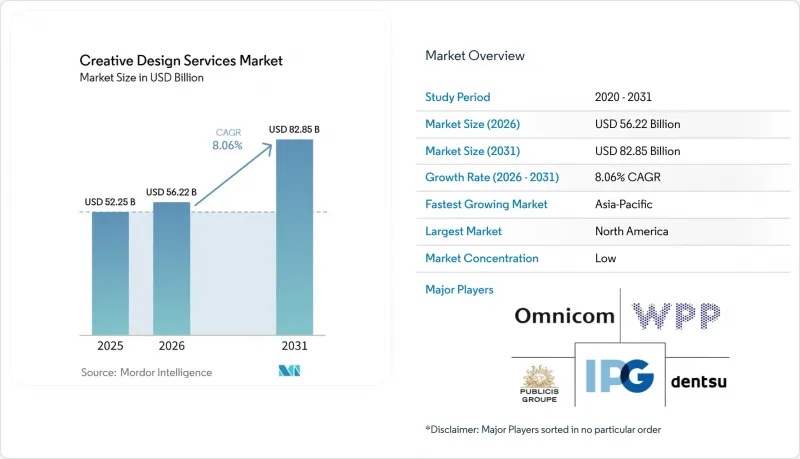
This report is Segmented by Service Type (Brand Identity and Assets, Social and Performance Creative, Packaging and Print Design, Digital Design Support, Campaign Design, and More), Platform (Creative Agency Networks, and More), Client Size (Large Enterprises, and More), Service Model (Project-Based Engagements, and More), and Geography. The Market Forecasts are Provided in Terms of Value (USD).
Global Creative Design Services Market Trends and Insights
Rising Demand for Always-On Omnichannel Creative Refresh
Brands now manage storefronts, social channels, connected TV, retail media placements, and in-store digital screens simultaneously. The Creative Design Services Market benefits because each channel requires its own format, copy length, and visual hierarchy. Marketing teams that once planned 12 campaign cycles a year now manage many smaller refreshes within each quarter. A single campaign, therefore, creates more production work across the client relationship. Omnicom introduced its next-generation Omni platform in January 2026 to support production at scale and stated that the system can improve creative throughput by 25-55%. The shift makes continuous creative capacity more important than isolated campaign execution.
AI-Augmented Design Production Shortening Turnaround Times
Generative AI has reduced production time for template-based and variant-heavy assets by 30-50% in Omnicom's stated experience with its platform. Routine production is therefore moving toward AI-assisted workflows. Complex assignments involving new concepts, cultural context, or regulated content still require substantial human judgment. WPP invested GBP 300 million (USD 383 million) at the 2025 annual average exchange rate, each year in WPP Open. WPP and Adobe expanded their partnership in February 2026 to integrate Adobe Firefly Foundry into WPP Open for content trained on brands' own intellectual property. Providers that embed AI coordination into client workflows can generate more billable output without matching the growth in headcount.
In-Housing and Self-Serve Tools Pressuring Pricing
Brands increasingly treat internal creative teams as a strategic capability rather than merely a cost-cutting measure. More than 53% of the surveyed brands viewed their in-house creative teams as strategic partners in the ANA In-House Agency Forum Report. Generative AI also makes routine social graphics, email templates, and minor adaptations easier for internal teams to complete. This pressure is strongest for providers whose work is defined by volume and standard formats. It is less acute where a brief requires strategic concepts, specialized craft, or complex coordination. The Creative Design Services Market, therefore, faces tighter pricing for routine output as more work shifts to self-serve tools and internal teams.
Other drivers and restraints analyzed in the detailed report include:
- E-Commerce and Social Commerce Expanding Visual Asset Demand
- Brand Consistency Investment Across Distributed Digital Touchpoints
- Shortage of Motion, 3D, and AI Workflow Talent
For complete list of drivers and restraints, kindly check the Table Of Contents.
Segment Analysis
Social and Performance Creative held 27.83% of the Creative Design Services Market share in 2025. Its position reflects sustained spending on paid social and performance advertising. Campaign optimization requires frequent testing, and each test calls for distinct visuals and copy variants that meet platform specifications. Brand Identity, Assets, and Campaign Design remain the foundations from which performance work is developed. They retain demand when brands rebrand, launch products, or enter new geographic areas. Packaging and Print Design is slower-growing, but it remains a complex, premium-fee activity for fast-moving consumer goods, luxury, and pharmaceutical clients. These assignments require close control of physical materials, regulatory information, and shelf presentation. That work cannot be easily replaced by a simple template. It also depends on coordination between brand, product, and production teams. Digital Design Support connects these service types by managing web, application, and interactive assets.
Motion and Multimedia Design is projected to expand at a 9.54% CAGR from 2026 to 2031. Short-form video is now a major engagement format across social platforms and streaming services. Connected TV advertising, shoppable video, and motion overlays used in augmented reality are widening the service base beyond conventional broadcast advertising. The Creative Design Services Market size for this activity is supported by clients that need adaptable video across formats. Real-time rendering can make localization and adaptation less expensive because teams do not need to reproduce content frame by frame. Digital Design Support also continues to support the broader production stack as brands manage more web, app, and interactive assets.
Creative Agency Networks held 42.63% of the Creative Design Services Market share in 2025. Their scale enables them to combine strategy, production, media planning, and measurement within a single client relationship. Enterprise buyers often value centralized accountability because it simplifies vendor management and supports brand governance. Large networks also provide proprietary data and technology platforms that smaller studios cannot easily replicate. Specialist Design Studios remain important where clients need deep capability in editorial work, packaging, or spatial design. Freelancer Marketplaces serve cost- and time-sensitive buyers by providing on-demand access to global design talent.
Online Design Platforms are projected to grow at a 9.63% CAGR from 2026 to 2031. Subscription adoption among mid-market buyers and AI-assisted production tools support this expansion. Platforms can absorb recurring work that was previously assigned to studios or subscription service providers. Figma reported 40% year-over-year revenue growth in the fourth quarter of 2025, reflecting enterprise interest in collaborative design infrastructure. The Creative Design Services Market has room for both platforms and agencies because larger clients still need governance, strategy, and coordinated execution. The main competitive effect is pressure on providers that offer standardized production without differentiated strategic or specialist capabilities. Platform workflows make routine collaboration easier for product and marketing teams. They can also help clients maintain common files and reusable components. Specialist studios can respond by emphasizing craft expertise and more demanding assignments. Agency networks can respond by combining creative delivery with media, data, and governance services.
Complete Report Scope:
- By Service Type
- Brand Identity and Assets
- Campaign Design
- Social and Performance Creative
- Packaging and Print Design
- Digital Design Support
- Motion and Multimedia Design
- By Platform
- Creative Agency Networks
- Specialist Design Studios
- Online Design Platforms
- Freelancer Marketplaces
- By Client Size
- Micro Businesses and Startups
- Small and Medium Enterprises
- Mid-market Enterprises
- Large Enterprises
- By Service Model
- Project-Based Engagements
- Retainer-Based Engagements
- Subscription Design Services
- DIY SaaS and Self-Serve Tools
- By Geography
- North America
- United States
- Canada
- Mexico
- South America
- Brazil
- Argentina
- Chile
- Rest of South America
- Europe
- Germany
- United Kingdom
- France
- Italy
- Spain
- Rest of Europe
- Asia-Pacific
- China
- Japan
- India
- South Korea
- Australia
- Rest of Asia-Pacific
- Middle East
- Saudi Arabia
- United Arab Emirates
- Qatar
- Rest of Middle East
- Africa
- South Africa
- Egypt
- Nigeria
- Rest of Africa
- North America
Geography Analysis
North America held 36.73% of the Creative Design Services Market share in 2025 and remains the leading regional base through the forecast period. The region has a deep agency ecosystem, many Fortune 500 headquarters, and a high concentration of technology platforms changing creative workflows. The United States is the main hub for consolidation and platform investment. Omnicom completed its acquisition of IPG in November 2025. WPP's USD 383 million annual WPP Open investment, and Publicis's USD 2.167 billion LiveRamp acquisition also reflect the scale of investment in the region. Canada and Mexico add demand, with Mexico increasingly serving as a nearshore source for Spanish-language content adaptation.
Europe remains a significant part of the Creative Design Services Market, led by Germany, the United Kingdom, and France. Advertising spending and premium brand categories support demand for brand identity, packaging, and campaign work. The United Kingdom has a dense base of specialist studios and independent agencies. Germany's manufacturing economy supports demand for premium packaging and product design. The European Accessibility Act introduced enforceable accessibility requirements for relevant digital products from June 2025. This broadens the scope of digital creative briefs by requiring accessibility-ready design. South America, led by Brazil and Argentina, is also building demand through local e-commerce and social commerce activity.
Asia-Pacific is projected to expand at a 10.11% CAGR from 2026 to 2031. India is both a growing buyer of brand-building services and a source of supply for global outsourcing work. China has strong domestic demand for content tailored to Douyin, Tmall Live, and WeChat. South Korea's digital infrastructure and established design standards support its role as a premium creative services exporter. The Creative Design Services Market size across Asia-Pacific benefits from these different but reinforcing sources of demand. The Middle East and Africa remain earlier-stage opportunities, with Saudi Arabia's Vision 2030 supporting branding and communications work. South Africa, Egypt, and Nigeria serve as important hubs for the continent's expanding brand economy.
- WPP plc
- Omnicom Group Inc.
- Publicis Groupe S.A.
- Dentsu Group Inc.
- The Interpublic Group of Companies, Inc.
- Accenture plc
- Deloitte Touche Tohmatsu Limited
- Adobe Inc.
- Canva Pty Ltd
- Fiverr International Ltd.
- Upwork Inc.
- Cimpress plc
- IDEO LP
- Pentagram Design Limited
- Design Pickle LLC
- Wieden+Kennedy, Inc.
- VaynerMedia LLC
- crowdspring, LLC.
Additional Benefits:
- The market estimate (ME) sheet in Excel format
- 3 months of analyst support
TABLE OF CONTENTS
1 INTRODUCTION
- 1.1 Study Assumptions and Market Definition
- 1.2 Scope of the Study
2 RESEARCH METHODOLOGY
3 EXECUTIVE SUMMARY
4 MARKET LANDSCAPE
- 4.1 Market Overview
- 4.2 Market Drivers
- 4.2.1 Rising Demand for Always-On Omnichannel Creative Refresh
- 4.2.2 AI-Augmented Design Production Shortening Turnaround Times
- 4.2.3 E-commerce and Social Commerce Expanding Visual Asset Demand
- 4.2.4 Brand Consistency Investment Across Distributed Digital Touchpoints
- 4.2.5 Retail Media Asset Proliferation Raising Need for Modular Creative Systems
- 4.2.6 Accessibility and Localization Requirements Increasing Design Scope
- 4.3 Market Restraints
- 4.3.1 In-Housing and Self-Serve Tools Pressuring Pricing
- 4.3.2 Shortage of Motion, 3D, and AI Workflow Talent
- 4.3.3 Generative AI Copyright and Provenance Risk Delaying Approvals
- 4.3.4 Platform Format Volatility Increasing Rework and Asset Obsolescence
- 4.4 Industry Value Chain Analysis
- 4.5 Regulatory Landscape
- 4.6 Technological Outlook
- 4.7 Porter's Five Forces Analysis
- 4.7.1 Threat of New Entrants
- 4.7.2 Bargaining Power of Buyers
- 4.7.3 Bargaining Power of Suppliers
- 4.7.4 Threat of Substitutes
- 4.7.5 Intensity of Rivalry
- 4.8 Impact of Macroeconomic Factors on the Market
5 MARKET SIZE AND GROWTH FORECASTS (VALUE)
- 5.1 By Service Type
- 5.1.1 Brand Identity and Assets
- 5.1.2 Campaign Design
- 5.1.3 Social and Performance Creative
- 5.1.4 Packaging and Print Design
- 5.1.5 Digital Design Support
- 5.1.6 Motion and Multimedia Design
- 5.2 By Platform
- 5.2.1 Creative Agency Networks
- 5.2.2 Specialist Design Studios
- 5.2.3 Online Design Platforms
- 5.2.4 Freelancer Marketplaces
- 5.3 By Client Size
- 5.3.1 Micro Businesses and Startups
- 5.3.2 Small and Medium Enterprises
- 5.3.3 Mid-market Enterprises
- 5.3.4 Large Enterprises
- 5.4 By Service Model
- 5.4.1 Project-Based Engagements
- 5.4.2 Retainer-Based Engagements
- 5.4.3 Subscription Design Services
- 5.4.4 DIY SaaS and Self-Serve Tools
- 5.5 By Geography
- 5.5.1 North America
- 5.5.1.1 United States
- 5.5.1.2 Canada
- 5.5.1.3 Mexico
- 5.5.2 South America
- 5.5.2.1 Brazil
- 5.5.2.2 Argentina
- 5.5.2.3 Chile
- 5.5.2.4 Rest of South America
- 5.5.3 Europe
- 5.5.3.1 Germany
- 5.5.3.2 United Kingdom
- 5.5.3.3 France
- 5.5.3.4 Italy
- 5.5.3.5 Spain
- 5.5.3.6 Rest of Europe
- 5.5.4 Asia-Pacific
- 5.5.4.1 China
- 5.5.4.2 Japan
- 5.5.4.3 India
- 5.5.4.4 South Korea
- 5.5.4.5 Australia
- 5.5.4.6 Rest of Asia-Pacific
- 5.5.5 Middle East
- 5.5.5.1 Saudi Arabia
- 5.5.5.2 United Arab Emirates
- 5.5.5.3 Qatar
- 5.5.5.4 Rest of Middle East
- 5.5.6 Africa
- 5.5.6.1 South Africa
- 5.5.6.2 Egypt
- 5.5.6.3 Nigeria
- 5.5.6.4 Rest of Africa
- 5.5.1 North America
6 COMPETITIVE LANDSCAPE
- 6.1 Market Concentration
- 6.2 Strategic Moves
- 6.3 Market Share Analysis
- 6.4 Company Profiles (includes Global Level Overview, Market Level Overview, Core Segments, Financials as available, Strategic Information, Market Rank/Share, Products and Services, Recent Developments)
- 6.4.1 WPP plc
- 6.4.2 Omnicom Group Inc.
- 6.4.3 Publicis Groupe S.A.
- 6.4.4 Dentsu Group Inc.
- 6.4.5 The Interpublic Group of Companies, Inc.
- 6.4.6 Accenture plc
- 6.4.7 Deloitte Touche Tohmatsu Limited
- 6.4.8 Adobe Inc.
- 6.4.9 Canva Pty Ltd
- 6.4.10 Fiverr International Ltd.
- 6.4.11 Upwork Inc.
- 6.4.12 Cimpress plc
- 6.4.13 IDEO LP
- 6.4.14 Pentagram Design Limited
- 6.4.15 Design Pickle LLC
- 6.4.16 Wieden+Kennedy, Inc.
- 6.4.17 VaynerMedia LLC
- 6.4.18 crowdspring, LLC.
7 MARKET OPPORTUNITIES AND FUTURE OUTLOOK
- 7.1 White-space and unmet-need assessment

