PUBLISHER: Mordor Intelligence | PRODUCT CODE: 2118899

PUBLISHER: Mordor Intelligence | PRODUCT CODE: 2118899
Video Transcoding For OTT - Market Share Analysis, Industry Trends & Statistics, Growth Forecasts (2026 - 2031)
According to Mordor Intelligence, the OTT video transcoding market size is projected to expand from USD 1.08 billion in 2025 and USD 1.21 billion in 2026 to USD 2.08 billion by 2031, registering a CAGR of 11.39% between 2026 and 2031.
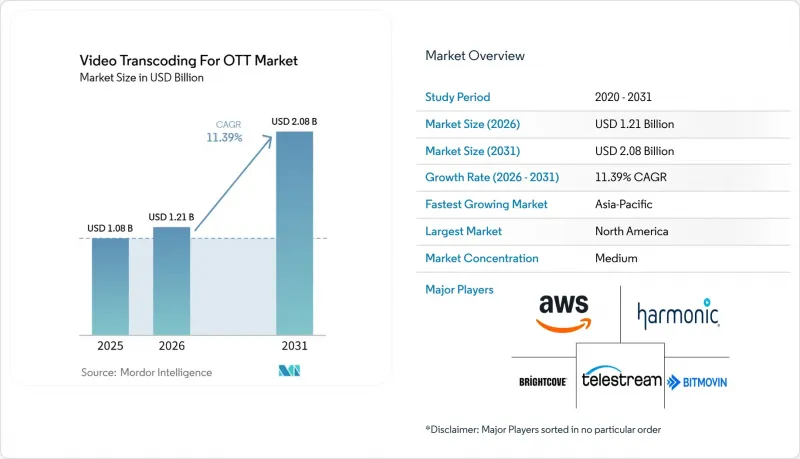
This report is Segmented by Component (Solutions, and Services), Processing Type (File-Based and Video-On-Demand Transcoding, and Live and Linear Real-Time Transcoding), End User (OTT and Direct-To-Consumer Streaming Platforms, Broadcasters and Television Networks, and More), and Geography. The Market Forecasts are Provided in Terms of Value (USD).
Global Video Transcoding For OTT Market Trends and Insights
OTT and Multiscreen Video Consumption Expansion
The OTT video transcoding supports viewing across smart TVs, mobile phones, tablets, and connected devices. Each device group has different codec support, resolution limits, and bitrate needs. Platforms must therefore maintain broader encoding ladders rather than simply process more files. In video transcoding for the OTT market, connected TV use in mature streaming markets is also shifting delivery toward 4K, increasing the work required for each title. This effect does not disappear as markets mature because new viewing devices continue to create compatibility requirements. The change increases demand for video transcoding in the OTT market, enabling platforms to manage multiple renditions without requiring operators to rebuild their workflows for every device category.
Live Sports, FAST Channels, and Interactive Streaming Growth
Live sports and FAST channels create demanding workloads because operators cannot rely on pre-processed assets or batch scheduling. Sports programming on major streaming platforms increased 52% year over year in early 2026, while dedicated sports FAST channels had grown 105% between mid-2024 and February 2025. Capacity must be available for peak concurrent events, rather than average traffic, which favors elastic infrastructure. Smaller leagues can now pursue FAST distribution, which was previously less accessible under traditional broadcast economics. Amagi reported that FAST viewing hours grew 55% year over year, and ad impressions increased 53% across nearly 6,500 channel deliveries in June 2026. Video transcoding for the over-the-top (OTT) market benefits from the need for parallel, real-time renditions for multiple viewers and devices.
High Compute, Storage, and Energy Requirements
Multi-format and multi-codec delivery increases compute, storage, and power requirements faster than infrastructure costs can fall. NETINT found that 72% of surveyed video professionals used GPU-based HEVC encoding, and 39% identified power consumption as a critical deployment challenge. The company reported that its Quadra T1U video processing unit used 17 watts while supporting up to 32 parallel 1080p 30fps streams across H.264, HEVC, and AV1. Data center power constraints in North America and Europe can limit capacity expansion even when video demand remains strong. This encourages platforms to assess purpose-built video processing units and other hardware that improve encoding efficiency. NETINT also found that 49% of respondents planned to evaluate video processing units in 2026, compared with 53.6% who planned to evaluate GPUs.
Other drivers and restraints analyzed in the detailed report include:
- Cloud Migration and Elastic Media Processing Demand
- 4K, 8K, HDR, and Immersive Video Format Adoption
- Legacy Workflow Integration and Format Compatibility Complexity
For complete list of drivers and restraints, kindly check the Table Of Contents.
Segment Analysis
Solutions accounted for 77.13% of revenue in 2025, giving software-based platforms the largest component position. In the video transcoding for the OTT market, these platforms have shifted attention away from dedicated hardware appliances and toward cloud-deployable software that can add format support without a physical replacement cycle. The software-led video transcoding for the OTT market reflected the appeal of codec-agnostic software that can run across GPU clusters, video processing units, and standard CPU resources. This separation of encoding logic from underlying compute hardware gives operators more choice when managing workload costs. It also allows a platform to adjust its infrastructure by use case instead of tying every job to the same appliance. Larger providers can apply this flexibility across established libraries, while smaller services can adopt it without making a broad hardware investment.
Bitmovin signed MUBI as a cloud video-on-demand encoding client through AWS Marketplace in May 2026. MUBI replaced its legacy on-premises stack with a managed service supporting AVC, HEVC, AV1, UHD, and three-pass encoding. This case provides a clear example of why managed platforms are relevant for OTT video transcoding, services that need multiple codecs but do not want to maintain specialist engineering teams. Services are projected to expand at a CAGR of 11.91% through 2031. Live-event operations are particularly suited to managed delivery because parallel events can create operational peaks that an internal team struggles to manage. Providers that combine infrastructure support with monitoring and workflow expertise can address this need. The video transcoding for the OTT market is therefore moving toward a mix of software platforms and managed operational support.
Complete Report Scope:
- By Component
- Solutions
- Software-Based Transcoding Platforms
- Hardware Transcoding Appliances
- Services
- Solutions
- By Processing Type
- File-Based and Video-on-Demand Transcoding
- Live and Linear Real-Time Transcoding
- By End User
- OTT and Direct-to-Consumer Streaming Platforms
- Broadcasters and Television Networks
- Pay-TV and Telecom Operators with OTT/IP Video Services
- Studios, Content Owners, and Digital Publishers
- Sports Rights Holders and Live-Event Streaming Providers
- Social Video and User-Generated Content Platforms
- By Geography
- North America
- United States
- Canada
- Mexico
- South America
- Brazil
- Argentina
- Rest of South America
- Europe
- Germany
- United Kingdom
- France
- Italy
- Spain
- Russia
- Rest of Europe
- Asia-Pacific
- China
- India
- Japan
- South Korea
- Southeast Asia
- Australia and New Zealand
- Rest of Asia-Pacific
- Middle East
- United Arab Emirates
- Saudi Arabia
- Turkey
- Israel
- Rest of Middle East
- Africa
- South Africa
- Nigeria
- Egypt
- Rest of Africa
- North America
Geography Analysis
North America held 44.37% of revenue in 2025, making it the largest regional contributor. The regional position in the video transcoding for the OTT market is supported by major streaming platforms, hyperscale data centers, and early cloud-native media infrastructure. AWS Elemental, Azure Media Services, and Google Cloud Transcoder have substantial capacity in the region, giving operators access to established media-processing services. Broadcasters moving from C-band satellite distribution to IP workflows create another source of demand for hybrid broadcast-to-streaming processing. The shift brings distribution and encoding decisions together as operators modernize their delivery systems.
Asia-Pacific is projected to expand at a CAGR of 11.93% through 2031. Video transcoding for the OTT market is developing in India, Indonesia, South Korea, and Southeast Asia as connected television use and local streaming catalogs grow. The region's mobile-first viewing patterns and varied network conditions make efficient delivery particularly important. Local-language catalogs also widen the number of content and distribution profiles platforms must manage. Tencent Cloud and Rockstreamer announced a partnership in July 2026 to provide cloud, AI, content delivery network, and enterprise OTT solutions in Bangladesh and other emerging Asian markets.
Europe ranked third in 2025. Next-generation broadcast changes, OTT development, and stronger expectations around data sovereignty shape the video transcoding for the over-the-top (OTT) market in the region. Qvest, ATEME, and Scaleway announced a 2026 partnership to develop production-ready OTT platforms built entirely on European technology. South America is gaining support from Brazil's DTV+ transition, and Harmonic updated its XOS Advanced Media Processor in March 2026 to support that migration. The Middle East and Africa remain smaller in absolute value but are developing through mobile-first streaming and sports rights investment. Vertical video and low-bandwidth delivery needs are shaping the encoding configurations used in African markets.
- Amazon Web Services, Inc.
- Harmonic Inc.
- Telestream, LLC
- Brightcove Inc.
- Bitmovin GmbH
- Akamai Technologies, Inc.
- Haivision Systems Inc.
- Synamedia Limited
- MediaKind Global Limited
- Imagine Communications Corp.
- Google LLC
- Tencent Holdings Limited
- Huawei Technologies Co., Ltd.
- Qencode, Inc.
- Kaltura, Inc.
- Wowza Media Systems, LLC
- ATEME S.A.
- Avid Technology, Inc.
- NETINT Technologies Inc.
- Vimeo, Inc.
Additional Benefits:
- The market estimate (ME) sheet in Excel format
- 3 months of analyst support
TABLE OF CONTENTS
1 INTRODUCTION
- 1.1 Study Assumptions and Market Definition
- 1.2 Scope of the Study
2 RESEARCH METHODOLOGY
3 EXECUTIVE SUMMARY
4 MARKET LANDSCAPE
- 4.1 Market Overview
- 4.2 Market Drivers
- 4.2.1 OTT and Multiscreen Video Consumption Expansion
- 4.2.2 Growth in Live Sports, FAST Channels, and Interactive Streaming
- 4.2.3 Cloud Migration and Elastic Media Processing Demand
- 4.2.4 Adoption of 4K, 8K, HDR, and Immersive Video Formats
- 4.2.5 Codec Portfolio Diversification Across AV1, HEVC, and VVC
- 4.2.6 Edge-Based Transcoding for Low-Latency and Localized Delivery
- 4.3 Market Restraints
- 4.3.1 High Compute, Storage, and Energy Requirements
- 4.3.2 Legacy Workflow Integration and Format Compatibility Complexity
- 4.3.3 Codec Patent Royalty Stacking and Licensing Uncertainty
- 4.3.4 Multi-Codec Duplication and Cache Inefficiency
- 4.4 Industry Value Chain Analysis
- 4.5 Impact of Macroeconomic Factors on the Market
- 4.6 Regulatory Landscape
- 4.7 Technological Outlook
- 4.8 Porter's Five Forces Analysis
- 4.8.1 Bargaining Power of Suppliers
- 4.8.2 Bargaining Power of Buyers
- 4.8.3 Threat of New Entrants
- 4.8.4 Threat of Substitutes
- 4.8.5 Intensity of Competitive Rivalry
5 MARKET SIZE AND GROWTH FORECASTS (VALUE)
- 5.1 By Component
- 5.1.1 Solutions
- 5.1.1.1 Software-Based Transcoding Platforms
- 5.1.1.2 Hardware Transcoding Appliances
- 5.1.2 Services
- 5.1.1 Solutions
- 5.2 By Processing Type
- 5.2.1 File-Based and Video-on-Demand Transcoding
- 5.2.2 Live and Linear Real-Time Transcoding
- 5.3 By End User
- 5.3.1 OTT and Direct-to-Consumer Streaming Platforms
- 5.3.2 Broadcasters and Television Networks
- 5.3.3 Pay-TV and Telecom Operators with OTT/IP Video Services
- 5.3.4 Studios, Content Owners, and Digital Publishers
- 5.3.5 Sports Rights Holders and Live-Event Streaming Providers
- 5.3.6 Social Video and User-Generated Content Platforms
- 5.4 By Geography
- 5.4.1 North America
- 5.4.1.1 United States
- 5.4.1.2 Canada
- 5.4.1.3 Mexico
- 5.4.2 South America
- 5.4.2.1 Brazil
- 5.4.2.2 Argentina
- 5.4.2.3 Rest of South America
- 5.4.3 Europe
- 5.4.3.1 Germany
- 5.4.3.2 United Kingdom
- 5.4.3.3 France
- 5.4.3.4 Italy
- 5.4.3.5 Spain
- 5.4.3.6 Russia
- 5.4.3.7 Rest of Europe
- 5.4.4 Asia-Pacific
- 5.4.4.1 China
- 5.4.4.2 India
- 5.4.4.3 Japan
- 5.4.4.4 South Korea
- 5.4.4.5 Southeast Asia
- 5.4.4.6 Australia and New Zealand
- 5.4.4.7 Rest of Asia-Pacific
- 5.4.5 Middle East
- 5.4.5.1 United Arab Emirates
- 5.4.5.2 Saudi Arabia
- 5.4.5.3 Turkey
- 5.4.5.4 Israel
- 5.4.5.5 Rest of Middle East
- 5.4.6 Africa
- 5.4.6.1 South Africa
- 5.4.6.2 Nigeria
- 5.4.6.3 Egypt
- 5.4.6.4 Rest of Africa
- 5.4.1 North America
6 COMPETITIVE LANDSCAPE
- 6.1 Market Concentration
- 6.2 Strategic Moves
- 6.3 Market Positioning Analysis
- 6.4 Company Profiles (includes Global Level Overview, Market Level Overview, Core Segments, Financials as available, Strategic Information, Market Rank/Share, Products and Services, Recent Developments)
- 6.4.1 Amazon Web Services, Inc.
- 6.4.2 Harmonic Inc.
- 6.4.3 Telestream, LLC
- 6.4.4 Brightcove Inc.
- 6.4.5 Bitmovin GmbH
- 6.4.6 Akamai Technologies, Inc.
- 6.4.7 Haivision Systems Inc.
- 6.4.8 Synamedia Limited
- 6.4.9 MediaKind Global Limited
- 6.4.10 Imagine Communications Corp.
- 6.4.11 Google LLC
- 6.4.12 Tencent Holdings Limited
- 6.4.13 Huawei Technologies Co., Ltd.
- 6.4.14 Qencode, Inc.
- 6.4.15 Kaltura, Inc.
- 6.4.16 Wowza Media Systems, LLC
- 6.4.17 ATEME S.A.
- 6.4.18 Avid Technology, Inc.
- 6.4.19 NETINT Technologies Inc.
- 6.4.20 Vimeo, Inc.
7 MARKET OPPORTUNITIES AND FUTURE OUTLOOK
- 7.1 White-Space and Unmet-Need Assessment

