PUBLISHER: Mordor Intelligence | PRODUCT CODE: 2118900

PUBLISHER: Mordor Intelligence | PRODUCT CODE: 2118900
Aerosol Caps - Market Share Analysis, Industry Trends & Statistics, Growth Forecasts (2026 - 2031)
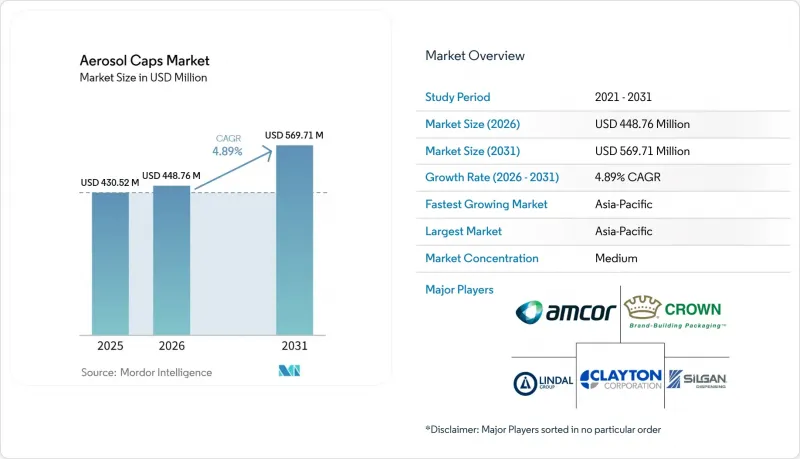
According to Mordor Intelligence, the aerosol caps market was valued at USD 430.52 million in 2025 and is estimated to grow from USD 448.76 million in 2026 to reach USD 569.71 million by 2031, at a CAGR of 4.89% during the forecast period (2026-2031).
This report is Segmented by Type (Single-Wall Caps, Double-Wall Caps, Necked-In Caps, Snap-On / Snap-Lock Caps, Child-Resistant Caps (CRC), and More), Application (Personal Care and Cosmetics, Household Products, Automotive and Industrial, and More), and Geography (Asia-Pacific, North America, Europe, South America, Middle-East and Africa). The Market Forecasts are Provided in Terms of Value (USD).
Global Aerosol Caps Market Trends and Insights
Growing Demand for Premium Aerosol Packaging in Personal Care and Cosmetic Products
Personal care and cosmetics remain the main value driver for advanced aerosol cap specifications. Brand owners are seeking metallic finishes, tailored colors, and ergonomic shapes that support product positioning at the shelf. These requirements raise tooling and design demands, which can be difficult for suppliers focused on standard single-wall parts. Personal care aerosol formats give brand owners a clear reason to differentiate closure appearance, handling, and overall product presentation. This mix favors higher-value personal care formats over lower-specification household formats. The aerosol caps market, therefore, gives greater weight to suppliers that can provide consistent decoration, fit, and actuator compatibility across a brand portfolio.
Increasing Adoption of Lightweight and Recyclable Aerosol Cap Designs
Packaging requirements are making material selection a more important part of aerosol cap development. The European Union Packaging and Packaging Waste Regulation requires packaging on the European market to be recyclable by 2030, creating pressure on cap designs that combine incompatible materials. An all-polypropylene cap and insert design can avoid the separation issues associated with mixed-material formats. This approach also gives brand owners a clearer route to using recycled polypropylene where the application and local collection system permit it. The change affects product qualification because recyclability must be considered alongside fit, appearance, and dispensing performance. The aerosol caps market can benefit when suppliers convert material simplification into repeatable, production-ready designs rather than isolated product concepts.
Challenges Associated with Recycling Multicomponent and Multilayer Aerosol Caps
Caps that combine polypropylene shells, Polyoxymethylene (POM) inserts, metal elements, or other mixed materials remain difficult to manage in recovery systems. Their complexity can limit material sorting and make it harder to present a clear recyclability claim. The Can Manufacturers Institute and the Household & Commercial Products Association issued an aerosol playbook for material recovery facilities in February 2026. The playbook supports safer and more consistent handling of aerosol containers and targets 85% household recycling access by 2030. Cap suppliers must still address the distinct issue of mixed polymers within an individual closure. The aerosol caps market faces a practical constraint where brands exclude designs that cannot support their packaging recovery commitments or future European compliance needs.
Other drivers and restraints analyzed in the detailed report include:
- Rising Demand for Tamper-Evident and Child-Resistant Aerosol Closure Solutions
- Expansion of Contract Manufacturing for Aerosol-Based FMCG and Household Products
- Lengthy Product Qualification and Approval Cycles with Global Brand Owners
For complete list of drivers and restraints, kindly check the Table Of Contents.
Segment Analysis
Single-wall caps held 31.82% of the aerosol caps market size in 2025, reflecting their use in high-volume deodorant, air freshener, and industrial spray products. Their widespread use comes from straightforward construction, familiar assembly processes, and a low unit cost. Double-wall caps and domed caps are more relevant where brands seek a premium appearance or a particular spray presentation. Necked-in caps and snap-on or snap-lock designs meet can-diameter and line-compatibility requirements in defined product programs. Polyurethane (PU) foam caps serve a narrower role where cosmetic products need protection during distribution.
Child-resistant caps are projected to grow at a 6.24% CAGR through 2031. The difference between standard and safety-led formats is important for supplier planning. Single-wall caps generate substantial unit demand, but they also face the greatest price competition from regional manufacturers. They are more exposed to requests for lower material use and to brand scrutiny of conventional mixed-material designs. Child-resistant caps have a smaller qualified supplier base because they must meet documented performance and safety requirements. This can support a higher value per unit when the supplier has the required testing and production controls. Suppliers that develop configurable safety and premium formats can use related tooling concepts across several customers while keeping critical compliance features consistent.
Complete Report Scope:
- By Type
- Single-Wall Caps
- Double-Wall Caps
- Necked-In Caps
- Snap-On / Snap-Lock Caps
- Child-Resistant Caps (CRC)
- PU Foam Caps
- Domed Caps
- Other Types
- By Application
- Personal Care and Cosmetics
- Household Products
- Automotive and Industrial
- Food Products
- Paints and Coatings
- Pharmaceuticals and Healthcare
- Other Applications
- By Geography
- Asia-Pacific
- China
- India
- Japan
- South Korea
- Rest of Asia-Pacific
- North America
- United States
- Canada
- Mexico
- Europe
- Germany
- United Kingdom
- France
- Italy
- Russia
- Rest of Europe
- South America
- Brazil
- Argentina
- Rest of South America
- Middle-East and Africa
- Saudi Arabia
- South Africa
- Rest of Middle-East and Africa
- Asia-Pacific
Geography Analysis
Asia-Pacific accounted for 41.35% of the aerosol caps market size in 2025 and is forecast to grow at a 5.44% CAGR through 2031. China has an established base for aerosol containers, valves, and related components. India is supported by growing personal care consumption, pharmaceutical activity, and contract manufacturing investment. Japan and South Korea contribute premium value because cosmetics brands often specify high-precision and differentiated closure designs. Southeast Asian manufacturing hubs also attract interest from global brands seeking regional supply relationships.
Regional compliance requirements make cross-border sourcing more complex. India applies Bureau of Indian Standards requirements, while China uses its own aerosol packaging standards. Japan's High-Pressure Gas Safety Act adds another compliance consideration for suppliers and brand owners. These differing requirements can support local manufacturers that already have certification and operating experience. They can also extend the time needed to qualify one cap design across several countries.
North America and Europe remain important for high-value pharmaceutical, household, and personal care aerosol uses. Child-resistant packaging requirements in regulated applications support North American demand. Europe is moving suppliers toward mono-material and recycled-content cap options as packaging recyclability rules take effect. South America, and Middle-East and Africa are smaller regions, but local aerosol production investment can create demand for nearby cap and actuator capacity. Regional suppliers that offer dependable lead times and adaptable designs can benefit when customers seek to reduce long supply routes.
- Amcor plc
- AptarGroup, Inc.
- Capardoni e C. Srl
- Clayton Corp.
- Coster Tecnologie Speciali S.p.A
- Crown
- LINDAL Group Holding GmbH
- MITANI VALVE CO.,LTD
- Precision Valve Corporation
- Shenzhen i-Like Fine Chemical Co., Ltd.
- Silgan Dispensing Systems
- Summit Packaging Systems
Additional Benefits:
- The market estimate (ME) sheet in Excel format
- 3 months of analyst support
TABLE OF CONTENTS
1 Introduction
- 1.1 Study Assumptions and Market Definition
- 1.2 Scope of the Study
2 Research Methodology
3 Executive Summary
4 Market Landscape
- 4.1 Market Overview
- 4.2 Market Drivers
- 4.2.1 Growing Demand for Premium Aerosol Packaging in Personal Care and Cosmetic Products
- 4.2.2 Increasing Adoption of Lightweight and Recyclable Aerosol Cap Designs
- 4.2.3 Rising Demand for Tamper-Evident and Child-Resistant Aerosol Closure Solutions
- 4.2.4 Expansion of Contract Manufacturing for Aerosol-Based FMCG and Household Products
- 4.2.5 Increasing Automation of Aerosol Cap Manufacturing and Quality Inspection Processes
- 4.3 Market Restraints
- 4.3.1 Challenges Associated with Recycling Multicomponent and Multilayer Aerosol Caps
- 4.3.2 Lengthy Product Qualification and Approval Cycles with Global Brand Owners
- 4.3.3 Increasing Packaging Lightweighting and Adoption of Refillable Packaging Formats
- 4.4 Value Chain Analysis
- 4.5 Porter's Five Forces Analysis
- 4.5.1 Threat of New Entrants
- 4.5.2 Bargaining Power of Suppliers
- 4.5.3 Bargaining Power of Buyers
- 4.5.4 Threat of Substitutes
- 4.5.5 Competitive Rivalry
5 Market Size and Growth Forecasts (Value)
- 5.1 By Type
- 5.1.1 Single-Wall Caps
- 5.1.2 Double-Wall Caps
- 5.1.3 Necked-In Caps
- 5.1.4 Snap-On / Snap-Lock Caps
- 5.1.5 Child-Resistant Caps (CRC)
- 5.1.6 PU Foam Caps
- 5.1.7 Domed Caps
- 5.1.8 Other Types
- 5.2 By Application
- 5.2.1 Personal Care and Cosmetics
- 5.2.2 Household Products
- 5.2.3 Automotive and Industrial
- 5.2.4 Food Products
- 5.2.5 Paints and Coatings
- 5.2.6 Pharmaceuticals and Healthcare
- 5.2.7 Other Applications
- 5.3 By Geography
- 5.3.1 Asia-Pacific
- 5.3.1.1 China
- 5.3.1.2 India
- 5.3.1.3 Japan
- 5.3.1.4 South Korea
- 5.3.1.5 Rest of Asia-Pacific
- 5.3.2 North America
- 5.3.2.1 United States
- 5.3.2.2 Canada
- 5.3.2.3 Mexico
- 5.3.3 Europe
- 5.3.3.1 Germany
- 5.3.3.2 United Kingdom
- 5.3.3.3 France
- 5.3.3.4 Italy
- 5.3.3.5 Russia
- 5.3.3.6 Rest of Europe
- 5.3.4 South America
- 5.3.4.1 Brazil
- 5.3.4.2 Argentina
- 5.3.4.3 Rest of South America
- 5.3.5 Middle-East and Africa
- 5.3.5.1 Saudi Arabia
- 5.3.5.2 South Africa
- 5.3.5.3 Rest of Middle-East and Africa
- 5.3.1 Asia-Pacific
6 Competitive Landscape
- 6.1 Market Concentration
- 6.2 Strategic Moves
- 6.3 Market Share (%)/Ranking Analysis
- 6.4 Company Profiles (includes Global Overview, Market Overview, Core Segments, Financials as available, Strategic Information, Products and Services, and Recent Developments)
- 6.4.1 Amcor plc
- 6.4.2 AptarGroup, Inc.
- 6.4.3 Capardoni e C. Srl
- 6.4.4 Clayton Corp.
- 6.4.5 Coster Tecnologie Speciali S.p.A
- 6.4.6 Crown
- 6.4.7 LINDAL Group Holding GmbH
- 6.4.8 MITANI VALVE CO.,LTD
- 6.4.9 Precision Valve Corporation
- 6.4.10 Shenzhen i-Like Fine Chemical Co., Ltd.
- 6.4.11 Silgan Dispensing Systems
- 6.4.12 Summit Packaging Systems
7 Market Opportunities and Future Outlook
- 7.1 White-Space and Unmet-Need Assessment

