PUBLISHER: Mordor Intelligence | PRODUCT CODE: 2118912

PUBLISHER: Mordor Intelligence | PRODUCT CODE: 2118912
United States Frozen Food - Market Share Analysis, Industry Trends & Statistics, Growth Forecasts (2026 - 2031)
According to Mordor Intelligence, the United States frozen food market size is expected to grow from USD 55.47 billion in 2025 to USD 57.94 billion in 2026, and is forecast to reach USD 74.78 billion by 2031 at a 5.24% CAGR over 2026-2031.
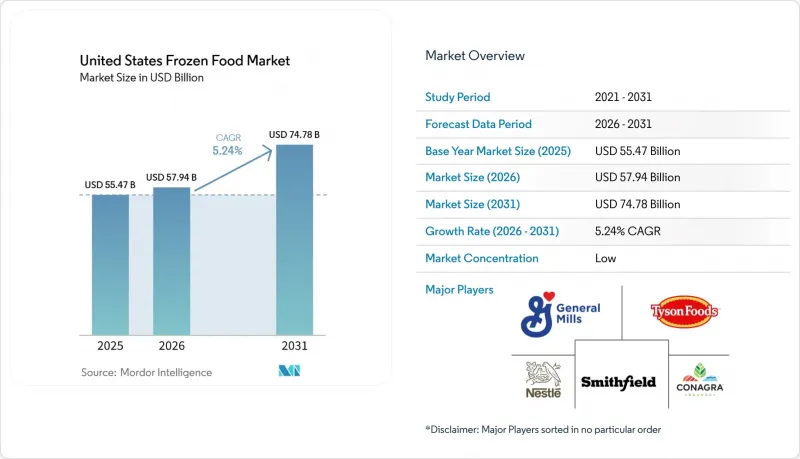
This report is Segmented by Product Type (Frozen Fruits and Vegetables, Frozen Meat and Seafood, Frozen Ready Meals, and More), Product Category (Ready-To-Eat and Ready-To-Cook), and Distribution Channel (On-Trade and Off-Trade). The Market Forecasts are Provided in Terms of Value (USD) and Volume (Tonnes).
United States Frozen Food Market Trends and Insights
Growing consumer preference for high-protein frozen foods
The growing focus on protein-rich diets for weight management, muscle maintenance, and overall wellness is accelerating demand for high-protein frozen foods in the United States. Consumers are increasingly choosing frozen meals that combine convenience with nutritional value, encouraging manufacturers to expand protein-rich offerings across meat, seafood, and plant-based categories. In 2026, the United States Department of Agriculture and the United States Department of Health and Human Services progressed with the development of the 2025-2030 Dietary Guidelines for Americans, reinforcing their focus on evidence-based dietary guidance to support healthy food choices across the country. The guidelines advise consumers to avoid "hyperprocessed" foods while recommending higher overall protein intake, primarily from animal sources. This continued federal emphasis on nutrition is reinforcing demand for protein-focused frozen food products.
Busy dual-income households favor frozen food purchases
Dual-income households continue to support demand for frozen snacks and prepared meal formats, as these products reduce the time required for routine cooking. The United States frozen food market serves households that need flexible options for workdays, school schedules, and informal family meals. Frozen snacks can function as quick meal replacements or indulgent options, broadening the reasons for consumers to visit the freezer aisle and enabling manufacturers to target daytime, evening, and informal gathering occasions. Family-size ready meals also address demand from multigenerational households and at-home social occasions. This demand pattern benefits manufacturers that offer both single-serve and multi-serve formats without compromising preparation convenience, as the same household may need a quick individual option on one occasion and a family meal on another.
Rising cold chain logistics costs pressure profitability
Cold chain costs pose an immediate restraint for the United States frozen food market. According to the Cold Chain Insights Survey by Lineage found that 73% of North American cold chain decision-makers expect tariffs to hurt their supply chain finances in 2026. The same survey found that 57% believe tariff effects on 2025 costs have exceeded expectations. The Environmental Protection Agency's phase-down of hydrofluorocarbon refrigerants also requires fleet operators to plan changes in refrigeration equipment, adding another planning requirement for carriers that transport frozen products across national freight lanes. Manufacturers with national distribution needs must carefully manage transport, equipment, and input costs, as these costs can be harder to absorb across products that require continuous temperature control from the plant to the retail outlet.
Other drivers and restraints analyzed in the detailed report include:
- Continuous innovation in premium frozen meal offerings
- Strong growth of quick-service restaurants and foodservice
- Health concerns over highly processed frozen foods
For complete list of drivers and restraints, kindly check the Table Of Contents.
Segment Analysis
Frozen ready meals accounted for 34.34% of the United States frozen food market share in 2025, making them the leading product type. Restaurant-inspired formats, flexible portions, and multi-serve family options support the segment's growth. Frozen fruits and vegetables, frozen bakery and desserts, and frozen snacks address frequent everyday consumption needs across the United States frozen food market. Frozen snacks also benefit from their use in meal replacement and indulgence occasions, which may increase the frequency of freezer aisle purchases.
Frozen meat and seafood is expected to be the fastest-growing product type in the United States frozen food market, forecasted to register a CAGR of 6.16% from 2026 to 2031. Growth is shifting beyond basic protein purchases toward marinated, value-added, and format-ready products. High Liner Foods is set to introduce Sea Cuisine Skillet Meals in July 2026, including Mediterranean-Style Sole, Thai Red Curry Salmon, and Chili Garlic Shrimp. The launch targets a ready-to-cook, complete-meal occasion rather than a protein-only purchase. The others category continues to include ethnic foods, dietary formats, and newer functional products, where smaller brands have room to enter.
Complete Report Scope:
- By Product Type
- Frozen Fruits and Vegetables
- Frozen Meat and Seafood
- Frozen Ready Meals
- Frozen Bakery and Dessert
- Frozen Snacks
- Others
- By Product Category
- Ready-to-Eat
- Ready-to-Cook
- By Distribution Channel
- On-Trade
- Off-Trade
- Supermarkets/Hypermarkets
- Convenience Stores
- Online Retail Stores
- Others
List of Companies Covered in this Report:
- Conagra Brands, Inc.
- Tyson Foods, Inc.
- Nestle S.A.
- McCain Foods Limited
- Ajinomoto Foods North America
- General Mills Inc.
- Kraft Heinz
- Kellanova
- Smithfied Foods, Inc
- Maple Leaf Foods, Inc
- Bellisio Foods, Inc.
- Hormel Foods Incorporation
- Ruiz Food Products, Inc.
- CJ CHEILJEDANG CORP.
- Wawona Frozen Foods
- The Hain Celestial Group
- Gorton's Inc
- Stuffed Foods LLC
- JBS Foods
- Applegate Farms, LLC
Additional Benefits:
- The market estimate (ME) sheet in Excel format
- 3 months of analyst support
TABLE OF CONTENTS
1 INTRODUCTION
- 1.1 Study Assumptions and Market Definition
- 1.2 Scope of the Study
2 RESEARCH METHODOLOGY
3 EXECUTIVE SUMMARY
4 MARKET LANDSCAPE
- 4.1 Market Overview
- 4.2 Market Drivers
- 4.2.1 Growing consumer prefernec for high protein frozen foods
- 4.2.2 Continuous innovation in premium frozen meal offerings
- 4.2.3 Expansion of plant-based and clean label frozen products
- 4.2.4 Increasing focus on food waste reduction and shelf life extension
- 4.2.5 Busy dual income households favor frozen snack purchases
- 4.2.6 Strong growth of quick-service restaurants and foodservice
- 4.3 Market Restraints
- 4.3.1 Rising cold chain logistics costs pressure profitability
- 4.3.2 Health concerns over highly processed frozen foods
- 4.3.3 Stringent food safety and labeling compliance requirements
- 4.3.4 Stringent sodium reduction regulations challenge formulations
- 4.4 Consumer Behaviour Analysis
- 4.5 Regulatory Outlook
- 4.6 Porter's Five Forces
- 4.6.1 Threat of New Entrants
- 4.6.2 Bargaining Power of Buyers/Consumers
- 4.6.3 Bargaining Power of Suppliers
- 4.6.4 Threat of Substitute Products
- 4.6.5 Intensity of Competitive Rivalry
5 MARKET SIZE AND GROWTH FORECASTS (VALUE AND VOLUME)
- 5.1 By Product Type
- 5.1.1 Frozen Fruits and Vegetables
- 5.1.2 Frozen Meat and Seafood
- 5.1.3 Frozen Ready Meals
- 5.1.4 Frozen Bakery and Dessert
- 5.1.5 Frozen Snacks
- 5.1.6 Others
- 5.2 By Product Category
- 5.2.1 Ready-to-Eat
- 5.2.2 Ready-to-Cook
- 5.3 By Distribution Channel
- 5.3.1 On-Trade
- 5.3.2 Off-Trade
- 5.3.2.1 Supermarkets/Hypermarkets
- 5.3.2.2 Convenience Stores
- 5.3.2.3 Online Retail Stores
- 5.3.2.4 Others
6 COMPETITIVE LANDSCAPE
- 6.1 Market Concentration
- 6.2 Strategic Moves
- 6.3 Market Share Analysis
- 6.4 Company Profiles (includes Global-level Overview, Market-level Overview, Core Segments, Financials (if available), Strategic Information, Market Rank/Share, Products and Services, Recent Developments)
- 6.4.1 Conagra Brands, Inc.
- 6.4.2 Tyson Foods, Inc.
- 6.4.3 Nestle S.A.
- 6.4.4 McCain Foods Limited
- 6.4.5 Ajinomoto Foods North America
- 6.4.6 General Mills Inc.
- 6.4.7 Kraft Heinz
- 6.4.8 Kellanova
- 6.4.9 Smithfied Foods, Inc
- 6.4.10 Maple Leaf Foods, Inc
- 6.4.11 Bellisio Foods, Inc.
- 6.4.12 Hormel Foods Incorporation
- 6.4.13 Ruiz Food Products, Inc.
- 6.4.14 CJ CHEILJEDANG CORP.
- 6.4.15 Wawona Frozen Foods
- 6.4.16 The Hain Celestial Group
- 6.4.17 Gorton's Inc
- 6.4.18 Stuffed Foods LLC
- 6.4.19 JBS Foods
- 6.4.20 Applegate Farms, LLC
7 MARKET OPPORTUNITIES AND FUTURE OUTLOOK

