PUBLISHER: Mordor Intelligence | PRODUCT CODE: 2118917

PUBLISHER: Mordor Intelligence | PRODUCT CODE: 2118917
Sparkling Coffee - Market Share Analysis, Industry Trends & Statistics, Growth Forecasts (2026 - 2031)
According to Mordor Intelligence, the sparkling coffee market size is expected to grow from USD 498.61 million in 2025 to USD 537.43 million in 2026, and is forecast to reach USD 821.67 billion by 2031 at an 8.86% CAGR over 2026-2031.
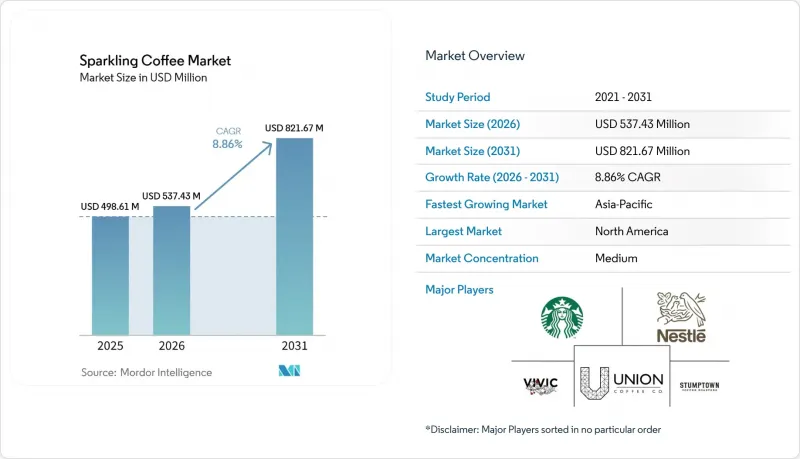
This report is Segmented by Product Type (Sparkling Cold Brew, Sparkling Espresso, and More), Packaging (Cans, Glass Bottles, PET Bottles, and More), Flavor (Black Coffee, Citrus, and More), Distribution Channel (On-Trade and Off-Trade), and Geography (North America, Europe, Asia-Pacific, South America, and the Middle East and Africa). The Market Forecasts are Provided in Terms of Value (USD).
Global Sparkling Coffee Market Trends and Insights
Rising demand for convenient ready-to-drink sparkling coffee beverages
Ready-to-drink availability gives the sparkling coffee market access to consumption occasions that hot coffee serves less effectively, including travel, mid-morning refreshment, and afternoon energy needs. The single-serve format also encourages product trial, as consumers can test the product without purchasing a larger coffee pack or visiting a cafe. This format supports placement in convenience stores, grocery outlets, vending locations, and online subscriptions, where consumers evaluate the product alongside other packaged beverages. Brands can gain traction when they position sparkling coffee as an alternative to both sweet carbonated drinks and conventional energy beverages. This positioning broadens the potential audience beyond consumers who regularly drink brewed coffee. The United States Food and Drug Administration states that up to 400 mg of caffeine per day is generally not associated with negative effects for most healthy adults. This supports the market acceptance of caffeinated ready-to-drink beverages, including sparkling coffee .
Expansion of cafe culture and specialty coffee chains
Cafe expansion supports the sparkling coffee market by introducing consumers to unfamiliar coffee formats in a guided purchase setting. Cafe menus help consumers understand carbonation, coffee intensity, sweetness, and flavor before they encounter packaged versions in retail coolers. This connection is particularly important in markets where coffee consumption is growing, but packaged sparkling coffee remains at an early stage of development. Cafe operators can test recipes, seasonal flavors, and serving occasions through direct customer feedback before considering larger retail launches. A wider cafe network can therefore improve product familiarity across income groups and urban locations. The sparkling coffee market benefits most when on-trade testing and off-trade availability advance together, rather than as separate commercial activities, as each channel can reinforce the other through product discovery, repeat purchases, and clearer consumer understanding.
Premium pricing limits mass market consumer adoption
Premium pricing can constrain the sparkling coffee market, as shoppers often compare specialty cans with lower-priced soda, instant coffee, or established energy drinks. This price gap has the greatest impact in regions where consumers have limited discretionary spending for packaged beverages. A high-quality coffee base, carbonation, functional ingredients, and differentiated packaging can each raise the costs that brands must recover at retail. However, reducing these costs too aggressively can weaken the product attributes that justify the premium positioning. Brands must, therefore, decide whether to target a narrow specialty audience or develop a more accessible product without making the offering appear generic. This tension can slow mass adoption, even as younger consumers show interest in new cold coffee formats. Curiosity may encourage initial trial, but the recurring retail price determines whether the product becomes part of regular beverage purchases.
Other drivers and restraints analyzed in the detailed report include:
- Premiumization of functional and specialty coffee offerings
- Increasing investments in sustainable packaging and premium beverage innovation
- Volatility in green coffee bean and packaging material costs
For complete list of drivers and restraints, kindly check the Table Of Contents.
Segment Analysis
Sparkling cold brew is expected to hold 58.21% of the sparkling coffee market share in 2025, while sparkling espresso is forecast to expand at a CAGR of 10.01% through 2031. Cold brew already has an established position in packaged coffee, giving consumers a familiar entry point when brands introduce carbonation. Its lower-acid profile can also make the combined coffee and sparkling taste easier to accept than formats based on hotter extraction methods. This familiarity supports its role as the volume base for the sparkling coffee market across grocery, specialty retail, and convenience locations. Brands can position the product as a familiar cold coffee with added refreshment value rather than as an entirely new beverage type. The format appeals to consumers seeking a coffee-forward drink without milk or a heavy sweetener profile. It also provides brands with a practical platform for black coffee, citrus, and botanical variations.
Sparkling espresso is expected to record the fastest growth through 2031, supported by increasing consumer demand for premium cafe-style beverages and differentiated coffee formats. The segment is gaining traction as brands introduce products that combine espresso with sparkling water, citrus flavors, and botanical ingredients, targeting younger consumers seeking premium ready-to-drink options. For instance, Starbucks Reserve expanded the visibility of sparkling espresso beverages across its Reserve Roasteries and select cafes, while specialty coffee brands such as Blue Bottle Coffee and Stumptown Coffee Roasters offer seasonal sparkling espresso beverages, indicating growing global demand for premium sparkling coffee offerings.
Cans accounted for 74.62% of the sparkling coffee market size in 2025 and are forecast to expand at a CAGR of 9.68% through 2031, positioning them as the category's leading packaging format. This share reflects strong brand alignment around a format that supports single-serve consumption and efficient ambient retail distribution. Cans also preserve carbonation effectively and provide a familiar format for consumers who already purchase sparkling water, energy drinks, and canned cold brew. Their broad printable surface enables brands to communicate key product attributes, including coffee origin, flavor, caffeine content, and nutritional additions. This is important in the sparkling coffee market because emerging formats must communicate their value proposition quickly in a competitive retail environment. The can format also supports distribution across convenience stores, supermarkets, and cafe takeaway settings.
Polyethylene terephthalate (PET) bottles are gaining adoption due to their lightweight structure, resealable format, and suitability for larger serving sizes and on-the-go consumption. This packaging format is expanding across supermarkets, convenience stores, and emerging markets, where cost efficiency and product visibility influence purchasing decisions. Manufacturers are increasing the use of recyclable polyethylene terephthalate and recycled polyethylene terephthalate (rPET) content to support sustainability targets, positioning PET bottles as a competitive packaging alternative alongside cans. PET bottles also provide flexibility for multi-serve and family-size formats, enabling brands to address varied consumption occasions. Their transparent structure improves shelf visibility and supports consumer demand for premium and flavored sparkling coffee beverages.
Complete Report Scope:
- By Product Type
- Sparkling Cold Brew
- Sparkling Espresso
- Other Product Type
- By Packaging
- Cans
- Glass Bottles
- PET Bottles
- Other Packaging Type
- By Flavor
- Black Coffee
- Citrus
- Fruit Flavoured
- Others
- By Distribution Channel
- On-Trade
- Off-Trade
- Hypermarkets/Supermarkets
- Convenience/Grocery Stores
- Online Retail Channel
- Other Distribution Channels
- By Geography
- North America
- United States
- Canada
- Mexico
- Rest of North America
- Europe
- Germany
- United Kingdom
- Italy
- France
- Spain
- Netherlands
- Poland
- Belgium
- Sweden
- Rest of Europe
- Asia-Pacific
- China
- India
- Japan
- Australia
- Indonesia
- South Korea
- Thailand
- Singapore
- Rest of Asia-Pacific
- South America
- Brazil
- Argentina
- Colombia
- Chile
- Peru
- Rest of South America
- Middle East and Africa
- South Africa
- Saudi Arabia
- United Arab Emirates
- Nigeria
- Egypt
- Morocco
- Turkey
- Rest of Middle East and Africa
- North America
Geography Analysis
North America accounted for 39.58% of the market value in 2025, supported by a mature premium cold brew retail environment and established specialty coffee brands. The region provides a familiar setting for canned cold coffee, which can lower the barrier to trial for sparkling variants. The United States offers the largest immediate consumer base, while Canada and Mexico provide additional room for cold-format development as specialty coffee activity expands. The sparkling coffee market in North America also benefits from established grocery, convenience, and specialty retail channels for premium ready-to-drink beverages. This distribution base allows brands to position products near related cold coffee and functional drink categories.
Asia-Pacific is forecast to grow at a CAGR of 10.34% through 2031. The sparkling coffee market size in the region is supported by rising coffee adoption, expanding specialty cafe coverage, and younger consumer groups entering ready-to-drink beverage occasions. China, India, Japan, and Southeast Asian markets offer different entry conditions, ranging from cafe-led product discovery to convenience retail and vending distribution. Japan remains a market where brands must address taste familiarity and price sensitivity with particular care.
Europe represents a significant regional blocs, as specialty coffee culture is well established in the United Kingdom, Germany, Scandinavia, and Italy. Espresso-tonic styles have made carbonated coffee combinations more recognizable in some cafe settings. This familiarity can support packaged products in markets where consumers already understand the intended taste experience. South America has a large coffee production base but remains a less developed consumer market for sparkling coffee. Premium pricing can be a stronger barrier in the region, especially when products compete with affordable instant coffee and soda. The Middle East and Africa also offer early-stage opportunities as cafe activity and ready-to-drink demand develop in urban markets. Distribution infrastructure, cold-chain capability, and retail price points will influence how quickly brands enter these markets.
- Drink Vivic
- Keepers Sparkling Coffee
- Manhattan Special
- Stumptown Coffee Roasters
- Union Coffee
- Paulig Group
- Ginseng UP Corporation
- ZUS Coffee
- Starbucks
- PEET'S COFFEE
- Nestle S.A.
- Upruit
- Mountjoy Enterprises Inc
- TERBODORE Coffee Roasters
- Sandows
- Esprizio
- Illycaffe S.p.A.
- Keurig Dr Pepper Inc.
- Asahi Group
- Lavazza Group
Additional Benefits:
- The market estimate (ME) sheet in Excel format
- 3 months of analyst support
TABLE OF CONTENTS
1 INTRODUCTION
- 1.1 Study Assumptions and Market Definition
- 1.2 Scope of the Study
2 RESEARCH METHODOLOGY
3 EXECUTIVE SUMMARY
4 MARKET LANDSCAPE
- 4.1 Market Overview
- 4.2 Market Drivers
- 4.2.1 Rising demand for convenient ready-to-drink sparkling coffee beverages
- 4.2.2 Product innovation through unique flavour and botanical infusions
- 4.2.3 Expansion of cafe culture and specialty coffee chains
- 4.2.4 Increasing investments in sustainable packaging and premium beverage innovation
- 4.2.5 Premiumization of functional and specialty coffee offerings
- 4.2.6 Rising demand for low-sugar and clean label beverage fromulations
- 4.3 Market Restraints
- 4.3.1 Premium pricing limits mass market consumer adoption
- 4.3.2 Limited consumer awareness and category familiarity
- 4.3.3 Regulatory scrutiny over caffeine and sugar content claims
- 4.3.4 Volatility in green coffee bean and packaging material costs
- 4.4 Consumer Behaviour Analysis
- 4.5 Regulatory Outlook
- 4.6 Porter's Five Forces
- 4.6.1 Threat of New Entrants
- 4.6.2 Bargaining Power of Buyers/Consumers
- 4.6.3 Bargaining Power of Suppliers
- 4.6.4 Threat of Substitute Products
- 4.6.5 Intensity of Competitive Rivalry
5 MARKET SIZE AND GROWTH FORECASTS (VALUE)
- 5.1 By Product Type
- 5.1.1 Sparkling Cold Brew
- 5.1.2 Sparkling Espresso
- 5.1.3 Other Product Type
- 5.2 By Packaging
- 5.2.1 Cans
- 5.2.2 Glass Bottles
- 5.2.3 PET Bottles
- 5.2.4 Other Packaging Type
- 5.3 By Flavor
- 5.3.1 Black Coffee
- 5.3.2 Citrus
- 5.3.3 Fruit Flavoured
- 5.3.4 Others
- 5.4 By Distribution Channel
- 5.4.1 On-Trade
- 5.4.2 Off-Trade
- 5.4.2.1 Hypermarkets/Supermarkets
- 5.4.2.2 Convenience/Grocery Stores
- 5.4.2.3 Online Retail Channel
- 5.4.2.4 Other Distribution Channels
- 5.5 By Geography
- 5.5.1 North America
- 5.5.1.1 United States
- 5.5.1.2 Canada
- 5.5.1.3 Mexico
- 5.5.1.4 Rest of North America
- 5.5.2 Europe
- 5.5.2.1 Germany
- 5.5.2.2 United Kingdom
- 5.5.2.3 Italy
- 5.5.2.4 France
- 5.5.2.5 Spain
- 5.5.2.6 Netherlands
- 5.5.2.7 Poland
- 5.5.2.8 Belgium
- 5.5.2.9 Sweden
- 5.5.2.10 Rest of Europe
- 5.5.3 Asia-Pacific
- 5.5.3.1 China
- 5.5.3.2 India
- 5.5.3.3 Japan
- 5.5.3.4 Australia
- 5.5.3.5 Indonesia
- 5.5.3.6 South Korea
- 5.5.3.7 Thailand
- 5.5.3.8 Singapore
- 5.5.3.9 Rest of Asia-Pacific
- 5.5.4 South America
- 5.5.4.1 Brazil
- 5.5.4.2 Argentina
- 5.5.4.3 Colombia
- 5.5.4.4 Chile
- 5.5.4.5 Peru
- 5.5.4.6 Rest of South America
- 5.5.5 Middle East and Africa
- 5.5.5.1 South Africa
- 5.5.5.2 Saudi Arabia
- 5.5.5.3 United Arab Emirates
- 5.5.5.4 Nigeria
- 5.5.5.5 Egypt
- 5.5.5.6 Morocco
- 5.5.5.7 Turkey
- 5.5.5.8 Rest of Middle East and Africa
- 5.5.1 North America
6 COMPETITIVE LANDSCAPE
- 6.1 Market Concentration
- 6.2 Strategic Moves
- 6.3 Market Share Analysis
- 6.4 Company Profiles (includes Global-level Overview, Market-level Overview, Core Segments, Financials (if available), Strategic Information, Market Rank/Share, Products and Services, Recent Developments)
- 6.4.1 Drink Vivic
- 6.4.2 Keepers Sparkling Coffee
- 6.4.3 Manhattan Special
- 6.4.4 Stumptown Coffee Roasters
- 6.4.5 Union Coffee
- 6.4.6 Paulig Group
- 6.4.7 Ginseng UP Corporation
- 6.4.8 ZUS Coffee
- 6.4.9 Starbucks
- 6.4.10 PEET'S COFFEE
- 6.4.11 Nestle S.A.
- 6.4.12 Upruit
- 6.4.13 Mountjoy Enterprises Inc
- 6.4.14 TERBODORE Coffee Roasters
- 6.4.15 Sandows
- 6.4.16 Esprizio
- 6.4.17 Illycaffe S.p.A.
- 6.4.18 Keurig Dr Pepper Inc.
- 6.4.19 Asahi Group
- 6.4.20 Lavazza Group
7 MARKET OPPORTUNITIES AND FUTURE OUTLOOK

