PUBLISHER: Mordor Intelligence | PRODUCT CODE: 2118918

PUBLISHER: Mordor Intelligence | PRODUCT CODE: 2118918
Antifreeze Protein - Market Share Analysis, Industry Trends & Statistics, Growth Forecasts (2026 - 2031)
According to Mordor Intelligence, the antifreeze protein market size is expected to grow from USD 18.99 million in 2025 to USD 21.45 million in 2026 and is forecast to reach USD 44.17 million by 2031 at 15.54% CAGR over 2026-2031.
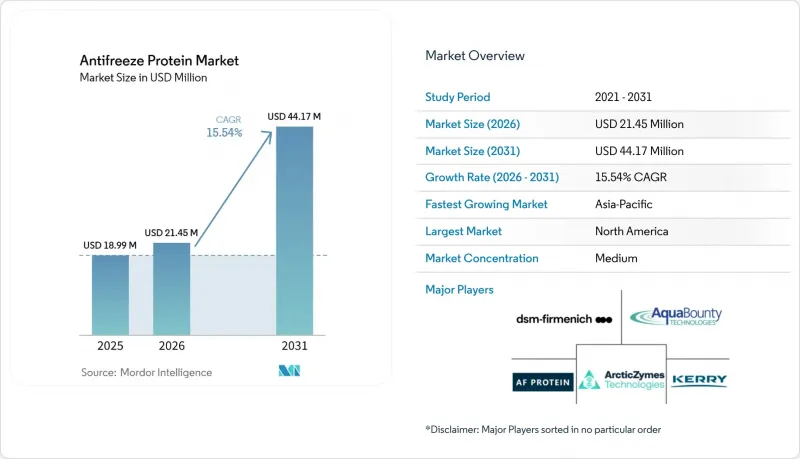
This report is Segmented by Source (Fish, Insect, Plant, Microbial), Production Method (Natural Extraction, Recombinant Production, Synthetic Production), Application (Food and Beverages, Pharmaceuticals and Biotechnology, Agriculture, Other Applications), and Geography (North America, Europe, Asia-Pacific, South America, Middle East and Africa). The Market Forecasts are Provided in Terms of Value (USD).
Global Antifreeze Protein Market Trends and Insights
Rising demand for cryopreservation in cell and gene therapy
Cell and gene therapy programs required cryopreservation agents that maintained cell viability after thawing. Researchers continued to use DMSO widely; however, its cytotoxicity and potential effects on stem cell differentiation increased interest in safer and more effective alternatives. A 2024 study reported 77.5% tumor suppression in a mouse lymphoma model after researchers administered cryopreserved T cells using an antifreeze protein-inspired nanoparticle system. This result reached twice the rate achieved with DMSO in the same study, indicating stronger post-thaw functional performance. A 2025 study reduced the immunogenicity of Marinomonas primoryensis antifreeze proteins by 48% through hydrophilic modification and reported 96% NIH/3T3 cell viability after thawing. These findings supported demand in the antifreeze protein market from GMP-oriented cell therapy supply chains, while organ, tissue, and regenerative medicine research could have expanded the long-term customer base.
Increasing use in premium frozen food products
Frozen food applications provide an established revenue base for the antifreeze protein market. Antifreeze proteins suppress ice recrystallization at low concentrations, helping preserve texture during storage and repeated temperature changes. A 2026 study reported that a synthetic alanine-glutamic acid polypeptide was non-toxic, biodegradable, digestible, and active at microgram-per-milliliter concentrations. Research published in 2025 found that Glaciozyma proteins protected food products without reported taste changes across ice cream, meat, and dairy applications. Studies on chicken-skin and Antarctic-krill peptides also showed protection against myofibrillar protein aggregation during freeze-thaw cycles. Therefore, the antifreeze protein market can serve processors that require cleaner labels and improved texture retention in premium frozen products.
High production and purification costs
Low natural extraction yields and high purification costs constrained the antifreeze protein market. Manufacturers faced added complexity because repeat-rich proteins complicated expression and downstream purification, especially when inclusion bodies formed. The cost gap remained wide between pharmaceutical-grade proteins and conventional cryoprotectants, such as glycerol or DMSO, which limited broader commercial adoption in cost-sensitive applications. Yeast systems offered a pathway to higher yields, but producers still required careful purification and quality control to meet performance and regulatory requirements. A 2026 collaboration between Ginkgo Bioworks and Invaio Sciences showed continued investment in industrial fermentation for peptide-based agricultural inputs. Cost reduction depended on scalable expression, simplified purification, and sufficient demand to keep production assets well utilized.
Other drivers and restraints analyzed in the detailed report include:
- Advances in recombinant antifreeze protein production
- Rising biologics and vaccine cold-chain requirements
- Limited commercial-scale manufacturing capacity
For complete list of drivers and restraints, kindly check the Table Of Contents.
Segment Analysis
Fish segment accounted for 47.61% of the antifreeze protein market share in 2025, making it the largest contributor to overall market revenue. Fish-derived antifreeze proteins have long been the most established and commercially utilized source due to their well-characterized molecular structures and proven cryoprotective properties. These proteins are extensively used in food preservation, frozen seafood processing, and biotechnology applications where effective protection against ice crystal formation is essential. The availability of naturally occurring antifreeze proteins from cold-water fish species has supported consistent commercial supply and industrial adoption.
The microbial segment is projected to grow at the fastest CAGR of 16.89% through 2031, reflecting increasing interest in scalable and sustainable production methods. Microbial sources, including bacteria, fungi, and yeast, offer significant advantages in terms of controlled cultivation, reproducibility, and cost-effective large-scale manufacturing. Advances in recombinant technology and microbial fermentation are enabling higher production yields and improved functional performance of antifreeze proteins.
Complete Report Scope:
- By Source
- Fish
- Insect
- Plant
- Microbial
- By Production Method
- Natural Extraction
- Recombinant Production
- Synthetic Production
- By Application
- Food and Beverages
- Pharmaceuticals & Biotechnology
- Agriculture
- Other Applications
- Geography
- North America
- United States
- Canada
- Mexico
- Rest of North America
- Europe
- Germany
- United Kingdom
- Italy
- France
- Spain
- Rest of Europe
- Asia-Pacific
- China
- India
- Japan
- Australia
- Rest of Asia-Pacific
- South America
- Brazil
- Argentina
- Rest of South America
- Middle East and Africa
- South Africa
- Saudi Arabia
- Rest of Middle East and Africa
- North America
Geography Analysis
North America accounted for 37.81% of the antifreeze protein market revenue in 2025, making it the largest regional market. The region benefits from a well-established biotechnology and pharmaceutical ecosystem, extensive research infrastructure, and strong commercialization capabilities for specialty proteins. The United States leads regional demand due to its advanced biopharmaceutical manufacturing sector, increasing investment in cryopreservation technologies, and widespread adoption of high-value food preservation solutions. Antifreeze proteins are increasingly used in frozen food products, medical research, organ preservation, and industrial biotechnology applications across North America.
Asia-Pacific is projected to grow at the fastest CAGR of 17.04% through 2031, driven by expanding biotechnology, pharmaceutical, and food processing industries across major economies such as China, Japan, South Korea, and India. Rapid industrialization and increasing investments in life sciences research are accelerating the adoption of antifreeze proteins in pharmaceutical manufacturing, cryopreservation, and agricultural biotechnology applications. The region is also witnessing rising demand for frozen and processed food products, creating additional opportunities for antifreeze protein use in food preservation and cold-chain systems.
Europe represents a significant market due to its strong biotechnology research base, advanced food processing industry, and emphasis on sustainable bio-based ingredients. South America is gradually expanding, supported by growth in aquaculture, agriculture, and frozen food production, while the Middle East and Africa remain relatively smaller markets but are gaining attention through improving healthcare infrastructure and food preservation investments. Increasing research collaborations and biotechnology development initiatives across these regions are expected to support steady market expansion over the forecast period.
- A/F Protein, Inc.
- AquaBounty Technologies, Inc.
- ArcticZymes Technologies ASA
- Novozymes A/S
- DSM-Firmenich AG
- Chr. Hansen Holding A/S
- Kerry Group plc
- Ingredion Incorporated
- Lallemand Inc.
- Ginkgo Bioworks Holdings, Inc.
- BASF SE
- Merck KGaA
- Thermo Fisher Scientific Inc.
- Sartorius AG
- Lonza Group AG
- Corning Incorporated
- Takara Bio Inc.
- Bio-Rad Laboratories, Inc.
- QIAGEN N.V.
- FUJIFILM Holdings Corporation
Additional Benefits:
- The market estimate (ME) sheet in Excel format
- 3 months of analyst support
TABLE OF CONTENTS
1 INTRODUCTION
- 1.1 Study Assumptions and Market Definition
- 1.2 Scope of the Study
2 RESEARCH METHODOLOGY
3 EXECUTIVE SUMMARY
4 MARKET LANDSCAPE
- 4.1 Market Overview
- 4.2 Market Drivers
- 4.2.1 Rising demand for cryopreservation in cell and gene therapy
- 4.2.2 Growth in organ and tissue preservation research
- 4.2.3 Increasing use in premium frozen food products
- 4.2.4 Expansion of regenerative medicine applications
- 4.2.5 Advances in recombinant antifreeze protein production
- 4.2.6 Rising biologics and vaccine cold-chain requirements
- 4.3 Market Restraints
- 4.3.1 High production and purification costs
- 4.3.2 Limited commercial-scale manufacturing capacity
- 4.3.3 Stringent regulatory approval requirements
- 4.3.4 Protein instability during processing
- 4.4 Value Chain Analysis
- 4.5 Regulatory Landscape
- 4.6 Technological Outlook
- 4.7 Porter's Five Forces
- 4.7.1 Threat of New Entrants
- 4.7.2 Bargaining Power of Suppliers
- 4.7.3 Bargaining Power of Buyers
- 4.7.4 Threat of Substitutes
- 4.7.5 Competitive Rivalry
5 MARKET SIZE AND GROWTH FORECASTS (VALUE)
- 5.1 By Source
- 5.1.1 Fish
- 5.1.2 Insect
- 5.1.3 Plant
- 5.1.4 Microbial
- 5.2 By Production Method
- 5.2.1 Natural Extraction
- 5.2.2 Recombinant Production
- 5.2.3 Synthetic Production
- 5.3 By Application
- 5.3.1 Food and Beverages
- 5.3.2 Pharmaceuticals & Biotechnology
- 5.3.3 Agriculture
- 5.3.4 Other Applications
- 5.4 Geography
- 5.4.1 North America
- 5.4.1.1 United States
- 5.4.1.2 Canada
- 5.4.1.3 Mexico
- 5.4.1.4 Rest of North America
- 5.4.2 Europe
- 5.4.2.1 Germany
- 5.4.2.2 United Kingdom
- 5.4.2.3 Italy
- 5.4.2.4 France
- 5.4.2.5 Spain
- 5.4.2.6 Rest of Europe
- 5.4.3 Asia-Pacific
- 5.4.3.1 China
- 5.4.3.2 India
- 5.4.3.3 Japan
- 5.4.3.4 Australia
- 5.4.3.5 Rest of Asia-Pacific
- 5.4.4 South America
- 5.4.4.1 Brazil
- 5.4.4.2 Argentina
- 5.4.4.3 Rest of South America
- 5.4.5 Middle East and Africa
- 5.4.5.1 South Africa
- 5.4.5.2 Saudi Arabia
- 5.4.5.3 Rest of Middle East and Africa
- 5.4.1 North America
6 COMPETITIVE LANDSCAPE
- 6.1 Market Concentration
- 6.2 Strategic Moves
- 6.3 Market Ranking Analysis
- 6.4 Company Profiles (includes Global level Overview, Market level overview, Core Segments, Financials as available, Strategic Information, Market Rank/Share for key companies, Products & Services, and Recent Developments)
- 6.4.1 A/F Protein, Inc.
- 6.4.2 AquaBounty Technologies, Inc.
- 6.4.3 ArcticZymes Technologies ASA
- 6.4.4 Novozymes A/S
- 6.4.5 DSM-Firmenich AG
- 6.4.6 Chr. Hansen Holding A/S
- 6.4.7 Kerry Group plc
- 6.4.8 Ingredion Incorporated
- 6.4.9 Lallemand Inc.
- 6.4.10 Ginkgo Bioworks Holdings, Inc.
- 6.4.11 BASF SE
- 6.4.12 Merck KGaA
- 6.4.13 Thermo Fisher Scientific Inc.
- 6.4.14 Sartorius AG
- 6.4.15 Lonza Group AG
- 6.4.16 Corning Incorporated
- 6.4.17 Takara Bio Inc.
- 6.4.18 Bio-Rad Laboratories, Inc.
- 6.4.19 QIAGEN N.V.
- 6.4.20 FUJIFILM Holdings Corporation
7 MARKET OPPORTUNITIES AND FUTURE OUTLOOK

