PUBLISHER: Mordor Intelligence | PRODUCT CODE: 2118923

PUBLISHER: Mordor Intelligence | PRODUCT CODE: 2118923
Spasticity Treatment - Market Share Analysis, Industry Trends & Statistics, Growth Forecasts (2026 - 2031)
According to Mordor Intelligence, the spasticity treatment market size is expected to grow from USD 3.06 billion in 2025 to USD 3.30 billion in 2026 and is forecast to reach USD 4.82 billion by 2031 at 7.86% CAGR over 2026-2031.
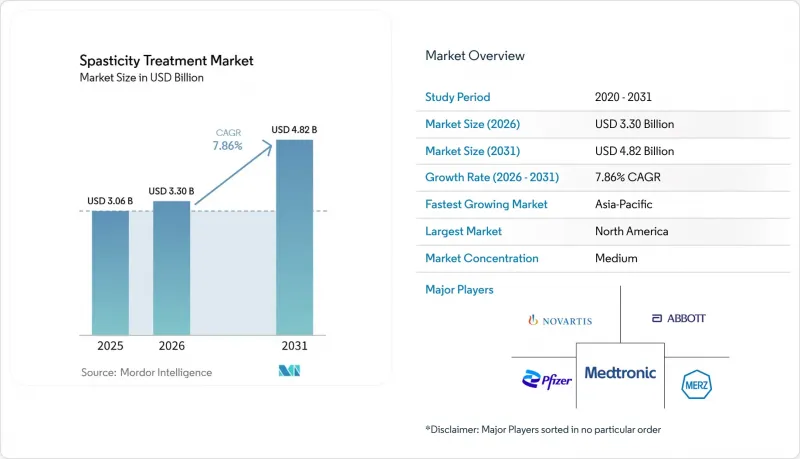
This report is Segmented by Treatment Modality (Drug Therapy, and More), Drug Class (GABA Agonists, and More), Indication (MS, Cerebral Palsy, and More), Route of Administration (Oral, Parenteral), End User (Hospitals, Others), Distribution Channel (Hospital Pharmacies, Oand More), Age Group (Pediatric, and More), and Geography (North America, and More). The Market Forecasts are Provided in Terms of Value (USD).
Global Spasticity Treatment Market Trends and Insights
Rising Burden of Stroke, Multiple Sclerosis, Cerebral Palsy, and Spinal Cord Injury
The spasticity treatment market is driven by neurological conditions that often require long-term care after injury or disease. The World Stroke Organization reported 11.9 million new stroke cases worldwide in 2024, and the lifetime stroke risk increased by 50% over the previous two decades. Spasticity develops in 25%-43% of stroke survivors within the first year after stroke and affects more than 90% of people with cerebral palsy and 37%-78% of people with multiple sclerosis. Cerebral palsy affected 3.1 per 1,000 children in the United States, and spinal cord injury also remains a treatment-intensive group, with 68% of 259,000 affected Americans developing some degree of spasticity.
Increasing Adoption of Botulinum Toxin for Focal Spasticity
Clinicians increasingly use botulinum toxin type A for focal spasticity because it targets affected muscles without requiring continuous systemic dosing. Ipsen presented the Phase IV DIRECTION study in May 2026, comparing Dysport and Botox in 464 adults across 72 sites in the United States, France, and Canada. The study reported treatment-emergent adverse event rates of 20.3% for Dysport and 23.0% for Botox, with durations of effect of 14.2 weeks and 13.8 weeks, respectively. A 2026 study also found that starting botulinum toxin within one year of stroke was associated with better goal attainment than delayed care, supporting market growth through stronger referral, specialist assessment, injection scheduling, and follow-up.
High Treatment, Procedure, and Long-Term Monitoring Costs
High treatment, procedure, and long-term monitoring costs limit access to premium options, particularly in healthcare systems with incomplete reimbursement. A 200-unit vial of onabotulinumtoxinA has a list price of USD 1,244; therefore, an upper-limb treatment course requiring up to 400 units could cost USD 2,488, while Medicare reimbursement for this treatment was USD 2,482.80, slightly below the product-only cost. Programmable intrathecal baclofen pump systems typically cost USD 20,000-USD 30,000 per unit, excluding implantation and ongoing management costs. Direct medical costs for stroke survivors with spasticity were four times higher in the first year than those for survivors without spasticity, constraining adoption in the spasticity treatment market as reimbursement decisions often prioritize immediate procedure and product expenses over broader disability, caregiver, and hospitalization costs.
Other drivers and restraints analyzed in the detailed report include:
- Expansion of Multidisciplinary Rehabilitation and Goal-Based Care
- Greater Use of Targeted Intrathecal Baclofen Therapy in Refractory Generalized Spasticity
- Adverse Effects and Dose-Limiting Tolerability of Oral Antispasticity Drugs
For complete list of drivers and restraints, kindly check the Table Of Contents.
Segment Analysis
Drug therapy held 34.55% of the spasticity treatment market share in 2025, supported by the continued use of oral antispasmodics and injectable botulinum toxin across major indications. Clinicians increasingly used combination care, pairing injections with closely managed oral GABA agonists when appropriate. This approach helped increase treatment intensity while allowing clinicians to adjust medication, focal injection, exercise, and supportive equipment based on functional impairment. Physical therapy and rehabilitation is projected to grow at an 8.93% CAGR from 2026 to 2031, reflecting wider use of structured rehabilitation alongside medicines and injections.
Orthoses and assistive devices continued to support treatment spending for patients with cerebral palsy and stroke, especially in North America and Europe, where reimbursement is more established. Surgical options, including selective dorsal rhizotomy and orthopedic tendon-release procedures, served patients with structural complications caused by spasticity. Botulinum toxin remained important in pediatric care, and a 2026 meta-analysis of 18 randomized trials involving 892 participants found a significant reduction in ankle spasticity in children with cerebral palsy. These findings supported the continued role of drug treatment, with rehabilitation and surgery complementing the core treatment pathway.
GABA agonists held 39.56% of the spasticity treatment market share in 2025, supported by the broad use of oral and intrathecal baclofen across several indications and the wide availability of generic products. Intrathecal use also created recurring demand for pump maintenance and refills. Alpha-2 adrenergic agonists are projected to grow at a 9.67% CAGR from 2026 to 2031. Clinicians increasingly used tizanidine in multidrug regimens for multiple sclerosis-related and stroke-related spasticity, although sedation, blood pressure, and liver safety monitoring continued to limit broader use.
Botulinum toxins remained a separate drug class with active branded competition, with onabotulinumtoxinA, abobotulinumtoxinA, and incobotulinumtoxinA established for adult upper-limb spasticity. In June 2026, Merz Therapeutics received an FDA label update for XEOMIN in children and adolescents aged 2 years and older with cerebral palsy-related upper-limb spasticity. Cannabinoid-based therapy remained a smaller option for multiple sclerosis-related spasticity in approved European and Canadian settings. Dantrolene continued to serve selected severe cases, but hepatotoxicity concerns and competing options limited its use.
Multiple sclerosis accounted for 36.77% of the spasticity treatment market share in 2025, driven by the high frequency of spasticity in this population and established medication pathways. Patients often required long-term management, which supported repeated prescriptions, injections, and rehabilitation. Cerebral palsy is projected to grow at a 10.35% CAGR from 2026 to 2031. Pediatric label expansions and earlier intervention supported this growth, while a 2025 study linked repeated botulinum toxin type A treatment plus intensive rehabilitation with improved gait kinematics and delayed deformity development in young children with bilateral spastic cerebral palsy.
Stroke-related spasticity remained another large indication, as stroke survivors often required ongoing care after the acute event. Spinal cord injury and traumatic brain injury also created consistent demand due to complex rehabilitation needs. Hereditary spastic paraplegia remained a smaller but distinct indication requiring long-term monitoring, with a 2025 review highlighting growing interest in telemedicine-enabled monitoring and digital biobanks, especially in Europe. This indication mix supported demand across hospital, clinic, and home-based settings.
Complete Report Scope:
- By Treatment Modality
- Drug Therapy
- Physical Therapy and Rehabilitation
- Orthoses and Assistive Devices
- Surgical Treatment
- Selective Dorsal Rhizotomy
- Orthopaedic and Tendon-Release Surgery
- Other Interventional Treatments
- By Drug Class
- GABA Agonists
- Alpha-2 Adrenergic Agonists
- Tizanidine
- Botulinum Toxins
- Dantrolene Sodium
- Cannabinoid-Based Therapies
- Other Drug Classes
- By Indication
- Cerebral Palsy
- Multiple Sclerosis
- Stroke
- Spinal Cord Injury
- Traumatic Brain Injury
- Hereditary Spastic Paraplegia
- Other Neurological Indications
- By Route of Administration
- Oral
- Parenteral
- By End User
- Hospitals
- Specialty Clinics
- Rehabilitation Centers
- Ambulatory Surgical Centers
- Others
- By Distribution Channel
- Hospital Pharmacies
- Retail Pharmacies
- Online Pharmacies
- Others
- By Age Group
- Pediatric Patients
- Adult Patients
- Geriatric Patients
- By Geography
- North America
- United States
- Canada
- Mexico
- Europe
- Germany
- United Kingdom
- France
- Italy
- Spain
- Rest of Europe
- Asia-Pacific
- China
- India
- Japan
- Australia
- South Korea
- Rest of Asia-Pacific
- Middle East and Africa
- GCC
- South Africa
- Rest of Middle East and Africa
- South America
- Brazil
- Argentina
- Rest of South America
- North America
Geography Analysis
North America held 40.84% of the spasticity treatment market share in 2025, supported by mature clinical protocols, payment coverage for botulinum toxin injections and intrathecal baclofen pumps, and a strong specialist base. The United States recorded 795,000 strokes annually, while an estimated 1.4 million Americans lived with stroke-related spasticity. Multiple sclerosis and cerebral palsy sustained recurring demand for medication and rehabilitation. Europe remained a key region, with Germany, France, and the United Kingdom among the larger national markets, while Sativex approvals across 29 countries strengthened cannabinoid-based treatment for multiple sclerosis-related spasticity.
Asia-Pacific is projected to grow at a CAGR of 8.56% from 2026 to 2031, the fastest regional rate in the spasticity treatment market. The rising stroke burden in China and Japan, expanding cerebral palsy rehabilitation capacity in India, and specialist training in South Korea and Australia supported this growth. China deployed an integrated brain-computer interface, spinal cord stimulation, and robotic exoskeleton system for stroke rehabilitation in Guangxi in April 2026. The Chinese Medical Association published a 2025 expert consensus on spinal cord stimulation for post-stroke hemiplegia, while Australia and New Zealand issued a 2025 physiotherapy guideline for spinal cord injury management.
The Middle East, Africa, and South America hold smaller shares but remain important long-term growth areas. The GCC leads adoption in the Middle East through specialized rehabilitation centers and expanding pump-based therapy capacity, while South Africa and other African markets face limited specialist access and weak botulinum toxin reimbursement outside private insurance. Brazil anchors South America as public coverage for spasticity care expands, and Argentina has a growing private rehabilitation sector. Large untreated patient pools make access, workforce development, and affordable treatment models critical for expanding structured care in smaller cities and rural communities.
- Abbvie
- Acorda Therapeutics
- Amneal Pharmaceuticals
- Azurity Pharmaceuticals
- Boston Scientific
- Cipla
- Dr. Reddy's Laboratories
- Roche
- Flowonix Medical Inc.
- Hikma Pharmaceuticals
- Ipsen
- Lupin
- Medtronic
- Merz Therapeutics GmbH
- Metacel Pharmaceuticals, LLC
- Novartis
- Pfizer
- Piramal Group
- Saol Therapeutics, Inc.
- Sun Pharmaceuticals Industries
- Teva Pharmaceutical Industries
- Tricumed Medizintechnik
- Viatris
- Zydus Lifesciences Limited
Additional Benefits:
- The market estimate (ME) sheet in Excel format
- 3 months of analyst support
TABLE OF CONTENTS
1 INTRODUCTION
- 1.1 Study Assumptions and Market Definition
- 1.2 Scope of the Study
2 RESEARCH METHODOLOGY
3 EXECUTIVE SUMMARY
4 MARKET LANDSCAPE
- 4.1 Market Overview
- 4.2 Market Drivers
- 4.2.1 Rising Burden of Stroke, Multiple Sclerosis, Cerebral Palsy, and Spinal Cord Injury
- 4.2.2 Increasing Adoption of Botulinum Toxin for Focal Spasticity
- 4.2.3 Expansion of Multidisciplinary Rehabilitation and Goal-Based Care
- 4.2.4 Greater Use of Targeted Intrathecal Baclofen Therapy in Refractory Generalized Spasticity
- 4.2.5 Standardization of Spasticity Assessment and Treatment Pathways
- 4.2.6 Underdiagnosis and Untreated Patient Pools in Emerging Markets
- 4.3 Market Restraints
- 4.3.1 High Treatment, Procedure, and Long-Term Monitoring Costs
- 4.3.2 Adverse Effects and Dose-Limiting Tolerability of Oral Antispasticity Drugs
- 4.3.3 Short Treatment Durability and Immunogenicity Risk of Botulinum Toxin
- 4.3.4 Specialist Infrastructure, Pump Maintenance, and Withdrawal Risks in Intrathecal Therapy
- 4.4 Value/Supply-Chain Analysis
- 4.5 Regulatory Landscape
- 4.6 Technological Outlook
- 4.7 Porter's Five Forces Analysis
- 4.7.1 Threat of New Entrants
- 4.7.2 Bargaining Power of Suppliers
- 4.7.3 Bargaining Power of Buyers
- 4.7.4 Threat of Substitutes
- 4.7.5 Competitive Rivalry
5 MARKET SIZE AND GROWTH FORECASTS (VALUE, USD)
- 5.1 By Treatment Modality
- 5.1.1 Drug Therapy
- 5.1.2 Physical Therapy and Rehabilitation
- 5.1.3 Orthoses and Assistive Devices
- 5.1.4 Surgical Treatment
- 5.1.5 Selective Dorsal Rhizotomy
- 5.1.6 Orthopaedic and Tendon-Release Surgery
- 5.1.7 Other Interventional Treatments
- 5.2 By Drug Class
- 5.2.1 GABA Agonists
- 5.2.2 Alpha-2 Adrenergic Agonists
- 5.2.3 Tizanidine
- 5.2.4 Botulinum Toxins
- 5.2.5 Dantrolene Sodium
- 5.2.6 Cannabinoid-Based Therapies
- 5.2.7 Other Drug Classes
- 5.3 By Indication
- 5.3.1 Cerebral Palsy
- 5.3.2 Multiple Sclerosis
- 5.3.3 Stroke
- 5.3.4 Spinal Cord Injury
- 5.3.5 Traumatic Brain Injury
- 5.3.6 Hereditary Spastic Paraplegia
- 5.3.7 Other Neurological Indications
- 5.4 By Route of Administration
- 5.4.1 Oral
- 5.4.2 Parenteral
- 5.5 By End User
- 5.5.1 Hospitals
- 5.5.2 Specialty Clinics
- 5.5.3 Rehabilitation Centers
- 5.5.4 Ambulatory Surgical Centers
- 5.5.5 Others
- 5.6 By Distribution Channel
- 5.6.1 Hospital Pharmacies
- 5.6.2 Retail Pharmacies
- 5.6.3 Online Pharmacies
- 5.6.4 Others
- 5.7 By Age Group
- 5.7.1 Pediatric Patients
- 5.7.2 Adult Patients
- 5.7.3 Geriatric Patients
- 5.8 By Geography
- 5.8.1 North America
- 5.8.1.1 United States
- 5.8.1.2 Canada
- 5.8.1.3 Mexico
- 5.8.2 Europe
- 5.8.2.1 Germany
- 5.8.2.2 United Kingdom
- 5.8.2.3 France
- 5.8.2.4 Italy
- 5.8.2.5 Spain
- 5.8.2.6 Rest of Europe
- 5.8.3 Asia-Pacific
- 5.8.3.1 China
- 5.8.3.2 India
- 5.8.3.3 Japan
- 5.8.3.4 Australia
- 5.8.3.5 South Korea
- 5.8.3.6 Rest of Asia-Pacific
- 5.8.4 Middle East and Africa
- 5.8.4.1 GCC
- 5.8.4.2 South Africa
- 5.8.4.3 Rest of Middle East and Africa
- 5.8.5 South America
- 5.8.5.1 Brazil
- 5.8.5.2 Argentina
- 5.8.5.3 Rest of South America
- 5.8.1 North America
6 COMPETITIVE LANDSCAPE
- 6.1 Market Concentration
- 6.2 Market Share Analysis
- 6.3 Company Profiles (includes Global Level Overview, Market Level Overview, Core Segments, Financials as available, Strategic Information, Market Rank/Share, Products and Services, Recent Developments)
- 6.3.1 AbbVie Inc.
- 6.3.2 Acorda Therapeutics, Inc.
- 6.3.3 Amneal Pharmaceuticals, Inc.
- 6.3.4 Azurity Pharmaceuticals, Inc.
- 6.3.5 Boston Scientific Corporation
- 6.3.6 Cipla Limited
- 6.3.7 Dr. Reddy's Laboratories Ltd.
- 6.3.8 F. Hoffmann-La Roche Ltd.
- 6.3.9 Flowonix Medical Inc.
- 6.3.10 Hikma Pharmaceuticals PLC
- 6.3.11 Ipsen Pharma
- 6.3.12 Lupin Limited
- 6.3.13 Medtronic plc
- 6.3.14 Merz Therapeutics GmbH
- 6.3.15 Metacel Pharmaceuticals, LLC
- 6.3.16 Novartis AG
- 6.3.17 Pfizer Inc.
- 6.3.18 Piramal Enterprises Limited
- 6.3.19 Saol Therapeutics, Inc.
- 6.3.20 Sun Pharmaceutical Industries Ltd.
- 6.3.21 Teva Pharmaceutical Industries Ltd.
- 6.3.22 Tricumed Medizintechnik GmbH
- 6.3.23 Viatris Inc.
- 6.3.24 Zydus Lifesciences Limited
7 MARKET OPPORTUNITIES AND FUTURE OUTLOOK
- 7.1 White-Space and Unmet-Need Assessment

