PUBLISHER: Mordor Intelligence | PRODUCT CODE: 2118938

PUBLISHER: Mordor Intelligence | PRODUCT CODE: 2118938
Virtual Event Marketing Services - Market Share Analysis, Industry Trends & Statistics, Growth Forecasts (2026 - 2031)
According to Mordor Intelligence, the virtual event marketing services market size is projected to expand from USD 4.52 billion in 2025 and USD 5.13 billion in 2026 to USD 10.13 billion by 2031, registering a CAGR of 14.58% between 2026 and 2031.
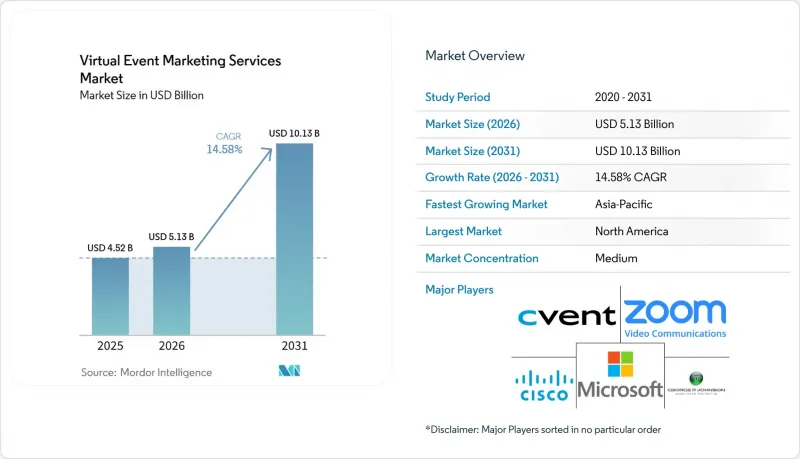
This report is Segmented by Service Type (Strategy and Campaign Planning, Audience Acquisition and Registration Management, and More), Event Format (Live-Streamed Corporate Events, and More), Organization Size (Large Enterprises, and Small and Medium-Sized Enterprises), End-User Industry (IT and Telecom, BFSI, and More), and Geography. The Market Forecasts are Provided in Terms of Value (USD).
Global Virtual Event Marketing Services Market Trends and Insights
Remote and Hybrid Work Programs Expand Digital Event Budgets
Hybrid work has created a dispersed audience that physical-only programs cannot fully serve. The Virtual Event Marketing Services Market benefits when businesses need a consistent way to involve employees, buyers, and partners across locations, especially when audience participation is not limited by travel schedules or venue capacity. Events accounted for up to 30% of program budgets in manufacturing, professional services, and technology, according to the referenced 2026 Forrester analysis. The same analysis reported that the share of organizations increasing event budgets by more than 10% doubled year over year. Bizzabo reported that 74% of Fortune 1000 marketers planned to increase event budgets in 2026, while 40% of all organizers expected budget growth. Accessibility requirements, including WCAG 2.2 and the European Accessibility Act, also favor services that provide captioning and multilingual delivery as standard capabilities.
Artificial Intelligence-Driven Personalization and Content Repurposing Lift Conversion
AI is changing how service providers prepare, deliver, and extend virtual programs. ON24 reported that personalized virtual event landing pages delivered a 3X increase in demo requests and a 2X rise in meetings booked in its life sciences benchmarks. The company also reported a 6X year-over-year increase in content output from a single webinar recording when teams used AI-generated derivative assets. Cvent stated that its CventIQ engine processes 12.7 billion attendee interactions annually and uses this data for attendance models, networking suggestions, and content recommendations. Goldcast's AI Content Lab can produce short video highlights and related assets from session recordings. These capabilities enable the Virtual Event Marketing Services Market to support campaigns that continue after the live session without requiring a corresponding increase in manual production work.
Webinar Fatigue Weakens Live Engagement and Networking
Heavy webinar calendars can reduce live participation and weaken networking results. The referenced Forrester survey found that nearly 70% of event leaders were reducing their total event count while protecting the quality of each program. Bizzabo reported that organizations with strong results averaged 412 registrations and a 52% event attendance rate. These figures indicate that buyers are placing more weight on relevance, production quality, and tailored interaction. The Virtual Event Marketing Services Market, therefore, faces pressure to deliver stronger outcomes rather than low-cost volume, including clear reasons for attendance and more useful opportunities for guided interaction. Providers that can show measurable results may gain funding from programs that would otherwise have been spread across basic webinar tools.
Other drivers and restraints analyzed in the detailed report include:
- First-Party Engagement Data Improves Revenue Attribution
- Always-On On-Demand Content Hubs Extend Campaign Life
- Data Privacy and Cross-Border Compliance Complexity Raises Delivery Risk
For complete list of drivers and restraints, kindly check the Table Of Contents.
Segment Analysis
Audience acquisition and registration management held 24.37% of the Virtual Event Marketing Services Market share in 2025. It meets a basic need because every program requires a qualified, permissioned audience before event delivery begins, and because downstream follow-up depends on accurate registration records. Enterprise teams increasingly judge registrations by lead quality, data completeness, readiness for campaign follow-up, and the ability to connect those records to existing customer systems. Registration workflows also establish the consent record needed to use engagement data responsibly after the event. This makes the service a practical entry point for providers that manage broader digital event campaigns.
Virtual product launch and live-stream promotion are projected to expand at a 16.69% CAGR from 2026 to 2031. Marketing teams use these formats to coordinate launches across regions without replicating physical programs. A live digital activation can generate first-party intent data while it introduces a product to a wider audience. Platform setup and operations remain important where teams need dependable integration across complex systems. Webinar, conference, engagement, and networking services gain relevance when personalized agendas and matched introductions are expected rather than optional.
Webinars accounted for 46.17% of the Virtual Event Marketing Services Market share in 2025. Their leading position reflects broad use in B2B demand generation and a delivery model that can be repeated across campaigns. Bizzabo reported that 53% of attendees planned to attend more webinars in 2026. The company also reported year-over-year attendance increases for 61% of organizers. These results support continued webinar use, even as audiences expect more relevant content and better production quality.
Virtual trade shows and expos are projected to expand at a 15.81% CAGR from 2026 to 2031, as exhibitors use extended digital lead-capture periods after live event dates and maintain contact with prospective buyers. Exhibitors value the lead-capture period that can remain open after the live event has ended. Virtual conferences and summits support higher-profile brand and executive communication programs. Live-streamed corporate events support investor relations and internal communication needs that require authentication, recording, and multiregion delivery. Training and workshop formats help distributed workforces avoid the cost of in-person certification travel, showing that the Virtual Event Marketing Services Market supports different requirements across formats.
Complete Report Scope:
- By Service Type
- Strategy and Campaign Planning
- Audience Acquisition and Registration Management
- Platform Setup and Event Operations
- Webinar and Virtual Conference Marketing
- Virtual Product Launch and Live-Stream Promotion
- Audience Engagement and Networking Services
- Other Service Types
- By Event Format
- Webinars
- Virtual Conferences and Summits
- Online Product Launches
- Virtual Trade Shows and Expos
- Live-Streamed Corporate Events
- Virtual Training and Workshops
- By Organization Size
- Large Enterprises
- Small and Medium-Sized Enterprises
- By End-User Industry
- Retail and E-commerce
- IT and Telecommunications
- BFSI
- Healthcare and Life Sciences
- Media and Entertainment
- Travel and Hospitality
- Manufacturing and Industrials
- Other End-User Industries (Automotive, Public Sector, amongst Others)
- By Geography
- North America
- United States
- Canada
- Mexico
- South America
- Brazil
- Argentina
- Chile
- Rest of South America
- Europe
- Germany
- United Kingdom
- France
- Italy
- Spain
- Rest of Europe
- Asia-Pacific
- China
- Japan
- India
- South Korea
- Australia
- Rest of Asia-Pacific
- Middle East
- United Arab Emirates
- Saudi Arabia
- Qatar
- Rest of Middle East
- Africa
- South Africa
- Egypt
- Nigeria
- Rest of Africa
- North America
Geography Analysis
North America held 39.86% of the Virtual Event Marketing Services Market share in 2025. The region brings together enterprise software vendors, marketing technology platforms, and event technology providers in a mature business environment, which supports a broad base of experienced buyers and specialist service providers. The United States drives demand across IT, BFSI, and healthcare, where customers seek integrated digital engagement. Cvent and Bizzabo are among the regional platform providers serving these needs. Canada supports financial services and government programs, while Mexico benefits from bilingual service demand from US-based multinationals.
Europe has a compliance-focused buyer base, led by Germany, the United Kingdom, and France. The European Union's 2025 GDPR enforcement agreement and the EU AI Act's full enforcement in 2026 are affecting platform evaluations. Providers with data residency settings, consent management, and AI documentation can gain an advantage in procurement reviews, as these controls address requirements that marketing teams cannot address through campaign design alone. Italy and Spain are secondary markets in manufacturing and professional services, while the United Kingdom's UK GDPR remains close enough to European rules to limit friction for regional programs.
Asia-Pacific is projected to expand at a 17.24% CAGR from 2026 to 2031, the fastest regional rate in the Virtual Event Marketing Services Market. India, China, Japan, and South Korea are the main demand centers, each supported by large technology, financial services, or business-to-business communications activity. India's IT services workforce, along with its BFSI and technology programs, supports frequent virtual engagement. A 2025 IT Communication Company survey ranked online seminars among the top 3 marketing activities for Japanese companies, and 51.9% of participants in media-hosted online seminars reported high effectiveness. China's enterprise digitalization supports webinar and conference use, while South Korea and Australia add demand from technology and financial services.
- Cvent Holding Corp.
- ON24, Inc.
- Bizzabo Ltd.
- 6Connex, Inc.
- vFairs LLC
- Airmeet Inc.
- BigMarker Holdings, Inc.
- Hubilo Technologies Inc.
- Zoom Communications, Inc.
- Cisco Systems, Inc.
- Microsoft Corporation
- Kaltura, Inc.
- RingCentral, Inc.
- EventMobi
- SpotMe SA
- Accelevents
- InEvent
- Goldcast Inc.
- Remo
- Whova Inc.
Additional Benefits:
- The market estimate (ME) sheet in Excel format
- 3 months of analyst support
TABLE OF CONTENTS
1 INTRODUCTION
- 1.1 Study Assumptions and Market Definition
- 1.2 Scope of the Study
2 RESEARCH METHODOLOGY
3 EXECUTIVE SUMMARY
4 MARKET LANDSCAPE
- 4.1 Market Overview
- 4.2 Market Drivers
- 4.2.1 Remote and Hybrid Work Programs Expand Digital Event Budgets
- 4.2.2 Cost-Efficient Global Reach Improves Virtual Event Economics
- 4.2.3 Artificial Intelligence-Driven Personalization and Content Repurposing Lift Conversion
- 4.2.4 First-Party Engagement Data Improves Revenue Attribution
- 4.2.5 Always-On On-Demand Content Hubs Extend Campaign Life
- 4.2.6 Sponsor Demand for Measurable Digital Activation Boosts Service Spend
- 4.3 Market Restraints
- 4.3.1 Webinar Fatigue Weakens Live Engagement and Networking
- 4.3.2 Data Privacy and Cross-Border Compliance Complexity Raises Delivery Risk
- 4.3.3 Fragmented Event Technology Stacks Create Data Silos and Friction
- 4.3.4 Return-on-Investment Proof Gaps Slow Budget Approval Cycles
- 4.4 Impact of Macroeconomic Factors on the Market
- 4.5 Industry Value-Chain Analysis
- 4.6 Technology Outlook
- 4.7 Regulatory Landscape
- 4.8 Porter's Five Forces Analysis
- 4.8.1 Threat of New Entrants
- 4.8.2 Bargaining Power of Suppliers
- 4.8.3 Bargaining Power of Buyers
- 4.8.4 Threat of Substitutes
- 4.8.5 Intensity of Competitive Rivalry
5 MARKET SIZE AND GROWTH FORECASTS (VALUE)
- 5.1 By Service Type
- 5.1.1 Strategy and Campaign Planning
- 5.1.2 Audience Acquisition and Registration Management
- 5.1.3 Platform Setup and Event Operations
- 5.1.4 Webinar and Virtual Conference Marketing
- 5.1.5 Virtual Product Launch and Live-Stream Promotion
- 5.1.6 Audience Engagement and Networking Services
- 5.1.7 Other Service Types
- 5.2 By Event Format
- 5.2.1 Webinars
- 5.2.2 Virtual Conferences and Summits
- 5.2.3 Online Product Launches
- 5.2.4 Virtual Trade Shows and Expos
- 5.2.5 Live-Streamed Corporate Events
- 5.2.6 Virtual Training and Workshops
- 5.3 By Organization Size
- 5.3.1 Large Enterprises
- 5.3.2 Small and Medium-Sized Enterprises
- 5.4 By End-User Industry
- 5.4.1 Retail and E-commerce
- 5.4.2 IT and Telecommunications
- 5.4.3 BFSI
- 5.4.4 Healthcare and Life Sciences
- 5.4.5 Media and Entertainment
- 5.4.6 Travel and Hospitality
- 5.4.7 Manufacturing and Industrials
- 5.4.8 Other End-User Industries (Automotive, Public Sector, amongst Others)
- 5.5 By Geography
- 5.5.1 North America
- 5.5.1.1 United States
- 5.5.1.2 Canada
- 5.5.1.3 Mexico
- 5.5.2 South America
- 5.5.2.1 Brazil
- 5.5.2.2 Argentina
- 5.5.2.3 Chile
- 5.5.2.4 Rest of South America
- 5.5.3 Europe
- 5.5.3.1 Germany
- 5.5.3.2 United Kingdom
- 5.5.3.3 France
- 5.5.3.4 Italy
- 5.5.3.5 Spain
- 5.5.3.6 Rest of Europe
- 5.5.4 Asia-Pacific
- 5.5.4.1 China
- 5.5.4.2 Japan
- 5.5.4.3 India
- 5.5.4.4 South Korea
- 5.5.4.5 Australia
- 5.5.4.6 Rest of Asia-Pacific
- 5.5.5 Middle East
- 5.5.5.1 United Arab Emirates
- 5.5.5.2 Saudi Arabia
- 5.5.5.3 Qatar
- 5.5.5.4 Rest of Middle East
- 5.5.6 Africa
- 5.5.6.1 South Africa
- 5.5.6.2 Egypt
- 5.5.6.3 Nigeria
- 5.5.6.4 Rest of Africa
- 5.5.1 North America
6 COMPETITIVE LANDSCAPE
- 6.1 Market Concentration
- 6.2 Strategic Moves
- 6.3 Market Share Analysis
- 6.4 Company Profiles (includes Global Level Overview, Market Level Overview, Core Segments, Financials as available, Strategic Information, Market Rank/Share, Products and Services, Recent Developments)
- 6.4.1 Cvent Holding Corp.
- 6.4.2 ON24, Inc.
- 6.4.3 Bizzabo Ltd.
- 6.4.4 6Connex, Inc.
- 6.4.5 vFairs LLC
- 6.4.6 Airmeet Inc.
- 6.4.7 BigMarker Holdings, Inc.
- 6.4.8 Hubilo Technologies Inc.
- 6.4.9 Zoom Communications, Inc.
- 6.4.10 Cisco Systems, Inc.
- 6.4.11 Microsoft Corporation
- 6.4.12 Kaltura, Inc.
- 6.4.13 RingCentral, Inc.
- 6.4.14 EventMobi
- 6.4.15 SpotMe SA
- 6.4.16 Accelevents
- 6.4.17 InEvent
- 6.4.18 Goldcast Inc.
- 6.4.19 Remo
- 6.4.20 Whova Inc.
7 MARKET OPPORTUNITIES AND FUTURE OUTLOOK
- 7.1 White-Space and Unmet-Need Assessment

