PUBLISHER: Mordor Intelligence | PRODUCT CODE: 2118960

PUBLISHER: Mordor Intelligence | PRODUCT CODE: 2118960
Benign Positional Vertigo - Market Share Analysis, Industry Trends & Statistics, Growth Forecasts (2026 - 2031)
According to Mordor Intelligence, the benign positional vertigo market size was valued at USD 2.63 billion in 2025 and is estimated to grow from USD 2.79 billion in 2026 to reach USD 4.11 billion by 2031, at a CAGR of 8.05% during the forecast period (2026-2031).
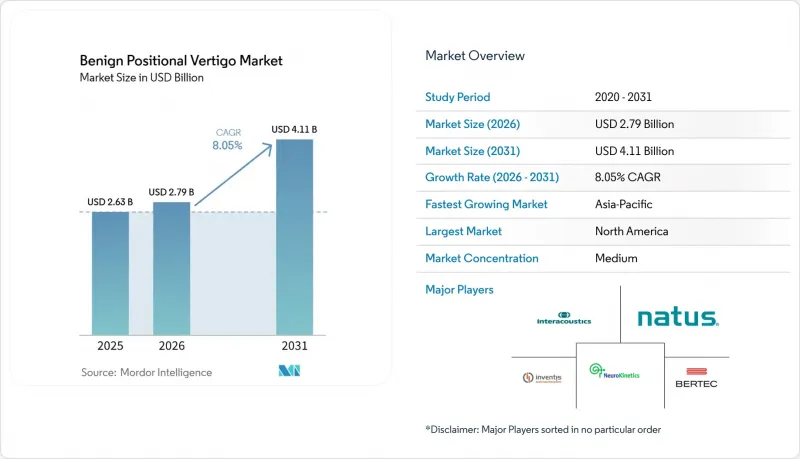
This report is Segmented by Offering (Treatment Type [CRM, VRT, Pharmacological, Others], Diagnosis Method [Clinical Examination, Imaging, Vestibular Testing]), Age Group (Adults, Elderly), Application (Posterior, Horizontal, Anterior Canal BPPV, Others), End User (Hospitals, Clinics, Rehab Centers, Others), and Geography (North America, Europe, Asia-Pacific, and More). Forecasts are in Value (USD).
Global Benign Positional Vertigo Market Trends and Insights
Rising BPPV Recurrence Driving Repeat Care Pathways
The benign positional vertigo market is shaped by a relapse pattern that keeps patients in active care long after the first episode has been treated. A 2025 multicenter study reported a 39.17% 1-year recurrence rate after successful canalith repositioning, and it linked hypertension, hyperlipidemia, and vitamin D deficiency to a higher probability of return visits. A randomized clinical study published in 2025 found that cholecalciferol supplementation reduced recurrence by 50% over 24 months compared with placebo, which shows that recurrence management is becoming a practical part of follow-up care rather than a side issue.
Another 2025 study found that hypertension staging was associated with both earlier recurrence and a higher number of repositioning maneuvers needed for symptom resolution, which points to a longer and more resource-intensive care cycle in patients with vascular risk. That pattern gives the benign positional vertigo market a repeat-utilization base that is less dependent on first-time incidence alone.
Aging Population Increasing Peripheral Vestibular Dysfunction
The benign positional vertigo market is also being lifted by population aging, especially in countries where the elderly cohort is expanding quickly. Japan reported that 29.1% of its population was aged 65 or older, and that demographic structure supports sustained demand for vestibular diagnosis, repositioning, and rehabilitation services. A 2025 study on older patients found that diagnostic delay rose with age, and that delays beyond 14 days were more common in elderly patients because symptoms were less distinct and care pathways were slower. A 2025 analysis in Frontiers in Aging also showed that age-related hearing loss and balance disorders often share the same deterioration pathway, which means dizziness in older adults often arrives with a broader sensory burden and a longer care episode.
Underdiagnosis and Misclassification of Dizziness Episodes
The benign positional vertigo market is still constrained by weak diagnosis at the first point of care, where dizziness remains a broad and often poorly differentiated complaint. A 2026 retrospective study from Mongolia found that only 3.7% of patients received a correct diagnosis before specialist referral, and 54.3% underwent MRI first, which extended diagnosis by a mean of 16.8 days. A population-based 2025 primary care study reported that non-specific dizziness diagnoses were 8.5 times more frequent than specific ones, while BPPV accounted for only 9.3% of dizziness encounters in that setting.
A U.S. chart review available through Duke University found that 54.4% of BPPV patients in primary care did not receive a diagnostic examination, and only 11.1% received the Epley maneuver, which shows how often definitive care is missed even when patients are seen.That pattern limits the benign positional vertigo market in the near term because patients may cycle through imaging or symptom relief without entering the formal vestibular care pathway
Other drivers and restraints analyzed in the detailed report include:
- Wider Use of Bedside and Portable Vestibular Diagnostics
- Shift Toward Non-Invasive Repositioning and Rehabilitation
- Reimbursement Gaps for Vestibular Rehabilitation and Digital Tools
For complete list of drivers and restraints, kindly check the Table Of Contents.
Segment Analysis
Treatment type represented 62.32% of the by-offering share in 2025, making it the largest commercial component of the benign positional vertigo market. Canalith repositioning maneuvers held the largest treatment sub-segment share at 36.32% in 2025, reflecting their established role in treating posterior canal BPPV. A 2025 randomized trial found that structured rehabilitation combined with canalith repositioning produced greater improvements in vestibular composite scores and Dizziness Handicap Inventory functional outcomes than repositioning alone.
The diagnosis method is projected to grow at 10.56% CAGR from 2026 to 2031, reflecting a need for more accurate canal-specific diagnosis in primary and emergency care settings. Clinical examination retained the largest diagnostic share at 40.34% in 2025 because the Dix-Hallpike and supine roll tests can be performed at the bedside without capital equipment. A 2025 JMIR feasibility study reported 82% sensitivity for augmented reality-based nystagmus examination against conventional video-oculography, indicating that wearable tools could shorten the referral path for selected patients.
Adults held 45.65% share in 2025, which reflects the concentration of first-presentation episodes in the middle-aged population across the benign positional vertigo market. This group benefits from relatively strong responsiveness to repositioning and usually carries a lower comorbidity burden than elderly patients, which supports shorter average care episodes. A 2025 review found that repositioning success can approach 90% when reassessment and repeat Epley are built into the short-term protocol.
The elderly segment is projected to grow at 10.56% CAGR through 2031, and that makes it the most important age-based expansion pool in the benign positional vertigo market. A 2025 study showed that time to diagnosis increased with age and that delays beyond 14 days were more common in older patients, which points to longer and more resource-intensive care episodes.
Complete Report Scope:
- By Offering
- Treatment Type
- Canalith Repositioning Maneuvers
- Vestibular Rehabilitation Therapy
- Pharmacological Treatment
- Others (Surgical Treatment, Home-Based Exercises)
- Diagnosis Method
- Clinical Examination
- Imaging Techniques
- Vestibular Testing
- Treatment Type
- By Age Group
- Adults
- Elderly
- By Application
- Posterior Canal BPPV
- Horizontal Canal BPPV
- Anterior Canal BPPV
- Others (Multicanal BPPV, Recurrent BPPV)
- By End User
- Hospitals
- Clinics
- Rehabilitation Centers
- Others (Home Healthcare, Specialty Ent Centers)
- By Geography
- North America
- United States
- Canada
- Mexico
- Europe
- Germany
- United Kingdom
- France
- Italy
- Spain
- Rest of Europe
- Asia-Pacific
- China
- India
- Japan
- Australia
- South Korea
- Rest of Asia-Pacific
- Middle East and Africa
- GCC
- South Africa
- Rest of Middle East and Africa
- South America
- Brazil
- Argentina
- Rest of South America
- North America
Geography Analysis
North America held 37.86% of the benign positional vertigo market share in 2025, which kept it as the largest regional cluster. The United States supports this approach through broad access to vestibular diagnostics in ENT and audiology practices, along with a dense outpatient network that can perform positional testing, maneuver-based treatment, and follow-up care in one pathway. Community adoption of clinic-ready systems also gives the benign positional vertigo market a stronger same-visit diagnostic base in North America than in many other regions.
Asia-Pacific is set to record the fastest regional benign positional vertigo market size expansion at 11.62% CAGR through 2031, which makes it the main growth engine for the benign positional vertigo market. Japan remains the most mature regional base because 29.1% of its population is aged 65 or older, and that age profile supports steady demand for vestibular care. The Middle East and Africa, and South America still account for the smallest combined portion of the benign positional vertigo market. Demand in these regions is concentrated in large urban centers, where private hospitals and specialist ENT clinics are more likely to offer formal vestibular diagnostics and rehabilitation services.
- Abbott Laboratories
- Bausch Health
- Bertec Corporation
- DIFRA Instrumentation
- Dr. Reddy's Laboratories
- Endomed Pty Ltd.
- Framiral S.r.l.
- Interacoustics
- INVENTIS S.r.l.
- Micromedical Technologies
- Natus Medical Incorporated (Otometrics)
- Neuro Kinetics, Inc.
- Sanofi
- Sun Pharmaceuticals Industries
- Teva Pharmaceutical Industries
- Vestibular Technologies LLC
- Viatris
Additional Benefits:
- The market estimate (ME) sheet in Excel format
- 3 months of analyst support
TABLE OF CONTENTS
1 Introduction
- 1.1 Study Assumptions & Market Definition
- 1.2 Scope of the Study
2 Research Methodology
3 Executive Summary
4 Market Landscape
- 4.1 Market Overview
- 4.2 Market Drivers
- 4.2.1 Rising BPPV Recurrence Driving Repeat Care Pathways
- 4.2.2 Aging Population Increasing Peripheral Vestibular Dysfunction
- 4.2.3 Wider Use of Bedside and Portable Vestibular Diagnostics
- 4.2.4 Shift Toward Non-Invasive Repositioning and Rehabilitation
- 4.2.5 Expansion of ENT and Neurology Outpatient Capacity
- 4.2.6 Tele-Vestibular Care and Remote Follow-Up Adoption
- 4.3 Market Restraints
- 4.3.1 Underdiagnosis and Misclassification of Dizziness Episodes
- 4.3.2 Limited Specialist Availability Outside Major Urban Centers
- 4.3.3 Low Persistence With Symptom-Relief Medicines
- 4.3.4 Reimbursement Gaps for Vestibular Rehabilitation and Digital Tools
- 4.4 Value Chain Analysis
- 4.5 Regulatory Landscape
- 4.6 Technological Outlook
- 4.7 Porter's Five Forces Analysis
- 4.7.1 Threat of New Entrants
- 4.7.2 Bargaining Power of Suppliers
- 4.7.3 Bargaining Power of Buyers
- 4.7.4 Threat of Substitutes
- 4.7.5 Industry Rivalry
5 Market Size & Growth Forecasts (Value, USD)
- 5.1 By Offering
- 5.1.1 Treatment Type
- 5.1.1.1 Canalith Repositioning Maneuvers
- 5.1.1.2 Vestibular Rehabilitation Therapy
- 5.1.1.3 Pharmacological Treatment
- 5.1.1.4 Others (Surgical Treatment, Home-Based Exercises)
- 5.1.2 Diagnosis Method
- 5.1.2.1 Clinical Examination
- 5.1.2.2 Imaging Techniques
- 5.1.2.3 Vestibular Testing
- 5.1.1 Treatment Type
- 5.2 By Age Group
- 5.2.1 Adults
- 5.2.2 Elderly
- 5.3 By Application
- 5.3.1 Posterior Canal BPPV
- 5.3.2 Horizontal Canal BPPV
- 5.3.3 Anterior Canal BPPV
- 5.3.4 Others (Multicanal BPPV, Recurrent BPPV)
- 5.4 By End User
- 5.4.1 Hospitals
- 5.4.2 Clinics
- 5.4.3 Rehabilitation Centers
- 5.4.4 Others (Home Healthcare, Specialty Ent Centers)
- 5.5 By Geography
- 5.5.1 North America
- 5.5.1.1 United States
- 5.5.1.2 Canada
- 5.5.1.3 Mexico
- 5.5.2 Europe
- 5.5.2.1 Germany
- 5.5.2.2 United Kingdom
- 5.5.2.3 France
- 5.5.2.4 Italy
- 5.5.2.5 Spain
- 5.5.2.6 Rest of Europe
- 5.5.3 Asia-Pacific
- 5.5.3.1 China
- 5.5.3.2 India
- 5.5.3.3 Japan
- 5.5.3.4 Australia
- 5.5.3.5 South Korea
- 5.5.3.6 Rest of Asia-Pacific
- 5.5.4 Middle East and Africa
- 5.5.4.1 GCC
- 5.5.4.2 South Africa
- 5.5.4.3 Rest of Middle East and Africa
- 5.5.5 South America
- 5.5.5.1 Brazil
- 5.5.5.2 Argentina
- 5.5.5.3 Rest of South America
- 5.5.1 North America
6 Competitive Landscape
- 6.1 Market Concentration
- 6.2 Market Share Analysis
- 6.3 Company Profiles {(includes Global level Overview, Market level overview, Core Segments, Financials as available, Strategic Information, Market Rank/Share for key companies, Products & Services, and Recent Developments)}
- 6.3.1 Abbott Laboratories
- 6.3.2 Bausch Health Companies Inc.
- 6.3.3 Bertec Corporation
- 6.3.4 DIFRA Instrumentation
- 6.3.5 Dr. Reddy's Laboratories Ltd.
- 6.3.6 Endomed Pty Ltd.
- 6.3.7 Framiral S.r.l.
- 6.3.8 Interacoustics A/S
- 6.3.9 INVENTIS S.r.l.
- 6.3.10 Micromedical Technologies
- 6.3.11 Natus Medical Incorporated (Otometrics)
- 6.3.12 Neuro Kinetics, Inc.
- 6.3.13 Sanofi S.A.
- 6.3.14 Sun Pharmaceutical Industries Ltd.
- 6.3.15 Teva Pharmaceutical Industries Ltd.
- 6.3.16 Vestibular Technologies LLC
- 6.3.17 Viatris Inc.
7 Market Opportunities & Future Outlook
- 7.1 White-space & unmet-need assessment

