PUBLISHER: Mordor Intelligence | PRODUCT CODE: 2118969

PUBLISHER: Mordor Intelligence | PRODUCT CODE: 2118969
Eczema Therapeutics - Market Share Analysis, Industry Trends & Statistics, Growth Forecasts (2026 - 2031)
According to Mordor Intelligence, the eczema therapeutics market size is projected to be USD 23.56 billion in 2025, USD 25.16 billion in 2026, and reach USD 37.58 billion by 2031, growing at a CAGR of 8.36% from 2026 to 2031.
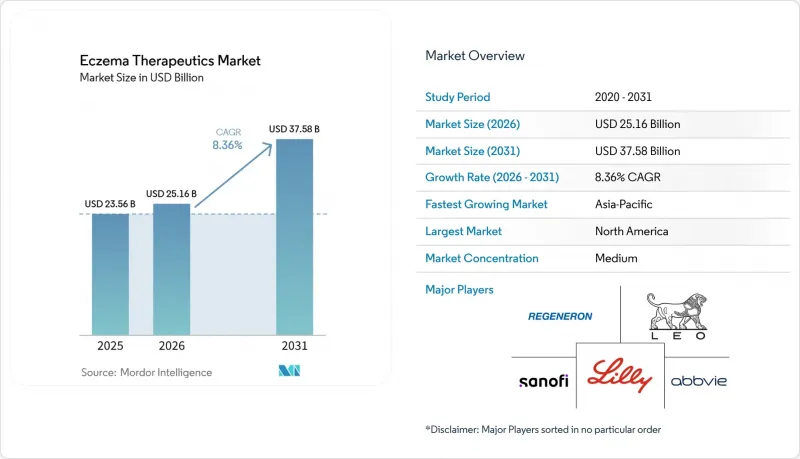
This report is Segmented by Type of Eczema (Atopic Dermatitis, Contact Dermatitis, Seborrheic Dermatitis, and More), Drug Class (Corticosteroids, Calcineurin Inhibitors, and More), Route of Administration (Topical, Oral, Parenteral), Age Group (Pediatric, Adults, Geriatric), Distribution Channel (Hospital, Retail, Online Pharmacies), and Geography (North America and More). Forecasts are in Value (USD).
Global Eczema Therapeutics Market Trends and Insights
Rising Diagnosed and Drug-Treated Eczema Population
The diagnosed and drug-treated patient pool is expanding faster than prevalence data alone suggests. Better access to dermatologists, digital screening, and primary-care guidance is bringing more patients into prescription treatment. Many countries still lack systematic atopic dermatitis epidemiology, which means the addressable population in APAC and sub-Saharan Africa may be undercounted. A 2025 analysis of Global Burden of Disease data found that age-standardized atopic dermatitis prevalence and disability burden were highest in high-income Asia-Pacific settings. Urban growth and healthcare investment are therefore increasing demand in markets that can support higher-value care. This gives the eczema therapeutics market a broader base for prescription topicals and systemic medicines.
Expansion of Targeted Biologics and Small-Molecule Therapies
The approval pace for eczema treatments accelerated from 2024 through 2026. The FDA approved Eli Lilly's lebrikizumab in September 2024 for moderate-to-severe atopic dermatitis in patients aged 12 years and older. Galderma's nemolizumab followed in December 2024 as the first FDA-approved IL-31 receptor antagonist for atopic dermatitis. These products give prescribers more ways to match treatment to symptoms and disease patterns. Sanofi reported positive Phase 3 results for amlitelimab across the COAST 1, COAST 2, and SHORE studies and plans global submissions in the second half of 2026. The eczema therapeutics market is becoming less dependent on one treatment approach as products act on IL-13, IL-31, OX40L, and related inflammatory pathways.
High Annual Cost and Payer Utilization Controls
The annual U.S. list price of dupilumab exceeds USD 35,000. Prior authorization was the most frequently reported reason for insurance coverage delays for atopic dermatitis prescriptions in a 2024 peer-reviewed study. The same study found that biologic-related delays could extend beyond 3 weeks. Major U.S. payers commonly require patients to use topical corticosteroids or calcineurin inhibitors before covering biologics or JAK inhibitors. In Europe, reimbursement decisions also involve tendering, pricing negotiations, and cost-effectiveness requirements. These controls can delay new products in the eczema therapeutics market, even where clinical need is clear.
Other drivers and restraints analyzed in the detailed report include:
- Broader Pediatric and Adolescent Label Coverage
- Increasing Specialist and Specialty-Pharmacy Treatment Intensity
- Long-Term Safety, Persistence, and Delivery Barriers
For complete list of drivers and restraints, kindly check the Table Of Contents.
Segment Analysis
Atopic dermatitis held 82.32% of the eczema therapeutics market share in 2025 and is forecast to expand at a 10.28% CAGR through 2031. Its scale reflects high prevalence and a greater ability to use higher-cost targeted therapies than other eczema subtypes. Pediatric approvals, added biologics, and stronger diagnosis in APAC and Eastern Europe support its growth.
Contact dermatitis is usually treated with generic topical medicines and has drawn less branded innovation. Seborrheic dermatitis and dyshidrotic eczema continue to produce prescribing demand for topical corticosteroids and antifungal combinations. Chronic hand eczema, included within other eczema types, received a dedicated U.S. option with the launch of delgocitinib cream in September 2025.
Corticosteroids accounted for 29.76% of the eczema therapeutics market size by drug class in 2025. They remain the standard topical option across mild and severe disease because they are familiar, broadly available, and used with other treatments. Their large revenue position is mainly a volume measure rather than proof of superior long-term outcomes. Nemolizumab is approved for use with topical corticosteroids and or calcineurin inhibitors, showing that established topical products remain part of systemic care. Calcineurin inhibitors are projected to grow at a 14.21% CAGR through 2031. Their growth reflects lower generic prices, wider access in APAC, and use as steroid-sparing options for eyelid and facial eczema.
Complete Report Scope:
- By Type of Eczema
- Atopic Dermatitis
- Contact Dermatitis
- Seborrheic Dermatitis
- Dyshidrotic Eczema
- Others (Nummular Eczema, Chronic Hand Eczema)
- By Drug Class
- Corticosteroids
- Calcineurin Inhibitors
- PDE4 Inhibitors
- JAK Inhibitors
- IL-4 and IL-13 Inhibitors
- IL-31 Inhibitors
- Antibiotics and Antiseptics
- Systemic Immunosuppressants
- Others (Antihistamines and Other Eczema Therapies)
- By Route of Administration
- Topical
- Oral
- Parenteral
- By Age Group
- Pediatric
- Adults
- Geriatric
- By Distribution Channel
- Hospital Pharmacies
- Retail Pharmacies and Drug Stores
- Online Pharmacies
- Other Distribution Channels
- By Geography
- North America
- United States
- Canada
- Mexico
- Europe
- Germany
- United Kingdom
- France
- Italy
- Spain
- Rest of Europe
- Asia-Pacific
- China
- India
- Japan
- Australia
- South Korea
- Rest of Asia-Pacific
- Middle East and Africa
- GCC
- South Africa
- Rest of Middle East and Africa
- South America
- Brazil
- Argentina
- Rest of South America
- North America
Geography Analysis
North America accounted for 41.23% of the eczema therapeutics market size in 2025. The region benefits from high spending on specialty dermatology products, private-payer coverage, and established specialty-pharmacy services. Canada and Mexico add demand, although public reimbursement in Canada can limit biologic use relative to the United States. North America, therefore, remains the leading commercial base for the eczema therapeutics market.
Europe is the second-largest regional contributor, supported by reimbursement systems in Germany, France, and the United Kingdom. NICE, Haute Autorite de Sante, and Gemeinsamer Bundesausschuss provide structured review paths for newer dermatology medicines. Asia-Pacific is expected to expand at a 12.36% CAGR through 2031. Japan has meaningful biologic revenue because its health insurance system reimburses dupilumab and JAK inhibitors after regulatory approval. China has a large opportunity because biologic use is still at an early stage, and access is widening through approvals and insurance coverage.
- Abbvie
- Almirall
- Amgen
- Arcutis Biotherapeutics, Inc.
- Astellas Pharma
- Bayer
- Bristol-Myers Squibb
- Dermavant Sciences Ltd.
- Eli Lilly and Company
- Galderma
- Incyte
- Kyowa Kirin
- Leo Pharma
- Novartis
- Organon
- Otsuka
- Pfizer
- Regeneron Pharmaceuticals
- Sanofi
- UCB
- Viatris
Additional Benefits:
- The market estimate (ME) sheet in Excel format
- 3 months of analyst support
TABLE OF CONTENTS
1 Introduction
- 1.1 Study Assumptions & Market Definition
- 1.2 Scope of the Study
2 Research Methodology
3 Executive Summary
4 Market Landscape
- 4.1 Market Overview
- 4.2 Market Drivers
- 4.2.1 Rising Diagnosed and Drug-Treated Eczema Population
- 4.2.2 Expansion of Targeted Biologics and Small-Molecule Therapies
- 4.2.3 Broader Pediatric and Adolescent Label Coverage
- 4.2.4 Increasing Specialist and Specialty-Pharmacy Treatment Intensity
- 4.2.5 Biomarker-Led Sequencing of Immune Pathways
- 4.2.6 Home-Administration and Tele-Dermatology Refill Models
- 4.3 Market Restraints
- 4.3.1 High Annual Cost and Payer Utilization Controls
- 4.3.2 Long-Term Safety Warnings for Systemic Immunomodulators
- 4.3.3 Treatment Persistence Erosion from Itch Relief and Skin-Clearance Mismatch
- 4.3.4 Cold-Chain and Injection-Training Friction in Emerging Markets
- 4.4 Supply-Chain Analysis
- 4.5 Regulatory Landscape
- 4.6 Porter's Five Forces
- 4.6.1 Threat of New Entrants
- 4.6.2 Bargaining Power of Suppliers
- 4.6.3 Bargaining Power of Buyers
- 4.6.4 Threat of Substitutes
- 4.6.5 Industry Rivalry
5 Market Size & Growth Forecasts (Value, USD)
- 5.1 By Type of Eczema
- 5.1.1 Atopic Dermatitis
- 5.1.2 Contact Dermatitis
- 5.1.3 Seborrheic Dermatitis
- 5.1.4 Dyshidrotic Eczema
- 5.1.5 Others (Nummular Eczema, Chronic Hand Eczema)
- 5.2 By Drug Class
- 5.2.1 Corticosteroids
- 5.2.2 Calcineurin Inhibitors
- 5.2.3 PDE4 Inhibitors
- 5.2.4 JAK Inhibitors
- 5.2.5 IL-4 and IL-13 Inhibitors
- 5.2.6 IL-31 Inhibitors
- 5.2.7 Antibiotics and Antiseptics
- 5.2.8 Systemic Immunosuppressants
- 5.2.9 Others (Antihistamines and Other Eczema Therapies)
- 5.3 By Route of Administration
- 5.3.1 Topical
- 5.3.2 Oral
- 5.3.3 Parenteral
- 5.4 By Age Group
- 5.4.1 Pediatric
- 5.4.2 Adults
- 5.4.3 Geriatric
- 5.5 By Distribution Channel
- 5.5.1 Hospital Pharmacies
- 5.5.2 Retail Pharmacies and Drug Stores
- 5.5.3 Online Pharmacies
- 5.5.4 Other Distribution Channels
- 5.6 By Geography
- 5.6.1 North America
- 5.6.1.1 United States
- 5.6.1.2 Canada
- 5.6.1.3 Mexico
- 5.6.2 Europe
- 5.6.2.1 Germany
- 5.6.2.2 United Kingdom
- 5.6.2.3 France
- 5.6.2.4 Italy
- 5.6.2.5 Spain
- 5.6.2.6 Rest of Europe
- 5.6.3 Asia-Pacific
- 5.6.3.1 China
- 5.6.3.2 India
- 5.6.3.3 Japan
- 5.6.3.4 Australia
- 5.6.3.5 South Korea
- 5.6.3.6 Rest of Asia-Pacific
- 5.6.4 Middle East and Africa
- 5.6.4.1 GCC
- 5.6.4.2 South Africa
- 5.6.4.3 Rest of Middle East and Africa
- 5.6.5 South America
- 5.6.5.1 Brazil
- 5.6.5.2 Argentina
- 5.6.5.3 Rest of South America
- 5.6.1 North America
6 Competitive Landscape
- 6.1 Market Concentration
- 6.2 Market Share Analysis
- 6.3 Company Profiles {(includes Global level Overview, Market level overview, Core Segments, Financials as available, Strategic Information, Market Rank/Share for key companies, Products & Services, and Recent Developments)}
- 6.3.1 AbbVie Inc.
- 6.3.2 Almirall, S.A.
- 6.3.3 Amgen Inc.
- 6.3.4 Arcutis Biotherapeutics, Inc.
- 6.3.5 Astellas Pharma Inc.
- 6.3.6 Bayer AG
- 6.3.7 Bristol Myers Squibb Company
- 6.3.8 Dermavant Sciences Ltd.
- 6.3.9 Eli Lilly and Company
- 6.3.10 Galderma S.A.
- 6.3.11 Incyte Corporation
- 6.3.12 Kyowa Kirin Co., Ltd.
- 6.3.13 LEO Pharma A/S
- 6.3.14 Novartis AG
- 6.3.15 Organon & Co.
- 6.3.16 Otsuka Pharmaceutical Co., Ltd.
- 6.3.17 Pfizer Inc.
- 6.3.18 Regeneron Pharmaceuticals, Inc.
- 6.3.19 Sanofi
- 6.3.20 UCB S.A.
- 6.3.21 Viatris Inc.
7 Market Opportunities & Future Outlook
- 7.1 White-space & unmet-need assessment

