PUBLISHER: Mordor Intelligence | PRODUCT CODE: 2118986

PUBLISHER: Mordor Intelligence | PRODUCT CODE: 2118986
Functional Apparel - Market Share Analysis, Industry Trends & Statistics, Growth Forecasts (2026 - 2031)
According to Mordor Intelligence, the functional apparel market size was valued at USD 436.61 billion in 2025 to USD 460.56 billion in 2026, and is forecast to reach USD 634.62 billion by 2031 at a 6.62% CAGR over 2026-2031.
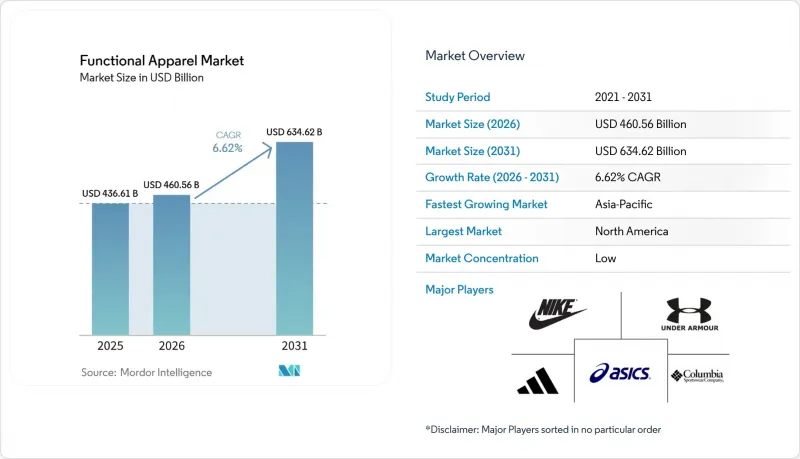
This report is Segmented by Product Type (Sportswear, Activewear, Protective Workwear, and Others), End User (Men, Women, and Kids), Distribution Channel (Online Retail Stores and Offline Retail Stores), and Geography (North America, Europe, Asia-Pacific, South America, and the Middle East and Africa). The Market Forecasts are Provided in Terms of Value (USD).
Global Functional Apparel Market Trends and Insights
Growing consumer focus on performance-oriented clothing
Rising health awareness and increasing participation in fitness and recreational activities are strengthening demand for functional apparel that delivers comfort, moisture management, stretchability, and breathability. According to Eventrac, a sports event management platform, global mass-participation sports events are projected to register 7.8% like-for-like growth in 2025, broadening the consumer base beyond professional athletes. In response, brands are introducing advanced performance collections, including adidas' CLIMACOOL apparel for enhanced cooling and sweat management, ASICS' ACTIBREEZE range for improved ventilation during training, and Decathlon's Kalenji running apparel designed with lightweight, quick-drying fabrics. The continued adoption of athleisure and hybrid work lifestyles is also driving everyday use of performance apparel, encouraging manufacturers to expand multifunctional product portfolios that combine athletic performance with daily comfort.
Advancements in high-performance textile technologies
Continuous advancements in high-performance textile technologies are enabling manufacturers to develop functional apparel with improved moisture management, thermoregulation, antimicrobial protection, UV resistance, lightweight construction, and durability. Innovations in smart textiles, specialty fibers, nanotechnology, and performance finishes are expanding the use of functional apparel across sports, healthcare, industrial safety, and defense applications. Government-backed investments in technical textile Research and Development are further accelerating innovation. For instance, India's Ministry of Textiles reported in December 2025 that the National Technical Textiles Mission (NTTM) had approved 168 projects, including 79 research projects worth INR 247 crore focused on specialty fibers, smart textiles, and advanced technical textile applications . These innovations are improving product performance, encouraging premium product development, and supporting sustained growth in the global functional apparel market.
Counterfeit products eroding brand trust and revenue
The proliferation of counterfeit functional apparel undermines brand credibility, reduces revenue for legitimate manufacturers, and creates unfair market competition. Counterfeit products often imitate the appearance of premium functional apparel but fail to deliver essential performance features, such as moisture management, UV protection, flame resistance, compression, and antimicrobial properties. This gap can compromise consumer safety and satisfaction. For instance, in July 2026, a truck carrying counterfeit Croatia jerseys intended for the Federation Internationale de Football Association (FIFA) World Cup arrived at the Bulgarian border but did not cross it. European authorities seized 41,280 counterfeit Nike-branded shirts valued at EUR 1.65 million. Authentication and traceability systems can help protect consumer trust, although their recurring costs are difficult for smaller regional brands to absorb. This widespread counterfeiting continues to erode consumer trust and restrain the growth of the global functional apparel market.
Other drivers and restraints analyzed in the detailed report include:
- Growing adoption of athleisure apparel across everyday lifestyles
- Strengthening textile promotion policies supporting industry expansion
- Complex raw material sourcing and supply chain disruptions
For complete list of drivers and restraints, kindly check the Table Of Contents.
Segment Analysis
Sportswear accounted for 38.89% of global functional apparel market revenue in 2025, positioning it as the largest product category. This leadership is driven by increasing participation in sports and fitness activities, broader athleisure adoption, and stronger consumer demand for high-performance apparel that supports both active and everyday use. Ongoing advancements in moisture-wicking, temperature-regulating, and stretch fabrics continue to support demand among professional athletes and recreational users. The others category, which includes medical apparel and niche technical products, is expected to remain the smallest revenue contributor.
Protective workwear is projected to register a CAGR of 7.72% through 2031, making it the fastest-growing product type. Regulatory developments continue to support market demand, with the Occupational Safety and Health Administration (OSHA) updating personal protective equipment requirements under 29 CFR 1910 and the European Union Personal Protective Equipment (PPE) Regulation (EU 2016/425) mandating certification for high-risk workplaces. Manufacturers are expanding their portfolios with advanced protective garments that combine flame resistance, chemical protection, durability, and wearer comfort. For example, DuPont's Nomex and Kevlar fiber-based protective apparel continues to gain adoption across the oil and gas, utilities, and industrial sectors. Growing industrialization, stricter workplace safety regulations, and rising adoption of advanced technical textiles are expected to sustain strong demand for protective workwear throughout the forecast period.
Complete Report Scope:
- By Product Type
- Sportswear
- Activewear
- Protective Workwear
- Others
- By End User
- Men
- Women
- Kids
- By Distribution Channel
- Online Retail Stores
- Offline Retail Stores
- By Geography
- North America
- United States
- Canada
- Mexico
- Rest of North America
- Europe
- Germany
- United Kingdom
- Italy
- France
- Spain
- Netherlands
- Poland
- Belgium
- Sweden
- Rest of Europe
- Asia-Pacific
- China
- India
- Japan
- Australia
- Indonesia
- South Korea
- Thailand
- Singapore
- Rest of Asia-Pacific
- South America
- Brazil
- Argentina
- Colombia
- Chile
- Peru
- Rest of South America
- Middle East and Africa
- South Africa
- Saudi Arabia
- United Arab Emirates
- Nigeria
- Egypt
- Morocco
- Turkey
- Rest of Middle East and Africa
- North America
Geography Analysis
North America is projected to account for 36.58% of revenue in 2025 and remain the largest regional contributor to the functional apparel market. High consumer spending on fitness, mature sponsorship networks, and wide availability of mass and premium products support the region's leadership. The region also benefits from a well-established athlete-endorsement ecosystem and a college-sports outfitting model that connects institutional demand with consumer brand visibility. Strong adoption of athleisure and outdoor recreation continues to broaden demand for performance apparel beyond core sports applications. Leading brands such as Nike, Under Armour, and lululemon continue to invest in product innovation and direct-to-consumer channels to strengthen market penetration.
Asia-Pacific is forecast to grow at a CAGR of 8.43% through 2031, making it the fastest-growing region in the functional apparel market. China remains the region's largest national market, with Li-Ning and Anta competing on fabric technology and pricing. India is expanding its fitness infrastructure and supporting domestic manufacturing through incentives for man-made fibers and technical textiles. In January 2026, Anta is expected to announce the acquisition of a 29.1% stake in PUMA for EUR 1.5 billion. Rapid urbanization, rising disposable incomes, and increasing participation in fitness activities are accelerating demand for functional apparel across emerging Asian markets. The expansion of domestic brands and local manufacturing capabilities is further improving the region's competitive position in the global market.
Europe benefits from demand for technical quality and sustainability credentials across Germany, the United Kingdom, France, Italy, and Spain. Adidas and PUMA provide established distribution infrastructure and invest in material development from their European bases. The Ecodesign for Sustainable Products Regulation is raising expectations for textile durability and repairability in institutional workwear procurement. In South America, Brazil leads the market, supported by e-commerce growth, a young population, and strong football and running cultures, despite currency and tariff pressures. The Middle East and Africa remain at an earlier stage of development, with Saudi Arabia and the United Arab Emirates offering the most concentrated opportunities through premium demand and regional distribution activity.
- Nike, Inc
- Under Armour
- Adidas
- Reebook
- Puma
- Asics Corporation
- Russell Brands LLC
- Hugo Boss
- Lakeland Industries
- Decathlon
- Ralph Lauren
- Amer Sports
- PVH Corp.
- Misto Luxembourg, SARL
- Jockey International
- Umbro
- Columbia Sportswear Company
- North Face
- New Balance
- Athleta LLC
Additional Benefits:
- The market estimate (ME) sheet in Excel format
- 3 months of analyst support
TABLE OF CONTENTS
1 INTRODUCTION
- 1.1 Study Assumptions and Market Definition
- 1.2 Scope of the Study
2 RESEARCH METHODOLOGY
3 EXECUTIVE SUMMARY
4 MARKET LANDSCAPE
- 4.1 Market Overview
- 4.2 Market Drivers
- 4.2.1 Growing consumer focus on performance oriented clothing
- 4.2.2 Advancements in high-performance textile technologies
- 4.2.3 Growing adoption of athleisure apparel across everyday lifestyles
- 4.2.4 Expansion of sports sponsorship influencing consumer adoption
- 4.2.5 Customization and mass personalization enhancing consumer appeal
- 4.2.6 Strengthening textile promotion policies supporting industry expansion
- 4.3 Market Restraints
- 4.3.1 Stringent multi regional regulatory compliance requirements
- 4.3.2 Complex raw material sourcing and supply chain disruptions
- 4.3.3 Counterfeit products eroding brand trust and revenue
- 4.3.4 Volatile prices of high performance synthetic fibres
- 4.4 Consumer Behaviour Analysis
- 4.5 Regulatory Outlook
- 4.6 Porter's Five Forces
- 4.6.1 Threat of New Entrants
- 4.6.2 Bargaining Power of Buyers/Consumers
- 4.6.3 Bargaining Power of Suppliers
- 4.6.4 Threat of Substitute Products
- 4.6.5 Intensity of Competitive Rivalry
5 MARKET SIZE AND GROWTH FORECASTS (VALUE)
- 5.1 By Product Type
- 5.1.1 Sportswear
- 5.1.2 Activewear
- 5.1.3 Protective Workwear
- 5.1.4 Others
- 5.2 By End User
- 5.2.1 Men
- 5.2.2 Women
- 5.2.3 Kids
- 5.3 By Distribution Channel
- 5.3.1 Online Retail Stores
- 5.3.2 Offline Retail Stores
- 5.4 By Geography
- 5.4.1 North America
- 5.4.1.1 United States
- 5.4.1.2 Canada
- 5.4.1.3 Mexico
- 5.4.1.4 Rest of North America
- 5.4.2 Europe
- 5.4.2.1 Germany
- 5.4.2.2 United Kingdom
- 5.4.2.3 Italy
- 5.4.2.4 France
- 5.4.2.5 Spain
- 5.4.2.6 Netherlands
- 5.4.2.7 Poland
- 5.4.2.8 Belgium
- 5.4.2.9 Sweden
- 5.4.2.10 Rest of Europe
- 5.4.3 Asia-Pacific
- 5.4.3.1 China
- 5.4.3.2 India
- 5.4.3.3 Japan
- 5.4.3.4 Australia
- 5.4.3.5 Indonesia
- 5.4.3.6 South Korea
- 5.4.3.7 Thailand
- 5.4.3.8 Singapore
- 5.4.3.9 Rest of Asia-Pacific
- 5.4.4 South America
- 5.4.4.1 Brazil
- 5.4.4.2 Argentina
- 5.4.4.3 Colombia
- 5.4.4.4 Chile
- 5.4.4.5 Peru
- 5.4.4.6 Rest of South America
- 5.4.5 Middle East and Africa
- 5.4.5.1 South Africa
- 5.4.5.2 Saudi Arabia
- 5.4.5.3 United Arab Emirates
- 5.4.5.4 Nigeria
- 5.4.5.5 Egypt
- 5.4.5.6 Morocco
- 5.4.5.7 Turkey
- 5.4.5.8 Rest of Middle East and Africa
- 5.4.1 North America
6 COMPETITIVE LANDSCAPE
- 6.1 Market Concentration
- 6.2 Strategic Moves
- 6.3 Market Share Analysis
- 6.4 Company Profiles (includes Global-level Overview, Market-level Overview, Core Segments, Financials (if available), Strategic Information, Market Rank/Share, Products and Services, Recent Developments)
- 6.4.1 Nike, Inc
- 6.4.2 Under Armour
- 6.4.3 Adidas
- 6.4.4 Reebook
- 6.4.5 Puma
- 6.4.6 Asics Corporation
- 6.4.7 Russell Brands LLC
- 6.4.8 Hugo Boss
- 6.4.9 Lakeland Industries
- 6.4.10 Decathlon
- 6.4.11 Ralph Lauren
- 6.4.12 Amer Sports
- 6.4.13 PVH Corp.
- 6.4.14 Misto Luxembourg, SARL
- 6.4.15 Jockey International
- 6.4.16 Umbro
- 6.4.17 Columbia Sportswear Company
- 6.4.18 North Face
- 6.4.19 New Balance
- 6.4.20 Athleta LLC
7 MARKET OPPORTUNITIES AND FUTURE OUTLOOK

