PUBLISHER: Mordor Intelligence | PRODUCT CODE: 2119041

PUBLISHER: Mordor Intelligence | PRODUCT CODE: 2119041
Thought Leadership Marketing Services - Market Share Analysis, Industry Trends & Statistics, Growth Forecasts (2026 - 2031)
According to Mordor Intelligence, the thought leadership marketing services market size is projected to expand from USD 1.71 billion in 2025 and USD 1.85 billion in 2026 to USD 2.68 billion by 2031, registering a CAGR of 7.69% between 2026 and 2031.
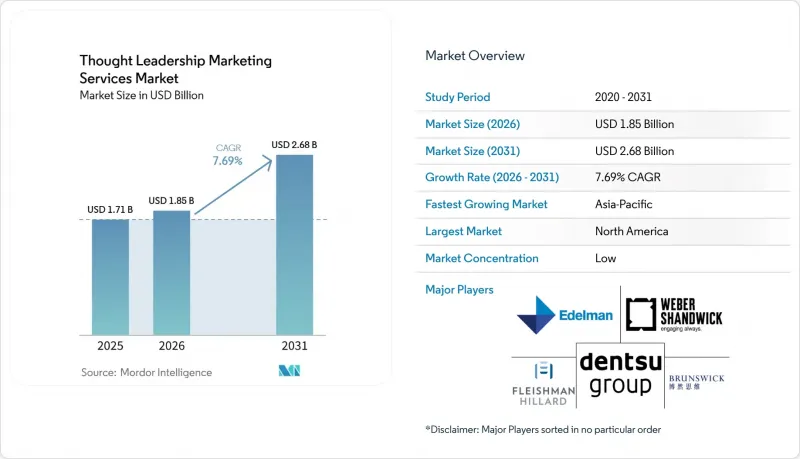
This report is Segmented by End User Industry (Retail and E-Commerce, Media and Entertainment, Healthcare and Life Sciences, Travel and Hospitality, Consumer Goods, and More [BFSI, Education, Automotive, and IT and Telecom and More]), and Geography (North America, Europe, Asia-Pacific, South America, Middle East, and Africa). The Market Forecasts are Provided in Terms of Value (USD).
Global Thought Leadership Marketing Services Market Trends and Insights
Rising Demand for Trust-Based B2B Differentiation
The Thought Leadership Marketing Services Market benefits from a stronger need for trust in complex B2B buying decisions. In 2025, 73% of decision-makers thought leadership was more trustworthy than marketing materials or product sheets when assessing organizational capabilities. Compelling content prompted 75% of decision-makers to research a provider they had not considered before. The same research found that 60% were willing to pay a premium to work with a provider that produced strong thought leadership. This matters as buying groups include people who may not directly engage with sales teams but can influence the final choice. Providers who turn expert knowledge into clear, evidence-based content can reach these hidden buyers without relying solely on direct outreach.
Expansion of LinkedIn-Led Executive Visibility Programs
LinkedIn has become a practical channel for executive visibility within the Thought Leadership Marketing Services Market. B2B marketing leaders increased LinkedIn advertising budgets by 31.7% between Q3 2024 and Q3 2025, compared with 6% growth in Google spending. LinkedIn reports that C-suite content attracts 5 times more views and engagement than content from other member categories. This shift expands demand for ghostwriting, message development, research design, and channel-specific distribution support. It also moves executive communication from an occasional public relations activity toward a sustained part of commercial positioning. The strongest programs use executive perspectives to explain difficult business issues rather than repeat product messages.
Difficulty Proving Revenue Attribution Across Long Buying Cycles
The Thought Leadership Marketing Services Market faces a persistent measurement challenge because enterprise B2B sales cycles often run for 6 to 18 months. Standard reporting windows may capture late-stage actions but miss the early content that establishes awareness and credibility. This makes it difficult to connect a white paper, research report, or executive article to closed revenue with confidence. Budget owners under quarterly review pressure may reduce long-term programs when they cannot see an auditable return on investment. Holdout testing and marketing mix modeling can improve the picture, but they require data skills and investment that many mid-sized clients do not have. The result can be smaller initial contracts and more difficult renewals, even when the program strengthens buyer consideration.
Other drivers and restraints analyzed in the detailed report include:
- Stronger ROI From Original Research and Data-Led Content
- Convergence of PR, Demand Generation, and Executive Branding Budgets
- Content Saturation and Declining Organic Reach
For complete list of drivers and restraints, kindly check the Table Of Contents.
Segment Analysis
Retail and e-commerce represented 28.12% of global revenue in the Thought Leadership Marketing Services Market in 2025. Competition in digital channels encourages retailers to build authority beyond price comparison and product promotion. Retailers and platforms use customer sentiment studies, category reports, and sustainability audits to give audiences a reason to return to their content. These programs help companies explain category change in language that is useful to customers, partners, and investors. They are also relevant when AI-mediated discovery can reduce the visibility of routine product pages, a central issue for the Thought Leadership Marketing Services Industry.
Healthcare and life sciences are forecast to grow at an 11.41% CAGR between 2026 and 2031, making the Thought Leadership Marketing Services Market for these end users one of the fastest-growing end-user opportunities. Scientific credibility, regulatory complexity, and long procurement processes make evidence quality central to communication in this segment. Pharmaceutical, biotech, and medtech organizations are moving away from generic digital messages toward content supported by subject matter expertise. FDA digital health communication frameworks and the European Medicines Agency's guidance on scientific dissemination reinforce the need for controlled, accurately attributed content. Media and entertainment firms use services to frame technology and creator-economy change, while travel, hospitality, consumer goods, financial services, education, automotive, IT, and telecom use them for reputation, investor narratives, and trade-media visibility across the Thought Leadership Marketing Services Industry.
Complete Report Scope:
- By End User Industry
- Retail and E-commerce
- Media and Entertainment
- Healthcare and Life Sciences
- Travel and Hospitality
- Consumer Goods
- Other End User Industries (BFSI, Education, Automotive, and IT and Telecom amongst Others)
- By Geography
- North America
- United States
- Canada
- Mexico
- South America
- Brazil
- Argentina
- Chile
- Rest of South America
- Europe
- Germany
- United Kingdom
- France
- Italy
- Spain
- Rest of Europe
- Asia-Pacific
- China
- Japan
- India
- South Korea
- Australia
- Rest of Asia-Pacific
- Middle East
- United Arab Emirates
- Saudi Arabia
- Qatar
- Rest of Middle East
- Africa
- South Africa
- Egypt
- Nigeria
- Rest of Africa
- North America
Geography Analysis
North America accounted for 46.48% of the Thought Leadership Marketing Services Market share in 2025. The region has a large base of B2B enterprise buyers, established communications agencies, and widespread use of LinkedIn for professional discussion. The United States remains central because global firms in financial services, technology, and healthcare are concentrated in major business centers. In 2026, 89% of North American marketing leaders said their budgets supported revenue and growth goals, while 69% expected budget increases. Canada and Mexico add demand through professional services and cross-border supply chains that need executive positioning in regulated industries.
Europe remains an important part of the Thought Leadership Marketing Services Market, supported by established corporate affairs and strategic communications practices in the United Kingdom and Germany. The November 2025 Omnicom acquisition of IPG led to agency portfolio changes that continue to reshape client relationships in 2026. Golin and Ketchum combined under a unified agency model in June 2026, while FleishmanHillard integrated Porter Novelli during the same period. Germany's professional services companies, together with French luxury and financial services firms, broaden demand beyond large multinationals. Asia-Pacific, led by India, Australia, China, and South Korea, is also expanding as B2B technology activity and cross-border business development increase.
The Middle East is forecast to grow at an 11.51% CAGR from 2026 to 2031 in the Thought Leadership Marketing Services Market. Saudi Vision 2030 and the UAE's digital economy agenda support communications programs that position institutions and companies as knowledge-led organizations. In 2026, 68% of communications agencies in the region expected revenue growth, up from 56% in 2025. Arabic-first content remains a clear local service opportunity because global content programs often require adaptation for regional audiences. South America and Africa remain smaller in terms of revenue, but Brazil's professional services sector and South Africa's corporate communications base support specialized work in sustainability narratives and executive visibility for international investors.
- Edelman Holdings Inc.
- Brunswick Group LLP
- Weber Shandwick Inc.
- FleishmanHillard Inc.
- Golin Inc
- APCO Worldwide, LLC
- Finn Partners, LLC
- Bully Pulpit International, LLC
- Dentsu Inc.
- FT Longitude Limited
- Burson LLC
- Ruder Finn, Inc.
- Walker Sands Communications, LLC
- Ogilvy Public Relations Worldwide LLC
- PAN Communications, Inc.
- Manifest, Inc.
- Teneo Holdings, LLC
- 2X Marketing, LLC
- Thinkers360, LLC
- Stagwell Inc.
Additional Benefits:
- The market estimate (ME) sheet in Excel format
- 3 months of analyst support
TABLE OF CONTENTS
1 INTRODUCTION
- 1.1 Study Assumptions and Market Definition
- 1.2 Scope of the Study
2 RESEARCH METHODOLOGY
3 EXECUTIVE SUMMARY
4 MARKET LANDSCAPE
- 4.1 Market Overview
- 4.2 Market Drivers
- 4.2.1 Rising Demand for Trust-Based B2B Differentiation
- 4.2.2 Expansion of LinkedIn-Led Executive Visibility Programs
- 4.2.3 Stronger ROI From Original Research and Data-Led Content
- 4.2.4 Convergence of PR, Demand Generation, and Executive Branding Budgets
- 4.2.5 Rising Influence of Hidden Buyers in Complex B2B Purchases
- 4.2.6 Growing Importance of GenAI Discovery and Citation Visibility
- 4.3 Market Restraints
- 4.3.1 Difficulty Proving Revenue Attribution Across Long Buying Cycles
- 4.3.2 Content Saturation and Declining Organic Reach
- 4.3.3 Executive Time Scarcity and Low Content Throughput
- 4.3.4 Higher Legal, Compliance, and AI Governance Burdens
- 4.4 Impact of Macroeconomic Factors on the Market
- 4.5 Industry Value-Chain Analysis
- 4.6 Technology Outlook
- 4.7 Regulatory Landscape
- 4.8 Porter's Five Forces Analysis
- 4.8.1 Threat of New Entrants
- 4.8.2 Bargaining Power of Suppliers
- 4.8.3 Bargaining Power of Buyers
- 4.8.4 Threat of Substitutes
- 4.8.5 Intensity of Competitive Rivalry
5 MARKET SIZE AND GROWTH FORECASTS (VALUE)
- 5.1 By End User Industry
- 5.1.1 Retail and E-commerce
- 5.1.2 Media and Entertainment
- 5.1.3 Healthcare and Life Sciences
- 5.1.4 Travel and Hospitality
- 5.1.5 Consumer Goods
- 5.1.6 Other End User Industries (BFSI, Education, Automotive, and IT and Telecom amongst Others)
- 5.2 By Geography
- 5.2.1 North America
- 5.2.1.1 United States
- 5.2.1.2 Canada
- 5.2.1.3 Mexico
- 5.2.2 South America
- 5.2.2.1 Brazil
- 5.2.2.2 Argentina
- 5.2.2.3 Chile
- 5.2.2.4 Rest of South America
- 5.2.3 Europe
- 5.2.3.1 Germany
- 5.2.3.2 United Kingdom
- 5.2.3.3 France
- 5.2.3.4 Italy
- 5.2.3.5 Spain
- 5.2.3.6 Rest of Europe
- 5.2.4 Asia-Pacific
- 5.2.4.1 China
- 5.2.4.2 Japan
- 5.2.4.3 India
- 5.2.4.4 South Korea
- 5.2.4.5 Australia
- 5.2.4.6 Rest of Asia-Pacific
- 5.2.5 Middle East
- 5.2.5.1 United Arab Emirates
- 5.2.5.2 Saudi Arabia
- 5.2.5.3 Qatar
- 5.2.5.4 Rest of Middle East
- 5.2.6 Africa
- 5.2.6.1 South Africa
- 5.2.6.2 Egypt
- 5.2.6.3 Nigeria
- 5.2.6.4 Rest of Africa
- 5.2.1 North America
6 COMPETITIVE LANDSCAPE
- 6.1 Market Concentration
- 6.2 Strategic Moves
- 6.3 Market Share Analysis
- 6.4 Company Profiles (includes Global Level Overview, Market Level Overview, Core Segments, Financials as available, Strategic Information, Market Rank/Share, Products and Services, Recent Developments)
- 6.4.1 Edelman Holdings Inc.
- 6.4.2 Brunswick Group LLP
- 6.4.3 Weber Shandwick Inc.
- 6.4.4 FleishmanHillard Inc.
- 6.4.5 Golin Inc
- 6.4.6 APCO Worldwide, LLC
- 6.4.7 Finn Partners, LLC
- 6.4.8 Bully Pulpit International, LLC
- 6.4.9 Dentsu Inc.
- 6.4.10 FT Longitude Limited
- 6.4.11 Burson LLC
- 6.4.12 Ruder Finn, Inc.
- 6.4.13 Walker Sands Communications, LLC
- 6.4.14 Ogilvy Public Relations Worldwide LLC
- 6.4.15 PAN Communications, Inc.
- 6.4.16 Manifest, Inc.
- 6.4.17 Teneo Holdings, LLC
- 6.4.18 2X Marketing, LLC
- 6.4.19 Thinkers360, LLC
- 6.4.20 Stagwell Inc.
7 MARKET OPPORTUNITIES AND FUTURE OUTLOOK
- 7.1 White-Space and Unmet-Need Assessment

