PUBLISHER: Mordor Intelligence | PRODUCT CODE: 2119054

PUBLISHER: Mordor Intelligence | PRODUCT CODE: 2119054
Low-Fat Yogurt - Market Share Analysis, Industry Trends & Statistics, Growth Forecasts (2026 - 2031)
According to Mordor Intelligence, the low-fat yogurt market size is expected to increase from USD 27.9 billion in 2025 to USD 29.7 billion in 2026 and reach USD 41.8 billion by 2031, growing at a CAGR of 7.0% over 2026-2031.
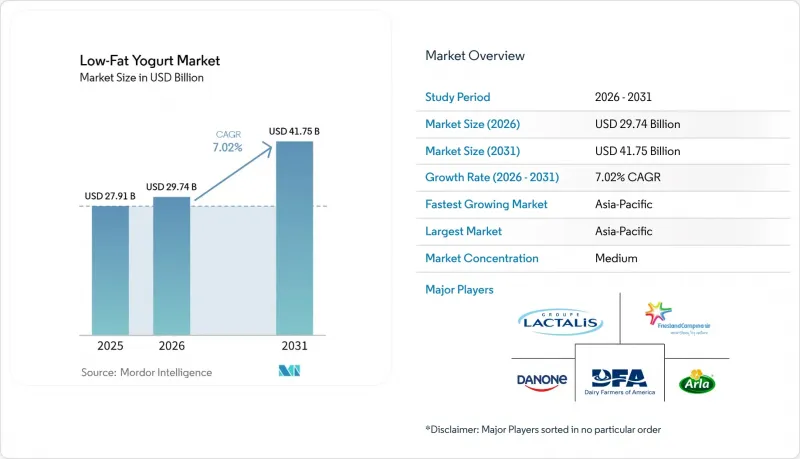
This report is Segmented by Product Type (Drinkable Yogurt and Spoonable Yogurt), Source (Dairy-Based and Non-Dairy-Based), Flavor (Flavored and Unflavored), Distribution Channel (On-Trade and Off-Trade), and Geography (North America, Europe, Asia-Pacific, South America, and the Middle East & Africa). The Report Provides Market Size Estimates and Forecasts in Terms of Value (USD) for all the Above Segments.
Global Low-Fat Yogurt Market Trends and Insights
Expanding Demand for Gut-Health Supporting Foods
Growing scientific evidence linking gut microbiome health to metabolic function, immunity, and overall well-being is repositioning low-fat yogurt from a calorie-conscious dairy product to a clinically supported functional food. This shift is increasingly reflected in consumer behavior, with the International Food Information Council (IFIC) reporting that 32% of U.S. consumers actively seek probiotics, while 24% consider digestive health their top health priority . Fermented dairy products containing live probiotic cultures such as Lactobacillus bulgaricus and Streptococcus thermophilus have demonstrated benefits for digestive health, gut microbiota balance, and intestinal function, reinforcing consumer confidence in probiotic yogurt. As gut-health awareness continues to rise, functional health positioning is increasingly overtaking taste-led marketing as the primary differentiator within the yogurt category. This trend enables premium probiotic low-fat yogurt products to sustain higher price points, while manufacturers investing in strain-specific, clinically validated formulations and evidence-based health claims are well positioned to capture greater consumer trust and premium value.
Expansion of Probiotic and Functional Yogurt Offerings
Manufacturers are shifting from broad probiotic positioning toward targeted formulations addressing specific health needs. This trend is supported by the growing prevalence of obesity, with the U.S. Centers for Disease Control and Prevention (CDC) estimating that more than 2 in 5 U.S. adults have obesity, driving demand for weight-management and high-protein nutritional products . At Vitafoods Europe 2026, Arla Foods Ingredients introduced a fermented, high-protein, low-fat drinking yogurt delivering 20 g of protein per 200 ml serving, specifically designed to support consumers using GLP-1 medications by helping maintain protein intake and muscle mass. Danone further strengthened this trend with the launch of Oikos Fusion in 2025, a cultured dairy drink positioned for weight-management journeys, including GLP-1 users. As ingredient suppliers increasingly collaborate with branded manufacturers to develop clinically targeted formulations, innovation is expanding beyond digestive health into bone health, cognition, sleep, and metabolic wellness, enabling faster commercialization of premium functional low-fat yogurt products.
Competition From Full-Fat Greek Yogurt Products, Higher Prices, and Distribution Limits
The low-fat yogurt market faces growing competitive pressure as full-fat Greek yogurt and skyr increasingly attract health-conscious consumers through high-protein, probiotic, and satiety-focused positioning. As these products redefine healthy dairy beyond fat reduction, low-fat brands must compete on broader functional benefits rather than reduced-fat claims alone. The launch of Chobani's 20 g Protein Flip range in 2026 underscores the industry's shift toward protein-led value propositions. In addition, sustaining a price premium remains challenging in cost-sensitive markets, where consumers prioritize nutritional value and affordability. Growth is further constrained by inadequate cold-chain infrastructure across parts of Southeast Asia, sub-Saharan Africa, and rural South America, creating opportunities for manufacturers to invest in extended shelf-life technologies and alternative distribution models that improve market reach.
Other drivers and restraints analyzed in the detailed report include:
- Growing Preference for Weight Management Foods
- Growing Demand for Low-Calorie Snack Options and Product Innovation
- Consumer Concerns Over Artificial Sweeteners Usage
For complete list of drivers and restraints, kindly check the Table Of Contents.
Segment Analysis
Spoonable yogurt accounted for 62.0% of the low-fat yogurt market in 2025, supported by its versatility across multiple consumption occasions, including breakfast, post-workout recovery, snacks, and culinary applications. Its integration into everyday household routines provides a broader consumption base than other yogurt formats. In contrast, drinkable yogurt is projected to expand at a CAGR of 8.0% during 2026-2031, driven by rising demand for convenient, on-the-go nutrition among urban consumers. This trend is particularly evident in Asia Pacific and Latin America, where fast-paced lifestyles are increasing demand for portable, ready-to-consume dairy products. The distinct consumption occasions of spoonable and drinkable yogurt are encouraging manufacturers to tailor packaging, flavors, and retail strategies to meet different consumer needs.
The distinction between spoonable and drinkable yogurt is becoming less pronounced as manufacturers introduce multifunctional products that combine convenience with enhanced nutritional value. Innovation is increasingly focused on improving texture, protein delivery, probiotic stability, and shelf life rather than simply introducing new flavors. Technologies such as high-pressure processing (HPP), advanced fermentation, and probiotic encapsulation are helping extend product freshness while preserving live cultures, enabling broader retail distribution and reducing cold-chain constraints. At the same time, manufacturers are differentiating both formats through clean-label formulations, functional ingredients, and premium positioning, allowing them to address evolving consumer preferences across traditional meal occasions and emerging on-the-go consumption.
Dairy-based products accounted for 51.2% of the low-fat yogurt market in 2025, supported by established consumer trust, widespread availability, and a strong nutritional profile. However, plant-based low-fat yogurt is projected to grow at a CAGR of 8.4% through 2031, driven by rising lactose intolerance, flexitarian eating patterns, and demand for sustainable nutrition. Rather than replacing dairy, plant-based products are broadening the category by attracting new consumer segments seeking greater dietary variety and functional nutrition.
Manufacturers are increasingly positioning plant-based yogurt around nutritional equivalence instead of dairy substitution. Recent product innovation has focused on improving protein quality, fiber content, and micronutrient fortification to narrow the nutritional gap with conventional yogurt while enhancing taste and texture. Plant-based adoption is expanding even in mature dairy markets, where consumers increasingly incorporate these products into their diets for health, environmental, or lifestyle reasons without fully eliminating dairy consumption. Regulatory frameworks, including Regulation (EU) No. 1169/2011, continue to shape product naming and labeling requirements for plant-based alternatives, increasing compliance costs and favoring manufacturers with greater regulatory and formulation capabilities.
Complete Report Scope:
- Product Type
- Drinkable Yogurt
- Spoonable Yogurt
- Source
- Dairy-based
- Non-dairy based
- Flavor
- Flavored
- Un-flavored
- Distribution Channel
- On-trade
- Off-trade
- Convenience Stores
- Specialist Retail Stores
- Supermarkets and Hypermarkets
- Online Retail Stores
- Other Distribution Channel
- Geography
- North America
- United States
- Canada
- Mexico
- Rest of North America
- Europe
- Germany
- United Kingdom
- Italy
- France
- Spain
- Netherlands
- Poland
- Belgium
- Sweden
- Rest of Europe
- Asia-Pacific
- China
- India
- Japan
- Australia
- Indonesia
- South Korea
- Thailand
- Singapore
- Rest of Asia-Pacific
- South America
- Brazil
- Argentina
- Colombia
- Chile
- Peru
- Rest of South America
- Middle East and Africa
- South Africa
- Saudi Arabia
- United Arab Emirates
- Nigeria
- Egypt
- Morocco
- Turkey
- Rest of Middle East and Africa
- North America
Geography Analysis
Asia Pacific accounted for 53.3% of the low-fat yogurt market in 2025 and is projected to grow at a CAGR of 8.6% through 2031, supported by its large consumer base, rising health awareness, and expanding cold-chain infrastructure. China and India continue to drive volume growth through increasing demand for functional dairy products and wider retail penetration, while Japan and South Korea remain key markets for premium, probiotic, and high-value yogurt offerings. Ongoing investments in nutrition-focused product innovation, modern retail, and refrigerated logistics are strengthening regional market expansion, although limited cold-chain infrastructure continues to restrict penetration in parts of Southeast Asia.
North America and Europe remain the global centers of product innovation and premiumization, supported by high consumer awareness of functional nutrition and established refrigerated distribution networks. Manufacturers are expanding portfolios through acquisitions, clean-label reformulations, and clinically positioned products enriched with protein, probiotics, and fiber. Demand in these regions is increasingly driven by digestive health, weight management, and high-protein nutrition, while stringent regulatory frameworks for nutrition and health claims continue to reinforce consumer confidence and encourage evidence-based product differentiation.
South America and the Middle East & Africa present attractive long-term growth opportunities, driven by urbanization, rising disposable incomes, and improving retail infrastructure. Manufacturers are increasingly reformulating products with functional ingredients such as probiotics, fiber, and protein to meet evolving consumer preferences. However, market expansion remains constrained by fragmented cold-chain networks, regulatory compliance requirements, and distribution challenges beyond major metropolitan areas. Continued investment in refrigerated logistics, modern trade, and localized product development will be critical to unlocking the growth potential of these emerging markets.
- Danone S.A.
- Chobani, LLC
- General Mills, Inc.
- Lactalis Group
- FAGE International S.A.
- Arla Foods amba
- Nestle S.A.
- Unternehmensgruppe Theo Muller
- Ehrmann SE
- Royal FrieslandCampina N.V.
- Valio Ltd.
- Sodiaal SCA
- Schreiber Foods, Inc.
- Dairy Farmers of America, Inc.
- The Hain Celestial Group, Inc.
- Glenisk Ltd.
- Biotiful Dairy Ltd.
- Yeo Valley Production Ltd.
- Almarai Company
- Yakult Honsha Co., Ltd.
Additional Benefits:
- The market estimate (ME) sheet in Excel format
- 3 months of analyst support
TABLE OF CONTENTS
1 INTRODUCTION
- 1.1 Study Assumptions and Market Definition
- 1.2 Scope of the Study
2 RESEARCH METHODOLOGY
3 EXECUTIVE SUMMARY
4 MARKET LANDSCAPE
- 4.1 Market Overview
- 4.2 Market Drivers
- 4.2.1 Expanding demand for gut-health supporting foods
- 4.2.2 Expansion of probiotic and functional yogurt offerings
- 4.2.3 Growing demand for low-calorie snack options
- 4.2.4 Product innovation in flavors and formulations
- 4.2.5 Expanding modern retail and refrigerated distribution
- 4.2.6 Growing preference for weight management foods
- 4.3 Market Restraints
- 4.3.1 Competition from full-fat Greek yogurt products
- 4.3.2 Higher prices than conventional yogurt products
- 4.3.3 Short shelf life increases distribution challenges
- 4.3.4 Consumer concerns over artificial sweeteners usage
- 4.4 Supply Chain Analysis
- 4.5 Regulatory Landscape
- 4.6 Technological Outlook
- 4.7 Porter's Five Forces Analysis
- 4.7.1 Bargaining Power of Suppliers
- 4.7.2 Bargaining Power of Buyers
- 4.7.3 Threat of New Entrants
- 4.7.4 Threat of Substitutes
- 4.7.5 Degree of Competition
5 MARKET SIZE AND GROWTH FORECASTS (VALUE)
- 5.1 Product Type
- 5.1.1 Drinkable Yogurt
- 5.1.2 Spoonable Yogurt
- 5.2 Source
- 5.2.1 Dairy-based
- 5.2.2 Non-dairy based
- 5.3 Flavor
- 5.3.1 Flavored
- 5.3.2 Un-flavored
- 5.4 Distribution Channel
- 5.4.1 On-trade
- 5.4.2 Off-trade
- 5.4.2.1 Convenience Stores
- 5.4.2.2 Specialist Retail Stores
- 5.4.2.3 Supermarkets and Hypermarkets
- 5.4.2.4 Online Retail Stores
- 5.4.2.5 Other Distribution Channel
- 5.5 Geography
- 5.5.1 North America
- 5.5.1.1 United States
- 5.5.1.2 Canada
- 5.5.1.3 Mexico
- 5.5.1.4 Rest of North America
- 5.5.2 Europe
- 5.5.2.1 Germany
- 5.5.2.2 United Kingdom
- 5.5.2.3 Italy
- 5.5.2.4 France
- 5.5.2.5 Spain
- 5.5.2.6 Netherlands
- 5.5.2.7 Poland
- 5.5.2.8 Belgium
- 5.5.2.9 Sweden
- 5.5.2.10 Rest of Europe
- 5.5.3 Asia-Pacific
- 5.5.3.1 China
- 5.5.3.2 India
- 5.5.3.3 Japan
- 5.5.3.4 Australia
- 5.5.3.5 Indonesia
- 5.5.3.6 South Korea
- 5.5.3.7 Thailand
- 5.5.3.8 Singapore
- 5.5.3.9 Rest of Asia-Pacific
- 5.5.4 South America
- 5.5.4.1 Brazil
- 5.5.4.2 Argentina
- 5.5.4.3 Colombia
- 5.5.4.4 Chile
- 5.5.4.5 Peru
- 5.5.4.6 Rest of South America
- 5.5.5 Middle East and Africa
- 5.5.5.1 South Africa
- 5.5.5.2 Saudi Arabia
- 5.5.5.3 United Arab Emirates
- 5.5.5.4 Nigeria
- 5.5.5.5 Egypt
- 5.5.5.6 Morocco
- 5.5.5.7 Turkey
- 5.5.5.8 Rest of Middle East and Africa
- 5.5.1 North America
6 COMPETITIVE LANDSCAPE
- 6.1 Market Concentration
- 6.2 Strategic Moves
- 6.3 Market Share Analysis
- 6.4 Company Profiles (includes Global level Overview, Market level overview, Core Segments, Financials as available, Strategic Information, Market Rank/Share for key companies, Products and Services, and Recent Developments)
- 6.4.1 Danone S.A.
- 6.4.2 Chobani, LLC
- 6.4.3 General Mills, Inc.
- 6.4.4 Lactalis Group
- 6.4.5 FAGE International S.A.
- 6.4.6 Arla Foods amba
- 6.4.7 Nestle S.A.
- 6.4.8 Unternehmensgruppe Theo Muller
- 6.4.9 Ehrmann SE
- 6.4.10 Royal FrieslandCampina N.V.
- 6.4.11 Valio Ltd.
- 6.4.12 Sodiaal SCA
- 6.4.13 Schreiber Foods, Inc.
- 6.4.14 Dairy Farmers of America, Inc.
- 6.4.15 The Hain Celestial Group, Inc.
- 6.4.16 Glenisk Ltd.
- 6.4.17 Biotiful Dairy Ltd.
- 6.4.18 Yeo Valley Production Ltd.
- 6.4.19 Almarai Company
- 6.4.20 Yakult Honsha Co., Ltd.
7 MARKET OPPORTUNITIES AND FUTURE OUTLOOK

