PUBLISHER: Mordor Intelligence | PRODUCT CODE: 2119057

PUBLISHER: Mordor Intelligence | PRODUCT CODE: 2119057
Audio Advertising Services - Market Share Analysis, Industry Trends & Statistics, Growth Forecasts (2026 - 2031)
According to Mordor Intelligence, the audio advertising services market size was valued at USD 5.38 billion in 2025 and estimated to grow from USD 6.14 billion in 2026 to reach USD 11.94 billion by 2031, at a CAGR of 14.23% during the forecast period (2026-2031).
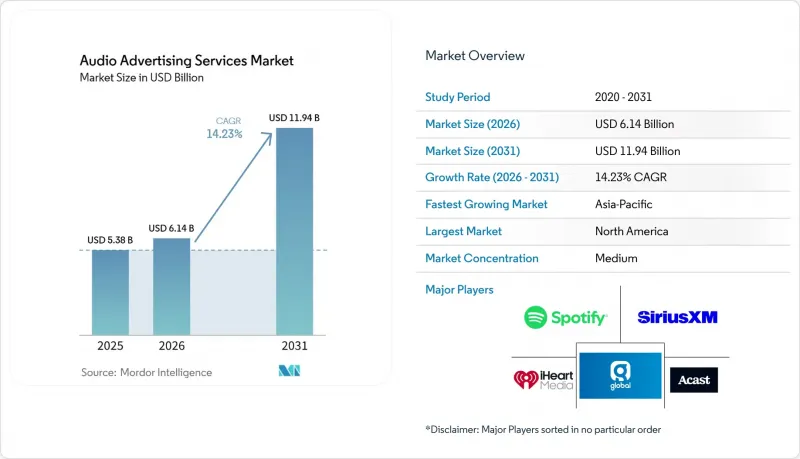
This report is Segmented by Service Type (Audio Media Buying and Distribution, Creative Production Services, and More), Buying Model (Direct Sales and Insertion Orders, and Programmatic Buying), Channel (In-Stream Audio Ads, and More), End-User Industry (Media and Entertainment, Automotive, Technology and Software and More), and Geography. The Market Forecasts are Provided in Terms of Value (USD).
Global Audio Advertising Services Market Trends and Insights
Rising Podcast Listenership and Higher Audience Attention
Podcast listening reached new highs, with monthly podcast consumption continuing to expand among people aged 12 and older in the United States. Weekly consumption also increased compared with the previous year. Total weekly podcast consumption time grew significantly over the past decade. Monthly online audio listening among Americans aged 55 and older also rose notably. This audience expansion brings more high-purchasing-power listeners into the audio advertising services market. Adults aged 35-54 also provide a large audience base, with strong monthly podcast consumption.
Growth of Programmatic Audio Buying and Dynamic Ad Insertion
Programmatic digital audio advertising spending continued to grow, supported by rising adoption among marketers and media agencies seeking more efficient, data-driven buying models. Automation in audio buying is expected to increase steadily over the long term as advertisers prioritize improved targeting, real-time optimization, and better campaign measurement. Audio remains less automated than programmatic display, which leaves considerable room for further budget movement as brands become more comfortable with automated audio inventory transactions. Amazon DSP integrated Spotify Ad Exchange podcast inventory with SiriusXM Media and iHeartMedia channels, strengthening access to premium audio supply across major publishers. This gives buyers a single interface for scaled programmatic audio campaigns and supports more streamlined planning, activation, and performance management across digital audio environments.
Ad-Free Subscriptions and Ad Blocking Limit Reachable Inventory
Many large digital audio platforms were designed around subscriptions, which can reduce the available ad-supported listener base. Spotify reported continued growth in its subscriber share among United States listeners in 2025 and projected further subscriber growth. SiriusXM also reported multiyear declines in its core satellite subscriber base, even as it expanded its podcast network. IAB Australia found that measurement barriers remained the leading concern for audio buyers in 2026. More than half of buyers nevertheless planned to increase streaming music advertising investment in 2026. As premium platforms move more users to paid tiers, advertisers may face scarcer inventory, higher CPMs, and limits on performance-led scaling.
Other drivers and restraints analyzed in the detailed report include:
- Expansion of Audio Consumption on Mobile, Connected Cars, and Smart Speakers
- Shift Toward Brand-Safe and Low-Clutter Media Environments
- Privacy Rules and Signal Loss Weaken Attribution Precision
For complete list of drivers and restraints, kindly check the Table Of Contents.
Segment Analysis
Audience Analytics and Targeting Services is projected to expand at a 14.91% CAGR through 2031, making it the fastest-growing service type. Audio Media Buying and Distribution held 41.80% of the audio advertising services market share in 2025. Its position reflects its role as the transactional layer for direct insertion orders and programmatic buying. The faster growth of audience analytics reflects a shift from reach-and-frequency planning toward listener-level modeling. Advertisers are seeking data tools as cookie-based signals decline in other digital channels. Authenticated and logged-in listener data can provide an identity-safe alternative for campaign planning.
Creative Production Services continued to support campaign development across publishers and brands. Measurement and Attribution Services also gained attention as platforms pursued outcome-based reporting. Triton Digital launched AdBuilder AI in October 2025, an audio creative generation tool that supports more than 60 languages. The tool addresses the volume limitations of studio production and voice talent. It may support wider use of audio advertising services in market campaigns outside English-speaking markets.
Direct Sales and Insertion Orders held 72.83% of the audio advertising services market share in 2025. This model remains central to host-read sponsorships, which depend on negotiated endorsements between brands and hosts. Programmatic Buying is projected to expand at a 15.08% CAGR through 2031. Programmatic Buying is expected to expand strongly through the forecast period. Its growth follows the expansion of dynamic ad insertion inventory that can be bought and sold through automated systems. Programmatic audio adoption has increased significantly among marketers and media agencies in recent years.
The two models are likely to remain important for different inventory types. In-stream inventory can be traded efficiently through automated auctions at scale. Host-read sponsorships remain premium formats sold through direct deals. These formats are valued for their personal endorsement and trusted delivery. Advertisers that focus only on programmatic efficiency may have less exposure to high-trust host-read placements in the audio advertising services market.
Complete Report Scope:
- By Service Type
- Audio Media Buying and Distribution
- Creative Production Services
- Measurement and Attribution Services
- Audience Analytics and Targeting Services
- By Buying Model
- Direct Sales and Insertion Orders
- Programmatic Buying
- By Channel
- In-Stream Audio Ads
- Host-Read and Announcer-Read Ads
- Branded Content and Sponsored Segments
- Other Channels
- By End-User Industry
- Retail and E-commerce
- Financial Services
- Media and Entertainment
- Technology and Software
- Healthcare and Pharmaceuticals
- Automotive
- Travel and Hospitality
- Food and Beverages
- Geography
- North America
- United States
- Canada
- Mexico
- South America
- Brazil
- Argentina
- Rest of South America
- Europe
- United Kingdom
- Germany
- France
- Spain
- Italy
- Russia
- Rest of Europe
- Asia-Pacific
- China
- Japan
- India
- South Korea
- Australia
- Indonesia
- Rest of Asia-Pacific
- Middle East
- Saudi Arabia
- United Arab Emirates
- Turkey
- Rest of Middle East
- Africa
- South Africa
- Nigeria
- Egypt
- Rest of Africa
- North America
Geography Analysis
North America held 39.00% of the audio advertising services market share in 2025. The United States combines a large podcast revenue base with mature programmatic infrastructure and a deep pool of specialist agencies and technology vendors. Podcast advertising revenue in the United States reached USD 2.862 billion in 2025. iHeartMedia launched AudioGraph on June 18, 2026, bringing identity targeting and outcome measurement to broadcast radio inventory. The service reaches more than 278 million monthly United States listeners and uses Triton Digital and TransUnion data.
South America remains an early-stage opportunity, with Brazil, Argentina, and Mexico supporting regional listener growth. Absolute spending remains a small share of the global total because measurement systems and digital advertising maturity vary across the region. Europe is centered on the United Kingdom, Germany, and France, while GDPR shapes identity and attribution practices. Digital audio and podcast advertising expenditure in Australia increased in the recent period. A majority of Australian buyers planned to increase original podcast advertising spending in the near term.
Asia-Pacific is projected to expand at a 14.88% CAGR through 2031, making it the fastest-growing geographic area in the audio advertising services market. Growth reflects smartphone-led listening, localized content creation, and developing programmatic infrastructure. Regional-language podcasts in India are creating more targeted audiences for local advertisers. Japan, South Korea, and Australia represent more mature regional markets, while China adds scale through domestic platforms. Host-read advertisements support direct-sales buying models because advertisers value the trust associated with familiar voices.
- Global Media Group Services Limited
- SXM Media (SiriusXM Holdings, Inc.)
- Spotify AB (Spotify Advertising)
- Acast AB
- iHeartMedia, Inc.
- Ad Results Media LLC
- Triton Digital Canada Inc.
- Oxford Road LLC
- AdsWizz Inc.
- Audacy, Inc.
- Veritone, Inc.
- Liberated Syndication Inc. (Libsyn Ads)
- PodcastOne, Inc.
- AudioGO
- Podscribe Inc.
- Comscore, Inc.
- Integral Ad Science, Inc.
- Magellan AI Inc.
- Stingray Group Inc.
Additional Benefits:
- The market estimate (ME) sheet in Excel format
- 3 months of analyst support
TABLE OF CONTENTS
1 INTRODUCTION
- 1.1 Study Assumptions and Market Definition
- 1.2 Scope of the Study
2 RESEARCH METHODOLOGY
3 EXECUTIVE SUMMARY
4 MARKET LANDSCAPE
- 4.1 Market Overview
- 4.2 Market Drivers
- 4.2.1 Rising Podcast Listenership and Higher Audience Attention
- 4.2.2 Growth of Programmatic Audio Buying and Dynamic Ad Insertion
- 4.2.3 Expansion of Audio Consumption on Mobile, Connected Cars, and Smart Speakers
- 4.2.4 Shift Toward Brand-Safe and Low-Clutter Media Environments
- 4.2.5 Privacy-Forward Identity Frameworks Improve Addressability in Audio
- 4.2.6 Video Simulcast Podcasts Expand Sellable Inventory and Measurement Touchpoints
- 4.3 Market Restraints
- 4.3.1 Ad-Free Subscriptions and Ad Blocking Limit Reachable Inventory
- 4.3.2 Privacy Rules and Signal Loss Weaken Attribution Precision
- 4.3.3 YouTube and Short-Form Video Absorb Incremental Brand Budgets
- 4.3.4 Cross-Channel Audio Measurement Fragmentation Slows Budget Scaling
- 4.4 Industry Value-Chain Analysis
- 4.5 Regulatory Landscape
- 4.6 Technological Outlook
- 4.7 Impact of Macroeconomic Factors on the Market
- 4.8 Porter's Five Forces Analysis
- 4.8.1 Threat of New Entrants
- 4.8.2 Bargaining Power of Buyers
- 4.8.3 Bargaining Power of Suppliers
- 4.8.4 Threat of Substitutes
- 4.8.5 Competitive Rivalry
5 MARKET SIZE AND GROWTH FORECASTS (VALUE)
- 5.1 By Service Type
- 5.1.1 Audio Media Buying and Distribution
- 5.1.2 Creative Production Services
- 5.1.3 Measurement and Attribution Services
- 5.1.4 Audience Analytics and Targeting Services
- 5.2 By Buying Model
- 5.2.1 Direct Sales and Insertion Orders
- 5.2.2 Programmatic Buying
- 5.3 By Channel
- 5.3.1 In-Stream Audio Ads
- 5.3.2 Host-Read and Announcer-Read Ads
- 5.3.3 Branded Content and Sponsored Segments
- 5.3.4 Other Channels
- 5.4 By End-User Industry
- 5.4.1 Retail and E-commerce
- 5.4.2 Financial Services
- 5.4.3 Media and Entertainment
- 5.4.4 Technology and Software
- 5.4.5 Healthcare and Pharmaceuticals
- 5.4.6 Automotive
- 5.4.7 Travel and Hospitality
- 5.4.8 Food and Beverages
- 5.5 Geography
- 5.5.1 North America
- 5.5.1.1 United States
- 5.5.1.2 Canada
- 5.5.1.3 Mexico
- 5.5.2 South America
- 5.5.2.1 Brazil
- 5.5.2.2 Argentina
- 5.5.2.3 Rest of South America
- 5.5.3 Europe
- 5.5.3.1 United Kingdom
- 5.5.3.2 Germany
- 5.5.3.3 France
- 5.5.3.4 Spain
- 5.5.3.5 Italy
- 5.5.3.6 Russia
- 5.5.3.7 Rest of Europe
- 5.5.4 Asia-Pacific
- 5.5.4.1 China
- 5.5.4.2 Japan
- 5.5.4.3 India
- 5.5.4.4 South Korea
- 5.5.4.5 Australia
- 5.5.4.6 Indonesia
- 5.5.4.7 Rest of Asia-Pacific
- 5.5.5 Middle East
- 5.5.5.1 Saudi Arabia
- 5.5.5.2 United Arab Emirates
- 5.5.5.3 Turkey
- 5.5.5.4 Rest of Middle East
- 5.5.6 Africa
- 5.5.6.1 South Africa
- 5.5.6.2 Nigeria
- 5.5.6.3 Egypt
- 5.5.6.4 Rest of Africa
- 5.5.1 North America
6 COMPETITIVE LANDSCAPE
- 6.1 Market Concentration
- 6.2 Strategic Moves
- 6.3 Market Share Analysis
- 6.4 Company Profiles (includes Global Level Overview, Market Level Overview, Core Segments, Financials as available, Strategic Information, Market Rank/Share, Products and Services, Recent Developments)
- 6.4.1 Global Media Group Services Limited
- 6.4.2 SXM Media (SiriusXM Holdings, Inc.)
- 6.4.3 Spotify AB (Spotify Advertising)
- 6.4.4 Acast AB
- 6.4.5 iHeartMedia, Inc.
- 6.4.6 Ad Results Media LLC
- 6.4.7 Triton Digital Canada Inc.
- 6.4.8 Oxford Road LLC
- 6.4.9 AdsWizz Inc.
- 6.4.10 Audacy, Inc.
- 6.4.11 Veritone, Inc.
- 6.4.12 Liberated Syndication Inc. (Libsyn Ads)
- 6.4.13 PodcastOne, Inc.
- 6.4.14 AudioGO
- 6.4.15 Podscribe Inc.
- 6.4.16 Comscore, Inc.
- 6.4.17 Integral Ad Science, Inc.
- 6.4.18 Magellan AI Inc.
- 6.4.19 Stingray Group Inc.
7 MARKET OPPORTUNITIES AND FUTURE OUTLOOK
- 7.1 White-Space and Unmet-Need Assessment

