PUBLISHER: Mordor Intelligence | PRODUCT CODE: 2119089

PUBLISHER: Mordor Intelligence | PRODUCT CODE: 2119089
Europe Urban Micro-Warehousing - Market Share Analysis, Industry Trends & Statistics, Growth Forecasts (2026 - 2031)
According to Mordor Intelligence, the Europe urban micro-warehousing market size was valued at USD 4.23 billion in 2025 and is estimated to grow from USD 4.73 billion in 2026 to reach USD 8.06 billion by 2031, at a CAGR of 11.27% during the forecast period (2026-2031).
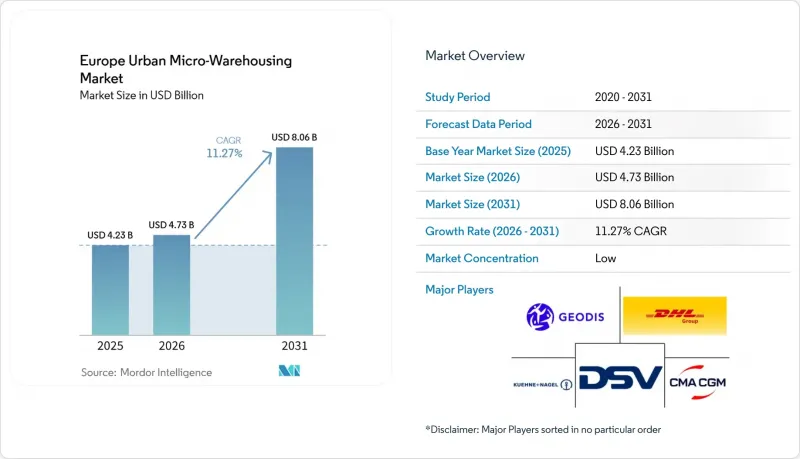
The Europe urban micro-warehousing market is expanding because urban supply chains are moving away from large perimeter distribution centers and toward smaller in-city nodes that sit closer to final demand. This report is Segmented by Facility Type (Dark Store, MFC, Retail, Hybrid), by Temperature Type (Controlled, Non-Controlled), by Automation Level (Manual, Semi-Automated, Fully Automated), by End-User Industry (E-Commerce, Quick Commerce, Grocery, FMCG, and More), and by Geography (United Kingdom, Germany, France, Spain, Italy, Belgium, Netherlands, Nordics). The Market Forecasts are in Value (USD).
Europe Urban Micro-Warehousing Market Trends and Insights
Last-Mile Delivery Density Pressure in Major European Cities
The Europe urban micro-warehousing market is being shaped by a simple operating reality: dense city routes do not leave enough room for slow inventory movement from distant facilities. When delivery stops are tightly packed and travel access is constrained, the value of inventory already inside the city rises faster than the value of adding more vehicles to an outer-network route. A 2026 study covering 90 European pedestrian zones found that different last-mile modes will be needed to decarbonize urban delivery in historic cores, reinforcing the case for closer inventory placement rather than longer dispatch distances. That finding matters because city logistics is no longer judged solely by speed and cost, and operators are increasingly being pushed to comply with local mobility and emissions rules. The Europe urban micro-warehousing market, therefore, gains support from the same urban conditions that are making legacy last-mile operating models less reliable. Operators that place stock closer to dense neighborhoods can respond faster, reduce route complexity, and protect fulfillment windows that are harder to sustain from peri-urban sites.
Growth of Quick Commerce and Same-Day Fulfillment Expectations
The Europe urban micro-warehousing market is also gaining from the steady normalization of same-day and near-immediate fulfillment expectations in large urban centers. Consumers now treat rapid delivery as part of the buying proposition for a wider set of products, which means operators must design networks around response time rather than around warehouse scale alone. Quick commerce has gone through a period of consolidation, leaving a more financially disciplined operator base better positioned to use larger, more efficient sites. This matters because the strongest players are no longer trying to fit every dark store into residential blocks; instead, they are shifting toward formats that support better throughput and more consistent replenishment. The Europe urban micro-warehousing market benefits from that transition because it redirects demand toward facilities that are easier to automate and more compatible with urban industrial zoning. Growth in this part of the market is therefore tied not only to category demand, but also to a maturing operating model that is becoming more durable after the early expansion phase.
High Urban Property Costs and Limited Site Availability
High urban property costs remain 1 of the clearest brakes on the Europe urban micro-warehousing market. Prime sites in cities such as London, Paris, and Amsterdam are controlled by a narrow landlord base, and the rent premium for micro-warehouse space can rise well above levels smaller operators can comfortably absorb. The issue is not limited to rent, because many investment-grade urban leases also require balance-sheet strength and covenant quality that exclude undercapitalized entrants. That leaves the Europe urban micro-warehousing market more dependent on larger incumbents that can underwrite expensive urban locations over a longer time horizon. The result is a market where access to capital often determines who can operate in the best city nodes before service quality or technological differences do. This pressure also accelerates consolidation, since operators that cannot secure viable sites often have little choice but to partner, sublease, or exit.
Other drivers and restraints analyzed in the detailed report include:
- Urban Real-Estate Scarcity Driving In-City Inventory Proximity
- Rising Need for Micro-Fulfillment to Reduce Delivery Cost per Order
- Complex Zoning, Permitting, and Municipal Use Restrictions
For complete list of drivers and restraints, kindly check the Table Of Contents.
Segment Analysis
Micro-fulfillment centers accounted for a 41.37% share of the Europe urban micro-warehousing market size in 2025, making them the leading facility type in the Europe urban micro-warehousing industry. Their lead reflects a good fit between dense-city service expectations and facilities that can support compact, high-throughput inventory operations close to demand. The format works especially well because footprints of 2,000 to 5,000 m2 are large enough for structured picking and storage, yet still small enough to fit urban logistics networks. Dark store-based fulfillment is forecast to grow at 18.18% CAGR through 2031, and that pace reflects adaptation as much as expansion. Growth is becoming concentrated in a more durable operator group that has responded to municipal pressure by moving away from residential settings and into better-suited industrial or mixed logistics zones.
Retail store-based fulfillment and hybrid facilities fill the rest of the facility mix, and both are important because they help operators use existing urban assets more efficiently. Hybrid models are especially relevant for omnichannel retailers that want a single location to support customer-facing activities and local fulfillment capacity. That structure can improve asset utilization and shorten break-even periods because the operator does not rely on a single use case for the site. Bleckmann's 2025 launch of its Bscale modular plug-and-play warehousing solution in the United Kingdom and the Netherlands shows how flexible access models are opening the Europe urban micro-warehousing market to brands that do not want to fund a full dedicated buildout at the start. Facility choice is therefore becoming a long-duration strategic decision, because the building type selected at lease signing often determines what level of automation and throughput the site can realistically support later.
Non-temperature-controlled storage held 63.02% of the Europe urban micro-warehousing market share in 2025, which shows that the market still depends mainly on e-commerce, FMCG, and fashion flows that do not require specialized environmental control. Even so, temperature-controlled capacity is projected to grow at a 14.84% CAGR through 2031, indicating clear expansion into more complex and higher-value product categories. Pharmaceutical cold chain, fresh grocery distribution, and biologic medicine logistics are all pushing operators to place controlled inventory closer to metropolitan demand. This is important because temperature-controlled urban space is harder to develop, more expensive to operate, and often more affordable once in use. As a result, the Europe urban micro-warehousing market is moving beyond ambient goods and into segments where compliance, quality assurance, and faster replenishment carry a larger revenue premium.
A second demand stream is coming from quick commerce, as product assortments expand beyond shelf-stable goods to include fresh produce, dairy, meal kits, and chilled convenience items. Once that category mix changes, dark stores and micro-fulfillment centers need a different internal configuration, better insulation, and stronger process control than simple ambient storage requires. The January 2026 Arla Foods and XPO Logistics distribution center project at Prologis RFI DIRFT in Northamptonshire shows how chilled food networks are being reorganized around more specialized distribution infrastructure, with XPO set to operate the site from late 2027. In the Europe urban micro-warehousing industry, that kind of development reinforces the case for city-serving cold-chain capacity that can support both regulated pharmaceutical flows and commercially driven food delivery expansion. The segment is therefore gaining from 2 separate demand drivers, regulated healthcare distribution and premium urban grocery fulfillment, which together lift its strategic importance within the Europe urban micro-warehousing market.
Complete Report Scope:
- By Facility Type
- Dark Store-Based Fulfillment
- Micro-Fulfillment Center (MFC)-Based Fulfillment
- Retail Store-Based Fulfillment
- Hybrid Facility and Others
- By Temperature Type
- Temperature Controlled
- Non-Temperature Controlled
- By Automation Level
- Manual Operations
- Semi-Automated Facilities
- Fully Automated Facilities
- By End-User Industry
- E-commerce
- Quick Commerce
- Grocery Retail
- FMCG
- Food and Beverage
- Pharmaceuticals and Healthcare
- Consumer Electronics and Household Appliances
- Fashion and Lifestyle (Accessories, Apparel, Footwear)
- Industrial and B2B Distribution
- Others
- By Country
- United Kingdom
- Germany
- France
- Spain
- Italy
- Belgium
- Netherlands
- NORDICS (Denmark, Finland, Iceland, Norway, and Sweden)
- Rest of Europe
List of Companies Covered in this Report:
- DHL Group
- Kuehne+Nagel
- DSV A/S
- CMA CGM Group (Including CEVA Logistics)
- GEODIS
- GXO Logistics, Inc.
- DACHSER
- Rhenus Logistics
- ID Logistics
- FM Logistic
- FIEGE
- Arvato
- Hellmann Worldwide Logistics
- Nippon Express Holdings
- NYK Line (Including Yusen Logistics)
- XPO Inc.
- Noatum Logistics
- Logwin AG
- Bleckmann Logistics
- STEF Group
- PostNord
- Katoen Natie
Additional Benefits:
- The market estimate (ME) sheet in Excel format
- 3 months of analyst support
TABLE OF CONTENTS
1 Introduction
- 1.1 Study Assumptions and Market Definition
- 1.2 Scope of the Study
2 Research Methodology
3 Executive Summary
4 Market Landscape
- 4.1 Market Overview and Role of Urban Micro-Warehousing in Urban Logistics
- 4.2 Market Drivers
- 4.2.1 Last-Mile Delivery Density Pressure in Major European Cities
- 4.2.2 Growth of Quick Commerce and Same-Day Fulfillment Expectations
- 4.2.3 Urban Real-Estate Scarcity Driving In-City Inventory Proximity
- 4.2.4 Rising Need for Micro-Fulfillment to Reduce Delivery Cost per Order
- 4.2.5 Retail Network Reconfiguration Away From Large Perimeter DCs
- 4.2.6 Urban Property Scarcity and Rising Labor-Efficiency Demand
- 4.3 Market Restraints
- 4.3.1 High Urban Property Costs and Limited Site Availability
- 4.3.2 Complex Zoning, Permitting, and Municipal Use Restrictions
- 4.3.3 Labor Constraints for Urban Night-Shift Operations
- 4.3.4 Capex Intensity of Automation and Retrofit Projects
- 4.4 Regulatory Framework
- 4.5 Value Chain and Distribution Channel Architecture Analysis
- 4.6 Technology Innovations Outlook
- 4.7 Porter's Five Forces Analysis
- 4.7.1 Threat of New Entrants
- 4.7.2 Bargaining Power of Suppliers
- 4.7.3 Bargaining Power of Buyers
- 4.7.4 Threat of Substitutes
- 4.7.5 Rivalry Among Competitors
- 4.8 Evolution of Urban Micro-Warehousing Requirements
- 4.9 Pricing and Cost Structure Analysis
- 4.10 Real Estate and Infrastructure Analysis
- 4.11 Consumer Behavior and Delivery Preferences Analysis
- 4.12 Sustainable Delivery Solutions and Green Logistics Initiatives
- 4.13 Impact of Geo-Political Events on Supply Chain Shifts
5 Market Size and Growth Forecasts (Value, 2026-2031)
- 5.1 By Facility Type
- 5.1.1 Dark Store-Based Fulfillment
- 5.1.2 Micro-Fulfillment Center (MFC)-Based Fulfillment
- 5.1.3 Retail Store-Based Fulfillment
- 5.1.4 Hybrid Facility and Others
- 5.2 By Temperature Type
- 5.2.1 Temperature Controlled
- 5.2.2 Non-Temperature Controlled
- 5.3 By Automation Level
- 5.3.1 Manual Operations
- 5.3.2 Semi-Automated Facilities
- 5.3.3 Fully Automated Facilities
- 5.4 By End-User Industry
- 5.4.1 E-commerce
- 5.4.2 Quick Commerce
- 5.4.3 Grocery Retail
- 5.4.4 FMCG
- 5.4.5 Food and Beverage
- 5.4.6 Pharmaceuticals and Healthcare
- 5.4.7 Consumer Electronics and Household Appliances
- 5.4.8 Fashion and Lifestyle (Accessories, Apparel, Footwear)
- 5.4.9 Industrial and B2B Distribution
- 5.4.10 Others
- 5.5 By Country
- 5.5.1 United Kingdom
- 5.5.2 Germany
- 5.5.3 France
- 5.5.4 Spain
- 5.5.5 Italy
- 5.5.6 Belgium
- 5.5.7 Netherlands
- 5.5.8 NORDICS (Denmark, Finland, Iceland, Norway, and Sweden)
- 5.5.9 Rest of Europe
6 Competitive Landscape
- 6.1 Market Concentration
- 6.2 Key Strategic Moves
- 6.3 Market Share Analysis
- 6.4 Company Profiles (includes Global Level Overview, Market Level Overview, Core Segments, Financials as Available, Strategic Information, Market Rank/Share for Key Companies, Products & Services, and Recent Developments)
- 6.4.1 DHL Group
- 6.4.2 Kuehne+Nagel
- 6.4.3 DSV A/S
- 6.4.4 CMA CGM Group (Including CEVA Logistics)
- 6.4.5 GEODIS
- 6.4.6 GXO Logistics, Inc.
- 6.4.7 DACHSER
- 6.4.8 Rhenus Logistics
- 6.4.9 ID Logistics
- 6.4.10 FM Logistic
- 6.4.11 FIEGE
- 6.4.12 Arvato
- 6.4.13 Hellmann Worldwide Logistics
- 6.4.14 Nippon Express Holdings
- 6.4.15 NYK Line (Including Yusen Logistics)
- 6.4.16 XPO Inc.
- 6.4.17 Noatum Logistics
- 6.4.18 Logwin AG
- 6.4.19 Bleckmann Logistics
- 6.4.20 STEF Group
- 6.4.21 PostNord
- 6.4.22 Katoen Natie
7 Market Opportunities and Future Outlook
- 7.1 White-space and Unmet-Need Assessment

