PUBLISHER: Mordor Intelligence | PRODUCT CODE: 2119097

PUBLISHER: Mordor Intelligence | PRODUCT CODE: 2119097
Asia-Pacific Mobile Homes - Market Share Analysis, Industry Trends & Statistics, Growth Forecasts (2026 - 2031)
According to Mordor Intelligence, the Asia-Pacific mobile homes market size is expected to increase from USD 2.11 billion in 2025 to USD 2.32 billion in 2026 and reach USD 3.66 billion by 2031, growing at a CAGR of 9.55% over 2026-2031.
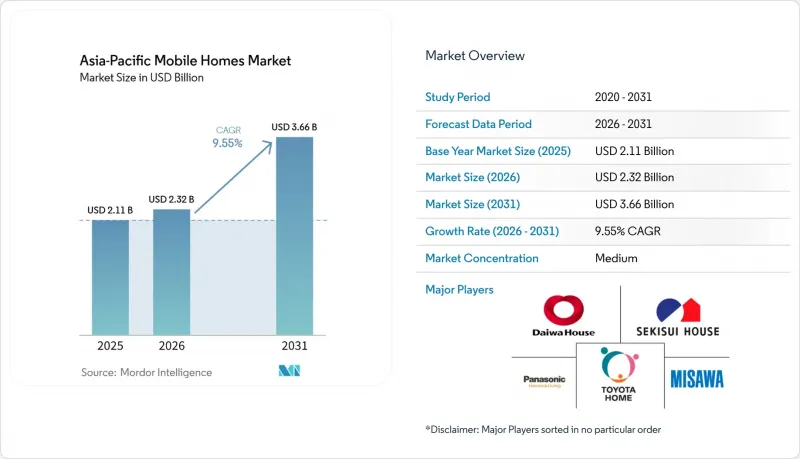
This report is Segmented by Product Type (Single-Section, Multi-Section, and Others), by Material (Timber-Based, Steel-Based, Concrete-Based, and Composite and Other Materials), by Application (Single-Family, Multi-Family, and More), and by Geography (China, Japan, India, Australia, and the Rest of Asia-Pacific). The Market Forecasts are Provided in Terms of Value (USD).
Asia-Pacific Mobile Homes Market Trends and Insights
Housing Affordability Challenges and Supply Shortfalls Drive Mobile Home Demand
Housing supply gaps are widening faster than conventional site construction can address in several locations across the Asia-Pacific. Australia's National Housing Accord targets 1.2 million new homes by mid-2029, while a Curtin University report cited in the draft identified a 220,000-home shortfall under its central forecast. The report recommended increasing the share of manufactured housing in new construction to 35% by 2036-37. Infill sites can support mobile home use where conventional concrete construction is harder to deliver. India's NITI Aayog stated in January 2026 that PMAY-U 2.0 alone would not close the full housing deficit and that land reform and financing measures are also needed. Higher land values and tighter affordable-housing finance are increasing the value of faster delivery and more predictable budgets for developers.
Construction Labor Shortages Increase Adoption of Factory-Built Homes
Labor availability is a central constraint on delivery in the Asia-Pacific mobile homes market. Factory production can move at least 80% of work away from the construction site and into controlled manufacturing settings. Hong Kong's Construction Industry Council projected a shortage of 45,000 to 50,000 skilled and semi-skilled workers by 2030. South Korean modular factories operated at 60% automation for supplied materials, and full-line automation was expected to reduce factory labor by 51% compared with conventional construction. Sekisui House has a major investment program for factory and information technology systems for FY2026 through FY2028. The program includes inspection robots, artificial intelligence design tools, and augmented reality accuracy systems, although manufacturers still need technically skilled factory employees.
Fragmented Building Approvals and Zoning Regulations Delay Market Expansion
Different building approvals and zoning rules limit producers' ability to use a single design across multiple markets. In Australia, a modular home certified in Victoria or Queensland may require reassessment before it is accepted in New South Wales. The New South Wales Government invested USD 1 million in a certification framework as part of its July 2026 program to address recognition issues. India had no dedicated modular construction standard in the supplied material, while prefabricated components faced an 18% goods and services tax rate in FY2026. A peer-reviewed 2025 study reported that fragmented regulation constrained prefabricated construction in Taiwan. China introduced Group standards T/COSOCC 045-2026 and T/COSOCC 063-2026 for prefabricated building design and green quality management, although regional alignment across ASEAN remains limited.
Other drivers and restraints analyzed in the detailed report include:
- Disaster-Resilient and Emergency Housing Demand Supports Market Expansion
- Digital Design, Factory Automation, and Smart Home Integration Enhance Product Appeal
- Transportation, Crane, and Site Access Constraints Increase Project Costs
For complete list of drivers and restraints, kindly check the Table Of Contents.
Segment Analysis
Single-section homes accounted for 54.8% of the Asia-Pacific mobile homes market in 2025. Their position reflects their fit with suburban infill, rural housing programs, and disaster relief projects that have site limits or strict budgets. These homes have fewer assembly requirements than multi-section formats. That makes them appropriate where rapid installation and manageable transport are important. Multi-section homes serve buyers seeking layouts more similar to those of larger site-built homes. They are more relevant in Japan and Australia, where more households can support larger factory-built footprints. Multi-section formats also need sites that can accommodate transport, assembly, and related approvals. Their role, therefore, remains more focused than that of single-section units.
The Others segment, which includes volumetric modular homes, panelized mobile homes, and container-based homes, is forecast to grow at 11.78% CAGR from 2026 to 2031. This growth reflects demand from disaster relief, workforce accommodation, student housing, resort hospitality, and other uses identified in the draft. Factory testing and documentation can help volumetric systems meet government procurement requirements. Third-party certification is becoming more important for these procurement channels. The supplied material described Samsung Electronics' opening of an artificial intelligence modular home showroom in June 2026, with more than 80% factory completion and over 20 compatible devices installed during production. That model points to demand from buyers who value integrated technology with factory-built housing. The product category can therefore expand beyond basic temporary and budget-led housing. It also gives suppliers a way to differentiate through installed systems rather than only structural materials or delivery speed.
Complete Report Scope:
- By Product Type
- Single-section Homes
- Multi-section Homes
- Others (Volumetric Modular Homes, Panelized Mobile Homes, and Container-based Mobile Homes)
- By Material
- Timber-Based Construction
- Steel-Based Construction
- Concrete-Based Construction
- Composite and Other Materials
- By Application
- Single-Family Housing
- Multi-Family Housing
- Commercial, Hospitality, and Institutional Buildings
- Others (Disaster Relief and Temporary Housing, Student and Senior Housing, Student and Senior Housing, Workforce Housing, and Container-based Mobile Homes)
- By Country
- China
- Japan
- India
- Australia
- Rest of Asia-Pacific
List of Companies Covered in this Report:
- Daiwa House Industry Co., Ltd.
- Sekisui House, Ltd.
- Panasonic Homes Co., Ltd.
- Toyota Housing Corporation
- Misawa Homes Co., Ltd.
- Ichijo Co., Ltd.
- Fleetwood Australia Pty Ltd
- VanHomes Pty Ltd
- Eastcoast Homes and Park Cabins
- Austam Homes
- Goldbeer Homes Pty Ltd
- Wright Choice Homes
- Shanghai Star House Co., Ltd.
- GS Housing Group Co., Ltd.
- Chengdong Modular Housing
- Honkarakenne Oyj (active in Asia-Pacific export markets)
- Wuxi Xingbang Modular Housing Co., Ltd.
- Guangdong Wellcamp Building Materials Co., Ltd.
- Zhejiang Putian Integrated Housing Co., Ltd.
- Guangdong Cbox Co., Ltd.
Additional Benefits:
- The market estimate (ME) sheet in Excel format
- 3 months of analyst support
TABLE OF CONTENTS
1 Introduction
- 1.1 Study Assumptions and Market Definition
- 1.2 Scope of the Study
2 Research Methodology
3 Executive Summary
4 Market Insights and Dynamics
- 4.1 Market Overview
- 4.2 Market Drivers
- 4.2.1 Housing Affordability Challenges and Supply Shortfalls Drive Mobile Home Demand
- 4.2.2 Government Support for Prefabricated and Affordable Housing Boosts Market Growth
- 4.2.3 Construction Labor Shortages Increase Adoption of Factory-Built Homes
- 4.2.4 Disaster-Resilient and Emergency Housing Demand Supports Market Expansion
- 4.2.5 Urban Infill and Remote Area Development Create New Growth Opportunities
- 4.2.6 Digital Design, Factory Automation, and Smart Home Integration Enhance Product Appeal
- 4.3 Market Restraints
- 4.3.1 Fragmented Building Approvals and Zoning Regulations Delay Market Expansion
- 4.3.2 Transportation, Crane, and Site Access Constraints Increase Project Costs
- 4.3.3 Limited Financing and Insurance Standardization Restrict Consumer Adoption
- 4.3.4 Consumer Perception and Resale Value Uncertainty Reduce Market Acceptance
- 4.4 Value and Supply-Chain Analysis
- 4.4.1 Raw Materials and Building Components
- 4.4.2 Factory Production and Quality Control
- 4.4.3 Logistics, Transportation, and Installation
- 4.4.4 Retailers, Dealers, and Direct Sales
- 4.4.5 Financing, Insurance, and Community Operations
- 4.5 Regulatory Landscape
- 4.6 Technological Outlook
- 4.7 Key Market Trends in the Mobile Home Market
- 4.8 Insights into Consumer Buying Behavior
- 4.9 Porter's Five Forces Analysis
- 4.9.1 Bargaining Power of Suppliers
- 4.9.2 Bargaining Power of Consumers
- 4.9.3 Threat of New Entrants
- 4.9.4 Threat of Substitutes
- 4.9.5 Intensity of Competitive Rivalry
5 Market Size & Growth Forecasts (Value, USD), 2020-2031
- 5.1 By Product Type
- 5.1.1 Single-section Homes
- 5.1.2 Multi-section Homes
- 5.1.3 Others (Volumetric Modular Homes, Panelized Mobile Homes, and Container-based Mobile Homes)
- 5.2 By Material
- 5.2.1 Timber-Based Construction
- 5.2.2 Steel-Based Construction
- 5.2.3 Concrete-Based Construction
- 5.2.4 Composite and Other Materials
- 5.3 By Application
- 5.3.1 Single-Family Housing
- 5.3.2 Multi-Family Housing
- 5.3.3 Commercial, Hospitality, and Institutional Buildings
- 5.3.4 Others (Disaster Relief and Temporary Housing, Student and Senior Housing, Student and Senior Housing, Workforce Housing, and Container-based Mobile Homes)
- 5.4 By Country
- 5.4.1 China
- 5.4.2 Japan
- 5.4.3 India
- 5.4.4 Australia
- 5.4.5 Rest of Asia-Pacific
6 Competitive Landscape
- 6.1 Market Concentration
- 6.2 Strategic Moves
- 6.3 Market Share Analysis
- 6.4 Company Profiles (Includes Global Level Overview, Market Level Overview, Core Segments, Financials as Available, Strategic Information, Products & Services, and Recent Developments)
- 6.4.1 Daiwa House Industry Co., Ltd.
- 6.4.2 Sekisui House, Ltd.
- 6.4.3 Panasonic Homes Co., Ltd.
- 6.4.4 Toyota Housing Corporation
- 6.4.5 Misawa Homes Co., Ltd.
- 6.4.6 Ichijo Co., Ltd.
- 6.4.7 Fleetwood Australia Pty Ltd
- 6.4.8 VanHomes Pty Ltd
- 6.4.9 Eastcoast Homes and Park Cabins
- 6.4.10 Austam Homes
- 6.4.11 Goldbeer Homes Pty Ltd
- 6.4.12 Wright Choice Homes
- 6.4.13 Shanghai Star House Co., Ltd.
- 6.4.14 GS Housing Group Co., Ltd.
- 6.4.15 Chengdong Modular Housing
- 6.4.16 Honkarakenne Oyj (active in Asia-Pacific export markets)
- 6.4.17 Wuxi Xingbang Modular Housing Co., Ltd.
- 6.4.18 Guangdong Wellcamp Building Materials Co., Ltd.
- 6.4.19 Zhejiang Putian Integrated Housing Co., Ltd.
- 6.4.20 Guangdong Cbox Co., Ltd.
7 Market Opportunities & Future Outlook
- 7.1 White-Space and Unmet-Need Assessment

