PUBLISHER: Mordor Intelligence | PRODUCT CODE: 2119120

PUBLISHER: Mordor Intelligence | PRODUCT CODE: 2119120
Telecom Fault Management Software - Market Share Analysis, Industry Trends & Statistics, Growth Forecasts (2026 - 2031)
According to Mordor Intelligence, the telecom fault management software market size was valued at USD 5.48 billion in 2025 and estimated to grow from USD 5.96 billion in 2026 to reach USD 9.82 billion by 2031, at a CAGR of 10.5% during the forecast period (2026-2031).
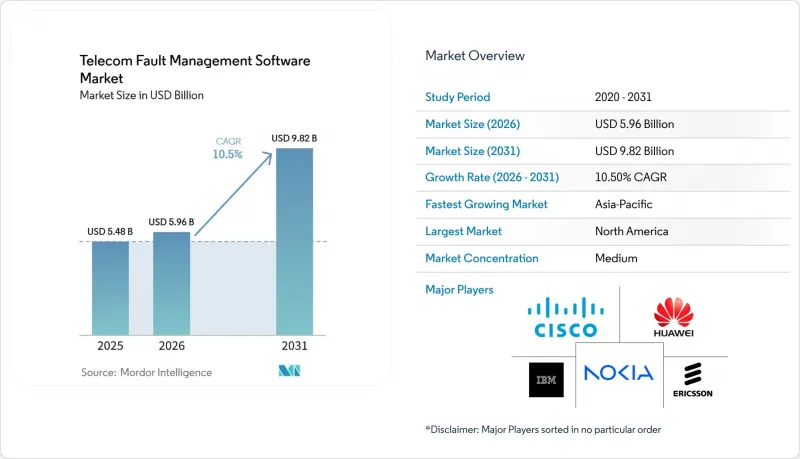
5G standalone networks, Open RAN, cloud-native network functions, and multi-vendor architectures are increasing the volume and variety of alarms that operators must interpret. This report is Segmented by Component (Software Solutions, and More), Fault Management (Alarm and Event Management, and More), Network Domain (Radio Access Network, and More), Deployment (On-Premises, and Cloud-Based), Enterprise Size (Large Enterprises, and SMEs), Application (Network Operations Center, and More), and Geography. The Market Forecasts are Provided in Terms of Value (USD).
Global Telecom Fault Management Software Market Trends and Insights
5G and Open RAN Multi-Domain Complexity
Open RAN separates radio units, distributed units, and centralized units that one supplier previously delivered as a single base station system. Each layer can create different alarm formats, making it harder for traditional OSS tools to form a common view of a service failure. This complexity is a major reason operators are evaluating multi-domain platforms in the Telecom fault management software market. Interoperability among supplier platforms is becoming more important as operators seek to run automation applications across multi-vendor RAN environments. Capgemini and Deutsche Telekom also developed a vendor-independent service management and orchestration platform for O-RAN and legacy RAN environments across Deutsche Telekom's European operations. Platforms that can ingest O1, E2, and A1 interface data across equipment suppliers are better positioned to support large operator deployments.
AI-Enabled Autonomous Network Operations
AI is moving from pilot programs into operational workflows for event correlation, diagnosis, and recovery. Deutsche Telekom launched its RAN Guardian Agent in Germany in November 2025 and reported that it reduced major event management time from hours to less than 1 minute and autonomously initiated more than 100 remediation actions in its first month. Nokia and Google Cloud expanded their partnership in June 2026 to integrate 6 Gemini-powered agents into Nokia Assurance Center, with a SaaS release planned for September 2026. This direction makes AI-assisted root-cause analysis and automated response central to vendor selection in the Telecom fault management software market. Managed service providers can also learn from a broader operating base, while operators that retain all activity on-site have more limited opportunities to reuse operational data. The resulting difference in data access may affect how quickly automation quality improves across competing platforms.
Legacy-System Integration and Migration Cost
Large operators often rely on customized OSS integrations for decades, which makes replacement programs costly and technically difficult. Parallel-run migration requirements can add substantial cost before any legacy module is retired. Full transformation programs can require extended implementation periods and careful operational continuity. These costs increase when southbound interfaces must support SNMP, NETCONF, and CLI across multiple equipment suppliers. Consequently, the Telecom fault management software market has a clearer entry point in greenfield private 5G networks, where legacy integration debt is lower. This also supports demand for managed deployments that reduce the amount of internal integration work required.
Other drivers and restraints analyzed in the detailed report include:
- Real-Time Quality of Experience and SLA Assurance
- Cloud-Native OSS/BSS Modernization
- Multi-Cloud Security and Data-Residency Complexity
For complete list of drivers and restraints, kindly check the Table Of Contents.
Segment Analysis
Software Solutions held 47.82% share in 2025, reflecting operator demand for analytics-driven platforms that work across network domains. The Telecom fault management software market industry is moving away from hardware-dependent tools that assess faults on a per-network-element basis. Software layers can correlate signals from RAN, core, transport, and edge operations in a single workflow. Hardware and Probe Infrastructure remain relevant in 5G standalone core environments where encrypted traffic restricts purely software-based visibility.
Managed Services is projected to grow at a 12% CAGR through 2031 as smaller operators seek external operational support. Professional Services also remains necessary when operators need integration, configuration, and migration support during modernization projects. Managed service delivery can lower capital requirements and reduce the need for in-house AI operations specialists. It also gives providers exposure to operating patterns across several customer networks. Vendors are connecting software products with ongoing automation services to support recurring operational needs.
Alarm and Event Management held 25.68% share in 2025 because alarm normalization remains the starting point for multi-vendor operations. Automated Remediation and Closed-Loop Control are projected to expand at a 12.4% CAGR through 2031 as operators seek machine-executed responses. The Telecom fault management software market still requires Fault Detection and Localization to identify the affected service or infrastructure layer. Fault Correlation and Root-Cause Analysis then helps operators distinguish a primary issue from the many related alarms it generates.
Predictive Fault Management is gaining relevance as models trained on historical key performance indicators become more reliable. Incident, Ticket, and Workflow Management links technical detection with field teams and operational accountability. Knowledge graph approaches are being applied to root cause analysis in large network environments. This supports the use of closed-loop functions at a large operating scale. However, operators still need reliable alarm semantics before they can broadly extend automated recovery.
Complete Report Scope:
- By Component
- Software Solutions
- Hardware and Probe Infrastructure
- Professional Services
- Managed Services
- By Fault Management Function
- Alarm and Event Management
- Fault Detection and Localization
- Fault Correlation and Root-Cause Analysis
- Predictive Fault Management
- Incident, Ticket, and Workflow Management
- Automated Remediation and Closed-Loop Control
- By Network Domain
- Radio Access Network
- Transport and Backhaul
- Fixed Access and Fiber
- IP and Core Network
- Cloud-Native Network Functions
- Edge and Private Networks
- By Deployment
- On-Premises
- Cloud-based
- By Enterprise Size
- Large Enterprises
- Small and Medium-Sized Enterprises
- By Application
- Network Operations Center Automation
- Service Assurance and Customer Experience
- Network Maintenance and Field Operations
- Network Security and Anomaly Response
- Enterprise and Private-Network Assurance
- By Geography
- North America
- United States
- Canada
- Mexico
- South America
- Brazil
- Argentina
- Rest of South America
- Europe
- Germany
- United Kingdom
- France
- Italy
- Spain
- Russia
- Rest of Europe
- Asia-Pacific
- China
- Japan
- India
- South Korea
- Australia
- Rest of Asia-Pacific
- Middle East
- Saudi Arabia
- United Arab Emirates
- Turkey
- Rest of Middle East
- Africa
- South Africa
- Egypt
- Rest of Africa
- North America
Geography Analysis
North America held 34.86% share in 2025, supported by advanced 5G deployments and active OSS modernization programs. The Telecom fault management software market size in the region reflects major carriers' investment in AI-driven network operations. In 2026, NVIDIA reported that network automation had overtaken customer experience as the leading AI investment use case for telecom operators. Canada follows 5G buildout cycles, while Mexican operators are using managed fault services to compensate for more limited internal automation resources.
Asia-Pacific is projected to grow at an 11.8% CAGR through 2031, making it the fastest-growing regional area. China had deployed more than 2.8 million 5G base stations by mid-2026, creating a significant need for large-scale alarm management. Large-scale 5G deployment is increasing the need for fault correlation and root-cause analysis across complex network estates. Japanese operators are also deploying AI-based maintenance and fault-cause identification systems. KDDI began operating a real-time fault-cause identification AI agent in February 2026, while SoftBank started multi-agent validation for base-station operations in March 2026. India's TRAI quality-of-service requirements add a regulatory reason for operators to adopt real-time assurance and dashboarding.
Europe maintained a substantial share in 2025 through mature operations in Germany, the United Kingdom, and France. Deutsche Telekom reported up to 65% energy savings in a 5G core network through energy-aware automation in 2025. European operators are consolidating fixed and mobile fault operations into unified management environments. The Middle East is adding intelligent operations platforms as 5G and 5.5G services expand. Africa and South America remain earlier-stage areas, with activity concentrated among major carriers in South Africa, Egypt, Brazil, and Argentina.
- International Business Machines Corporation
- Telefonaktiebolaget LM Ericsson
- Nokia Corporation
- Huawei Technologies Co., Ltd.
- Cisco Systems, Inc.
- Amdocs Limited
- Netcracker Technology Corporation
- Oracle Corporation
- NEC Corporation
- Hewlett Packard Enterprise Company
- Broadcom Inc.
- NETSCOUT Systems, Inc.
- Comarch SA
- TEOCO Corporation
- Subex Limited
- VIAVI Solutions Inc.
- Spirent Communications plc
- EXFO Inc.
- RADCOM Ltd.
- Infovista SAS
Additional Benefits:
- The market estimate (ME) sheet in Excel format
- 3 months of analyst support
TABLE OF CONTENTS
1 INTRODUCTION
- 1.1 Study Assumptions and Market Definition
- 1.2 Scope of the Study
2 RESEARCH METHODOLOGY
3 EXECUTIVE SUMMARY
4 MARKET LANDSCAPE
- 4.1 Market Overview
- 4.2 Market Drivers
- 4.2.1 5G and Open RAN Multi-Domain Complexity
- 4.2.2 Real-Time Quality of Experience and SLA Assurance
- 4.2.3 Cloud-Native OSS/BSS Modernization
- 4.2.4 AI-Enabled Autonomous Network Operations
- 4.2.5 Network Energy Optimization Through Fault Intelligence
- 4.2.6 Network-Slice Revenue Protection and Assurance
- 4.3 Market Restraints
- 4.3.1 Legacy-System Integration and Migration Cost
- 4.3.2 Multi-Cloud Security and Data-Residency Complexity
- 4.3.3 Scarcity of Telco-Grade AI and Automation Talent
- 4.3.4 Inconsistent Alarm Semantics Across Disaggregated Network Domains
- 4.4 Value Chain Analysis
- 4.5 Regulatory Landscape
- 4.6 Technological Outlook
- 4.7 Porter's Five Forces Analysis
- 4.7.1 Bargaining Power of Suppliers
- 4.7.2 Bargaining Power of Buyers
- 4.7.3 Threat of New Entrants
- 4.7.4 Threat of Substitutes
- 4.7.5 Competitive Rivalry
5 MARKET SIZE AND GROWTH FORECASTS (VALUE)
- 5.1 By Component
- 5.1.1 Software Solutions
- 5.1.2 Hardware and Probe Infrastructure
- 5.1.3 Professional Services
- 5.1.4 Managed Services
- 5.2 By Fault Management Function
- 5.2.1 Alarm and Event Management
- 5.2.2 Fault Detection and Localization
- 5.2.3 Fault Correlation and Root-Cause Analysis
- 5.2.4 Predictive Fault Management
- 5.2.5 Incident, Ticket, and Workflow Management
- 5.2.6 Automated Remediation and Closed-Loop Control
- 5.3 By Network Domain
- 5.3.1 Radio Access Network
- 5.3.2 Transport and Backhaul
- 5.3.3 Fixed Access and Fiber
- 5.3.4 IP and Core Network
- 5.3.5 Cloud-Native Network Functions
- 5.3.6 Edge and Private Networks
- 5.4 By Deployment
- 5.4.1 On-Premises
- 5.4.2 Cloud-based
- 5.5 By Enterprise Size
- 5.5.1 Large Enterprises
- 5.5.2 Small and Medium-Sized Enterprises
- 5.6 By Application
- 5.6.1 Network Operations Center Automation
- 5.6.2 Service Assurance and Customer Experience
- 5.6.3 Network Maintenance and Field Operations
- 5.6.4 Network Security and Anomaly Response
- 5.6.5 Enterprise and Private-Network Assurance
- 5.7 By Geography
- 5.7.1 North America
- 5.7.1.1 United States
- 5.7.1.2 Canada
- 5.7.1.3 Mexico
- 5.7.2 South America
- 5.7.2.1 Brazil
- 5.7.2.2 Argentina
- 5.7.2.3 Rest of South America
- 5.7.3 Europe
- 5.7.3.1 Germany
- 5.7.3.2 United Kingdom
- 5.7.3.3 France
- 5.7.3.4 Italy
- 5.7.3.5 Spain
- 5.7.3.6 Russia
- 5.7.3.7 Rest of Europe
- 5.7.4 Asia-Pacific
- 5.7.4.1 China
- 5.7.4.2 Japan
- 5.7.4.3 India
- 5.7.4.4 South Korea
- 5.7.4.5 Australia
- 5.7.4.6 Rest of Asia-Pacific
- 5.7.5 Middle East
- 5.7.5.1 Saudi Arabia
- 5.7.5.2 United Arab Emirates
- 5.7.5.3 Turkey
- 5.7.5.4 Rest of Middle East
- 5.7.6 Africa
- 5.7.6.1 South Africa
- 5.7.6.2 Egypt
- 5.7.6.3 Rest of Africa
- 5.7.1 North America
6 COMPETITIVE LANDSCAPE
- 6.1 Market Concentration
- 6.2 Strategic Moves
- 6.3 Market Share Analysis
- 6.4 Company Profiles (includes Global Level Overview, Market Level Overview, Core Segments, Financials as available, Strategic Information, Market Rank/Share, Products and Services, Recent Developments)
- 6.4.1 International Business Machines Corporation
- 6.4.2 Telefonaktiebolaget LM Ericsson
- 6.4.3 Nokia Corporation
- 6.4.4 Huawei Technologies Co., Ltd.
- 6.4.5 Cisco Systems, Inc.
- 6.4.6 Amdocs Limited
- 6.4.7 Netcracker Technology Corporation
- 6.4.8 Oracle Corporation
- 6.4.9 NEC Corporation
- 6.4.10 Hewlett Packard Enterprise Company
- 6.4.11 Broadcom Inc.
- 6.4.12 NETSCOUT Systems, Inc.
- 6.4.13 Comarch SA
- 6.4.14 TEOCO Corporation
- 6.4.15 Subex Limited
- 6.4.16 VIAVI Solutions Inc.
- 6.4.17 Spirent Communications plc
- 6.4.18 EXFO Inc.
- 6.4.19 RADCOM Ltd.
- 6.4.20 Infovista SAS
7 MARKET OPPORTUNITIES AND FUTURE OUTLOOK
- 7.1 White-Space and Unmet-Need Assessment

