PUBLISHER: Mordor Intelligence | PRODUCT CODE: 2119162

PUBLISHER: Mordor Intelligence | PRODUCT CODE: 2119162
Advanced High Strength Steel - Market Share Analysis, Industry Trends & Statistics, Growth Forecasts (2026 - 2031)
According to Mordor Intelligence, the advanced high strength steel market size was estimated at USD 24.26 billion in 2025 and is estimated to grow from USD 25.98 billion in 2026 to USD 38.67 billion by 2031, at a CAGR of 8.28% during the forecast period (2026-2031).
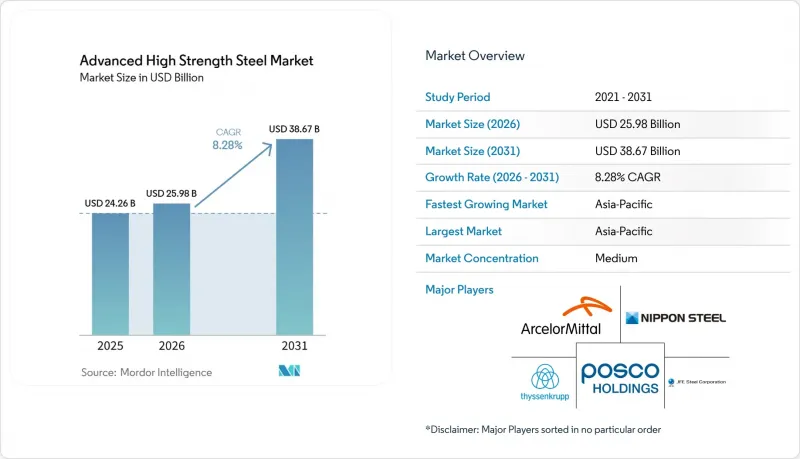
This report is Segmented by Grade (Dual Phase (DP) Steel, Martensitic Steel, and More), Tensile Strength (400-600 MPa, 600-800 MPa, and More), Application (Automotive, Construction, and More), and Geography (Asia-Pacific, North America, Europe, South America, and Middle-East and Africa). The Market Forecasts are Provided in Terms of Value (USD).
Global Advanced High Strength Steel Market Trends and Insights
Increasing Demand for Lightweight Vehicles to Improve Fuel Efficiency and Driving Range
Vehicle lightweighting has become a core design requirement as electric vehicle platforms carry heavier battery packs. Removing weight from the body structure can extend driving range without requiring additional battery cells. The Department of Energy states that advanced high-strength steel can reduce a vehicle's structural weight by 15-25% compared with conventional steel. It also states that lightweight components used in one-quarter of the US vehicle fleet could save more than 5 billion gallons of fuel each year by 2030. Third-generation grades are in serial production for B-pillars and door rings in the Chevrolet Blazer EV and Toyota bZ4X, helping meet crash targets with thinner gauges. Research on heavy-duty vehicle chassis found that press-hardened material can reduce chassis weight by up to 34% compared with cold-stamped advanced high-strength steel, while reducing global warming potential by 21-32%.
Stringent Vehicle Safety, Fuel Economy, and Emission Regulations
Safety regulations are increasing the need for stronger steel in side-impact, roof-crush, and far-side protection areas. Euro NCAP's 2026 protocol revision organizes assessment around four safety stages and raises the requirements for a 5-star rating from 2028. A vehicle must achieve at least 80% in each stage for that rating under the future protocol. This supports the use of ultra-high-strength, hot-stamped steel when crash protection needs to fit within a defined vehicle weight. United Nations Economic Commission for Europe (UNECE) Regulations R94 and R95 also reinforce occupant protection requirements for frontal and side impacts. European fleet CO2 targets and the US Corporate Average Fuel Economy (CAFE) framework add pressure to reduce vehicle mass, so the advanced high-strength steel market serves both safety and emissions objectives.
High Manufacturing and Tooling Costs for Advanced High Strength Steel Processing
Processing grades above 980 MPa requires specialized tooling and careful control of forming conditions. Hot-stamping lines heat blanks to 900°C before forming, which raises equipment and operating requirements. Tooling also requires hard-die steels and precise geometries to compensate for springback. A 2025 study on DP450 to DP1000 steels found that springback in higher-strength grades can require mold geometry optimized to below 10° for dimensional accuracy. Repeated die revisions add cost to large-scale programs and make entry harder for smaller press shops. These conditions can concentrate sourcing among qualified suppliers and slow adoption in price-sensitive segments of the advanced high-strength steel market.
Other drivers and restraints analyzed in the detailed report include:
- Expanding Adoption of Press Hardened Steel in Automotive Body Structures
- Scope 3 and Low-Carbon Steel Procurement Pressure
- Technical Processing and Recycled Feedstock Constraints
For complete list of drivers and restraints, kindly check the Table Of Contents.
Segment Analysis
Dual-phase steel held 25.18% of the advanced high-strength steel market share in 2025, making it the largest grade category. Its broad use reflects deployment in body-in-white outer panels, floor cross-members, and door intrusion beams. TRIP steel supports crash-energy absorption in front rails and bumper systems, while Martensitic and Complex Phase grades serve high-stress parts such as seat tracks and sill reinforcements. HSLA steel remains relevant where cost per MPa is more important than maximum weight reduction. TWIP steel is suitable for selected anti-intrusion applications, but its welding compatibility limits wider deployment.
Press Hardened Steel is forecast to grow at a 9.35% CAGR through 2031, the highest rate among grades in the advanced high-strength steel market. It allows manufacturers to form complex geometries at 900°C and achieve finished component strength of up to 2,000 MPa at scale. Electric vehicle platforms reached up to 38% of body-in-white weight by 2025. Nippon Steel's 2.0 GPa high-bending grade for Mazda demonstrates how the material is moving from localized crash parts into larger structural designs. These developments increase the need for producers to differentiate through grade performance rather than solely on output.
Complete Report Scope:
- By Grade
- Dual Phase (DP) Steel
- Transformation-Induced Plasticity (TRIP) Steel
- Twinning-Induced Plasticity (TWIP) Steel
- Martensitic Steel
- High-Strength Low-Alloy (HSLA) Steel
- Complex Phase (CP) Steel
- Press Hardened Steel (PHS)
- By Tensile Strength
- 400-600 MPa
- 600-800 MPa
- 800-1000 MPa
- 1000-1200 MPa
- Over 1200 MPa
- By Application
- Automotive
- Construction
- Energy
- Heavy Equipment and Transportation
- Aerospace and Defense
- By Geography
- Asia-Pacific
- China
- India
- Japan
- South Korea
- Rest of Asia-Pacific
- North America
- United States
- Canada
- Mexico
- Europe
- Germany
- United Kingdom
- France
- Italy
- Russia
- Rest of Europe
- South America
- Brazil
- Argentina
- Rest of South America
- Middle-East and Africa
- Saudi Arabia
- South Africa
- Rest of Middle-East and Africa
- Asia-Pacific
Geography Analysis
Asia-Pacific accounted for 49.37% of regional revenue in 2025 and is forecast to grow at a 9.32% CAGR through 2031. China supports this position through its steel capacity, automotive manufacturing base, and electric vehicle production. GB/T 3273-2026, published in March 2026 and effective in October 2026, updates requirements for hot-rolled steel sheet and strip for automobile frames. Japan and South Korea continue to supply high-value automotive grades. JFE Steel won the 72nd Okochi Memorial Technical Prize in February 2026 for its JEFORMA high-formability AHSS series.
Europe and North America are shaped more directly by safety regulations, fleet emissions standards, and low-carbon procurement requirements. Euro NCAP's 2026 protocol revision increases the relevance of high-strength steel in vehicle crash-protection zones. The BMW Group aims to source more than 40% of its European plant steel demand from low-carbon suppliers by 2030. SSAB and Volvo Cars established a serial-production agreement for SSAB Zero steel in June 2025. These commitments make low-carbon supply a more direct consideration in vehicle material procurement.
South America, the Middle-East, and Africa represent smaller advanced high-strength steel markets with varying demand conditions. Brazil leads South American demand through its vehicle assembly base and infrastructure activity. Saudi Arabia's Vision 2030 program supports demand for high-strength steel in building frames, industrial zones, energy assets, and new residential development. Reliance on imports for premium grades and limited domestic hot-stamping capacity continue to constrain broader regional adoption.
- Acerinox S.A.
- ARCELORMITTAL
- China Baowu Steel Group Corperation Limited
- China Steel Corporation (CSC)
- Cleveland-Cliffs Inc.
- Hyundai Steel Co., Ltd.
- JFE Steel Corporation
- JSW Steel Limited
- NIPPON STEEL CORPORATION
- Nucor Corporation
- Outokumpu Oyj
- POSCO HOLDINGS
- SSAB AB
- Tata Steel Limited
- thyssenkrupp AG
- United States Steel Corporation
- voestalpine AG
Additional Benefits:
- The market estimate (ME) sheet in Excel format
- 3 months of analyst support
TABLE OF CONTENTS
1 Introduction
- 1.1 Study Assumptions and Market Definition
- 1.2 Scope of the Study
2 Research Methodology
3 Executive Summary
4 Market Landscape
- 4.1 Market Overview
- 4.2 Market Drivers
- 4.2.1 Increasing Demand for Lightweight Vehicles to Improve Fuel Efficiency and Driving Range
- 4.2.2 Stringent Vehicle Safety, Fuel Economy, and Emission Regulations
- 4.2.3 Increasing Demand for Low-Carbon and Sustainable Steel Solutions
- 4.2.4 Expanding Adoption of Press Hardened Steel in Automotive Body Structures and Safety Components
- 4.2.5 Scope 3 and Low-Carbon Steel Procurement Pressure
- 4.3 Market Restraints
- 4.3.1 High Manufacturing and Tooling Costs for Advanced High Strength Steel Processing
- 4.3.2 Technical Challenges Related to Formability, Springback, Welding, and Repairability
- 4.3.3 Limited Availability and Quality Consistency of High-Grade Recycled Steel Feedstock
- 4.4 Value Chain Analysis
- 4.5 Porter's Five Forces Analysis
- 4.5.1 Threat of New Entrants
- 4.5.2 Bargaining Power of Suppliers
- 4.5.3 Bargaining Power of Buyers
- 4.5.4 Threat of Substitutes
- 4.5.5 Competitive Rivalry
5 Market Size and Growth Forecasts (Value)
- 5.1 By Grade
- 5.1.1 Dual Phase (DP) Steel
- 5.1.2 Transformation-Induced Plasticity (TRIP) Steel
- 5.1.3 Twinning-Induced Plasticity (TWIP) Steel
- 5.1.4 Martensitic Steel
- 5.1.5 High-Strength Low-Alloy (HSLA) Steel
- 5.1.6 Complex Phase (CP) Steel
- 5.1.7 Press Hardened Steel (PHS)
- 5.2 By Tensile Strength
- 5.2.1 400-600 MPa
- 5.2.2 600-800 MPa
- 5.2.3 800-1000 MPa
- 5.2.4 1000-1200 MPa
- 5.2.5 Over 1200 MPa
- 5.3 By Application
- 5.3.1 Automotive
- 5.3.2 Construction
- 5.3.3 Energy
- 5.3.4 Heavy Equipment and Transportation
- 5.3.5 Aerospace and Defense
- 5.4 By Geography
- 5.4.1 Asia-Pacific
- 5.4.1.1 China
- 5.4.1.2 India
- 5.4.1.3 Japan
- 5.4.1.4 South Korea
- 5.4.1.5 Rest of Asia-Pacific
- 5.4.2 North America
- 5.4.2.1 United States
- 5.4.2.2 Canada
- 5.4.2.3 Mexico
- 5.4.3 Europe
- 5.4.3.1 Germany
- 5.4.3.2 United Kingdom
- 5.4.3.3 France
- 5.4.3.4 Italy
- 5.4.3.5 Russia
- 5.4.3.6 Rest of Europe
- 5.4.4 South America
- 5.4.4.1 Brazil
- 5.4.4.2 Argentina
- 5.4.4.3 Rest of South America
- 5.4.5 Middle-East and Africa
- 5.4.5.1 Saudi Arabia
- 5.4.5.2 South Africa
- 5.4.5.3 Rest of Middle-East and Africa
- 5.4.1 Asia-Pacific
6 Competitive Landscape
- 6.1 Market Concentration
- 6.2 Strategic Moves
- 6.3 Market Share (%)/Ranking Analysis
- 6.4 Company Profiles (includes Global Overview, Market Overview, Core Segments, Financials as available, Strategic Information, Products and Services, and Recent Developments)
- 6.4.1 Acerinox S.A.
- 6.4.2 ARCELORMITTAL
- 6.4.3 China Baowu Steel Group Corperation Limited
- 6.4.4 China Steel Corporation (CSC)
- 6.4.5 Cleveland-Cliffs Inc.
- 6.4.6 Hyundai Steel Co., Ltd.
- 6.4.7 JFE Steel Corporation
- 6.4.8 JSW Steel Limited
- 6.4.9 NIPPON STEEL CORPORATION
- 6.4.10 Nucor Corporation
- 6.4.11 Outokumpu Oyj
- 6.4.12 POSCO HOLDINGS
- 6.4.13 SSAB AB
- 6.4.14 Tata Steel Limited
- 6.4.15 thyssenkrupp AG
- 6.4.16 United States Steel Corporation
- 6.4.17 voestalpine AG
7 Market Opportunities and Future Outlook
- 7.1 White-Space and Unmet-Need Assessment

