PUBLISHER: Mordor Intelligence | PRODUCT CODE: 2119172

PUBLISHER: Mordor Intelligence | PRODUCT CODE: 2119172
Bacterial Disease Diagnostics - Market Share Analysis, Industry Trends & Statistics, Growth Forecasts (2026 - 2031)
According to Mordor Intelligence, the bacterial disease diagnostics market size is projected to be USD 3.77 billion in 2025, USD 4.06 billion in 2026, and reach USD 5.88 billion by 2031, growing at a CAGR of 7.70% from 2026 to 2031.
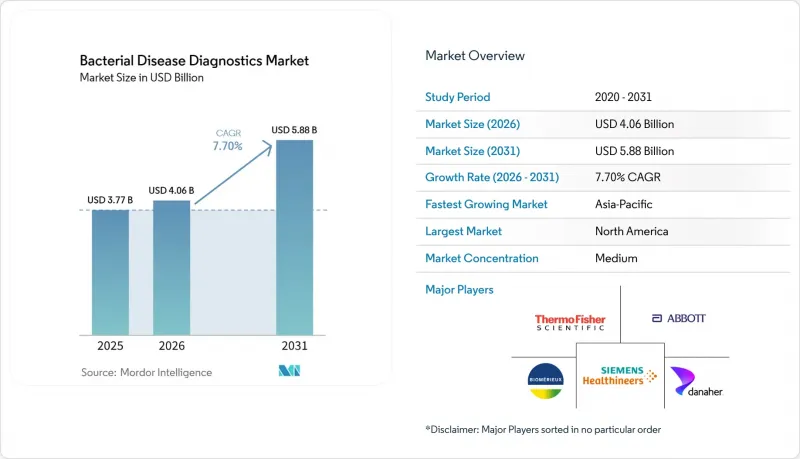
This report is Segmented by Product Type (Instruments, Reagents/Kits/Consumables), Technology (PCR, MALDI-TOF, Rapid POC, NGS, Others), Sample Type (Blood/Serum/Plasma, and More), Disease Application (Respiratory, GI, UTI, BSI/Sepsis, STI, Others), End User (Hospitals, Diagnostic Labs, and More), and Geography (North America, Europe, Asia-Pacific, MEA, South America). Forecasts in Value (USD).
Global Bacterial Disease Diagnostics Market Trends and Insights
Rising Antimicrobial Resistance and Need for Targeted Therapy
Antimicrobial resistance has made bacterial diagnostics a critical part of clinical decision-making. The World Health Organization's GLASS report covered more than 23 million bacteriologically confirmed cases from 110 countries and showed high resistance rates among key bloodstream infection pathogens. High resistance to third-generation cephalosporins in Klebsiella pneumoniae and Escherichia coli limits the reliability of empirical treatment in many serious infections. As a result, hospitals are placing greater value on testing that identifies pathogens and resistance patterns before clinicians finalize therapy.
The World Health Organization has also identified ongoing gaps in point-of-care antimicrobial susceptibility testing and multiplex resistance detection for priority bacterial pathogens. These gaps create demand for diagnostic tools that support treatment decisions in critical care, infectious disease, and antimicrobial stewardship programs. The bacterial disease diagnostics market is shaped by the need to reduce unnecessary or ineffective antibiotic use. Hospitals increasingly require results that guide therapy, rather than simply confirming an infection after treatment has begun.
Demand for Faster Sepsis and Bloodstream Infection Decisions
Sepsis remains one of the most urgent areas of bacterial diagnostics because treatment delays can worsen outcomes. The World Health Organization estimated that sepsis affects around 49 million people annually and causes 11 million deaths globally. Conventional blood culture workflows can take 48 to 72 hours before they fully support targeted therapy. Rapid molecular panels are reducing this interval by identifying pathogens and resistance markers from positive blood cultures.
Molecular methods are becoming more valuable as laboratories work to distinguish among several likely organisms in clinically unstable patients. The bacterial disease diagnostics market is therefore seeing sustained demand for systems that improve time to identification and susceptibility-related results. Host-response assays are also becoming relevant alongside direct pathogen testing. These tests can help distinguish bacterial infections from viral infections when clinical symptoms alone do not provide enough information to guide treatment.
Reimbursement and Laboratory Budget Pressure
Reimbursement remains a constraint for complex molecular panels, particularly when coverage policies do not keep pace with new diagnostic formats. High-complexity multiplex tests may cost more than conventional culture workflows, even when they deliver faster and broader results. Hospitals must assess whether reductions in length of stay, antibiotic use, and repeat testing justify the added cost. Public health procurement programs may have greater flexibility when testing supports antimicrobial resistance surveillance. Routine laboratories operating under fixed reimbursement models can face greater pressure when adopting premium molecular panels. This pressure may slow adoption among mid-tier hospitals with growing testing needs but limited capital and operating budgets. The restraint varies across testing environments.
Other drivers and restraints analyzed in the detailed report include:
- Expansion of Multiplex Molecular and Syndromic Testing
- Decentralization of Testing to Near-Patient Settings
- Discordance Between Resistance Genes and Phenotypic Susceptibility
For complete list of drivers and restraints, kindly check the Table Of Contents.
Segment Analysis
Instruments held 52.56% of the bacterial disease diagnostics market share in 2025. This segment includes automated blood culture systems, molecular analyzers, MALDI-TOF mass spectrometers, and near-patient devices. Its large share reflects the high value of capital equipment and the role of installed systems in hospital laboratories. Instrument placements also support recurring demand, as laboratories often use proprietary or validated reagent workflows.
Automated blood culture platforms remain central to many bacteriology laboratories because they support the initial detection of bloodstream infections. MALDI-TOF systems have reduced the time required for species-level identification in high-volume laboratories and can provide species identification from a processed colony in around 38 minutes at a cost of USD 0.50 per test in some laboratory settings. Reagents, kits, and consumables are forecast to grow at a 9.15% CAGR through 2031. Molecular assay kits, antimicrobial susceptibility testing panels, immunoassay products, lateral-flow consumables, and culture media remain key components of this segment.
PCR and real-time PCR accounted for 37.56% of the bacterial disease diagnostics market share in 2025. This position reflects broad clinical validation, established reimbursement practices, and a wide range of available assays. Laboratories use PCR across respiratory, gastrointestinal, bloodstream, and sexually transmitted bacterial infections. Automated molecular platforms can process multiple samples while maintaining standardized workflows for core laboratories.
Conventional microbiology remains important for routine testing, culture confirmation, and antimicrobial susceptibility assessment. MALDI-TOF, immunodiagnostics, and isothermal amplification continue to address distinct diagnostic needs. Rapid point-of-care technology is forecast to grow at an 8.80% CAGR through 2031. Rapid PCR, isothermal amplification, and CRISPR-based approaches are enabling bacterial detection closer to the patient.
Complete Report Scope:
- By Product Type
- Instruments
- Automated Blood Culture Systems
- Automated ID and AST Systems
- Molecular Diagnostic Analyzers
- MALDI-TOF Mass Spectrometers
- Point-of-Care and Near-Patient Analyzers
- Reagents, Kits and Consumables
- Culture Media and Blood Culture Bottles
- Molecular Assay Kits and Panels
- AST Panels and Discs
- Sample Preparation and Extraction Reagents
- Immunoassay and Lateral-Flow Consumables
- Instruments
- By Technology
- Conventional Microbiology
- PCR and Real-Time PCR
- Isothermal Nucleic Acid Amplification
- NGS and Nanopore Sequencing
- MALDI-TOF Mass Spectrometry
- Immunodiagnostics
- Rapid Point-of-care Technology
- Others
- By Sample Type
- Blood, Serum and Plasma
- Urine
- Sputum and Other Respiratory Samples
- Stool
- Others
- By Disease and Clinical Application
- Respiratory Bacterial Diseases
- Gastrointestinal Bacterial Diseases
- Urinary Tract Infections
- Sexually Transmitted Bacterial Infections
- Bloodstream Infections and Sepsis
- Skin, Soft-Tissue and Wound Infections
- Others
- By End User
- Hospitals and Ambulatory Surgical Centers
- Diagnostic Laboratories and Reference Laboratories
- Academic and Research Institutes
- Pharmaceutical and Biotechnology Companies
- Others
- By Geography
- North America
- United States
- Canada
- Mexico
- Europe
- Germany
- United Kingdom
- France
- Italy
- Spain
- Rest of Europe
- Asia-Pacific
- China
- India
- Japan
- Australia
- South Korea
- Rest of Asia-Pacific
- Middle East and Africa
- GCC
- South Africa
- Rest of Middle East and Africa
- South America
- Brazil
- Argentina
- Rest of South America
- North America
Geography Analysis
North America held 42.44% of the bacterial disease diagnostics market share in 2025, supported by established reimbursement systems, widespread automated microbiology platforms, and active regulatory clearances. The United States drove much of the regional demand, as integrated delivery networks supported large laboratory purchasing programs. FDA-cleared tests expanded automated gastrointestinal and other bacterial assay availability for US laboratories. Hologic received FDA clearance for automated molecular tests for gastroenteritis pathogens in 2025, while BD received FDA 510(k) clearance and CE-IVDR certification for high-throughput enteric bacterial panels on its BD COR system in 2025.
Europe remained a key regional center for laboratory modernization and molecular diagnostic development. Germany, France, the United Kingdom, and Italy supported much of the region's advanced laboratory infrastructure. The EU In Vitro Diagnostic Regulation increased evidence requirements for products sold in European markets, favoring larger manufacturers with the capacity to fund complex, multi-site clinical validation studies. Sequentia Biotech received CE-IVD certification under IVDR for its MICK Clinical gastrointestinal pathogen diagnostic platform in April 2026, while Central and Eastern European markets increased investment in laboratory modernization.
Asia-Pacific is forecast to grow at a CAGR of 10.88% through 2031, making it the fastest-growing region in the bacterial disease diagnostics market. China, India, Japan, South Korea, and Australia supported regional demand, although adoption drivers varied by country. China increased molecular testing procurement in tertiary hospitals, while India integrated more point-of-care sepsis testing and outsourced complex bacteriology testing to reference laboratories. Japan and South Korea maintained mature laboratory environments, while the Middle East and Africa and South America expanded through hospital investment, public procurement, and antimicrobial resistance surveillance initiatives.
- Abbott Laboratories
- Accelerate Diagnostics, Inc.
- Agilent Technologies
- Beckton Dickinson
- bioMerieux
- Bio-Rad Laboratories
- Bruker
- Danaher
- DiaSorin
- Roche
- Roche
- Hologic
- Karius, Inc.
- Oxford Nanopore Technologies plc
- QIAGEN
- QuidelOrtho
- Revvity, Inc.
- Seegene
- Siemens Healthineers
- Sysmex
- T2 Biosystems, Inc.
- Thermo Fisher Scientific
- Waters Corporation
Additional Benefits:
- The market estimate (ME) sheet in Excel format
- 3 months of analyst support
TABLE OF CONTENTS
1 INTRODUCTION
- 1.1 Study Assumptions and Market Definition
- 1.2 Scope of the Study
2 RESEARCH METHODOLOGY
3 EXECUTIVE SUMMARY
4 MARKET LANDSCAPE
- 4.1 Market Overview
- 4.2 Market Drivers
- 4.2.1 Rising Antimicrobial Resistance and Need for Targeted Therapy
- 4.2.2 Demand for Faster Sepsis and Bloodstream Infection Decisions
- 4.2.3 Expansion of Multiplex Molecular and Syndromic Testing
- 4.2.4 Public-Health Investment in Bacteriology and AMR Surveillance
- 4.2.5 Decentralization of Testing to Near-Patient Settings
- 4.2.6 Digitization, Automation and AI-Assisted Microbiology Workflows
- 4.3 Market Restraints
- 4.3.1 Reimbursement and Laboratory Budget Pressure
- 4.3.2 Discordance Between Resistance Genes and Phenotypic Susceptibility
- 4.3.3 Pre-Analytical Variability and Low Pathogen Loads
- 4.3.4 Fragmented Regulatory and Breakpoint-Update Requirements
- 4.4 Value/Supply-Chain Analysis
- 4.5 Regulatory Landscape
- 4.6 Technological Outlook
- 4.7 Porter's Five Forces Analysis
- 4.7.1 Threat of New Entrants
- 4.7.2 Bargaining Power of Suppliers
- 4.7.3 Bargaining Power of Buyers
- 4.7.4 Threat of Substitutes
- 4.7.5 Competitive Rivalry
5 MARKET SIZE AND GROWTH FORECASTS (VALUE, USD)
- 5.1 By Product Type
- 5.1.1 Instruments
- 5.1.1.1 Automated Blood Culture Systems
- 5.1.1.2 Automated ID and AST Systems
- 5.1.1.3 Molecular Diagnostic Analyzers
- 5.1.1.4 MALDI-TOF Mass Spectrometers
- 5.1.1.5 Point-of-Care and Near-Patient Analyzers
- 5.1.2 Reagents, Kits and Consumables
- 5.1.2.1 Culture Media and Blood Culture Bottles
- 5.1.2.2 Molecular Assay Kits and Panels
- 5.1.2.3 AST Panels and Discs
- 5.1.2.4 Sample Preparation and Extraction Reagents
- 5.1.2.5 Immunoassay and Lateral-Flow Consumables
- 5.1.1 Instruments
- 5.2 By Technology
- 5.2.1 Conventional Microbiology
- 5.2.2 PCR and Real-Time PCR
- 5.2.3 Isothermal Nucleic Acid Amplification
- 5.2.4 NGS and Nanopore Sequencing
- 5.2.5 MALDI-TOF Mass Spectrometry
- 5.2.6 Immunodiagnostics
- 5.2.7 Rapid Point-of-care Technology
- 5.2.8 Others
- 5.3 By Sample Type
- 5.3.1 Blood, Serum and Plasma
- 5.3.2 Urine
- 5.3.3 Sputum and Other Respiratory Samples
- 5.3.4 Stool
- 5.3.5 Others
- 5.4 By Disease and Clinical Application
- 5.4.1 Respiratory Bacterial Diseases
- 5.4.2 Gastrointestinal Bacterial Diseases
- 5.4.3 Urinary Tract Infections
- 5.4.4 Sexually Transmitted Bacterial Infections
- 5.4.5 Bloodstream Infections and Sepsis
- 5.4.6 Skin, Soft-Tissue and Wound Infections
- 5.4.7 Others
- 5.5 By End User
- 5.5.1 Hospitals and Ambulatory Surgical Centers
- 5.5.2 Diagnostic Laboratories and Reference Laboratories
- 5.5.3 Academic and Research Institutes
- 5.5.4 Pharmaceutical and Biotechnology Companies
- 5.5.5 Others
- 5.6 By Geography
- 5.6.1 North America
- 5.6.1.1 United States
- 5.6.1.2 Canada
- 5.6.1.3 Mexico
- 5.6.2 Europe
- 5.6.2.1 Germany
- 5.6.2.2 United Kingdom
- 5.6.2.3 France
- 5.6.2.4 Italy
- 5.6.2.5 Spain
- 5.6.2.6 Rest of Europe
- 5.6.3 Asia-Pacific
- 5.6.3.1 China
- 5.6.3.2 India
- 5.6.3.3 Japan
- 5.6.3.4 Australia
- 5.6.3.5 South Korea
- 5.6.3.6 Rest of Asia-Pacific
- 5.6.4 Middle East and Africa
- 5.6.4.1 GCC
- 5.6.4.2 South Africa
- 5.6.4.3 Rest of Middle East and Africa
- 5.6.5 South America
- 5.6.5.1 Brazil
- 5.6.5.2 Argentina
- 5.6.5.3 Rest of South America
- 5.6.1 North America
6 COMPETITIVE LANDSCAPE
- 6.1 Market Concentration
- 6.2 Market Share Analysis
- 6.3 Company Profiles (includes Global Level Overview, Market Level Overview, Core Segments, Financials as available, Strategic Information, Market Rank/Share, Products and Services, Recent Developments)
- 6.3.1 Abbott Laboratories
- 6.3.2 Accelerate Diagnostics, Inc.
- 6.3.3 Agilent Technologies, Inc.
- 6.3.4 Becton, Dickinson and Company
- 6.3.5 bioMerieux SA
- 6.3.6 Bio-Rad Laboratories, Inc.
- 6.3.7 Bruker Corporation
- 6.3.8 Danaher Corporation
- 6.3.9 DiaSorin S.p.A.
- 6.3.10 F. Hoffmann-La Roche Ltd
- 6.3.11 F. Hoffmann-La Roche Ltd
- 6.3.12 Hologic, Inc.
- 6.3.13 Karius, Inc.
- 6.3.14 Oxford Nanopore Technologies plc
- 6.3.15 QIAGEN N.V.
- 6.3.16 QuidelOrtho Corporation
- 6.3.17 Revvity, Inc.
- 6.3.18 Seegene Inc.
- 6.3.19 Siemens Healthineers AG
- 6.3.20 Sysmex Corporation
- 6.3.21 T2 Biosystems, Inc.
- 6.3.22 Thermo Fisher Scientific Inc.
- 6.3.23 Waters Corporation
7 MARKET OPPORTUNITIES AND FUTURE OUTLOOK
- 7.1 White-Space and Unmet-Need Assessment

