PUBLISHER: Mordor Intelligence | PRODUCT CODE: 2119175

PUBLISHER: Mordor Intelligence | PRODUCT CODE: 2119175
Autoimmune Drugs - Market Share Analysis, Industry Trends & Statistics, Growth Forecasts (2026 - 2031)
According to Mordor Intelligence, the autoimmune drugs market size is projected to expand from USD 113.70 billion in 2025 and USD 119.73 billion in 2026 to USD 155 billion by 2031, registering a CAGR of 5.30% between 2026 to 2031.
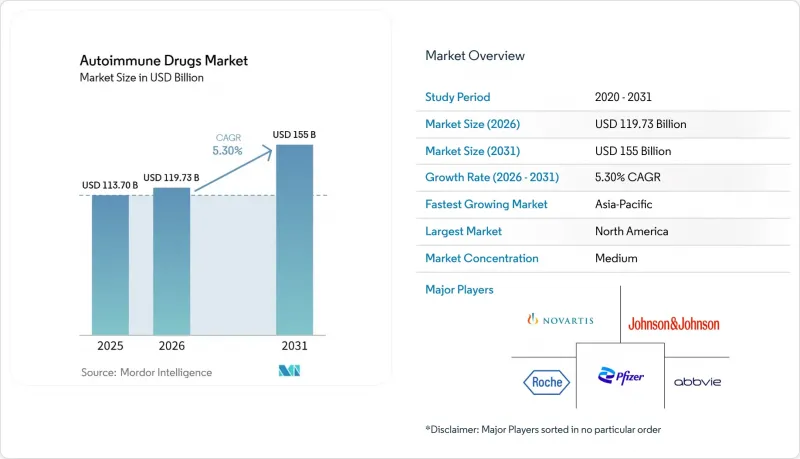
This report is Segmented by Drug Class (DMARDs, Corticosteroids, Nsaids, Immunosuppressants), Disease Indication (Rheumatoid Arthritis, and More), Route of Administration (Oral, IV, Subcutaneous), Formulation (Prefilled Syringes, Tablets, Auto-Injectors, Others), End User (Hospitals, Clinics, Infusion Centers, and More), and Geography (North America, Europe, Asia-Pacific, and More). Forecasts in Value (USD).
Global Autoimmune Drugs Market Trends and Insights
Rising Prevalence and Earlier Diagnosis of Autoimmune Diseases
Earlier patient identification supports the autoimmune drugs market, driven by improved biomarker panels, point-of-care serology tests, and integrated electronic health records. A 2024 analysis using Global Burden of Disease 2024 data found rising incidence trends for rheumatoid arthritis, multiple sclerosis, and type 1 diabetes among people aged 15-39 years from 1990 to 2024, with prevalence projected to continue rising through 2032. A 2025 study across six major U.S. health systems identified more than 15 million Americans diagnosed with at least one of 105 autoimmune conditions, and 34% of diagnosed patients had more than one autoimmune condition. Earlier diagnosis in primary care supports timely treatment before severe complications, favoring therapies that address multiple inflammatory conditions or adapt to changing patient care needs.
Expansion of Biologic and Targeted Synthetic Therapies
Biologic and targeted synthetic therapies remain key value drivers in the autoimmune drugs market, especially for patients not adequately controlled with conventional treatment. Emerging approaches include BTK inhibitors for multiple sclerosis, FcRn inhibitors for IgG-mediated conditions, and later-stage cell therapies for severe autoimmune diseases. These programs are shifting competition beyond established TNF and IL-12/23 mechanisms toward specialized pathways. Generic tofacitinib tablets launched in the United States in June 2026, increasing price pressure on an earlier oral targeted therapy and making differentiated clinical profiles, convenient administration, broader labels, biomarker-led patient selection, and self-administered formats more important.
High Cost of Biologic Development and Long Clinical Timelines
Developing a new biologic requires lengthy clinical programs, complex trial designs, and extensive safety monitoring. These requirements become more demanding when sponsors study narrowly defined patient groups or use adaptive trial designs. Sanofi's tolebrutinib was not approved by the FDA for non-relapsing secondary progressive multiple sclerosis in December 2025, despite positive HERCULES Phase 3 results, due to concerns over severe drug-induced liver injury. The European Commission approved the medicine as Cenrifki in June 2026 for the same condition, highlighting regulatory variation across markets and increasing the financial risk of parallel global development programs.
Other drivers and restraints analyzed in the detailed report include:
- Increasing Treatment Adoption in Emerging Markets
- Expansion of Indications for Established Immunology Products
- Biosimilar Competition and Loss of Exclusivity
For complete list of drivers and restraints, kindly check the Table Of Contents.
Segment Analysis
NSAIDs held 34.56% of segment revenue in 2025, supported by broad use across rheumatoid arthritis, ankylosing spondylitis, lupus, and psoriatic arthritis. Their affordability and familiar safety profile support routine prescribing, although they do not modify the underlying disease course. Conventional synthetic DMARDs, including methotrexate and hydroxychloroquine, remain key first-line options for rheumatoid arthritis, especially in markets where reimbursement limits or out-of-pocket costs restrict biologic access. Biologic DMARDs and targeted synthetic DMARDs contribute significant value, with U.S. annual prices ranging from USD 15,000 to USD 60,000 per patient, while interferons retain an established role in multiple sclerosis.
Corticosteroids recorded the highest projected growth rate among drug classes, at a 9.15% CAGR from 2026 to 2031. Their use is expanding in induction combinations, bridging strategies, and regimens that require low-dose support while a biologic takes effect. European guidance increasingly treats dosing as a precision decision rather than applying broad avoidance. Immunosuppressants, intravenous immunoglobulin, FcRn inhibitors, S1P receptor modulators, and pipeline agents targeting APRIL, BAFF, and complement pathways continue to broaden the autoimmune drugs market beyond conventional inflammatory control.
Rheumatoid arthritis accounted for 46.93% of indication revenue in 2025, driven by a large patient base, high treatment intensity, and frequent use of combination therapy. Conventional DMARDs, biologics, and targeted therapies each support treatment as disease severity or response changes. Psoriatic arthritis, psoriasis, and atopic dermatitis form a large treatment cluster, where IL-17, IL-23, and IL-4/13 therapies compete for prescriber preference. Inflammatory bowel disease remains a high-spend area, with Crohn's disease and ulcerative colitis supporting demand for agents such as vedolizumab and risankizumab, while ankylosing spondylitis, axial spondyloarthritis, and other indications remain stable contributors.
Multiple sclerosis is forecast to grow at an 8.80% CAGR from 2026 to 2031, the fastest rate among disease indications. The European Commission approved Sanofi's Cenrifki in June 2026 for secondary progressive multiple sclerosis without relapses, adding a new option for smoldering neuroinflammation. This development could shift prescribing toward CNS-penetrant BTK inhibitors and away from older first-line therapies for relevant patients. The U.S. launch of Tyruko, the first natalizumab biosimilar, in November 2025 increased competitive pressure in multiple sclerosis, while FDA approval of Benlysta autoinjector for pediatric lupus nephritis patients aged 5 years and older in June 2025 broadened access in an underpenetrated indication.
Complete Report Scope:
- By Drug Class
- Conventional Synthetic DMARDs
- Biologic DMARDs
- Targeted Synthetic DMARDs
- Corticosteroids
- Nonsteroidal Anti-Inflammatory Drugs
- Immunosuppressants
- Interferons
- Intravenous Immunoglobulin
- Other Drug Classes
- Conventional Synthetic DMARDs
- By Disease Indication
- Rheumatoid Arthritis
- Psoriatic Arthritis
- Ankylosing Spondylitis and Axial Spondyloarthritis
- Systemic Lupus Erythematosus
- Lupus Nephritis
- Inflammatory Bowel Disease
- Crohn's Disease
- Ulcerative Colitis
- Multiple Sclerosis
- Psoriasis
- Atopic Dermatitis
- Others
- By Route of Administration
- Oral
- Intravenous
- Subcutaneous
- Intramuscular
- Topical
- Others
- By Formulation
- Prefilled Syringes
- Auto-Injector Pens
- Vials and Ampoules
- Tablets and Capsules
- Oral Solutions and Suspensions
- Others
- By End User
- Hospitals
- Specialty Clinics
- Physician Offices
- Ambulatory Infusion Centers
- Home Healthcare and Home Infusion
- Others
- By Geography
- North America
- United States
- Canada
- Mexico
- Europe
- Germany
- United Kingdom
- France
- Italy
- Spain
- Rest of Europe
- Asia-Pacific
- China
- India
- Japan
- Australia
- South Korea
- Rest of Asia-Pacific
- Middle East and Africa
- GCC
- South Africa
- Rest of Middle East and Africa
- South America
- Brazil
- Argentina
- Rest of South America
- North America
Geography Analysis
North America held 38.67% of regional revenue in 2025, supported by high treatment rates, broad biologic reimbursement, and strong immunology research activity. The United States remained a key center of biosimilar-led price disruption. Ustekinumab biosimilars reached a 42% U.S. share in the first quarter of 2026, while infliximab biosimilars controlled 51% of market volume. These shifts lowered originator pricing pressure and expanded patient access, while Canada's formulary expansions and Mexico's hospital modernization supported regional demand.
AbbVie expected Skyrizi and Rinvoq to generate USD 34.5 billion in combined revenue in 2026, within total company sales guidance of USD 67 billion. Europe was the second-largest regional contributor, with Germany, the United Kingdom, France, Italy, and Spain accounting for much of the region's autoimmune therapy revenue. The European Commission's approval of Cenrifki in June 2026 indicated continued regulatory support for therapies addressing progressive neurological autoimmune disease. German reference-pricing processes reduced launch-year pricing leverage for newer biologics, while higher-income Central and Eastern European markets increased biologic use.
Asia-Pacific is forecast to grow at a 9.58% CAGR from 2026 to 2031, making it the fastest-growing regional part of the autoimmune drugs market. Manufacturing capacity, clinical infrastructure, and biosimilar development expanded across China, India, and South Korea. India's biotechnology expansion supported its role as a biosimilar exporter and clinical trial destination. Middle East and Africa and South America remained smaller contributors, although Gulf countries, Brazil, and Argentina increased specialty-care investment and public procurement for autoimmune treatment.
- Abbvie
- Amgen
- argenx SE
- AstraZeneca
- Biogen
- Bristol-Myers Squibb
- Eli Lilly and Company
- Roche
- GlaxoSmithKline
- Incyte
- Johnson & Johnson
- Merck
- Novartis
- Organon
- Pfizer
- Regeneron Pharmaceuticals
- Sanofi
- Takeda Pharmaceuticals
- Teva Pharmaceutical Industries
- UCB
Additional Benefits:
- The market estimate (ME) sheet in Excel format
- 3 months of analyst support
TABLE OF CONTENTS
1 INTRODUCTION
- 1.1 Study Assumptions and Market Definition
- 1.2 Scope of the Study
2 RESEARCH METHODOLOGY
3 EXECUTIVE SUMMARY
4 MARKET LANDSCAPE
- 4.1 Market Overview
- 4.2 Market Drivers
- 4.2.1 Rising Prevalence and Earlier Diagnosis of Autoimmune Diseases
- 4.2.2 Expansion of Biologic and Targeted Synthetic Therapies
- 4.2.3 Increasing Treatment Adoption in Emerging Markets
- 4.2.4 Expansion of Indications for Established Immunology Products
- 4.2.5 Precision Immunology Enabled by Biomarker and Patient Stratification
- 4.2.6 Growth of Convenient Self-Administration and Home-Based Treatment
- 4.3 Market Restraints
- 4.3.1 High Cost of Biologic Development and Long Clinical Timelines
- 4.3.2 Biosimilar Competition and Loss of Exclusivity
- 4.3.3 Fragmented Diagnosis and Delayed Referral Across Autoimmune Diseases
- 4.3.4 Long-Term Safety, Immunogenicity, and Treatment-Persistence Concerns
- 4.4 Value/Supply-Chain Analysis
- 4.5 Regulatory Landscape
- 4.6 Technological Outlook
- 4.7 Porter's Five Forces Analysis
- 4.7.1 Bargaining Power of Suppliers
- 4.7.2 Bargaining Power of Buyers
- 4.7.3 Threat of New Entrants
- 4.7.4 Threat of Substitutes
- 4.7.5 Competitive Rivalry
5 MARKET SIZE AND GROWTH FORECASTS (VALUE, USD)
- 5.1 By Drug Class
- 5.1.1 Conventional Synthetic DMARDs
- 5.1.1.1 Biologic DMARDs
- 5.1.1.2 Targeted Synthetic DMARDs
- 5.1.2 Corticosteroids
- 5.1.3 Nonsteroidal Anti-Inflammatory Drugs
- 5.1.4 Immunosuppressants
- 5.1.5 Interferons
- 5.1.6 Intravenous Immunoglobulin
- 5.1.7 Other Drug Classes
- 5.1.1 Conventional Synthetic DMARDs
- 5.2 By Disease Indication
- 5.2.1 Rheumatoid Arthritis
- 5.2.2 Psoriatic Arthritis
- 5.2.3 Ankylosing Spondylitis and Axial Spondyloarthritis
- 5.2.4 Systemic Lupus Erythematosus
- 5.2.5 Lupus Nephritis
- 5.2.6 Inflammatory Bowel Disease
- 5.2.7 Crohn's Disease
- 5.2.8 Ulcerative Colitis
- 5.2.9 Multiple Sclerosis
- 5.2.10 Psoriasis
- 5.2.11 Atopic Dermatitis
- 5.2.12 Others
- 5.3 By Route of Administration
- 5.3.1 Oral
- 5.3.2 Intravenous
- 5.3.3 Subcutaneous
- 5.3.4 Intramuscular
- 5.3.5 Topical
- 5.3.6 Others
- 5.4 By Formulation
- 5.4.1 Prefilled Syringes
- 5.4.2 Auto-Injector Pens
- 5.4.3 Vials and Ampoules
- 5.4.4 Tablets and Capsules
- 5.4.5 Oral Solutions and Suspensions
- 5.4.6 Others
- 5.5 By End User
- 5.5.1 Hospitals
- 5.5.2 Specialty Clinics
- 5.5.3 Physician Offices
- 5.5.4 Ambulatory Infusion Centers
- 5.5.5 Home Healthcare and Home Infusion
- 5.5.6 Others
- 5.6 By Geography
- 5.6.1 North America
- 5.6.1.1 United States
- 5.6.1.2 Canada
- 5.6.1.3 Mexico
- 5.6.2 Europe
- 5.6.2.1 Germany
- 5.6.2.2 United Kingdom
- 5.6.2.3 France
- 5.6.2.4 Italy
- 5.6.2.5 Spain
- 5.6.2.6 Rest of Europe
- 5.6.3 Asia-Pacific
- 5.6.3.1 China
- 5.6.3.2 India
- 5.6.3.3 Japan
- 5.6.3.4 Australia
- 5.6.3.5 South Korea
- 5.6.3.6 Rest of Asia-Pacific
- 5.6.4 Middle East and Africa
- 5.6.4.1 GCC
- 5.6.4.2 South Africa
- 5.6.4.3 Rest of Middle East and Africa
- 5.6.5 South America
- 5.6.5.1 Brazil
- 5.6.5.2 Argentina
- 5.6.5.3 Rest of South America
- 5.6.1 North America
6 COMPETITIVE LANDSCAPE
- 6.1 Market Concentration
- 6.2 Market Share Analysis
- 6.3 Company Profiles (includes Global Level Overview, Market Level Overview, Core Segments, Financials as available, Strategic Information, Market Rank/Share, Products and Services, Recent Developments)
- 6.3.1 AbbVie Inc.
- 6.3.2 Amgen Inc.
- 6.3.3 argenx SE
- 6.3.4 AstraZeneca PLC
- 6.3.5 Biogen Inc.
- 6.3.6 Bristol-Myers Squibb Company
- 6.3.7 Eli Lilly and Company
- 6.3.8 F. Hoffmann-La Roche Ltd
- 6.3.9 GSK plc
- 6.3.10 Incyte Corporation
- 6.3.11 Johnson & Johnson
- 6.3.12 Merck & Co., Inc.
- 6.3.13 Novartis AG
- 6.3.14 Organon & Co.
- 6.3.15 Pfizer Inc.
- 6.3.16 Regeneron Pharmaceuticals, Inc.
- 6.3.17 Sanofi
- 6.3.18 Takeda Pharmaceutical Company Limited
- 6.3.19 Teva Pharmaceutical Industries Ltd.
- 6.3.20 UCB S.A.
7 MARKET OPPORTUNITIES AND FUTURE OUTLOOK
- 7.1 White-Space and Unmet-Need Assessment

